
How Competitor Insights Solve Market Entry Challenges for Key Account Growth
Expanding into new markets with key accounts presents unique challenges: unfamiliar competitive landscapes, complex buyer ecosystems, and the high stakes of enterprise relationships. Traditional market research often fails here—it reveals market size and demographics but misses the critical competitive dynamics that determine success.
Competitor intelligence transforms market entry by revealing where competitors are vulnerable and where they're over-serving customers. This insight identifies high-value entry points that traditional research overlooks. For example, analyzing competitor pricing gaps or service weaknesses can uncover underserved segments perfect for key account targeting.
Practical steps:
- 🗺️ Map competitor account portfolios to identify gaps
- 💰 Analyze competitor pricing strategies for underserved tiers
- 🎯 Monitor competitor customer feedback for pain points
- ⏱️ Track competitor product roadmaps for timing advantages
💡 Tip: Focus on competitor weaknesses in customer support or implementation—these are often the most valuable entry points for key account growth, where relationship quality matters more than features alone.
Learning from Competitor Expansion Patterns: Timing and Location Strategy
Competitor expansion patterns reveal critical market intelligence for your key account growth strategy. By tracking where competitors are investing in new facilities, you can identify emerging opportunities and avoid saturated markets. For instance, when competitors open new stores or offices, it signals confidence in that region's demand.
Take Sephora as an example: RivalSense tracked that Sephora opened its first new store of 2026 at Collections in Niagara, Canada, aiming to create career opportunities and build strong teams. This type of insight is valuable because it shows where a competitor is doubling down on physical presence, indicating market growth potential and highlighting areas for your own expansion considerations. 
Practical steps:
- 📅 Create a competitor expansion timeline spreadsheet
- 🗺️ Map facility locations against your current key account coverage
- 🔍 Identify geographic gaps where competitors serve clients you don't
Infrastructure investments provide timing signals. When competitors invest in specialized equipment or technology for specific regions, it indicates market readiness. Monitor their capital expenditure announcements and correlate with regional economic indicators. The optimal entry window often opens 6-12 months after multiple competitors commit to similar infrastructure.
Certifications and awards reveal market expectations. Track which quality standards, industry certifications, or local business awards your competitors pursue in target regions. These requirements often become de facto market entry barriers. Create a checklist of must-have certifications before expanding to new territories.
🔑 Key insight: Competitors' expansion failures are equally valuable. Analyze where they closed facilities or withdrew from markets to avoid similar pitfalls in your key account growth strategy.
Route and Service Analysis: Identifying Market Gaps and Opportunities
Route and service analysis provides critical intelligence for identifying market gaps and opportunities. By analyzing competitor routes and service changes, you can spot unmet needs and position your offerings effectively. This approach helps you anticipate demand shifts and capitalize on emerging corridors.
For example, RivalSense identified that Vietnam Airlines will launch scheduled service to Schiphol this summer. This insight is crucial for understanding competitor expansion into new regions, helping you assess market readiness and plan your own service enhancements. 
Route monitoring checklist:
- ✅ Track frequency changes monthly
- ✅ Document route additions and removals quarterly
- ✅ Note seasonal variations in service
- ✅ Cross-reference with customer feedback for validation
Analyze service frequency changes to identify underserved niches. Competitors reducing frequency in specific corridors may reveal opportunities for targeted service improvements. Look for patterns: are certain days or times consistently underserved? This reveals where you can differentiate with more reliable or frequent service.
📊 Key action steps:
- Map competitor routes quarterly
- Track service frequency changes monthly
- Document equipment upgrades as they occur
- Cross-reference findings with customer feedback to validate opportunities
Operational Intelligence: Avoiding Pitfalls and Optimizing Resources
Operational intelligence transforms competitor movements into actionable strategies for market entry. It helps you optimize resources by learning from competitors' successes and failures, ensuring efficient expansion and risk mitigation in new markets.
Consider Vietjet Air launching a direct flight route from Suvarnabhumi to Tokyo (Narita) using new Boeing 737-8 aircraft. This insight is valuable as it combines route expansion with equipment upgrades, signaling operational investments and evolving customer preferences for efficiency and comfort. 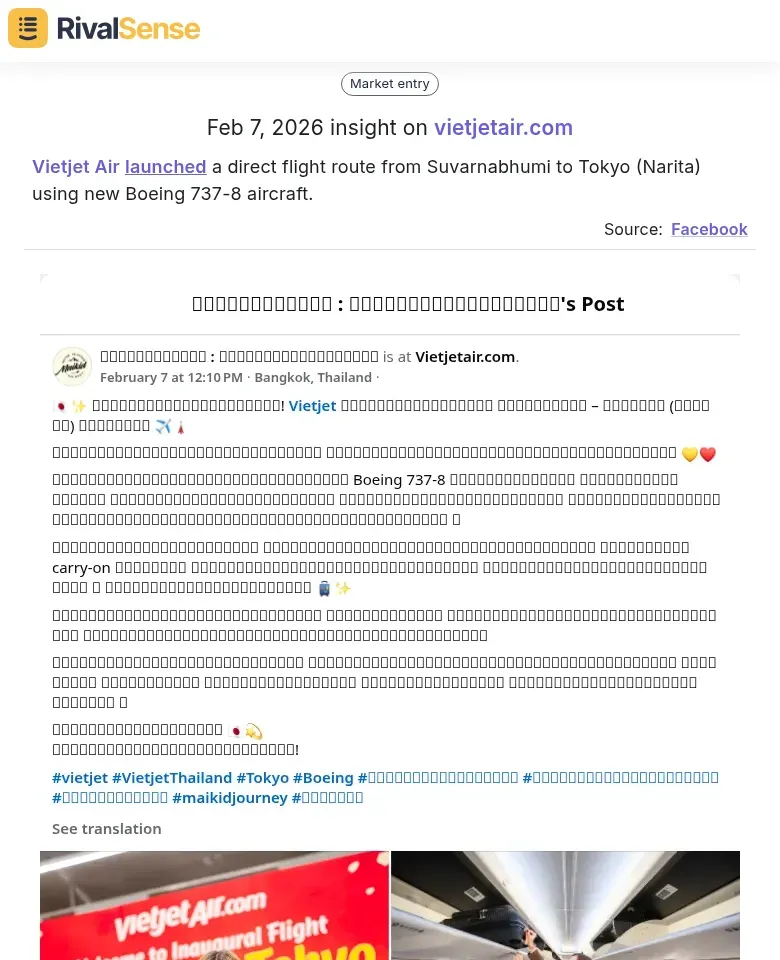
Quarterly competitor location audit checklist:
- 🗺️ Map all competitor offices and facilities
- 📍 Note openings and closures
- 📊 Analyze regional patterns
- 🔗 Cross-reference with market data
Competitor talent distribution offers recruitment optimization insights. Where are they hiring aggressively? Which roles receive premium compensation? This reveals skill shortages and competitive advantages in specific markets. Practical tip: Monitor competitor job postings in target regions to identify talent hotspots and adjust your recruitment strategy accordingly.
Key operational intelligence steps:
- ⚡ Set up alerts for competitor location changes
- 📈 Analyze relocation patterns quarterly
- 👥 Map competitor talent concentration against your hiring needs
- 💼 Use footprint data to negotiate better real estate deals in expansion markets
Strategic Implementation: Turning Insights into Key Account Wins
To transform competitor insights into tangible key account victories, you need a structured approach. Implementing these strategic pillars ensures that insights lead to actionable results and sustainable growth in competitive landscapes.
1. Continuous Monitoring System:
- Tool Setup: Deploy AI-powered competitor tracking tools that monitor pricing changes, product launches, and marketing campaigns in real-time
- Alert Framework: Create automated alerts for critical competitor moves affecting your key accounts
- Weekly Review: Establish a 30-minute weekly competitor intelligence briefing with sales leadership
2. Risk-Opportunity Framework:
- SWOT Integration: Map competitor weaknesses against your key accounts' pain points to identify expansion opportunities
- Risk Scoring: Develop a 1-10 scoring system for competitor threats to each key account
- Quarterly Assessment: Conduct formal risk-opportunity reviews before key account planning cycles
3. Cross-Functional Collaboration:
- Monthly War Room: Host cross-departmental sessions (sales, marketing, product, customer success) to translate insights into action plans
- Shared Dashboard: Implement a centralized competitor intelligence dashboard accessible to all key account stakeholders
- Account-Specific Playbooks: Create tailored competitor response strategies for each key account, updated quarterly
Practical Checklist:
✓ Set up automated competitor monitoring with daily alerts
✓ Create a risk-opportunity matrix for top 20 key accounts
✓ Schedule monthly cross-functional competitor strategy sessions
✓ Develop account-specific competitor battle cards
✓ Establish quarterly competitor intelligence review cadence
By embedding competitor insights into your key account management DNA, you'll proactively identify expansion opportunities, mitigate competitive threats, and consistently deliver value that keeps key accounts loyal and growing.
Conclusion: Building a Sustainable Competitive Advantage
Systematic competitor tracking transforms market entry from a one-time challenge into an ongoing competitive advantage. By continuously monitoring rivals' pricing, messaging, and customer feedback, you can identify underserved market segments and position your offering more effectively. This creates a sustainable edge that evolves with the market dynamics.
For key account growth, competitor insights accelerate acquisition by revealing decision-makers' pain points that rivals aren't addressing. Track which competitors are losing key accounts and why—this intelligence helps you craft targeted value propositions that resonate with high-value prospects. For retention, monitor competitors' account-based marketing campaigns to proactively address potential churn risks.
Practical steps for building this advantage:
- 📊 Create a competitor tracking dashboard with automated alerts for pricing changes, feature launches, and customer reviews
- 📈 Conduct quarterly win/loss analysis to identify patterns in competitor weaknesses
- 🗺️ Map competitor account coverage to identify gaps in their key account strategy
- 🛡️ Develop response playbooks for common competitive scenarios
- 🤝 Share competitor insights weekly with sales and account management teams
Shift from reactive to proactive by anticipating competitor moves before they happen. When you understand competitors' quarterly goals and resource allocations, you can position your offerings to counter their expansion plans. This forward-looking approach turns market entry challenges into predictable growth opportunities.
To assist with the challenges described, try out RivalSense for free at https://rivalsense.co/ and get your first competitor report today to start transforming insights into key account wins.
📚 Read more
👉 Turning Competitor Awards into Strategic Advantage
👉 Key Account Management for SaaS: The Complete 2026 Guide to Strategic Growth
👉 Predictive Analytics for Water Treatment Key Account Risk: A Strategic Guide
👉 How Block's UCP Integration Accelerated Competitors in Agentic Commerce
👉 LinkedIn Competitor Insights Case Study: A Practical Key Account Tracking Workflow