
How Competitor Hiring and Layoff Insights Solve Key Account Management Challenges
Competitor hiring and layoff patterns serve as transparent windows into strategic priorities. They reveal where rivals are investing or retreating before quarterly reports confirm it, providing real-time signals that directly impact your key account vulnerabilities and opportunities.
Practical steps to leverage this intelligence:
- Monitor hiring patterns: Track competitor job postings for enterprise account executives or industry specialists to identify which verticals they're prioritizing.
- Analyze layoff announcements: When competitors cut sales or account teams, identify affected regions or industries to exploit market weaknesses.
- Connect talent movements to account opportunities: If a competitor lays off their healthcare account team, those accounts become vulnerable targets for proactive outreach.
- Build real-time intelligence systems: Set up alerts for competitor job postings and LinkedIn team changes—don't wait for quarterly analysis when real-time signals provide immediate competitive advantage.
Real-time workforce intelligence transforms you from reactive follower to strategic leader. While others analyze last quarter's results, you're identifying next quarter's opportunities based on current competitor movements.
Decoding Leadership Changes: Executive Moves as Strategic Signals 📈
Executive leadership changes offer powerful strategic signals about competitor direction. These moves can telegraph strategic pivots and reveal underlying priorities before they become public. For instance, tracking appointments like AI executives moving into gaming roles indicates shifts in innovation focus.
Practical Analysis Framework:
- Track executive backgrounds - AI/tech appointments signal platform investments
- Monitor family business leadership structures - Succession patterns reveal stability risks or generational transitions
- Analyze C-suite expansions - Multiple simultaneous appointments indicate integration acceleration and growth scaling
Key Signals to Watch:
- External hires vs. internal promotions (indicates strategic shifts vs. continuity)
- Multiple simultaneous appointments (signals major integration or restructuring)
- Family member vs. professional manager transitions (reveals succession planning maturity)
Real-World Insights:
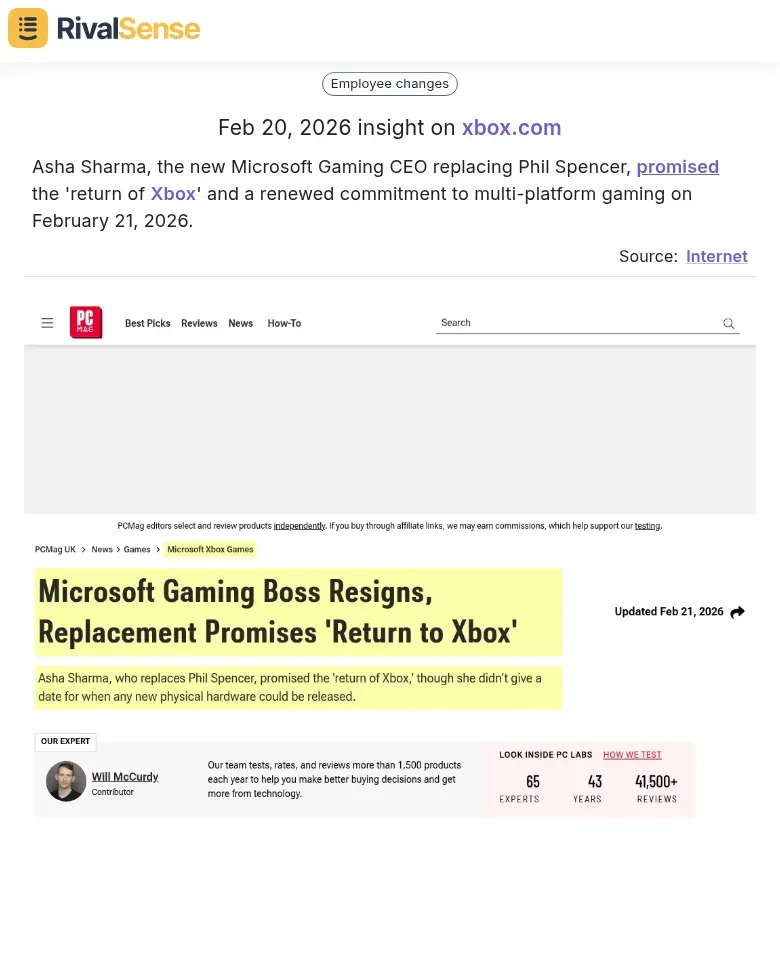
Asha Sharma, the new Microsoft Gaming CEO replacing Phil Spencer, promised the 'return of Xbox' and a renewed commitment to multi-platform gaming on February 21, 2026.
Why this is valuable: Such insights into executive appointments help anticipate market shifts and innovation focuses, allowing you to align your product and marketing strategies accordingly.
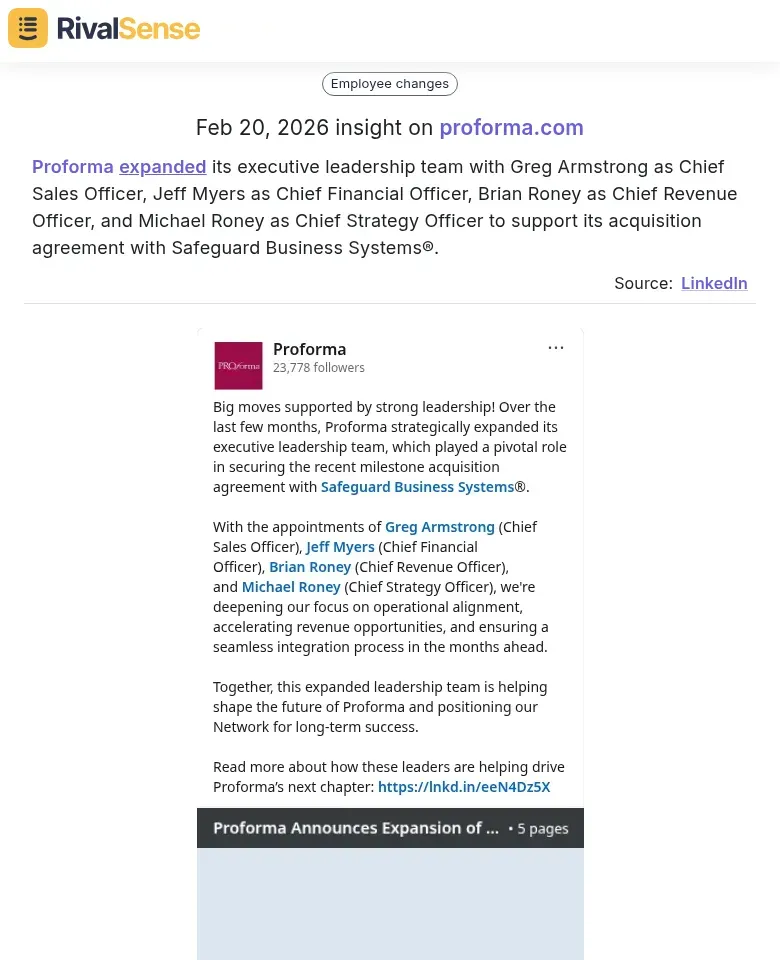
Proforma expanded its executive leadership team with Greg Armstrong as Chief Sales Officer, Jeff Myers as Chief Financial Officer, Brian Roney as Chief Revenue Officer, and Michael Roney as Chief Strategy Officer to support its acquisition agreement with Safeguard Business Systems®.
Why this is valuable: Tracking multiple executive appointments can signal major integrations or growth scaling efforts, giving you early warning of competitive expansions or restructuring.
Actionable Checklist:
✓ Map competitor leadership changes quarterly
✓ Cross-reference executive backgrounds with announced strategies
✓ Note timing relative to major announcements or acquisitions
✓ Identify patterns across industry peers
✓ Assess whether changes signal offensive or defensive positioning
Executive moves provide early warning of market expansion, acquisition integration, or strategic realignment before public announcements.
Geographic and Functional Hiring Patterns: Mapping Competitor Expansion 🌍
Geographic and functional hiring patterns provide the clearest signals of competitor expansion strategies. By tracking where and what roles competitors are hiring for, you can anticipate their market moves and adjust your key account defenses. These patterns often precede revenue changes by several months, offering a lead time for strategic planning.
Practical Checklist:
- Monitor LinkedIn for country-specific leadership hires
- Track regional sales team expansion (5+ hires in a new region = serious intent)
- Note functional role creation patterns: sales hires indicate market penetration goals, customer success roles signal retention focus, product marketing hires suggest vertical specialization
- Cross-reference hiring with office lease announcements
Functional hiring reveals capability priorities. When competitors create "Enterprise Sales Director - Healthcare" roles, they're targeting specific verticals. Similarly, "Customer Success Manager - Financial Services" indicates account expansion strategies. Connect these patterns to your key accounts: if a competitor hires heavily in your client's industry, prepare defensive strategies.
Key Insight: Hiring precedes revenue by 6-12 months. Use this lead time to strengthen relationships with at-risk accounts. Create a quarterly hiring pattern dashboard that flags competitive threats to your top 20 key accounts based on competitor role creation in their industries and regions.
Pro Tip: Use a simple spreadsheet to list competitors, new hires by location/role, and correlate with market trends for quick analysis.
Layoff Analysis: Reading Between the Lines of Workforce Reductions 📉
When competitors announce layoffs, smart leaders look beyond the headlines to uncover strategic intelligence. Differentiating between strategic restructuring and reactive cost-cutting is crucial for identifying opportunities in key account management. Analyzing which departments are affected—such as R&D cuts signaling innovation slowdowns or sales reductions revealing service gaps—can guide your proactive moves.
Practical Checklist for Layoff Analysis:
- Track department-specific impact percentages
- Monitor LinkedIn for ex-employee skill sets
- Analyze geographic concentration of cuts
- Review competitor earnings calls for restructuring language
Key Account Vulnerability Detection: When competitors reduce customer-facing teams, their key accounts become vulnerable. For example, Salesforce's 2025 customer service layoffs created service gaps that savvy competitors exploited. Monitor Glassdoor reviews and customer forums for service complaints post-layoffs.
Market Retrenchment Opportunities: Competitor exits from specific regions or verticals create immediate expansion opportunities. When Microsoft reduced European operations in 2025, competitors gained market share by hiring laid-off local experts. Create a "retrenchment response plan" with targeted hiring, localized marketing, and partnership outreach.
Family Business Insights:
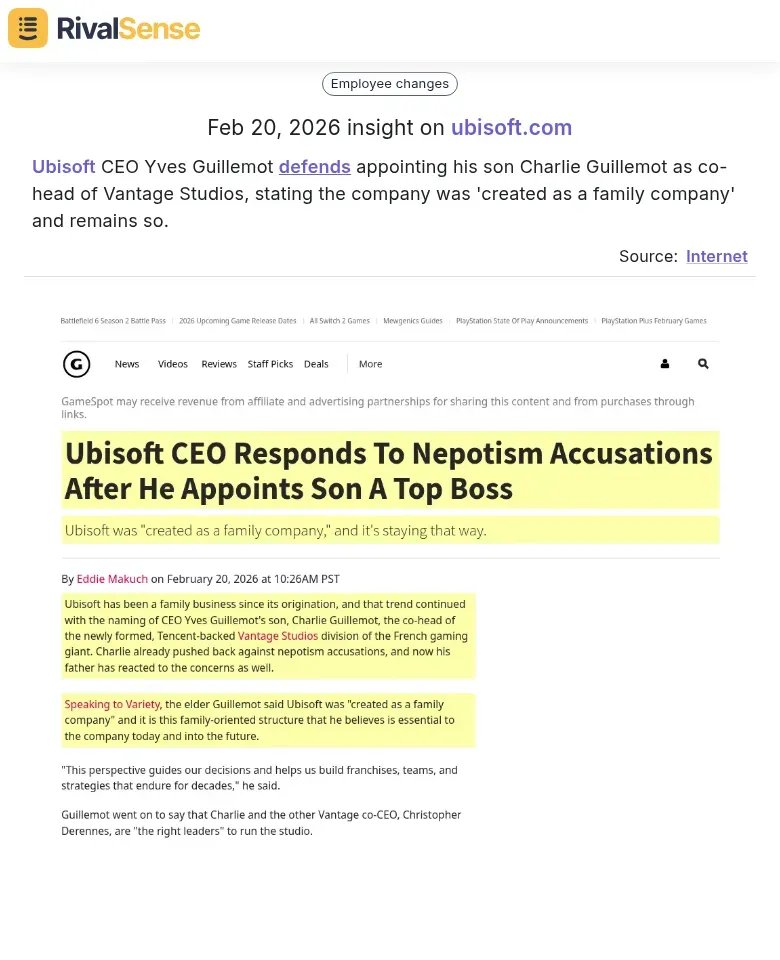
Ubisoft CEO Yves Guillemot defends appointing his son Charlie Guillemot as co-head of Vantage Studios, stating the company was 'created as a family company' and remains so.
Why this is valuable: Insights into family business leadership transitions help assess stability risks and succession planning, which can affect long-term competitor strategies and your account targeting.
Pro Tip: Use tools like RivalSense to track competitor job postings alongside layoff announcements. When a competitor cuts 20% of support staff but hires AI specialists, they're automating customer service—prepare your competitive response accordingly.
From Insights to Action: Building a Workforce Intelligence System 🛠️
Building a workforce intelligence system requires three key components: automated tracking, analytical frameworks, and strategic review cycles. Implementing such a system transforms raw data into actionable competitive advantages, ensuring you stay ahead of market shifts. Start by setting up alerts and dashboards to monitor competitor movements in real time.
1. Automated Tracking Setup:
- Use tools like RivalSense to monitor competitor job boards, LinkedIn updates, and industry news
- Set up alerts for specific roles (sales, account management, product) and seniority levels
- Create a centralized dashboard showing competitor headcount changes by department
2. Analytical Framework Development:
- Map talent movements to specific accounts: When a competitor loses a key account manager, that account becomes vulnerable
- Create a scoring system: Rate opportunities based on role importance, timing, and account alignment
- Document patterns: Track which competitors are expanding/contracting in which market segments
3. Strategic Review Cadence:
- Weekly: Review new hiring/layoff alerts and flag immediate opportunities
- Monthly: Analyze trends and update account prioritization lists
- Quarterly: Adjust overall account strategy based on competitor workforce shifts
Pro Tip: Create a simple spreadsheet template with columns for: Competitor Name, Role Type, Date of Change, Affected Accounts, Opportunity Score, and Action Steps. This transforms raw data into actionable intelligence.
By connecting workforce insights to specific accounts, you can identify when competitors are understaffed (creating service gaps) or overstaffed (indicating aggressive expansion plans). This intelligence helps you time your outreach, customize your value proposition, and allocate resources where they'll have the greatest impact.
Conclusion: Turning Workforce Intelligence into Key Account Wins 🏆
Turning workforce intelligence into key account wins requires a systematic approach. By monitoring competitor instability and acting proactively, you can convert their challenges into your opportunities. Implement a three-step framework to leverage hiring and layoff insights for account growth.
- Monitor & Analyze: Track competitor hiring surges and layoff patterns using tools like LinkedIn, WARN Act databases, and Google Alerts. Identify which departments are expanding or contracting.
- Target & Engage: Within 48 hours of major competitor layoffs, create targeted outreach lists for affected accounts. Develop personalized messaging highlighting your stability and relevant solutions.
- Position & Adapt: Adjust your competitive positioning based on competitor resource allocation. If they're hiring AI engineers, emphasize your existing AI capabilities; if they're cutting customer support, highlight your superior service.
Proactive Outreach Checklist:
✓ Identify accounts with recent competitor talent departures
✓ Research specific pain points those accounts likely face
✓ Craft value propositions addressing stability concerns
✓ Time outreach within 1-2 weeks of competitor instability
✓ Offer migration assistance or special onboarding packages
Competitive Positioning Adjustments:
- Map competitor hiring patterns to anticipate their strategic direction
- Adjust messaging to highlight your strengths where competitors are weak
- Create comparison matrices showing your advantages in affected areas
- Train sales teams on competitor instability talking points
Remember: Workforce moves precede market moves by 3-6 months. By systematically converting competitor hiring and layoff insights into targeted account strategies, you transform workforce intelligence into tangible key account wins.
Ready to put these insights into action? Try out RivalSense for free to track competitor product launches, pricing updates, event participations, partnerships, regulatory changes, management moves, and media mentions—all delivered in a weekly email report. Get your first competitor report today and start turning intelligence into advantage!
📚 Read more
👉 Turning Event Insights into Competitive Advantage: A Proxima Fusion Case Study
👉 How to Conduct Competitor Research in 2026: A Step-by-Step Guide with Practical Checklists
👉 How a RivalSense Alert on Jane Street's Lawsuit Delivered Competitive Edge
👉 Twitter Competitor Tracking: The Ultimate Checklist for Key Account Engagement