
How a Key Account Tracking API Works to Monitor Your Most Important Competitors
Tracking your most important competitors—your key accounts—can feel like trying to solve a puzzle with missing pieces. Their strategies evolve across websites, social media, regulatory filings, and industry events, making it challenging to pull together a complete picture. With manual monitoring being time-consuming and unreliable, staying ahead of competitive moves is harder than ever.
Most B2B companies today recognize that tracking key competitors is essential, and a Key Account Tracking API can automate this intelligence gathering while improving data accuracy. This makes it easier to anticipate market shifts and make informed strategic decisions.
In this guide, you’ll learn what a Key Account Tracking API is, how it works, and how to implement it in your business to gain a sustainable competitive edge.
WHAT IS A KEY ACCOUNT TRACKING API?
In today's fast-paced business environment, keeping tabs on competitors is crucial for maintaining market relevance. A Key Account Tracking API provides a technological solution to automate this process, ensuring you never miss a critical move. An Application Programming Interface (API) is a tool that allows two different software systems to exchange specific data in a structured way. In essence, it enables System A and System B to communicate and share only the information needed for a particular task, without exposing their entire internal workings.
A Key Account Tracking API lets a business programmatically pull competitive intelligence data from various sources directly into its own systems. The API shares selected data—such as product launches, pricing changes, executive moves, partnership announcements, and media coverage—while the tracking platform aggregates this information from 80+ sources including company websites, social media, news outlets, and regulatory registries. By consolidating these data streams, you can monitor competitor activity systematically, regardless of where changes occur.
Think of it like having a dedicated intelligence officer. The officer visits multiple locations (i.e., data sources) collecting only the reports you’ve specified (i.e., competitor events) and delivers them straight to your command center (i.e., your business intelligence dashboard). This direct pipeline avoids the noise and delays of manual searches.
Although this concept could apply to various competitive intelligence tools, a Key Account Tracking API typically refers to a direct integration with platforms that specialize in automated competitor monitoring. Depending on your industry, APIs may need to handle public data in compliance with privacy regulations—protecting you from legal risks while maintaining ethical intelligence practices.
KEY BENEFITS OF USING A KEY ACCOUNT TRACKING API
- Automated Intelligence Gathering
- Comprehensive Data Coverage
- Proactive Strategy Development
Implementing a Key Account Tracking API delivers three connected advantages for your competitive strategy—each building on the others to strengthen your market position. Here are the main advantages:
AUTOMATED INTELLIGENCE GATHERING
One of the key benefits is the elimination of manual monitoring. Instead of spending hours each week scanning competitor websites, social feeds, and news alerts, the API automatically collects and structures relevant data. This frees up your team to focus on analysis and action rather than data collection.
COMPREHENSIVE DATA COVERAGE
Since the API pulls from 80+ sources—including websites, social media platforms, patent registries, regulatory databases, and news outlets—you get a holistic view of competitor activity. This prevents blind spots that occur when relying on just one or two information channels. APIs also help prevent data gaps caused by human oversight, timing delays, or inaccessible sources.
PROACTIVE STRATEGY DEVELOPMENT
For all the reasons listed above, a Key Account Tracking API enables proactive rather than reactive strategy. Receiving accurate, timely intelligence about competitor moves lets you adjust your own plans accordingly, whether that’s countering a new product launch, matching a pricing change, or capitalizing on a competitor’s misstep. That’s a compelling recipe for maintaining competitive advantage.
EXAMPLE OF KEY ACCOUNT TRACKING APIS IN PRACTICE
To understand the practical application, let's look at a hypothetical scenario. Consider a mid-sized SaaS company called CloudFlow that competes with several established players in the project management space. CloudFlow decides to use a Key Account Tracking API to monitor its three main competitors.
When a competitor launches a new feature, changes their pricing page, or announces a partnership, the API automatically detects these changes from the competitor’s website, social media, and press releases. CloudFlow receives this intelligence in their weekly competitive report, allowing them to quickly analyze the move and decide whether to respond with their own feature update, adjust messaging, or accelerate a planned initiative. Over time, this systematic tracking helps CloudFlow anticipate market trends and stay one step ahead.
REAL-WORLD COMPETITIVE INSIGHTS FROM RIVALSENSE
Seeing actual competitor movements can illuminate how a Key Account Tracking API informs strategy. Here are recent examples from RivalSense’s monitoring, highlighting why different types of insights are valuable for business leaders.
PRODUCT AND REGULATORY UPDATES: ZOOM
Zoom has expanded its government platform offerings to include Zoom for Defense and updated its messaging to emphasize secure communications with compliance certifications like DoD IL4, FedRAMP JAB Moderate, CJIS, StateRAMP Moderate, and TX-RAMP Level 2.
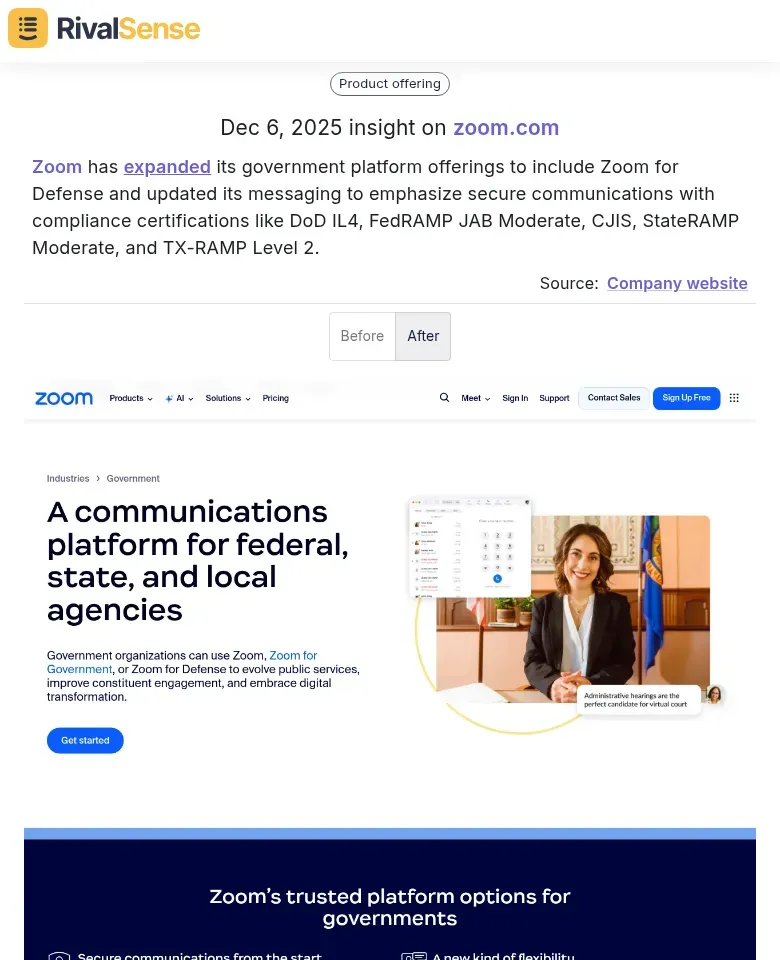
Why this matters: Tracking product launches and regulatory compliance helps you assess competitive positioning in security-sensitive markets. For a B2B company, this insight could signal a competitor targeting high-compliance industries, prompting you to bolster your own certifications or messaging.
INNOVATION AND COMMUNITY ENGAGEMENT: ROBLOX
Roblox introduced SLIM (Scalable Lightweight Interactive Models) and launched a Live Creator Tournament with a $50,000 prize pool.
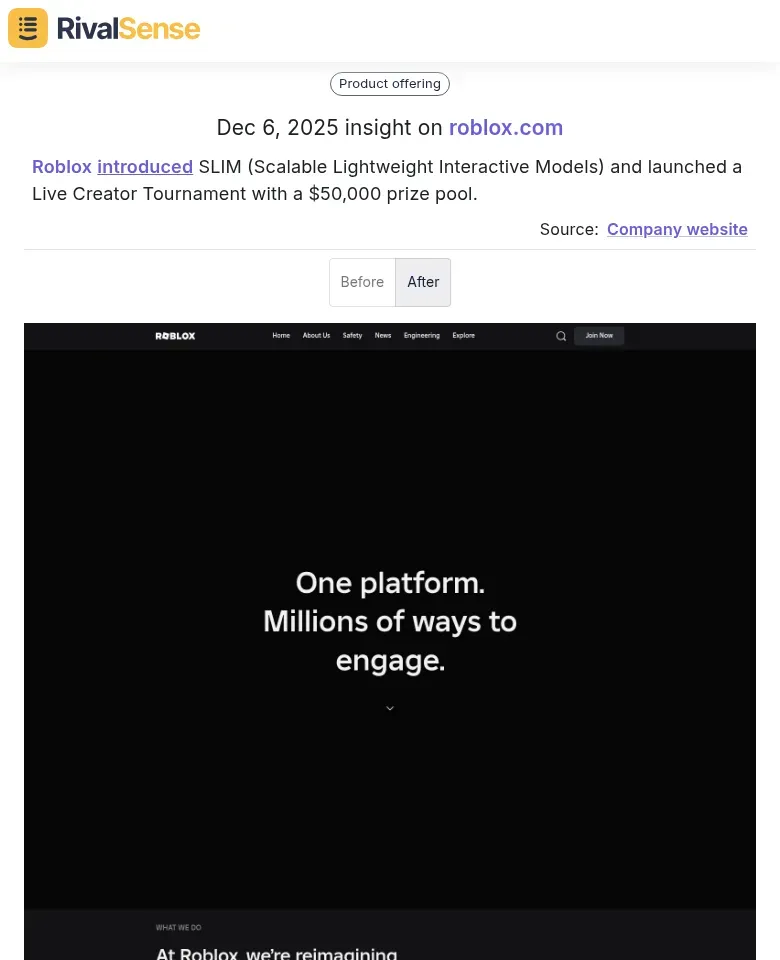
Why this matters: Monitoring product innovations and event participations reveals how competitors invest in technology and community. This can inspire your own R&D priorities or marketing initiatives to engage key audiences.
MANAGEMENT CHANGES: KIHO
Martti Lahtinen joined Kiho as CFO this week, previously leading finance at Aico Group, Mercur Solutions, and Aaro Systems where revenue grew from 5 MEUR to 40 MEUR with support from Accel-KKR.
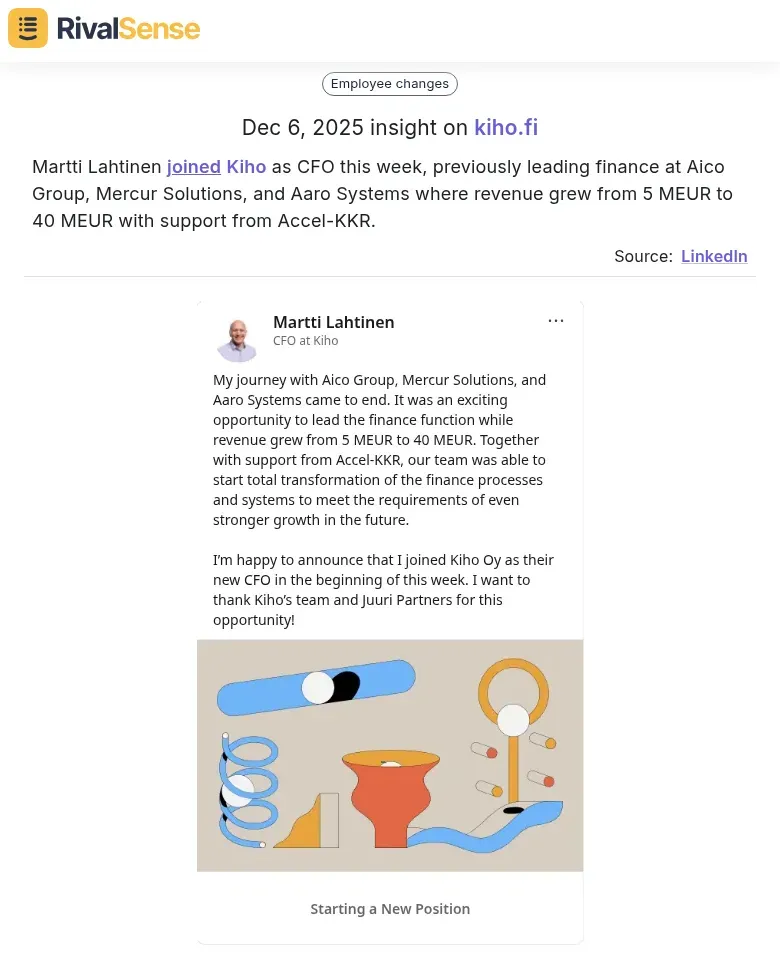
Why this matters: Executive moves often precede strategic shifts, such as funding rounds or market expansions. Tracking management changes helps you anticipate competitor financial strategies and talent acquisitions.
HOW TO SET UP A KEY ACCOUNT TRACKING API
- Identify Your Key Competitors
- Define Your Intelligence Priorities
- Select and Configure Your Tracking Solution
- Integrate the API with Your Systems
- Establish Review and Action Processes
The specific implementation details may vary by tracking platform, but the steps generally follow this pattern. While some technical knowledge is helpful for API integration, many modern solutions offer user-friendly setups and documentation. For example, platforms like RivalSense provide straightforward API access that delivers competitor tracking data—including product launches, pricing updates, event participations, partnerships, regulatory changes, management moves, and media mentions—from 80+ sources directly to your systems via weekly email reports or API endpoints.
Here’s what the setup process looks like:
1. IDENTIFY YOUR KEY COMPETITORS
Start by defining which competitors matter most to your strategy. These are typically 3-5 companies that directly compete for your target customers, have similar offerings, or are gaining market share. Some businesses also track adjacent players or potential disruptors.
Practical Tip: Create a competitor matrix with columns for direct competitors, indirect competitors, and emerging threats. Rank them by competitive intensity and strategic importance.
2. DEFINE YOUR INTELLIGENCE PRIORITIES
Once you’ve identified key accounts, determine what types of intelligence are most valuable. For most B2B companies, this includes:
- Product/feature launches and updates
- Pricing and packaging changes
- Partnership and integration announcements
- Executive team changes
- Funding rounds or M&A activity
- Regulatory compliance updates
- Media coverage and sentiment
Checklist Item: Document which intelligence categories align with your strategic goals (e.g., product development, pricing strategy, talent acquisition).
3. SELECT AND CONFIGURE YOUR TRACKING SOLUTION
Choose a competitive intelligence platform that offers API access and covers your needed data sources. Evaluate based on:
- Source coverage (80+ sources is ideal for comprehensive tracking)
- Data freshness and accuracy
- API documentation and support
- Integration capabilities with your existing tools
- Delivery formats (API, email reports, dashboards)
Hint: Look for solutions that offer both API access for automation and summarized reports for executive consumption, like RivalSense’s weekly email reports that consolidate competitor movements across all monitored channels.
4. INTEGRATE THE API WITH YOUR SYSTEMS
Once you’ve selected a solution, configure the API integration. This typically involves:
- Generating API keys or tokens from the tracking platform
- Setting up webhook endpoints or scheduled data pulls
- Mapping data fields to your internal systems (CRM, BI tools, etc.)
- Testing data flow and format
Practical Advice: Start with a simple integration—perhaps just pulling data into a spreadsheet or dedicated dashboard—before building complex automated workflows.
5. ESTABLISH REVIEW AND ACTION PROCESSES
Finally, create processes to ensure intelligence turns into action. This might include:
- Weekly review meetings to discuss competitor movements
- Alert thresholds for urgent developments (e.g., major price cuts)
- Integration with strategic planning cycles
- Designated team members responsible for monitoring specific competitors
Step-by-Step: Schedule a recurring 30-minute weekly meeting where your team reviews the latest competitor intelligence and decides on any necessary responses or strategy adjustments.
KEY ACCOUNT TRACKING API FAQ
WHAT IS A KEY ACCOUNT TRACKING API?
A Key Account Tracking API is a direct integration that lets a business programmatically receive competitive intelligence data from monitoring platforms via automated data feeds. This bypasses manual research, creating a more systematic and reliable intelligence pipeline.
WHAT IS THE BENEFIT OF A KEY ACCOUNT TRACKING API?
The main benefits are automation (saving time on manual monitoring), comprehensiveness (covering 80+ data sources), and proactivity (enabling faster strategic responses to competitor moves). Together, these help optimize your competitive strategy and resource allocation.
WHICH KEY ACCOUNT TRACKING API IS BEST?
The best API depends on your specific needs, but ideal solutions offer broad source coverage, reliable data accuracy, flexible integration options, and actionable delivery formats. Many businesses find value in platforms that combine API access with curated reporting, like receiving consolidated weekly updates alongside raw data access.
HOW DOES RIVALSENSE’S APPROACH DIFFER?
RivalSense tracks competitor movements across 80+ sources—including websites, social media, regulatory databases, and news outlets—and delivers this intelligence in actionable weekly email reports. This combination of comprehensive automated tracking and curated insights helps businesses stay informed without getting overwhelmed by data volume. The platform’s API allows integration with existing business systems while the email reports ensure key stakeholders receive summarized intelligence regularly.
Stay ahead of your competition.
Join thousands of business leaders who use competitive intelligence to inform their strategy. Get systematic tracking of your key competitors without the manual work.
Try RivalSense for free today at https://rivalsense.co/ to see how automated key account tracking can help your business. Get your first competitor report and start making proactive strategic decisions.
📚 Read more
👉 Advanced Tactics: Monitor Fintech Competitor Product Launches for B2B Payments
👉 How Roblox's SLIM and $50K Tournament Revealed Competitors' Next Moves
👉 Optimize Twitter Monitoring for Competitor Industry Award Insights
👉 Optimizing Key Account Management for Tech Companies: A Strategic Playbook
👉 Beginner's Guide to Analyzing Competitor Product Offerings for Market Share