
From Tracking to Winning: How Competitor Insights Unlock Key Account Opportunities
In today's competitive B2B landscape, tracking competitor activities transforms reactive monitoring into proactive key account strategy. By analyzing competitor moves—such as product launches, pricing changes, or marketing campaigns—you can anticipate market shifts and identify untapped account opportunities before they become obvious. This intelligence reveals gaps where competitors are under-serving clients, allowing you to tailor your approach to high-value accounts.
Real-world examples show how business leaders leverage these insights: a SaaS CEO used competitor feature announcements to highlight their own superior integrations, winning a key enterprise account. Another firm tracked competitor layoffs to target their displaced talent and clients, gaining market advantage.
Practical steps to start:
- Monitor competitor websites, social media, and news for changes
- Analyze customer reviews of competitors to spot pain points
- Use tools like RivalSense to automate tracking and alerts
- Map competitor weaknesses to your strengths for targeted outreach
By connecting competitor intelligence to account strategy, you move from defense to offense, securing opportunities that drive growth.
Learning from Competitor Leadership Patterns and Personal Insights
Executive lifestyle choices and personal patterns offer valuable windows into strategic priorities. For example, a CEO's focus on wellness retreats may signal upcoming health-tech investments, while frequent AI conference attendance hints at automation initiatives. Track these patterns through LinkedIn activity, speaking engagements, and industry event participation.
Leadership changes are powerful predictors. When a competitor hires a Chief AI Officer, expect AI-driven product launches within 6-9 months. New sales leadership often precedes aggressive market expansion. Create a tracking checklist: 1) Document all C-suite changes, 2) Analyze new executives' backgrounds, 3) Monitor their first 90-day initiatives, 4) Watch for related hiring patterns.
Executive interviews contain strategic gold. Listen for repeated keywords - 'ecosystem' suggests partnership strategies, 'scalability' indicates growth focus. Analyze tone shifts: increased urgency around 'innovation' often precedes product launches. Practical tip: Create a keyword tracker for competitor executives' public statements across earnings calls, interviews, and social media. Look for patterns in what they emphasize and what they avoid discussing - these omissions can be as revealing as their stated priorities.
Insight Example: Consider this real-world insight from RivalSense: Incode CEO and founder Ricardo Amper says he unplugs by skiing and spending time with his daughter. 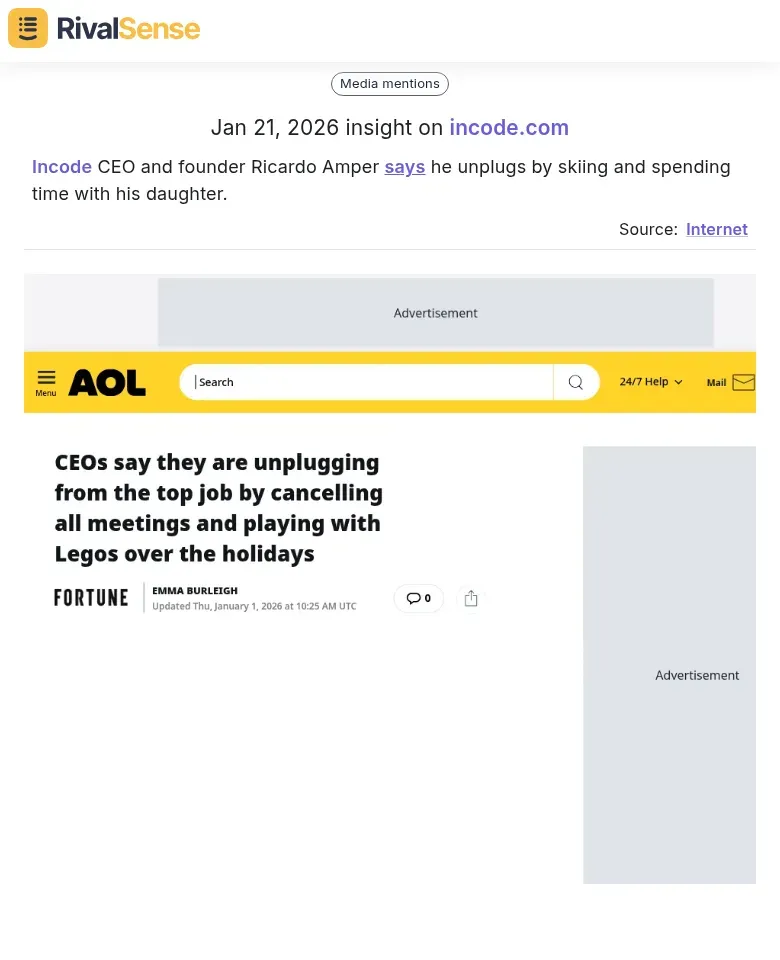
Understanding such personal insights can be valuable for business strategy as it reveals leadership priorities and potential stability. For instance, a CEO who values work-life balance might indicate a consistent strategic direction, helping you anticipate fewer abrupt shifts in competitor behavior.
Monitoring Competitor Technology Adoption and AI Implementation
Monitoring how competitors adopt emerging technologies provides crucial signals for identifying key account opportunities. Track competitors' AI implementation patterns by analyzing their product updates, technical blog posts, and partnership announcements. Look for specific frameworks they're adopting (TensorFlow vs. PyTorch), cloud infrastructure choices (AWS vs. Azure AI services), and API integrations that reveal their technical direction.
Practical steps:
- Create a technology adoption matrix comparing 3-5 key competitors across AI capabilities, cloud platforms, and emerging tech partnerships
- Monitor competitor job postings for technical roles - AI/ML engineer positions signal upcoming capabilities
- Analyze competitor product release notes for AI-powered features and automation enhancements
- Track technology conference participation and speaking engagements for innovation signals
Use these insights to identify market gaps where your accounts might benefit from similar (or better) AI implementations. When you see competitors adopting specific AI frameworks for customer service automation, evaluate if your key accounts would value similar capabilities. Competitor technology partnerships (like Salesforce Einstein integration) reveal market validation you can leverage in your own account strategies.
Insight Example: Here's a RivalSense insight: Gen's LifeLock brand general manager Ian Bednowitz discussed AI's impact on identity protection in a January 21 interview. 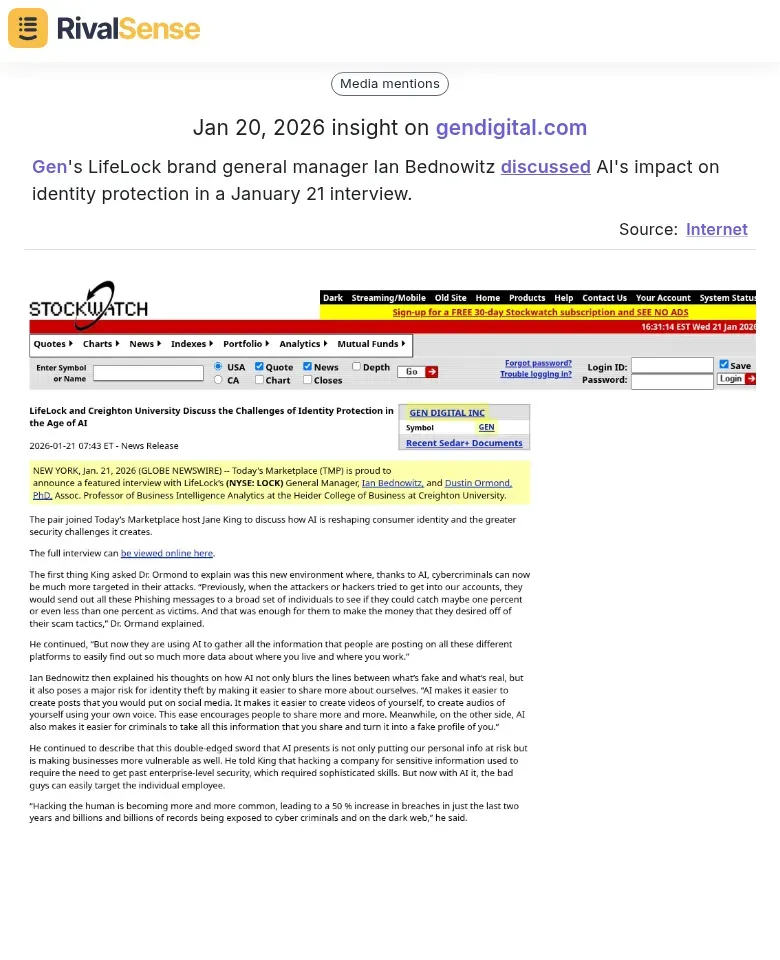
This type of insight is valuable for business strategy because it provides early signals of how competitors are positioning AI in their offerings. By monitoring such interviews, you can anticipate AI-driven feature launches and adjust your key account messaging to highlight your own AI advantages.
Analyzing Pricing Strategies and Market Positioning Changes
Competitor pricing adjustments reveal strategic shifts in market positioning. When rivals lower prices for enterprise tiers, they're targeting SMBs; premium increases signal focus on high-value accounts. Track these changes weekly using automated tools like RivalSense to identify patterns.
Practical Checklist for Pricing Analysis:
- ✅ Monitor competitor pricing pages for tier changes and new bundles
- ✅ Document discount structures (volume, annual, early renewal)
- ✅ Analyze customer benefit programs (loyalty tiers, implementation credits)
- ✅ Map pricing changes to feature additions/removals
- ✅ Calculate value-per-dollar ratios across competitors
Learn from competitor discount structures to refine your key account offerings. If competitors offer 20% annual discounts but limited support, counter with 15% discounts plus dedicated account management. Their customer benefit programs reveal target segments—free training indicates focus on user adoption, while API credits target technical buyers.
Key Action Steps:
- Create a competitor pricing matrix with columns for base price, discounts, and hidden fees
- Identify gaps where competitors under-serve specific account needs
- Develop tiered offerings that address these gaps with premium support or customization
- Use pricing intelligence to position your solution as delivering 20-30% better ROI
Real-world example: When Proton Pass made credit card storage free but charged for autotype features, they revealed a freemium strategy targeting casual users while monetizing power users. Use such insights to differentiate your key account approach with bundled enterprise features at competitive price points.
Insight Example: Take this RivalSense insight: Autotransporta direkcija confirms new increased ticket prices for regional public transport in Latvia starting January 15, 2026, while keeping social discounts and subscription benefits unchanged. 
Tracking such pricing updates is valuable for business strategy as it shows how competitors balance revenue growth with customer retention. In B2B contexts, similar changes can indicate shifts in target markets or value propositions, helping you adjust your key account strategies accordingly.
Building an Actionable Competitor Tracking System for Key Accounts
Building an actionable competitor tracking system for key accounts requires a structured approach that transforms insights into strategic advantage. Start by creating automated monitoring systems that track competitor activities across all account lifecycle stages. Use tools like RivalSense to set up alerts for website changes, pricing updates, content strategies, and social media activity. Create a tracking matrix with columns for each lifecycle stage (acquisition, onboarding, growth, retention) and rows for your top 3-5 competitors to spot patterns.
Develop specific KPIs that connect competitor insights to account outcomes. Track metrics like win/loss rates against competitors, deal cycle time reduction, customer retention improvements, and market share changes. Define 2-3 core KPIs that directly link competitor movements to your account performance.
Establish regular review cadences with structured frameworks. Conduct weekly tactical reviews of competitor movements, monthly strategic analysis sessions, and quarterly deep dives. Use this framework: 1) Collect competitor data, 2) Analyze patterns and gaps, 3) Identify opportunities/threats, 4) Develop counter-strategies, 5) Implement actions, 6) Measure results.
Practical checklist:
- Set up automated alerts for 3-5 key competitor activities
- Define 2-3 KPIs linking insights to account outcomes
- Schedule recurring review meetings
- Create a simple template to document insights and actions
- Assign ownership for monitoring specific competitors
Start small with 2-3 key competitors and 1-2 critical metrics, then expand as you refine your process.
Conclusion: Turning Competitor Intelligence into Key Account Wins
Turning competitor intelligence into key account wins requires a systematic approach. First, establish a structured process: identify high-value accounts where competitors are vulnerable, analyze their weaknesses through pricing gaps, service limitations, or feature deficiencies, then develop targeted value propositions that directly address these gaps. Create a competitor tracking dashboard that monitors pricing changes, feature releases, customer reviews, and market positioning in real-time.
Continuous monitoring is non-negotiable in B2B environments. Set up automated alerts for competitor announcements, pricing adjustments, and customer feedback. Regularly review win/loss analysis to identify patterns in competitor weaknesses. Adapt your approach quarterly based on market shifts and competitor responses.
Practical next steps:
- Implement a competitor tracking tool with automated monitoring
- Create a weekly review cadence for competitor updates
- Develop account-specific battle cards highlighting competitor vulnerabilities
- Train sales teams on using competitor insights in account conversations
- Establish a feedback loop between sales and marketing to refine competitive positioning
Remember: the goal isn't just to track competitors, but to systematically convert their weaknesses into your key account opportunities.
Ready to turn competitor insights into key account wins? Try RivalSense for free at https://rivalsense.co/ and get your first competitor report today. With automated tracking of product launches, pricing updates, event participations, partnerships, and more, RivalSense delivers weekly email reports to keep you ahead of the competition.
📚 Read more
👉 Predictive Analytics for Key Account Monitoring: A Web Scraping Guide for B2B Leaders
👉 Data-Driven Insights: How Competitor Partnerships & Client Wins Reveal Hiring Strategies
👉 How to Leverage Competitor Executive Changes for Strategic Insights
👉 The Ultimate Guide to Key Account Health Dashboards in 2026: Practical Strategies for B2B Success
👉 A Practical Guide to Building a Key Account Management Framework for Software Development