
Facebook Competitor Trend Analysis: Uncover Key Insights for B2B Strategy
Facebook stands as the premier platform for real-time competitive intelligence gathering, offering unparalleled access to competitor activities, audience engagement, and market trends. With over 3 billion monthly active users, it provides a living laboratory where you can observe competitors' content strategies, advertising approaches, and customer interactions as they happen.
Trend analysis transforms this raw data into actionable business insights by identifying patterns in competitor behavior. For example, tracking when competitors launch new products, run promotional campaigns, or shift messaging can reveal their strategic priorities. Practical tip: Create a weekly monitoring checklist that includes tracking competitor post frequency, engagement rates, and ad spend patterns.
This analysis directly connects to strategic market positioning by helping you identify gaps in competitors' approaches. You can spot underserved audience segments, discover content opportunities they're missing, and anticipate market shifts before they happen. Actionable step: Map competitor strengths and weaknesses based on their Facebook performance to inform your own positioning strategy.
By systematically analyzing Facebook competitor trends, you gain the intelligence needed to make informed decisions about product development, marketing campaigns, and overall business strategy in today's dynamic digital marketplace.
Key Account Intelligence: Tracking Strategic Moves and Partnerships
Effective Facebook competitor analysis goes beyond surface-level metrics to uncover strategic insights about key accounts. By systematically tracking partnership announcements, product launches, and strategic alliances, you can anticipate market shifts before they impact your business relationships. This intelligence is crucial for B2B leaders to protect and grow their client base.
For instance, RivalSense tracked that BASF and Corteva Agriscience launched the Clearfield Mustard Production System in India on February 18, 2026, to help farmers improve weed control and yields in mustard crops.
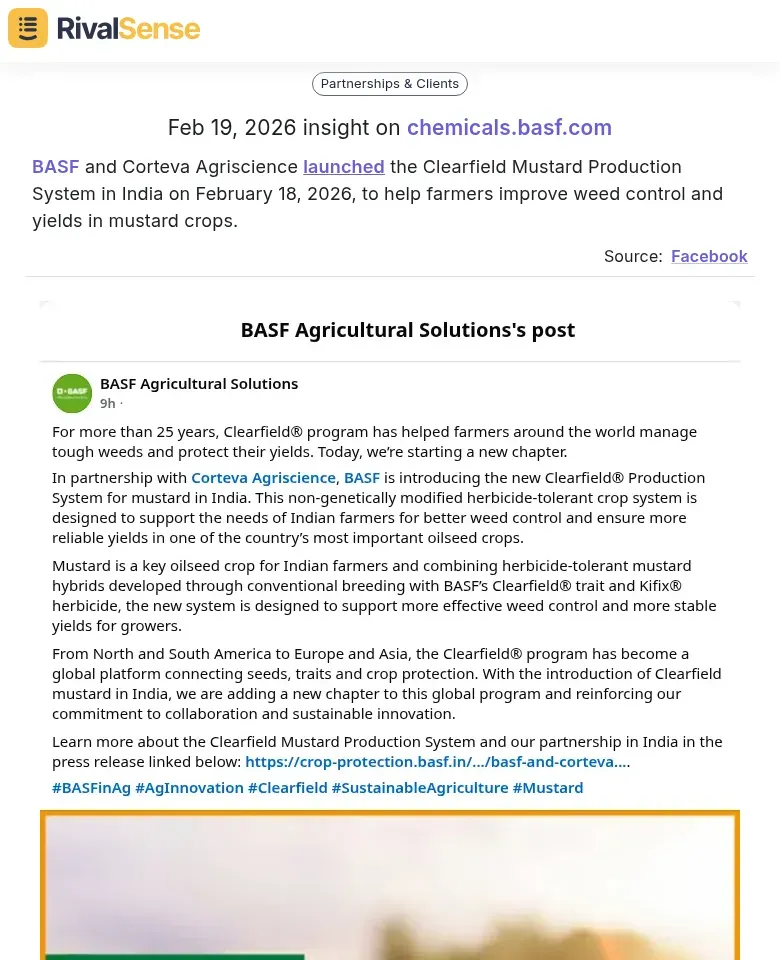
Tracking such product launches is valuable for business strategy as it reveals market expansion efforts, partnership synergies, and competitive focus areas, allowing you to adjust your own offerings or partnerships accordingly.
Practical Checklist for Partnership Analysis:
✅ Monitor competitor Facebook pages for co-branded content and joint announcements
✅ Categorize partnerships by type (media, technology, distribution)
✅ Map each partnership to specific audience segments or regions
✅ Track announcement frequency and engagement metrics
✅ Identify gaps where competitors lack coverage in your key accounts' markets
Analyzing partnership announcements like the BASF-Corteva collaboration reveals market expansion strategies. These collaborations signal where competitors are allocating resources and which segments they're targeting. For early market shift detection, set up daily alerts for competitor Facebook announcements, partnership reveals, and client testimonials. These signals often precede formal sales outreach to your accounts.
Actionable Steps:
- Create a partnership matrix with columns for partner type, target audience, geographic focus, and value proposition
- Compare partnership strategies across competitors to spot underserved niches
- Use tools like RivalSense for automated alerts on new collaborations
- Correlate competitor announcements with your account health metrics
- Establish weekly review cadence to spot emerging threats/opportunities
Strategic alliances reveal competitor resource allocation and target segments. When you spot a competitor targeting your key client's pain points, you gain critical lead time to reinforce your value proposition. By establishing this systematic approach, you transform reactive account management into proactive strategic advantage, ensuring your key relationships remain secure while identifying new growth vectors competitors haven't yet discovered.
Content and Engagement Pattern Analysis
Content and engagement patterns reveal how competitors connect with their audience. Analyzing these patterns helps you understand what resonates with their target market and identify opportunities for your own strategy. By dissecting format effectiveness, timing, and audience response, you can refine your content calendar for maximum impact.
For example, RivalSense captured that Swarovski launched a Created Diamonds Collection featuring laboratory grown diamonds set in precious metals for fine jewelry, as announced on February 17.

Monitoring such product launch announcements is valuable for business strategy as it highlights trends in consumer preferences, announcement timing, and content strategies that drive engagement, enabling you to align your own launches with market interest.
Start by analyzing content format effectiveness across different segments. For example, track whether B2B competitors use whitepapers for enterprise clients versus short videos for SMBs.
Checklist for Content Analysis:
- Categorize content by format (blog, video, webinar, case study)
- Map formats to audience segments
- Measure engagement rates per segment
- Note announcement timing and cadence patterns
- Analyze comment sentiment and share-of-voice
Next, examine announcement timing and cadence. Monitor when competitors launch major updates or campaigns. Look for patterns—do they release big announcements on Tuesdays? Before industry events? Track quarterly vs. monthly cadences. Practical tip: Use a calendar to visualize competitor announcement patterns and identify optimal windows for your own launches.
Finally, track engagement metrics to gauge audience resonance. Beyond likes and shares, analyze comment sentiment and share-of-voice in industry discussions. Are competitors dominating conversations around specific topics? Tools like RivalSense can automate tracking of engagement patterns across platforms. Key insight: High engagement on thought leadership content often signals strong brand perception, while promotional content may generate less organic interaction.
Operational Insights from Service and Infrastructure Updates
Service expansions and infrastructure changes reveal competitors' market penetration strategy. Tracking these operational updates can provide early signals of new market entries or service enhancements. For B2B companies, this intelligence is key to anticipating competitive moves in logistics, support, or regional availability.
Consider this RivalSense insight: Autotransporta direkcija added the new bus stop 'Baroni' in Lejasstrazdu village to several regional bus routes starting March 1, with services provided by AS 'Talsu autotransports' in cooperation with SIA 'Tukuma auto'.
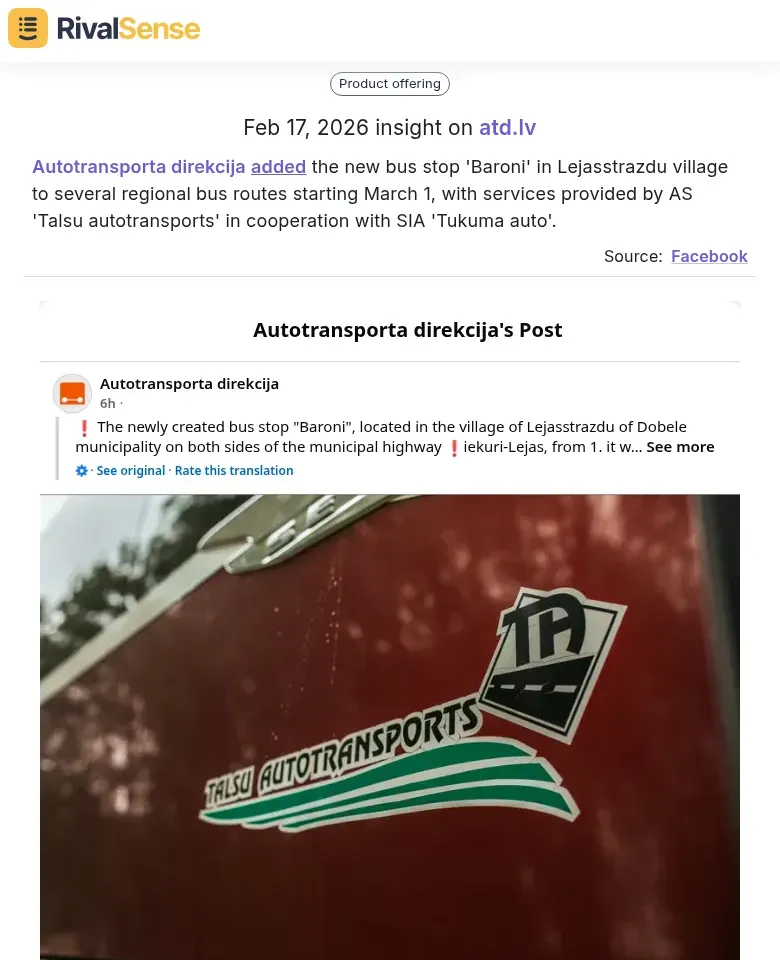
Such service updates are valuable for business strategy as they indicate operational investments, partnership models, and geographic expansion, helping you assess competitive threats in your service areas or identify collaboration opportunities.
When you notice new data centers in emerging markets or expanded service offerings in specific regions, you're seeing their operational roadmap unfold. For example, when Facebook launched Marketplace in new countries, it signaled a deeper push into e-commerce beyond social networking.
Practical Steps for Tracking Operational Insights:
- Monitor job postings for infrastructure roles in new regions
- Track data center announcements and server expansions
- Watch for localized service launches (language support, regional features)
- Document partnership announcements with local telecom providers
Regional market entries often follow infrastructure investments. When Facebook expands into Southeast Asia, they typically partner with local telecom companies first, then launch localized versions of Messenger and Workplace. This reveals a pattern: infrastructure → partnerships → localization → market capture.
Key Checklist for Operational Intelligence:
- [ ] Track infrastructure investments by region
- [ ] Monitor localization efforts (language, payment methods)
- [ ] Document operational partnerships (cloud providers, telecom)
- [ ] Analyze service expansion timelines
- [ ] Compare infrastructure density vs. market share
Operational partnerships with companies like Jio in India or Vodafone in Europe reveal Facebook's go-to-market approach. These partnerships often precede major market entries and indicate which segments they're targeting first. By mapping these operational moves, you can anticipate where competitors will compete most aggressively next.
Methodology for Effective Facebook Competitor Research
Effective Facebook competitor research requires a structured methodology that combines systematic categorization with comprehensive tracking. This approach ensures you gather consistent and actionable intelligence over time, enabling data-driven decision-making for your B2B strategy.
Start by identifying three competitor types: direct competitors (offering similar products/services), indirect competitors (targeting the same audience with different solutions), and aspirational competitors (brands whose strategies you admire). Create a competitor matrix to organize your analysis.
Combine manual observation with automated tools like RivalSense for continuous monitoring. Manually analyze competitor content, engagement patterns, and community interactions weekly, while using tools to track metrics like follower growth, engagement rates, and posting frequency automatically.
Apply both quantitative and qualitative analysis: track metrics (engagement rates, reach, follower growth) alongside qualitative insights (content themes, brand voice, community sentiment). Use a SWOT framework to translate findings into actionable strategies.
Practical Checklist:
- Identify 3-5 competitors in each category
- Set up automated tracking for key metrics
- Schedule weekly manual content reviews
- Analyze both top-performing and underperforming posts
- Document insights in a centralized dashboard
- Update competitor list quarterly to reflect market changes
Turning Insights into Competitive Advantage
Turning competitor insights into tangible advantage requires systematic execution. By leveraging the intelligence gathered, you can make informed decisions that differentiate your business and capture market share. This process involves identifying gaps, benchmarking performance, and developing strategic responses.
First, identify content gaps by analyzing competitor top-performing posts - what topics do they dominate where you're absent? Create a content matrix mapping their coverage vs. yours, then prioritize underserved niches. For differentiation, analyze their brand voice and positioning - can you occupy a more authoritative, customer-centric, or innovative stance?
Benchmark performance metrics realistically: track engagement rates, follower growth, and conversion metrics across competitors. Set tiered goals - baseline (match top competitor), stretch (exceed by 20%), and moonshot (industry-leading). Use these benchmarks to allocate resources effectively.
Develop strategic responses through SWOT analysis: exploit competitor weaknesses (slow response times, inconsistent posting) while neutralizing their strengths (match their best practices). Create an action checklist: 1) Weekly competitive content audit, 2) Monthly performance benchmarking, 3) Quarterly strategic response planning. Pro tip: Monitor competitor customer complaints - these reveal unmet needs you can address. Remember: The goal isn't imitation but strategic differentiation based on market intelligence.
Conclusion: Leverage Tools for Continuous Intelligence
Facebook competitor trend analysis is a powerful tool for B2B founders, business owners, entrepreneurs, and CEOs to stay ahead in a competitive landscape. By systematically tracking strategic moves, content patterns, and operational updates, you can uncover insights that drive informed decisions and sustainable growth.
To streamline this process, consider using automated tools like RivalSense, which tracks competitor product launches, pricing updates, event participations, partnerships, regulatory aspects, management changes, and media mentions across company websites, social media, and various registries. It delivers all this intelligence in a weekly email report, saving you time and ensuring you never miss a critical update.
Try out RivalSense for free today at https://rivalsense.co/ and get your first competitor report to start transforming insights into competitive advantage.
📚 Read more
👉 Data-Driven Competitive Intelligence: Winning in Licensed Pop Culture Apparel
👉 Avoid These Regulatory Competitor Insight Mistakes That Are Hurting Your ROI
👉 Analyzing Harvey's Shared Spaces Launch: A Practical Competitor Insight
👉 The Ultimate Key Account Tracking Spreadsheet Template: A Practical Guide for B2B Leaders
👉 Predictive Analytics for Engineering Consulting Key Account Management: Free Trial Guide