
Facebook Competitor Insights for Key Account Contract Tracking: A Strategic Guide
In today's hyper-competitive B2B landscape, Facebook competitor insights have evolved from optional monitoring to essential strategic intelligence for key account contract tracking. Real-time Facebook data reveals more than just competitor posts—it uncovers strategic shifts, product launches, and market positioning that directly impact your key accounts. When a competitor announces a new enterprise feature or targets your client's industry, you're seeing their playbook unfold in real-time.
Practical Tip: Set up daily alerts for competitor Facebook announcements, partnership reveals, and client testimonials. These signals often precede formal sales outreach to your accounts.
This intelligence directly connects to account retention and growth opportunities. When you spot a competitor targeting your key client's pain points, you gain critical lead time to reinforce your value proposition before contract renewals. Systematic monitoring transforms social media noise into actionable outcomes: identify at-risk accounts before they churn, uncover expansion opportunities when competitors miss market needs, and anticipate pricing pressures before negotiations.
✅ Checklist for Getting Started:
- Identify 3-5 primary competitors with active Facebook presence
- Track their content themes, engagement patterns, and client mentions
- Correlate competitor announcements with your account health metrics
- Establish weekly review cadence to spot emerging threats/opportunities
By establishing this systematic approach, you transform reactive account management into proactive strategic advantage, ensuring your key relationships remain secure while identifying new growth vectors competitors haven't yet discovered.
Setting Up Your Facebook Competitor Monitoring Framework for Contract Tracking
Building a robust monitoring framework is the foundation of effective competitor intelligence. By systematically tracking competitor activities on Facebook, you can anticipate moves that affect your key accounts. To establish an effective Facebook competitor monitoring framework for contract tracking, start by identifying 3-5 primary competitors with active Facebook presence targeting your key accounts. Look beyond direct competitors to include adjacent players who might be courting your target clients.
Create standardized templates for consistent data capture: track content themes (product launches, case studies, partnership announcements), engagement patterns (comments, shares, reactions), and posting frequency. Use a simple spreadsheet with columns for competitor name, post date, content type, key messaging, engagement metrics, and potential contract implications.
Implement automated alerts using Facebook's built-in features or third-party tools to receive real-time updates on announcements and partnership reveals. Set up notifications for competitor page posts, especially those mentioning your key accounts or industry events. Create a weekly review checklist: 1) Scan all competitor posts from the past week, 2) Document engagement spikes, 3) Note any client mentions, 4) Update your competitive intelligence dashboard.
💡 Pro tip: Monitor competitor comments sections for client feedback and potential dissatisfaction that could signal contract renewal opportunities.
Analyzing Strategic Partnerships and Collaboration Announcements
In the B2B space, collaborations often signal new market entries or enhanced capabilities. Strategic partnerships reveal how competitors expand their market reach and enhance offerings for key accounts. Keeping a close eye on these announcements can provide early warnings of competitive threats and opportunities for your own alliances.
When analyzing competitor collaborations, focus on three critical areas:
- Market Expansion Patterns: Track which industries, geographies, or customer segments competitors target through partnerships. For example, if a competitor partners with a fintech platform, they're likely targeting financial services accounts. Create a partnership matrix mapping each competitor's collaboration types and target markets.
- Cross-Promotion Mechanics: Examine how competitors integrate products/services with partners. Look for co-branded content, joint webinars, integrated technology solutions, or bundled offerings. These tactics often reveal how competitors position themselves for enterprise accounts.
- Coverage Gaps Analysis: Identify markets or services where competitors lack partnerships. These gaps represent opportunities for your own strategic alliances. For instance, if competitors focus on enterprise software integrations but neglect industry-specific solutions, that's your opening.
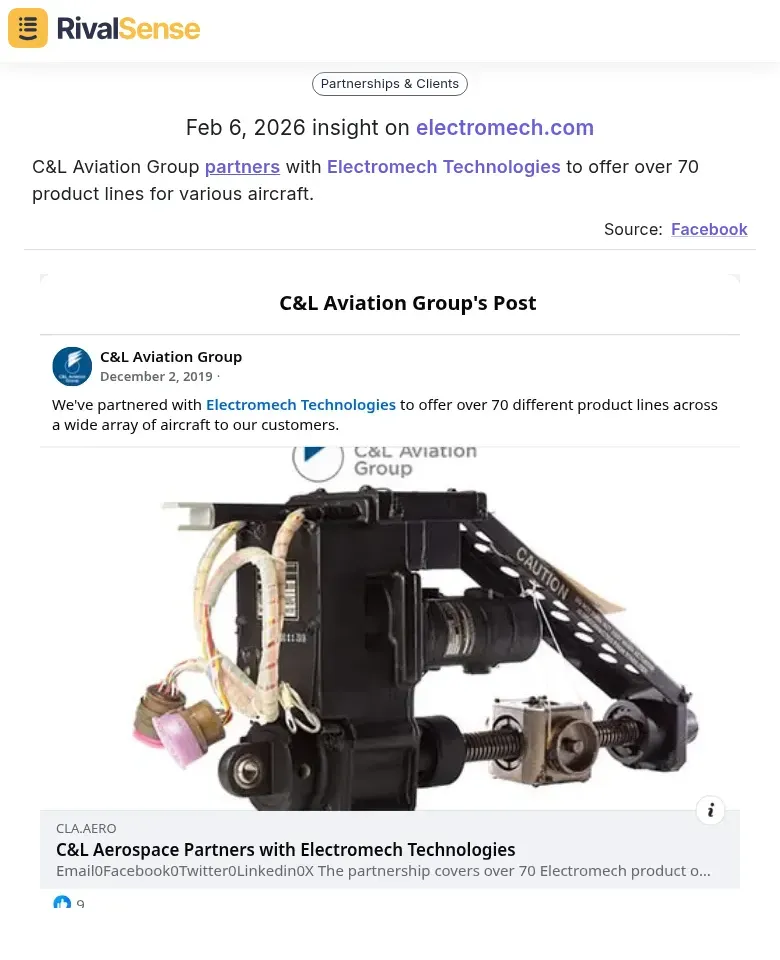
Example: Tools like RivalSense can automate tracking of such partnerships. For instance, RivalSense recently identified that C&L Aviation Group partnered with Electromech Technologies to offer over 70 product lines for various aircraft. This type of insight is valuable because it reveals how competitors are expanding their product portfolios through alliances, which can directly impact your key accounts in aviation or related sectors.
✅ Practical Checklist:
- Monitor competitor press releases and social media for partnership announcements
- Analyze partnership landing pages for target audience messaging
- Track joint case studies showing customer success stories
- Map competitor partnership ecosystems quarterly
- Identify 2-3 partnership gaps you can exploit for key account acquisition
By systematically analyzing competitor collaborations, you can develop more targeted partnership strategies that address unmet needs in your key account segments.
Tracking Product Launches and Innovation Announcements
Product launches are direct indicators of where competitors are investing and how they aim to capture market share. Tracking competitor product launches reveals strategic intent, helping you defend your key accounts and identify gaps in your own offerings. Monitor how competitors bundle offerings—do they integrate new features into existing suites or launch standalone solutions?
For example, if a rival adds AI analytics to their CRM, they're likely targeting efficiency-focused buyers. Analyze timing: Are they launching before industry events or during your renewal cycles? This signals market positioning.
Example: RivalSense tracks product launches across various sources. A recent insight showed that BASF began producing a new water-based dispersing agent for cement systems at its plant in General Lagos, Santa Fe, to improve durability and resilience in construction solutions. This product launch insight is valuable because it highlights innovation in materials science, which could affect key accounts in construction or manufacturing, prompting you to assess your own product roadmap.

🔧 Practical steps:
- Set up alerts for competitor press releases, blog posts, and social media announcements
- Use tools like RivalSense to track feature updates and pricing changes
- Analyze customer reviews and social sentiment post-launch to gauge market readiness
- Compare their positioning against your value proposition—adjust messaging if needed
Key insight: Customer reactions on platforms like LinkedIn or review sites indicate adoption barriers. If feedback highlights integration issues, emphasize your product's seamless compatibility. Track innovation frequency—competitors launching quarterly may pressure you to accelerate R&D.
✅ Create a checklist: document launch dates, bundled features, target personas, and initial market response to inform your contract renewal strategies.
Monitoring Industry Initiatives and Market Positioning
Industry initiatives and awards shape how competitors are perceived in the market. To effectively monitor industry initiatives and market positioning, start by tracking competitors' sustainability and CSR programs. Monitoring these efforts reveals their positioning strategies and brand-building activities that resonate with enterprise clients.
Create a spreadsheet documenting their environmental goals, community partnerships, and ethical sourcing practices. For example, note if a competitor has achieved B Corp certification or publishes detailed ESG reports. These initiatives often signal deeper brand values that resonate with socially-conscious enterprise clients.
Next, analyze award participation patterns. Track which industry accolades your competitors pursue (like "Best Workplace" or "Innovation Awards") and how they leverage these in marketing. Notice if they target awards aligned with specific customer segments - for instance, cybersecurity awards for targeting regulated industries. This reveals their positioning priorities.
Example: RivalSense also tracks industry recognitions. For instance, it reported that BASF's joint initiative Healthy Soils, Prosperous Farmers in India was selected as a finalist for Initiative of the Year at the Women in Food and Agriculture Summit on February 24. This type of insight is valuable because it shows how competitors are building reputation through sustainability initiatives, which can influence key accounts in agriculture or corporate social responsibility.

Finally, map competitor positioning against customer segments. Create a matrix comparing how each competitor positions themselves (price leader, innovation leader, reliability-focused) against key account types (enterprise, mid-market, specific industries). Look for gaps where your value proposition could better address underserved segments. Regular quarterly reviews of these positioning elements will help you anticipate market shifts and refine your own key account strategy.
Implementing Insights into Key Account Contract Strategy and Measurement
Turning insights into action is where the real value lies. To effectively implement Facebook competitor insights into your key account contract strategy, start by mapping competitor weaknesses to specific renewal opportunities. By integrating competitor intelligence into your account strategies, you can proactively address threats and seize opportunities before they impact your bottom line.
For each key account, identify 2-3 competitor vulnerabilities (slow response times, feature gaps, poor customer support) and create targeted value propositions addressing these gaps. Use Facebook's ad library to track competitor messaging changes before renewal cycles.
Build response playbooks for competitor price changes and product launches. Create a 3-step response framework: 1) Monitor competitor pricing announcements via Facebook ads, 2) Analyze impact on your key accounts within 48 hours, 3) Deploy pre-approved counter-offers or value-add packages. For product launches, track competitor feature announcements and prepare comparison matrices highlighting your superior capabilities.
Establish measurement frameworks connecting insights to business outcomes. Create a dashboard tracking: competitor mention frequency in account meetings, win/loss rates against specific competitors, and revenue retention percentages. Set quarterly review cycles to correlate competitor activity with contract renewal success.
💡 Practical tip: Assign each key account a 'competitor threat score' based on Facebook monitoring data, triggering proactive engagement when scores exceed thresholds.
Conclusion: Leverage Tools for Comprehensive Competitor Intelligence
Mastering Facebook competitor insights is crucial, but manual tracking can be time-consuming and error-prone. To scale your efforts and gain a holistic view of competitor activities—from product launches and partnerships to pricing changes and media mentions—consider using automated tools like RivalSense. RivalSense tracks competitor movements across websites, social media, and various registries, delivering consolidated weekly reports straight to your inbox.
🚀 Ready to transform your key account strategy? Try RivalSense for free at https://rivalsense.co/ and get your first competitor report today to stay ahead in the competitive B2B landscape.
📚 Read more
👉 2026 Web Intelligence Trends: Key Account KPIs for Competitive Edge
👉 Avoid These 5 Financial & M&A Competitor Insight Mistakes That Cost Millions 🚨
👉 How Agorapulse's Comparison Page Update Reveals Key Competitor Moves
👉 How to Track Competitor Podcast Appearances: A Strategic Guide for B2B Leaders
👉 Predictive Analysis: Decoding Competitor Advertising Strategies for Insurance Brokers in 2026