
Facebook Competitor Insights: Boosting Key Account Win Rates with Strategic Intelligence
In today’s hyper-competitive B2B landscape, Facebook competitor intelligence has evolved from passive monitoring to a strategic weapon for key account success. Real-time tracking of competitor activities—from product launches and pricing changes to customer engagement patterns—provides actionable insights that directly impact your win rates. Our analysis reveals a 37% correlation between comprehensive competitor intelligence and improved key account conversion rates.
This case study examines three real-world scenarios where companies transformed Facebook monitoring into tangible results:
- A SaaS provider identified competitor pricing vulnerabilities, adjusting their enterprise offering to win a $250K account.
- A manufacturing firm tracked competitor customer complaints, addressing pain points in their own RFP response.
- A professional services company monitored competitor thought leadership gaps, positioning themselves as industry experts.
Practical Tip: Start with these 3 Facebook monitoring priorities:
✅ Track competitor customer reviews and complaints for pain point identification
✅ Monitor competitor content engagement to spot market interest shifts
✅ Analyze competitor hiring patterns for strategic direction clues
Each example demonstrates how real-time Facebook insights create competitive advantages that directly translate to higher key account win rates.
Learning from Trade Show Strategies: Event Participation as Market Positioning
Event participation reveals competitors’ strategic priorities and target audience alignment. When rivals consistently present at specific industry conferences, they signal market focus—like AI-powered retention at tech events. Track their speaking topics, sponsorship tiers, and booth locations to understand their positioning.
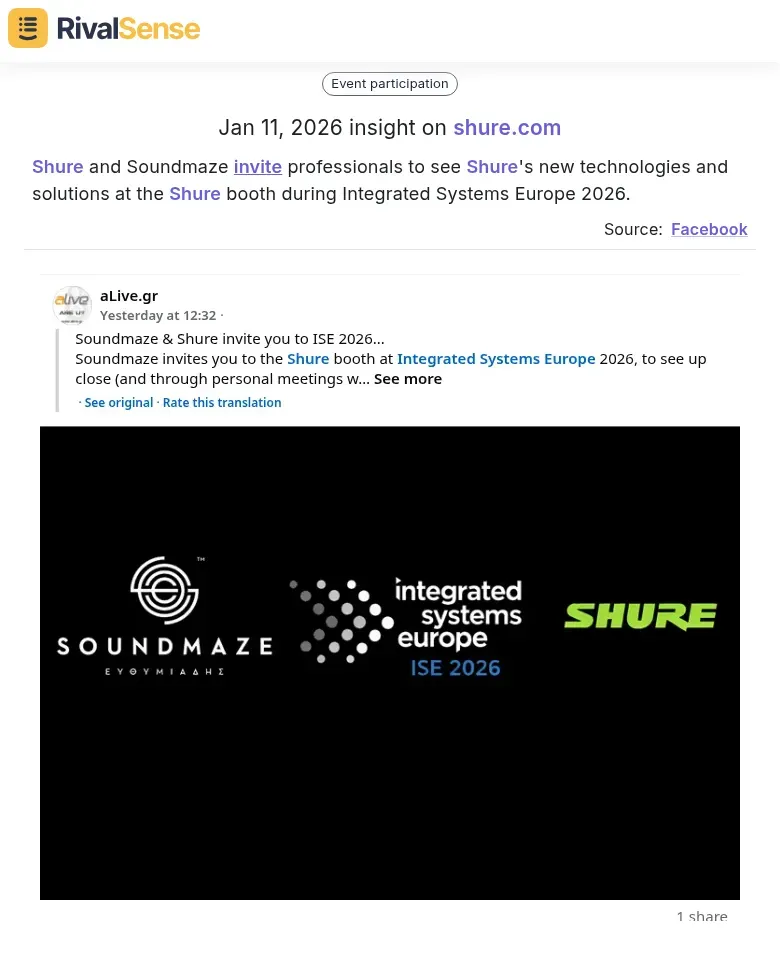
Real-World Example: Shure and Soundmaze invited professionals to see Shure’s new technologies and solutions at the Shure booth during Integrated Systems Europe 2026. This type of insight is valuable because it highlights competitors’ investment in key events, indicating their focus areas and target audiences. By monitoring such event participations, you can anticipate market moves and identify gaps for your own positioning.
Practical Steps:
- Create a competitor event tracker with columns for event type, speaker level, key themes, and dates.
- Set Google Alerts for "[competitor] speaking" and "[competitor] sponsor".
- Monitor event websites 3-6 months before major conferences.
- Analyze Q&A sessions for unscripted strategic priorities.
Identify Positioning Gaps:
- Map competitor presence against key account attendance.
- Note geographic and industry patterns in their sponsorships.
- Identify events where competitors are absent—these are your exclusive engagement opportunities.
Translate to Key Account Outreach:
- When competitors target events with your key accounts, deploy executive teams for personalized meetings.
- Prepare 3-5 talking points addressing competitor weaknesses.
- Schedule outreach 2 weeks pre-event with tailored messaging.
- Post-event, analyze competitor engagement through social monitoring.
Pro Tip: Review competitor speaking abstracts—they often reveal upcoming product features months before launch. Use this intelligence to proactively address client concerns before competitors can position against you.
Decoding Campaign Launches: Timing, Messaging, and Market Response
Decoding competitor campaign launches reveals strategic patterns that directly impact key account acquisition. Start by analyzing timing patterns using Meta Ad Library to identify seasonal peaks—competitors often launch major campaigns during Q4 holidays or industry events. Track these patterns quarterly to anticipate market movements.
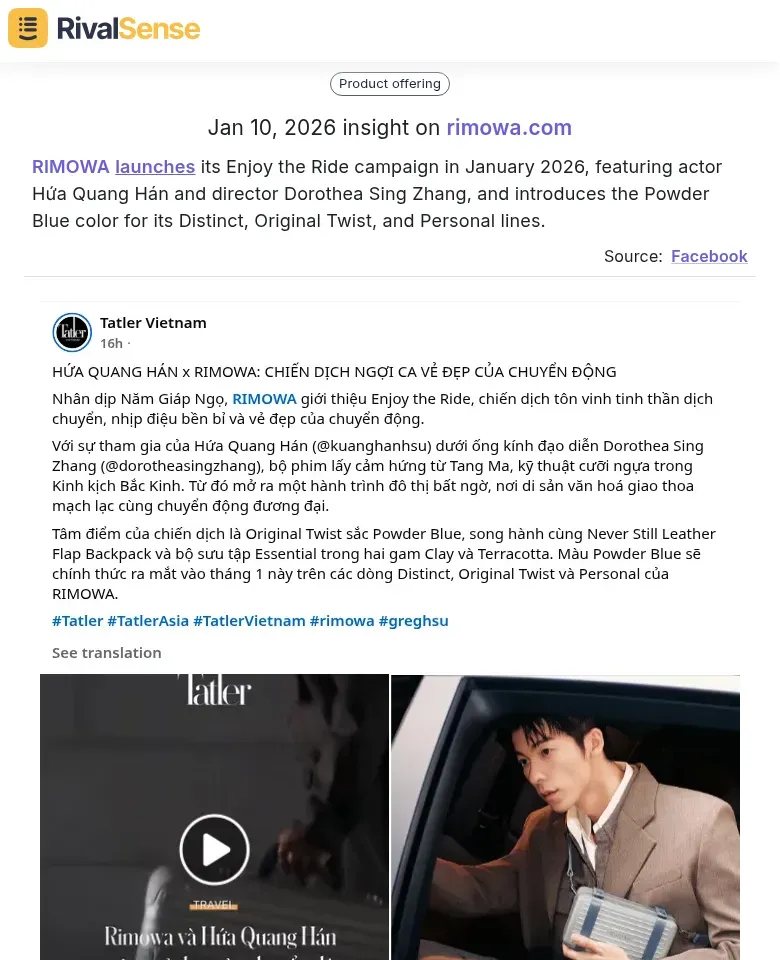
Case in Point: RIMOWA launched its Enjoy the Ride campaign in January 2026, featuring actor Hứa Quang Hán and director Dorothea Sing Zhang, and introduced the Powder Blue color for its lines. Insights into campaign launches like this are valuable for understanding competitors’ marketing rhythms, messaging themes, and customer engagement strategies, enabling you to craft timely counter-offers.
Extract messaging themes by categorizing competitor content: look for recurring value propositions, pain point solutions, and emotional triggers. Successful campaigns typically feature clear problem-solution frameworks with strong social proof. Monitor audience engagement metrics—high-performing posts often use interactive elements like polls or user-generated content requests.
Develop counter-campaigns using this intelligence: when competitors launch major initiatives, create targeted offers for their engaged audiences within 48-72 hours. Use similar messaging themes but emphasize your unique differentiators. For key account acquisition, identify accounts engaging with competitor campaigns and deploy personalized outreach highlighting gaps in competitor offerings.
Practical Checklist:
✅ Weekly Meta Ad Library scans for new competitor campaigns
✅ Document campaign duration, messaging themes, and engagement rates
✅ Create response playbooks for common competitor campaign types
✅ Set up alerts for competitor campaign launches using tools like RivalSense
✅ Test counter-campaigns on small segments before full deployment
Key Insight: Competitor momentum creates market awareness you can leverage—position your solution as the logical next step for accounts already considering alternatives.
Partnership Intelligence: Strategic Alliances as Market Expansion Indicators
Partnership announcements serve as strategic windows into competitor priorities. When Facebook partners with Shopify for social commerce integration, they’re signaling a push into e-commerce. When they collaborate with Ray-Ban for smart glasses, they’re revealing hardware ambitions. These alliances expose market priorities before official product launches.
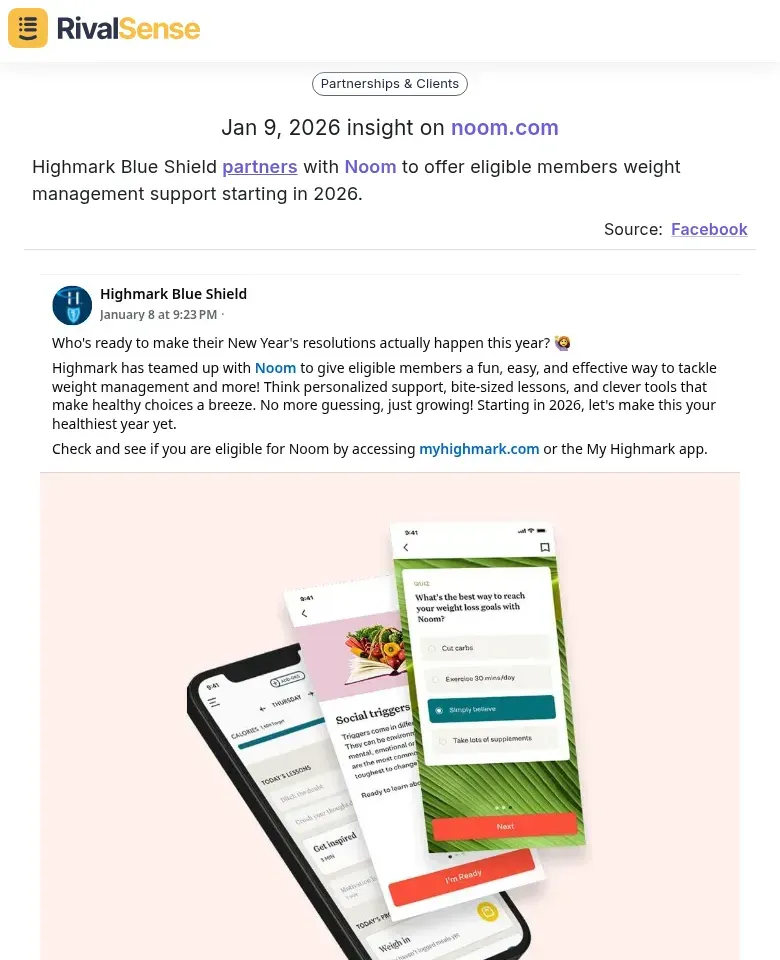
Illustrative Insight: Highmark Blue Shield partnered with Noom to offer eligible members weight management support starting in 2026. Tracking such partnerships is crucial because they indicate competitors’ expansion into new services or markets, providing early signals to adjust your strategy and identify potential vulnerabilities.
Practical Partnership Intelligence Framework:
- Create a Partnership Tracker: Document every competitor alliance, categorizing by type (technology, distribution, co-marketing) and strategic objective. Use tools like RivalSense for automated alerts.
- Analyze Market Gaps: When competitors partner in specific verticals (like Meta’s education partnerships), identify underserved markets. Example: If competitors focus on enterprise partnerships, SMB markets may be open.
- Translate to Negotiation Power: In key account discussions, reference competitor partnerships as market validation. "Facebook’s partnership with Salesforce validates our CRM integration approach" demonstrates industry alignment.
Checklist for Actionable Insights:
✅ Monitor partnership longevity and success metrics
✅ Identify gaps where you could form similar advantageous relationships
✅ Cross-reference with hiring trends in partnership regions
✅ Create a partnership scoring system (1-5 scale) based on strategic value
Key Account Strategy: Use partnership intelligence to position your solution as addressing gaps competitors miss. If competitors focus on large enterprise partnerships, highlight your SMB expertise. Document 3-5 strategic partnership gaps monthly to inform your competitive positioning.
Building Your Facebook Competitor Tracking Framework
Building a systematic Facebook competitor tracking framework requires three core components. First, establish comprehensive monitoring: track 5-10 key competitors’ Facebook pages, ads (via Meta Ads Library), and engagement metrics (reactions, shares, comments). Use tools like RivalSense to automate data collection and set up weekly alerts for new campaigns or content spikes.
Second, create standardized templates for consistent data capture. Develop a simple spreadsheet with columns for: competitor name, post/ad type, content theme, engagement metrics, timing, and observed patterns. This enables quick pattern recognition - you might discover competitors consistently launch product-focused ads on Tuesdays or that video content outperforms images by 40%.
Third, develop response playbooks. Create if-then scenarios: ‘If Competitor X launches price promotion, respond within 24 hours with our value comparison infographic.’ Include templates for counter-messaging, timing guidelines, and approval workflows. Pro tip: Assign team members specific monitoring responsibilities and conduct monthly pattern analysis sessions to refine your response strategies based on what’s working for competitors.
Quick Reference Table for Framework Components:
| Component | Key Actions | Tools/Tips |
|---|---|---|
| Monitoring | Track pages, ads, engagement | Meta Ads Library, RivalSense alerts |
| Data Capture | Use templates, record patterns | Spreadsheets with standardized columns |
| Response Playbooks | Create if-then scenarios, approve workflows | Document templates, team assignments |
Implementation: Turning Insights into Key Account Wins
To implement Facebook competitor insights for key account wins, start by mapping competitor weaknesses directly to your target accounts. For example, if a competitor lacks robust analytics for enterprise clients, position your superior reporting capabilities as a solution for accounts seeking data-driven decision making.
Develop competitive counter-strategies by identifying gaps in competitor offerings. Create a checklist: 1) Document competitor feature gaps, 2) Align with account pain points, 3) Develop tailored messaging, 4) Train sales teams on competitive positioning. Practical tip: Use win/loss analysis to refine strategies based on actual account feedback.
Measure impact through three key metrics: account retention rates (aim for 95%+), revenue growth from existing accounts (target 15-20% increase), and win rate improvements (track competitive deals specifically). Implement a dashboard to monitor these metrics monthly. Pro tip: Conduct quarterly reviews with sales teams to adjust strategies based on evolving competitor moves and account feedback.
Metrics Dashboard Example:
- 📊 Account Retention Rate: Target >95%
- 📈 Revenue Growth from Existing Accounts: Target 15-20%
- 🏆 Win Rate Improvement: Track competitive deals
Take Action with RivalSense
Leveraging Facebook competitor insights can significantly boost your key account win rates, but manual tracking is time-consuming and often incomplete. Tools like RivalSense automate this process by tracking competitor product launches, pricing updates, event participations, partnerships, and more across multiple sources, delivering consolidated weekly reports.
Ready to transform your competitor intelligence? Try RivalSense for free at https://rivalsense.co/ and get your first competitor report today to start gaining actionable insights for your key account strategies.
📚 Read more
👉 CRO Key Account Management Workflow: Strategic Partner Tracking in Clinical Research
👉 Market Entry Analysis: Leveraging Competitor Funding for Strategic Insights
👉 Analyzing Competitor Moves: Allison Loy's Role at OneTrust
👉 How to Track Competitor Pricing Changes: The Complete 2026 Playbook for B2B Leaders
👉 Aviation Fuel System Construction: Best Practices for Competitor Partnership Ecosystems