
Decoding Competitor Moves: How Hiring Insights Reveal Strategic Shifts
Monitoring competitor hiring activities is a critical component of effective competitor analysis. It offers valuable clues about a company's strategic direction, expansion plans, and operational priorities. For instance, when a fintech firm like Eleving Group hires a Head of Legal & Compliance in Lithuania, it signals a deepened commitment to regulatory compliance and risk management in that region.
By analyzing such hires, you can anticipate market trends and adjust your own strategies accordingly. This insight helps you stay ahead in competitive landscapes, especially in regulated industries like fintech where legal frameworks are constantly evolving.
🎯 Turning Hiring Insights into Actionable Strategies
When you discover a competitor hiring for a key role, it's essential to interpret what this means for your business. The hiring of a Head of Legal & Compliance often indicates that the competitor is preparing for growth, entering new markets, or addressing regulatory challenges. Here are practical steps to leverage this information:
- Assess the Role's Impact: Consider how this hire might affect the competitor's product offerings, customer trust, or market entry speed. For example, Eleving Group's focus on compliance could lead to more secure services, attracting risk-averse customers.
- Benchmark Your Position: Compare your own legal and compliance capabilities. Are you adequately staffed to compete? Use this insight to identify gaps in your team or processes.
- Monitor Follow-up Actions: Track if this hire leads to new partnerships, product launches, or regulatory filings. Tools like RivalSense can automate this monitoring, as seen with the Eleving Group insight.
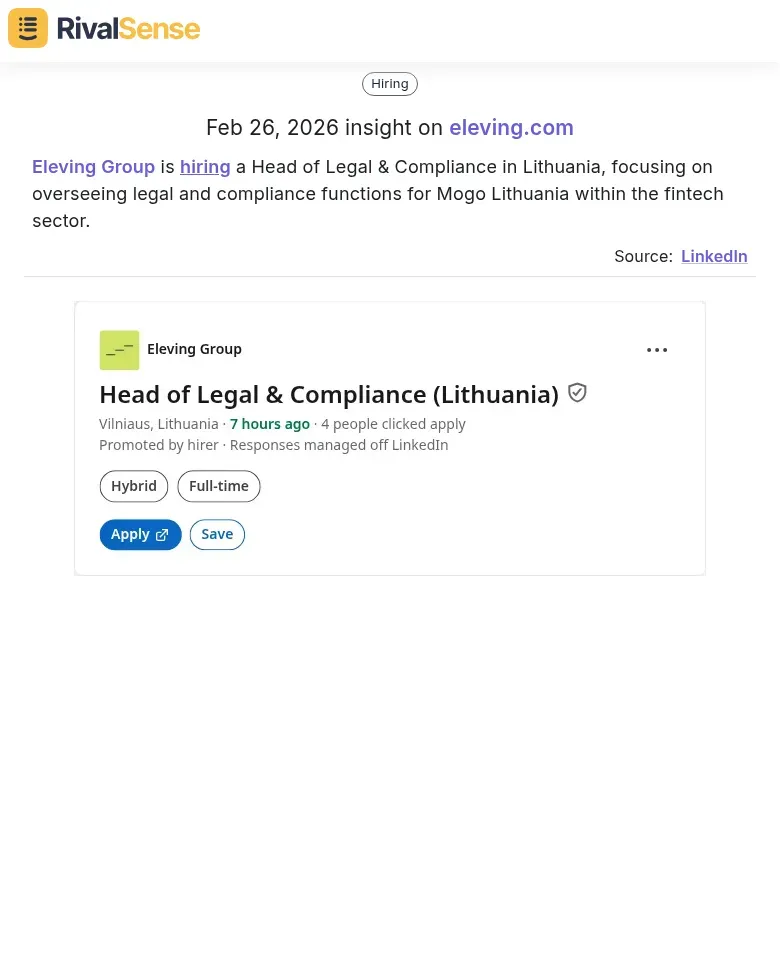
Example from RivalSense: Tracking Eleving Group's hiring move in Lithuania.
📋 Checklist for Responding to Competitor Hiring News
To systematically act on hiring insights, use this checklist:
- [ ] Identify the Role's Strategic Importance: Determine if it's for innovation, compliance, expansion, or cost-cutting.
- [ ] Update Competitive Profiles: Revise your competitor analysis documents to reflect this new capability.
- [ ] Engage with Key Accounts: Inform your key accounts about how your company compares, highlighting your strengths.
- [ ] Review Internal Resources: Ensure your team has the skills and tools to counter potential competitive advantages.
- [ ] Set Alerts for Related Developments: Use intelligence platforms to catch subsequent moves, like partnerships or regulatory changes.
💡 Pro Tips for Continuous Monitoring
Consistently tracking competitor hires requires a structured approach. Start by prioritizing roles that directly impact market dynamics, such as legal, product, or sales leadership. Incorporate these insights into regular strategy meetings to keep your team aligned and proactive. Remember, hiring trends often precede public announcements, so early detection can give you a significant edge.
For seamless competitor monitoring, consider using automated tools like RivalSense. It tracks product launches, pricing updates, event participations, partnerships, regulatory aspects, management changes, and media mentions across various sources. By delivering regular email reports, RivalSense helps you stay informed without manual effort.
🚀 Ready to enhance your competitor analysis? Try RivalSense for free at https://rivalsense.co/ and get your first report today to navigate these challenges with confidence.
📚 Read more
👉 Mastering Competitor Trade Show Strategy for 2026 Business Growth
👉 A Step-by-Step Guide to Comparing Key Account Management Tools for Industrial Machinery Maintenance
👉 How n8n's Pricing Shift Let Competitors Capture Enterprise Clients
👉 Predictive Facebook Competitor Insights: Key Account Management Case Study
👉 Mastering Key Account Management in Quantitative Trading: Strategies and Insights