
Data-Driven LinkedIn Competitor Insights for Key Account Tracking
LinkedIn has evolved from a professional networking platform into a real-time intelligence hub for tracking competitor movements and market shifts. By monitoring competitor company pages, you can detect hiring trends, product launches, and partnership announcements as they happen—providing immediate strategic value. For instance, when a rival posts about expanding their sales team, it signals untapped market opportunities you can capitalize on immediately.
These LinkedIn insights directly connect to proactive key account management strategies. Tracking key personnel changes—like when a competitor's CMO joins from a tech firm—reveals strategic priorities and helps anticipate shifts in competitor focus. This enables you to adjust your account outreach and value propositions before market dynamics change.
To transform LinkedIn monitoring into actionable competitive intelligence, implement these practical steps:
- Monitor competitor company pages daily for updates on posts and announcements
- Set up alerts for competitor job postings to infer expansion plans and talent needs
- Track key personnel movements to predict strategy shifts and market trends
- Analyze competitor content themes and engagement weekly to spot emerging patterns
- Use tools like RivalSense to automate tracking of follower growth, engagement rates, and share-of-voice metrics
This systematic approach turns LinkedIn data into a strategic advantage, helping you identify underserved niches, refine offerings, and maintain competitive parity in dynamic markets.
Tracking Competitor Recognition and Market Positioning Through Awards and Rankings
Industry awards and rankings reveal more than just bragging rights—they're powerful signals of market positioning and credibility. Tracking these recognitions helps you understand where competitors excel and what the market values most. For key account tracking, this data informs how to position your differentiation and identify credibility gaps.
For example, RivalSense tracked that Sprout Social ranked #1 in 40 categories in G2's 2026 Winter Reports, including Social Media Listening Tools and Social Customer Service, and earned a 2026 TrustRadius Buyer's Choice Award. 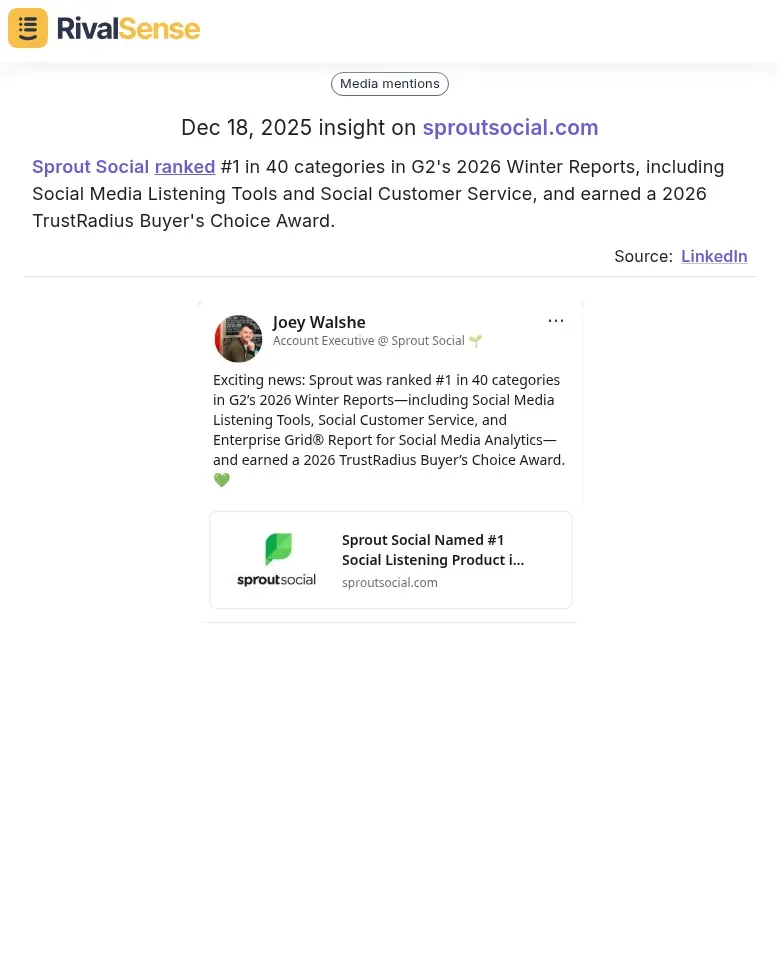
This type of insight is valuable because it shows which competitors are dominating specific niches, allowing you to benchmark your offerings and spot opportunities where no clear leader exists. If no competitor dominates the "innovation" category, for instance, that's your opening.
Practical steps:
- Create a monitoring list of key industry awards (e.g., Forbes lists, G2 categories, industry-specific recognitions)
- Track frequency and category patterns—are certain competitors dominating specific niches?
- Analyze the criteria behind awards to understand what the market values
- Benchmark your own positioning against award-winning competitors
Use these insights to anticipate competitor strategic moves and refine your messaging for key accounts based on what credibility markers matter most to them.
Monitoring Key Personnel Changes for Strategic Anticipation
Tracking executive and key employee movements provides critical signals for anticipating competitor strategy shifts. When a competitor hires a new VP of Sales from a SaaS company, expect them to target enterprise accounts more aggressively. Similarly, losing a product lead might signal innovation gaps you can exploit.
For instance, RivalSense identified that Dana Leshem joined NiCE as Director, Legal M&A in Israel, previously unspecified. 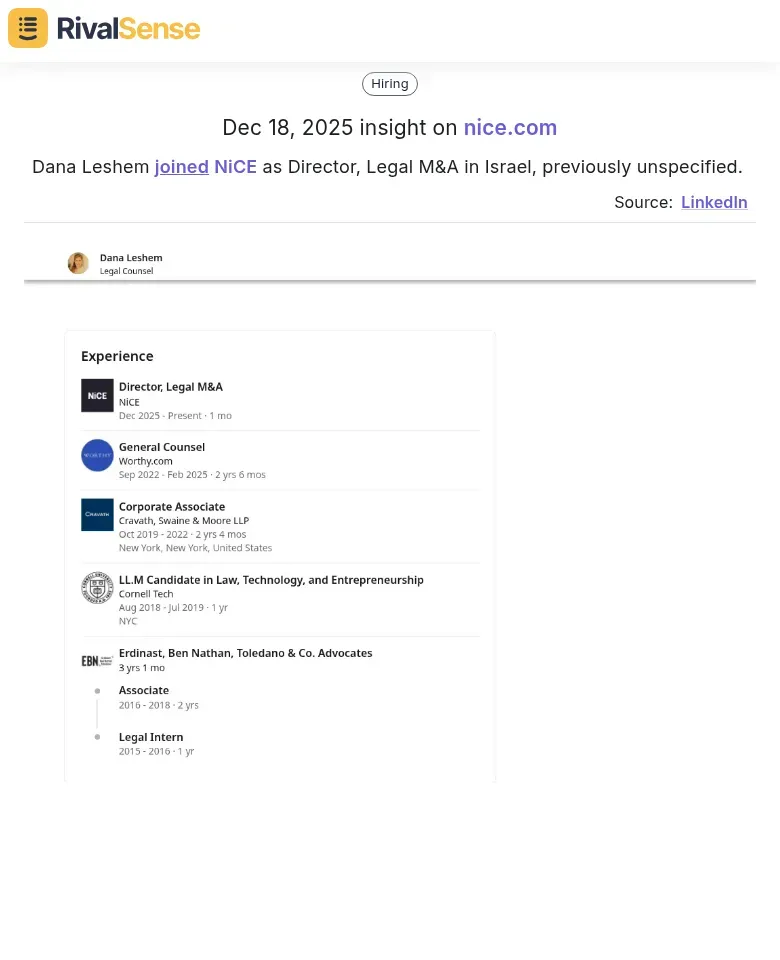
This insight is valuable because it reveals strategic priorities, such as increased focus on mergers and acquisitions or geographic expansion, helping you adjust your key account engagement before market dynamics shift.
Practical steps for monitoring personnel changes:
- Set up alerts for competitor leadership team changes on LinkedIn
- Track talent flow patterns between competitors to identify emerging industry trends
- Monitor key account managers moving between companies to anticipate account targeting shifts
- Analyze hiring patterns in specific departments to predict market focus areas
When you detect personnel changes, adjust your key account strategy accordingly. If a competitor hires an executive with healthcare experience, for example, anticipate increased focus on healthcare accounts and strengthen relationships with your healthcare clients.
Analyzing Product Announcements and Innovation Roadmaps
Product announcements reveal competitors' strategic priorities and innovation timelines. Tracking every launch, feature update, and roadmap mention helps you understand where they're investing and what capabilities they're building next. For key account tracking, this intelligence anticipates what solutions competitors might pitch to your target accounts.
A recent example from RivalSense: Aura's founder and CEO Hari Ravichandran announced that Aura Parents will launch an AI Usage tool in the coming week to monitor children's use of over 250 AI apps. 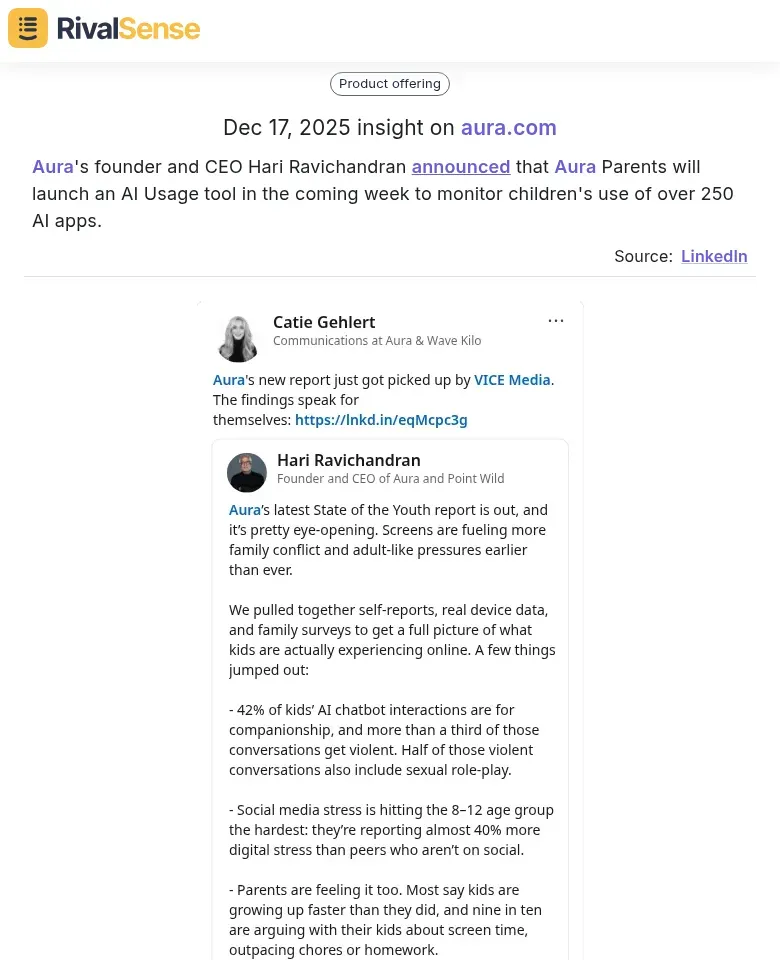
This insight is crucial because it provides early warning of new competitive advantages, enabling you to refine your value propositions and counter-messaging for sales conversations with key accounts.
Practical Steps:
- Set up alerts for competitor names + "product launch," "new feature," or "roadmap" on LinkedIn and news sites
- Analyze patterns - Are they focusing on AI integration, mobile optimization, or enterprise security? This shows their competitive advantage focus
- Map announcements to your key accounts - If a competitor launches an AI feature, which of your target accounts would care most about this?
- Update your value propositions - Counter their new features by highlighting your unique strengths
Pro Tip: Don't just track what they launch—analyze how they position it. The language they use reveals what customer pain points they're solving, helping you tailor your messaging for each key account.
Implementing a Systematic LinkedIn Monitoring Framework for Key Accounts
To implement a systematic LinkedIn monitoring framework for key accounts, start by establishing automated tracking systems. Use tools like RivalSense to continuously monitor competitors' LinkedIn company pages, employee updates, content strategies, and key personnel changes. Set up alerts for specific triggers such as new hires in target accounts, product announcements, or partnership announcements.
Integrate LinkedIn insights with other data sources for comprehensive competitive analysis. Combine LinkedIn data with CRM information, news alerts, financial reports, and market research. This holistic approach reveals patterns like which competitors are targeting your key accounts, their messaging strategies, and relationship-building tactics.
Develop actionable dashboards to visualize competitor strengths, weaknesses, and key account opportunities. Create visualizations showing:
- Competitor engagement levels with your target accounts
- Share of voice in relevant discussions
- Talent acquisition patterns
- Content performance metrics
Include a checklist for regular review:
✅ Update tracking parameters monthly
✅ Cross-reference LinkedIn data with sales intelligence
✅ Identify relationship gaps in key accounts
✅ Monitor competitor thought leadership positioning
This framework transforms raw data into strategic insights for proactive account defense and expansion.
Conclusion: Turning LinkedIn Insights into Sustainable Key Account Advantage
To transform LinkedIn insights into sustainable key account advantage, implement these practical steps:
-
Establish Ongoing Monitoring: Set up automated alerts for competitor job postings, content strategy shifts, and leadership changes. Create a weekly review cadence to analyze competitor engagement patterns and identify emerging threats.
-
Build Proactive Engagement Systems: Map competitor connections to your key accounts and develop targeted outreach sequences. When you spot competitors engaging with your accounts, respond within 24 hours with value-added content or personalized offers.
-
Create Data-Driven Playbooks: Document competitor weaknesses you've identified and develop specific counter-strategies. For example, if competitors lack case studies in a particular industry, prioritize creating those for your key accounts in that sector.
-
Implement Continuous Adaptation: Conduct quarterly competitive landscape reviews using LinkedIn data to adjust your positioning. Track competitor messaging evolution and ensure your value proposition remains differentiated.
-
Measure Impact: Establish KPIs for competitive intelligence ROI, such as account retention rates, competitive displacement wins, and response time to competitor moves.
Key tip: Designate a competitive intelligence champion within your sales team who owns LinkedIn monitoring and translates insights into actionable account strategies. This ensures competitive data drives real business decisions rather than remaining in reports.
By making LinkedIn competitor insights an integral part of your key account management rhythm, you transform reactive defense into proactive market leadership.
Ready to streamline your competitor tracking? Tools like RivalSense automate the monitoring of competitor product launches, pricing updates, event participations, partnerships, regulatory aspects, management changes, and media mentions across company websites, social media, and various registries, delivering all in a weekly email report. Try RivalSense for free at https://rivalsense.co/ and get your first competitor report today to enhance your key account strategy!
📚 Read more
👉 Actionable Audio Tech Key Account Strategies for Competitive Edge
👉 Actionable Pricing Strategies: Uncover Competitor Insights with Strategic Account Tracking
👉 How Media Mentions Unlock Competitor Insights: A Real-World Case
👉 Key Account Management Best Practices 2024: The Strategic Playbook for B2B Growth
👉 Actionable Strategies: Analyze Competitor Laundry Equipment Features to Win