
Data-Driven Insights: Track Key Account Communications in B2B Fintech
In today's data-intensive B2B fintech landscape, traditional account management often falls short. Relying on manual notes and gut feelings leaves teams reactive, missing critical signals that drive revenue growth and retention. Competitors who leverage data-driven insights gain a decisive edge by transforming client relationships from reactive to proactive management.
Track key account communications to uncover patterns in client interactions, identify upsell opportunities, and prevent churn before it happens. For example, monitor email frequency, meeting topics, and sentiment trends across accounts. Practical steps: 1) Centralize all communication data (emails, calls, meetings), 2) Analyze engagement metrics weekly, 3) Set alerts for declining activity, 4) Use insights to tailor outreach. This approach not only boosts retention by 20-30% but also uncovers hidden revenue streams, turning account managers into strategic advisors. Embrace data to stay ahead in the competitive fintech arena.
What to Track: Essential Communication Metrics for B2B Fintech Accounts
To effectively track B2B fintech account communications, you need a clear focus on the right metrics. Understanding these metrics allows you to proactively manage relationships and identify opportunities before they slip away. Focus on these essential metrics across key channels:
Key Communication Channels to Monitor:
- Email exchanges (including automated notifications and manual correspondence)
- Phone calls and video meetings (record duration, participants, follow-up actions)
- Platform interactions (API calls, dashboard logins, feature usage)
- Support tickets and chat conversations
Critical Engagement Metrics:
- Response Times: Track average reply times for both your team and client contacts. Aim for under 4 hours for urgent financial matters.
- Communication Frequency: Monitor touchpoint cadence - weekly for high-value accounts, monthly for standard.
- Sentiment Analysis: Use NLP tools to analyze email tone, meeting transcripts, and support conversations for positive/negative trends.
- Topic Coverage: Tag conversations by subject (compliance, integration, billing, product features) to identify knowledge gaps.
Practical Integration Checklist:
- ✓ Sync email/calendar systems with CRM (Salesforce, HubSpot) for automatic logging
- ✓ Connect support platforms (Zendesk, Intercom) to track resolution patterns
- ✓ Integrate product analytics (Mixpanel, Amplitude) to correlate usage with communication
- ✓ Create unified dashboards showing communication health scores alongside financial metrics
- ✓ Set alerts for declining sentiment scores or extended response delays
Pro Tip: Combine quantitative metrics with qualitative insights from quarterly business reviews. Track executive sponsor engagement levels alongside technical support interactions for a complete relationship view. This holistic approach helps predict churn risks 60-90 days before contract renewals.
Turning Data into Actionable Insights: Analytics for Strategic Decision-Making
Turning communication data into strategic insights requires a systematic approach. Start by identifying at-risk accounts through pattern analysis to preempt potential issues. Track declining response rates (below 20%), extended reply times (over 72 hours), and reduced meeting attendance as early warning signals.
Create a dashboard that flags accounts showing 3+ consecutive negative communication patterns. Optimize resource allocation by analyzing communication effectiveness across account tiers. For enterprise accounts (Tier 1), measure ROI through deal velocity and expansion opportunities. For mid-market (Tier 2), track conversion rates and implementation success. For SMB (Tier 3), focus on volume efficiency and automated engagement.
Personalize engagement using historical data: analyze preferred communication channels (email vs. video), response patterns by time/day, and content engagement levels. Create client preference profiles and implement a 3-step personalization checklist:
- Match communication style to historical preferences
- Schedule outreach during peak engagement windows
- Reference past successful interactions in messaging
This data-driven approach transforms raw communication metrics into actionable strategic decisions.
Implementation Framework: Building Your Key Account Communication Tracking System
Building an effective key account communication tracking system requires a strategic implementation framework. You need to select the right technology and ensure team adoption for seamless integration. Start with technology selection: integrate your CRM (Salesforce, HubSpot) with communication tracking tools like Gong or Chorus, and connect to analytics platforms like Tableau or Power BI for visualization.
For data governance, implement strict access controls, encryption for sensitive financial communications, and audit trails. Comply with GDPR, CCPA, and financial regulations like FINRA/SEC requirements. Create a data retention policy and conduct regular compliance audits.
Team adoption is critical: develop training programs focused on interpreting communication analytics, not just tool usage. Use change management strategies like pilot groups, executive sponsorship, and clear ROI demonstrations. Create checklists for daily/weekly review of account communication patterns and action items.
Practical Tip: Start with 3-5 key accounts as a pilot, track metrics like response times, sentiment trends, and engagement frequency, then scale. Regular team workshops to review insights and adjust strategies ensure continuous improvement.
Measuring ROI: Quantifying the Impact of Communication Tracking on Business Outcomes
To quantify communication tracking ROI in B2B fintech, focus on core KPIs that link directly to business results. Understanding this impact helps justify investments and optimize strategies. Focus on three core KPIs: retention rates (track churn reduction post-intervention), upsell/cross-sell success (measure conversion lift from targeted outreach), and client satisfaction scores (via NPS or CSAT surveys linked to communication patterns).
For cost-benefit analysis, compare implementation costs (software, training) against traditional methods—manual tracking often incurs 20-30% higher labor costs and misses 40% of client interactions, while automated systems reduce response times by 50% and increase deal visibility.
Practical Steps:
- Baseline current metrics before implementation
- Use tracking data to identify at-risk accounts (e.g., declining engagement triggers alerts)
- Align communication insights with revenue data (e.g., link email opens to renewal rates)
Case Study: A fintech firm used tracking to spot unmet needs in key accounts, leading to a 25% upsell increase and 15% higher retention—outpacing competitors relying on anecdotal feedback.
Tip: Integrate tracking with CRM to automate KPI dashboards, ensuring real-time ROI visibility.
Future Trends: AI and Predictive Analytics in B2B Fintech Account Management
The future of B2B fintech account management is being reshaped by AI and predictive analytics, moving from reactive monitoring to proactive intelligence. By 2026, 75% of top-performing B2B teams will leverage AI-powered predictive analytics, delivering 85% accuracy in insights and 15-25% ROI lifts.
AI-Powered Communication Analysis: Advanced NLP algorithms now analyze email, meeting transcripts, and support tickets to identify churn signals 30-45 days before they manifest. For example, sentiment shifts in payment-related communications can predict financial distress with 92% accuracy.
Practical Tip: Implement weekly sentiment trend analysis across key account communications to catch negative patterns early.
Real-Time Insights & Automated Alerts: Modern systems provide real-time dashboards with automated alerts for critical events like payment delays, support ticket escalations, or competitor mentions.
Checklist for Alerts:
- Set up alerts for payment delays >7 days
- Monitor support ticket volume spikes >50%
- Track negative sentiment in executive communications
Competitive Intelligence Integration: Combine account communication data with market intelligence to identify expansion opportunities. When a key account mentions competitor pricing concerns, AI can trigger personalized retention offers while updating your competitive positioning strategy.
Action Step: Create a monthly competitive intelligence report that cross-references account sentiment with market share data.
Implementation Roadmap: Start with 3-5 key accounts, implement basic sentiment analysis, establish alert thresholds, then scale to full portfolio while integrating with CRM and competitive intelligence platforms.
Competitor Insights: Enhancing Account Strategy with External Data
While tracking internal communications is crucial, integrating competitor insights can provide a competitive edge in B2B fintech. Understanding competitor moves helps you anticipate market shifts, identify opportunities, and protect your key accounts from competitive threats.
Here are real-world examples of competitor insights that can inform your strategy:
-
Product Deprecations:
- Insight: Zapier announced that the Conversation With Assistant (Legacy) action in their Slack-ChatGPT integration will be deprecated by August 26, 2026.
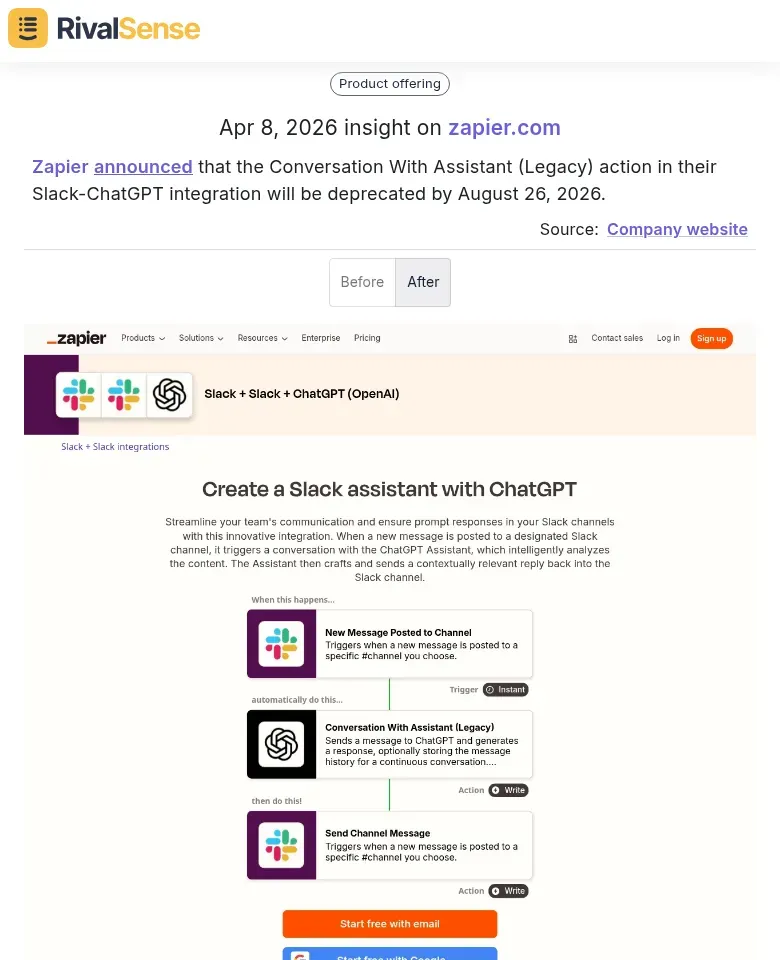
- Strategic Value: Tracking product deprecations helps you anticipate changes that might affect your clients' workflows. For instance, if your clients use this integration, you can proactively offer alternatives or support, strengthening trust and retention.
-
Product Updates and Events:
- Insight: Isometric released Version 2.0 of its Standard with updates including refined buffer pools, extended crediting periods, expanded scope for superpollutants, and a new protocol versioning approach, and will host a webinar on April 14 featuring Stacy Kauk, P.Eng., Ola Sitarska, and Michael Shell to discuss these changes.
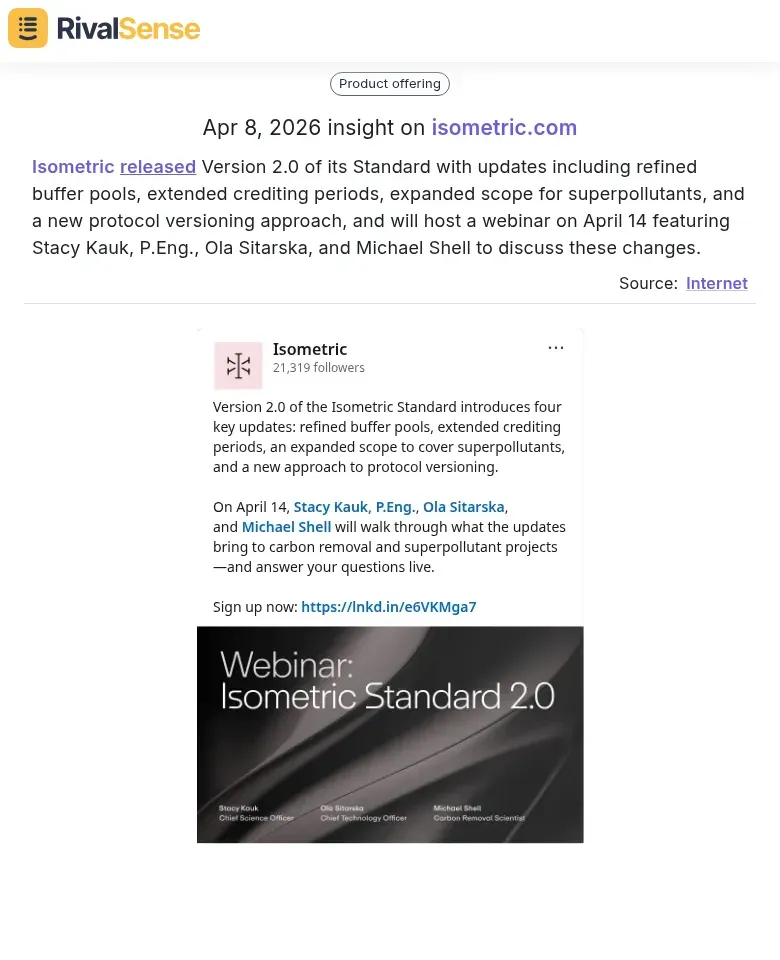
- Strategic Value: Monitoring competitor product updates and events keeps you informed about industry trends and best practices. Attending or analyzing such webinars can reveal insights into new features or strategies that you can adapt for your own offerings.
-
AI and Automation Initiatives:
- Insight: n8n uses an AI Agent to write prompts, generate product images with deAPI, and create short ad videos from product descriptions.
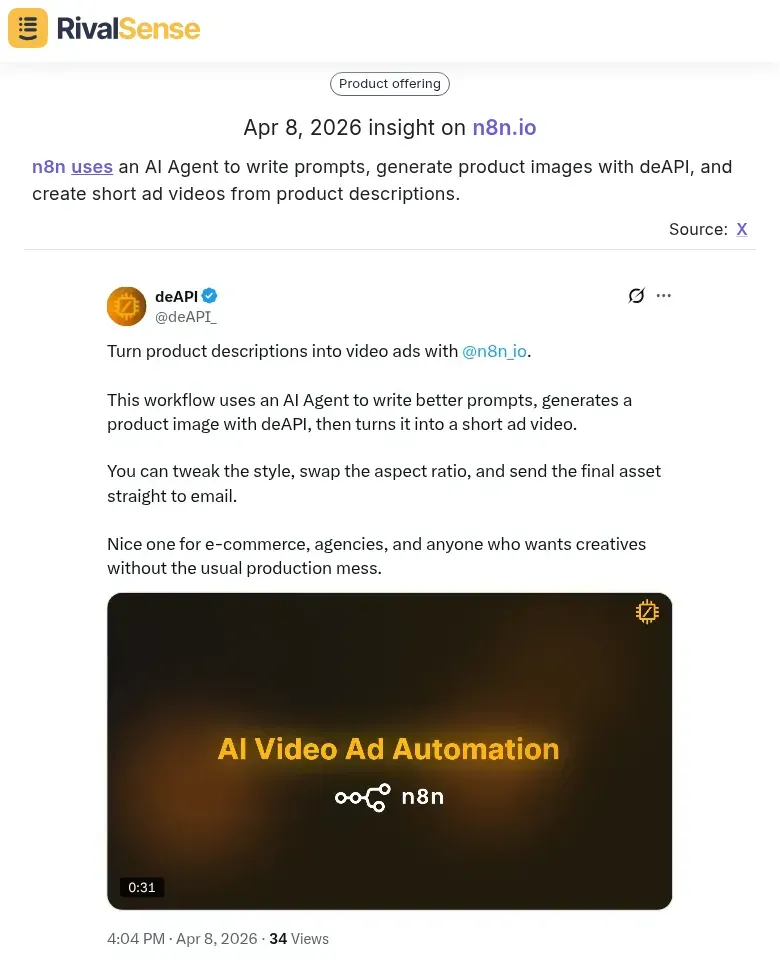
- Strategic Value: Learning about competitors' AI implementations can inspire innovation in your own processes. For example, adopting similar AI tools can improve efficiency in content creation or customer engagement, giving you a technological advantage.
Incorporating these types of competitor insights into your account management strategy allows you to stay ahead of the curve and respond proactively to market dynamics.
Conclusion: Take Action with Data-Driven Competitor Tracking
Mastering key account communications is essential for success in B2B fintech, but combining it with competitor intelligence creates an unbeatable strategy. By tracking both internal interactions and external market moves, you can anticipate challenges, seize opportunities, and drive sustainable growth.
To assist with the challenges described in this post, try out RivalSense for free. RivalSense tracks competitor product launches/updates, pricing changes, event participations, partnerships, regulatory aspects, management changes, and media mentions across various sources, delivering all in a weekly email report. Get your first competitor report today at https://rivalsense.co/ and start transforming your account management with data-driven insights.
📚 Read more
👉 How NVIDIA's Nuclear AI Deal Enabled Competitors to Secure Energy Partnerships
👉 Quick Twitter Hacks: Competitor Intelligence for B2B Leaders
👉 Advanced Financial Analysis for Video Editing Software Competitors: Turning Insights into Strategy
👉 Competitor Product Analysis Workflow: From Tracking to Strategic Insights
👉 Decoding Competitor Moves: What Vanta's New Storytelling Hire Reveals