
Data-Driven Competitor Product Insights: Track for Strategic Sales Wins
Introduction: The Power of Data-Driven Competitor Product Insights
In today's hyper-competitive business landscape, tracking competitor product developments isn't just about staying informed—it's about uncovering strategic market opportunities that directly impact your bottom line. When you monitor competitor product launches, feature updates, and pricing changes in real-time, you gain actionable insights that reveal gaps in the market, emerging customer needs, and potential competitive vulnerabilities.
Practical Tip: Set up automated alerts for competitor product announcements and feature updates. This enables you to respond strategically within days, not months.
The connection between product insights and sales performance is direct and measurable. By analyzing which competitor features drive their sales success, you can optimize your own product positioning, refine your sales messaging, and identify upsell opportunities. For example, if a competitor's new integration feature is gaining traction, your sales team can immediately highlight your superior alternative.
Checklist: Track competitor product metrics including feature adoption rates, customer reviews, pricing tiers, and market share changes.
Real-time competitor monitoring is no longer optional—it's essential for modern business strategy. Markets evolve rapidly, and yesterday's competitive advantage can become today's industry standard. By implementing systematic competitor tracking, you transform reactive responses into proactive strategic wins, ensuring your sales team always has the intelligence needed to close deals and capture market share.
Key Competitor Product Signals to Track for Sales Intelligence
To gain strategic sales intelligence, you need to monitor specific competitor actions. Tracking these signals helps you anticipate market shifts and refine your sales approach.
1. API Integrations & Developer Ecosystem Expansions
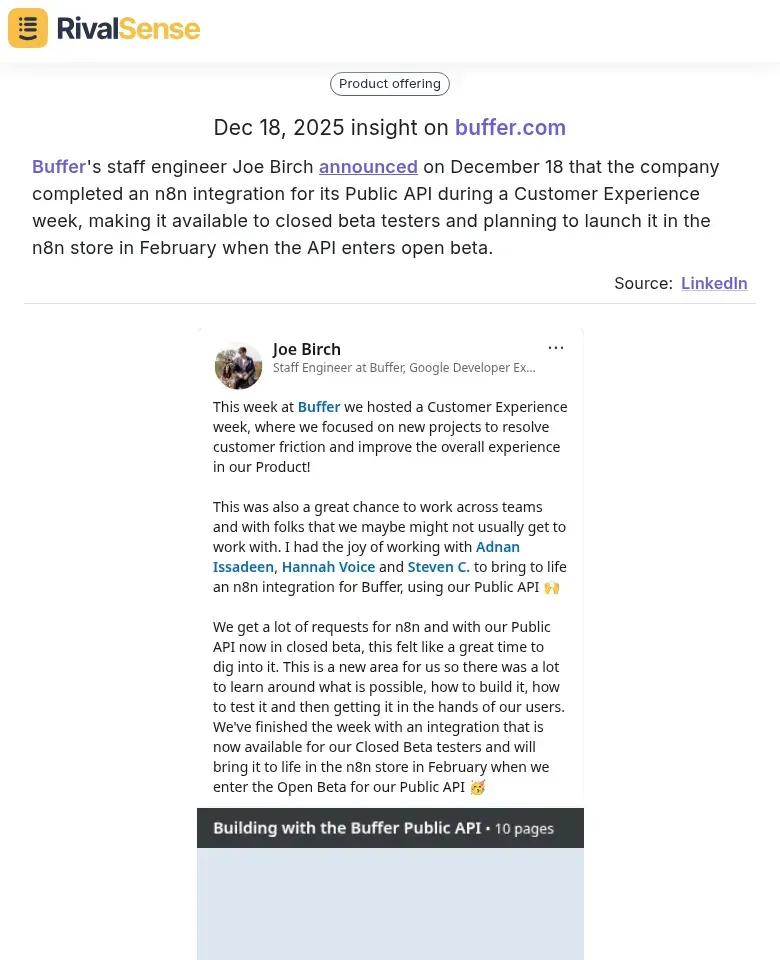
Monitor new API partnerships and developer tools to understand where competitors are expanding their reach. For example, RivalSense captured that Buffer's staff engineer Joe Birch announced on December 18 that the company completed an n8n integration for its Public API during a Customer Experience week. This integration is available to closed beta testers and plans to launch in the n8n store in February when the API enters open beta.
Why this insight is valuable: API integrations signal expansion into new workflows and partnerships, revealing strategic priorities. By tracking such moves, you can identify gaps in your own ecosystem and adjust your product roadmap or sales messaging to compete effectively.
Actionable tip: Set up alerts for competitor API documentation updates and GitHub repository activity to spot integration trends early.
2. Customer Loyalty & Retention Programs
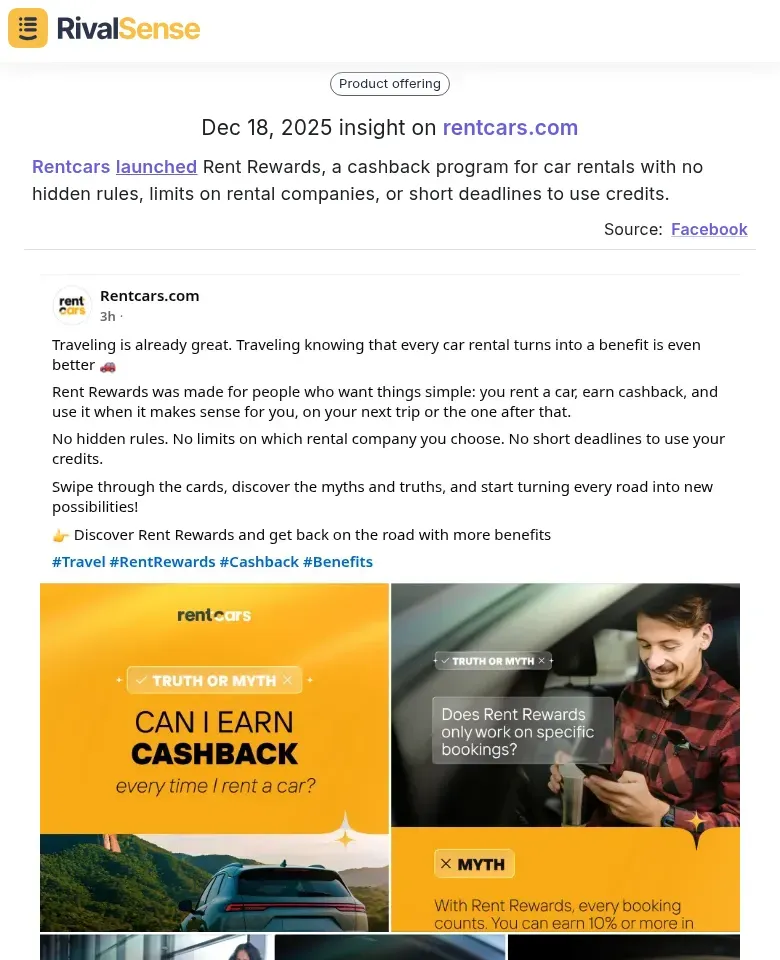
Loyalty initiatives provide insights into how competitors value and retain customers. RivalSense tracked that Rentcars launched Rent Rewards, a cashback program for car rentals with no hidden rules, limits on rental companies, or short deadlines to use credits.
Why this insight is valuable: Loyalty programs reveal retention strategies and customer perception of value. Monitoring these can help you design better retention offers and understand what drives repeat business in your industry.
Practical step: Analyze competitor loyalty program announcements and customer testimonials to understand what drives repeat business in your market.
3. Automation & AI Implementation
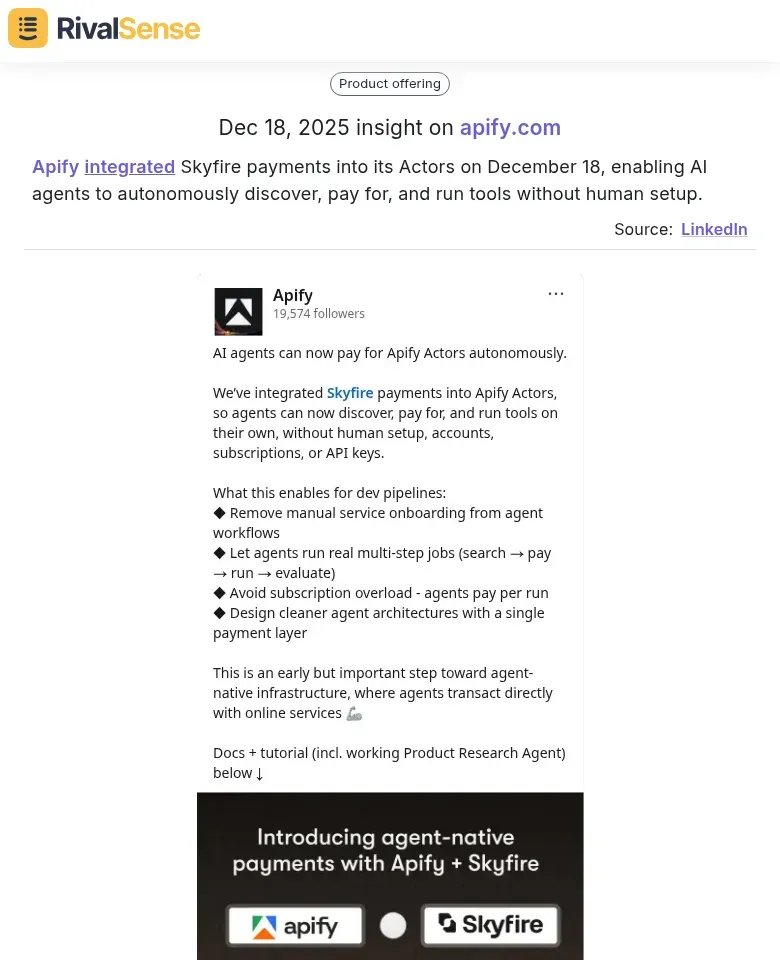
Observing AI adoption in competitor products indicates efficiency improvements and competitive advantages. For instance, Apify integrated Skyfire payments into its Actors on December 18, enabling AI agents to autonomously discover, pay for, and run tools without human setup.
Why this insight is valuable: Automation and AI features can significantly impact customer workflows and cost savings. Tracking these implementations helps you benchmark your own capabilities and highlight efficiency advantages in sales conversations.
Checklist item: Regularly review competitor product changelogs, blog posts about AI features, and job postings for AI/automation roles to gauge their tech roadmap.
Pro tip: Combine these signals with usage data to predict competitor moves and adjust your sales strategy proactively. Focus on signals that directly impact customer decision-making and retention.
From Product Insights to Sales Strategy: The Data Connection
The bridge between product insights and sales strategy is built on competitor data. By systematically analyzing this data, you can identify opportunities and threats that inform your sales approach.
Start by analyzing competitor feature gaps to identify underserved customer segments. For example, if competitors lack integrations your target customers need, you've found a sales wedge. Create a checklist: 1) Map all competitor features, 2) Identify missing capabilities, 3) Validate with customer interviews.
Next, use competitor pricing and value propositions to refine your sales positioning. Track how competitors price similar features and what benefits they emphasize. If they position as "budget-friendly," you can counter with "premium support" positioning. Practical tip: Create a value matrix comparing your solution against competitors on key dimensions.
Finally, leverage competitor release timing to optimize sales campaigns. Monitor when competitors launch major updates or new products. Schedule your outreach campaigns 2-3 weeks before their releases to capture attention, or immediately after to highlight gaps. Track their announcement patterns and align your sales pushes accordingly. This data-driven approach turns competitive intelligence into concrete sales advantages.
Building a Systematic Competitor Product Tracking Framework
Building a systematic competitor product tracking framework requires moving beyond sporadic monitoring to structured intelligence gathering. Establishing clear processes ensures that insights are consistently captured and acted upon.
Start by establishing key metrics that reveal true market impact: track competitor product adoption rates through app store downloads, user review volume trends, and social media mentions. Monitor market share shifts using third-party analytics tools and customer win/loss data.
Create automated alerts for competitor announcements that directly affect your sales pipeline. Set up Google Alerts for product launches, pricing changes, and feature updates. Use social listening tools to catch early signals of new capabilities. Integrate these alerts into your CRM so sales teams receive real-time notifications when prospects mention competitor features.
Develop competitive response protocols with clear escalation paths. Create a decision matrix categorizing threats by impact and urgency. For minor feature gaps, empower product teams with quick-win solutions. For major competitive advantages, trigger cross-functional war rooms involving product, marketing, and sales leadership. Document response templates for common scenarios like price changes or feature parity announcements.
Practical checklist:
- Define 3-5 core competitor product metrics
- Set up automated alerts for key competitor domains
- Create response protocol documentation
- Schedule quarterly competitive intelligence reviews
- Train sales teams on using product intelligence in deals
Case Studies: Turning Competitor Insights into Sales Wins
Real-world examples demonstrate how competitor insights can be leveraged for sales success. By learning from these cases, you can apply similar strategies in your own business.
Integration Announcements = Partnership Opportunities
When a competitor announces a new integration, sales teams can immediately identify partnership gaps. For example, if Competitor X integrates with Salesforce but not HubSpot, your sales team can target HubSpot users with your superior integration capabilities. Actionable Checklist:
- Monitor competitor integration announcements weekly
- Map their integration partners vs. your own
- Identify gaps where you have stronger partnerships
- Create targeted sales plays for those specific customer segments
Loyalty Program Analysis for Retention Wins
A SaaS company analyzed a competitor's tiered loyalty program and discovered customers churned after 12 months due to diminishing rewards. They developed a superior retention strategy with escalating benefits and saw 35% lower churn. Practical Steps:
- Analyze competitor loyalty program structures and reward schedules
- Identify pain points in their customer journey
- Develop counter-offers that address those specific weaknesses
- Test retention offers with at-risk customers
Automation Feature Gaps = Efficiency Advantages
When a competitor launched limited automation features, one B2B company identified they could automate 3x more workflows. Sales teams used this as a key differentiator, winning deals by highlighting the 40+ hours/month saved. Implementation Tips:
• Track competitor automation feature releases
• Benchmark your automation capabilities against theirs
• Quantify time/cost savings for prospects
• Create battlecards showing side-by-side efficiency comparisons
Key Takeaway: Systematic competitor tracking transforms insights into actionable sales advantages. The most successful teams don't just monitor competitors—they actively convert intelligence into targeted sales plays that address specific customer pain points revealed through competitor analysis.
Implementing Your Data-Driven Competitor Tracking System
Implementing a data-driven competitor tracking system requires strategic tool selection and seamless integration. Choosing the right tools and processes ensures that insights are effectively utilized.
Start by choosing tools that offer real-time monitoring of competitor product launches, pricing changes, and feature updates. Look for platforms with automated alerts, historical data analysis, and customizable dashboards.
Integrate these insights directly into your CRM and sales enablement systems. Create custom fields in Salesforce or HubSpot to track competitor mentions, win/loss reasons, and competitive positioning. Develop battle cards and objection-handling scripts that sales teams can access during customer conversations.
Establish feedback loops by implementing a structured process: 1) Sales teams log competitor encounters in CRM, 2) Competitive intelligence analyzes patterns weekly, 3) Insights are shared in sales meetings, 4) Updated strategies are deployed. Use automated reporting to track competitor win rates against your offerings.
Practical checklist:
• Set up automated alerts for competitor product announcements
• Create CRM integration for competitor data capture
• Schedule weekly competitive intelligence reviews
• Develop quarterly competitor strategy updates
• Train sales teams on using competitive insights
Tip: Start with 2-3 key competitors and expand as your system matures. Focus on actionable insights that directly impact sales conversations and deal closures.
Conclusion: Enhance Your Strategy with RivalSense
To efficiently track competitor product launches, pricing updates, event participations, partnerships, regulatory aspects, management changes, and media mentions across company websites, social media, and various registries, consider using a dedicated tool like RivalSense. It delivers all these insights in a weekly email report, saving you time and ensuring you never miss a critical move.
By leveraging RivalSense, you can transform competitor data into strategic sales wins. Get your first competitor report today and start making data-driven decisions.
📚 Read more
👉 Real-World Competitor Analysis: Insights and Actionable Strategies
👉 The Strategic Benefits of Real-Time Competitor Alerts: A Practical Guide for Business Leaders
👉 Commercial Laundry Services: Key Account Sentiment Tracking Checklist
👉 How Perplexity's iPad Move Prompted Rivals to Accelerate Mobile Strategy
👉 Data-Driven LinkedIn Competitor Insights for Key Account Tracking