
Data-Driven Competitor Intelligence: Key Account Success Strategies
In today's hyper-competitive B2B landscape, competitor intelligence has evolved from optional monitoring to essential strategic intelligence for key account management. Real-time data from sources like Facebook, industry news, and regulatory filings reveals competitor strategic shifts—new product launches, pricing changes, or targeted campaigns—before they formally reach your accounts, giving you a critical window to respond proactively.
This intelligence directly impacts account retention and growth. By tracking competitors' engagements and announcements, you can identify potential threats early and reinforce your value proposition. For example, if a competitor launches a campaign targeting your client's industry, you can immediately address concerns and showcase your superior solution.
Practical steps to leverage competitor insights:
- Monitor competitors' public channels for announcements, content strategy shifts, and engagement patterns
- Track competitor interactions with your key accounts' pages
- Set up alerts for competitor mentions of your clients' industries or pain points
- Analyze competitor ad strategies targeting similar audiences
- Use insights to anticipate competitor outreach and prepare counter-messaging
This data-driven approach transforms reactive account management into proactive relationship building, ensuring you stay ahead of competitive threats while identifying new growth opportunities within your most valuable accounts.
Learning from Product Launch Patterns: Sustainable Innovation and Market Positioning
Analyzing competitor product launches reveals strategic positioning beyond mere features. By tracking how competitors introduce new offerings, you can decode their market priorities and innovation cycles. For instance, sustainable initiatives like eco-friendly materials or carbon-neutral programs signal long-term value to enterprise clients.
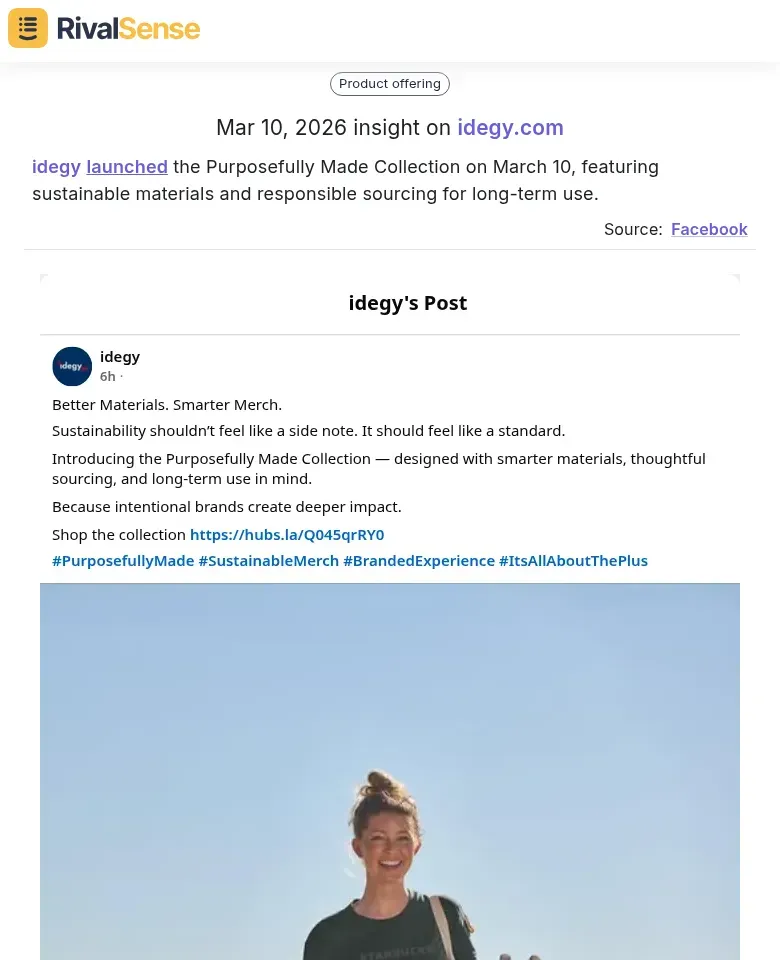
Tracking product launches is valuable for business strategy because it helps you anticipate market trends and identify gaps in your own offerings. For example, RivalSense recently captured this insight: idegy launched the Purposefully Made Collection on March 10, featuring sustainable materials and responsible sourcing for long-term use. This shows how competitors are leveraging sustainability to attract environmentally-conscious clients, allowing you to adjust your value propositions accordingly.
Practical Checklist:
✅ Monitor launch frequency and messaging evolution
✅ Track customer reactions to gauge market readiness
✅ Document how competitors position sustainability vs. performance
✅ Identify gaps in your key account value propositions
Key Insight: Competitors use feature bundling to create "sticky" enterprise solutions. When they announce AI-powered sustainability dashboards or carbon tracking integrations, they're targeting specific client pain points. Use tools like Facebook's Ad Library to see which audience segments receive these messages.
Action Steps:
- Create a launch tracking spreadsheet with columns for announcement date, sustainability claims, target industries, and engagement metrics
- Set up alerts for competitor sustainability announcements
- Compare your key account offerings against competitor bundles
- Identify 2-3 sustainability features missing from your enterprise packages
💡 Pro Tip: When competitors launch "green" initiatives, analyze comment sentiment. Positive reactions indicate market demand you can address with enhanced value propositions for environmentally-conscious key accounts.
Decoding Recognition and Awards: Leveraging Third-Party Validation for Account Credibility
Third-party validation through awards and recognition serves as powerful social proof for enterprise clients. Understanding which accolades resonate most can enhance your credibility and differentiate your offerings. Analyzing competitors' award patterns helps identify industry standards and client priorities, such as innovation or customer satisfaction.
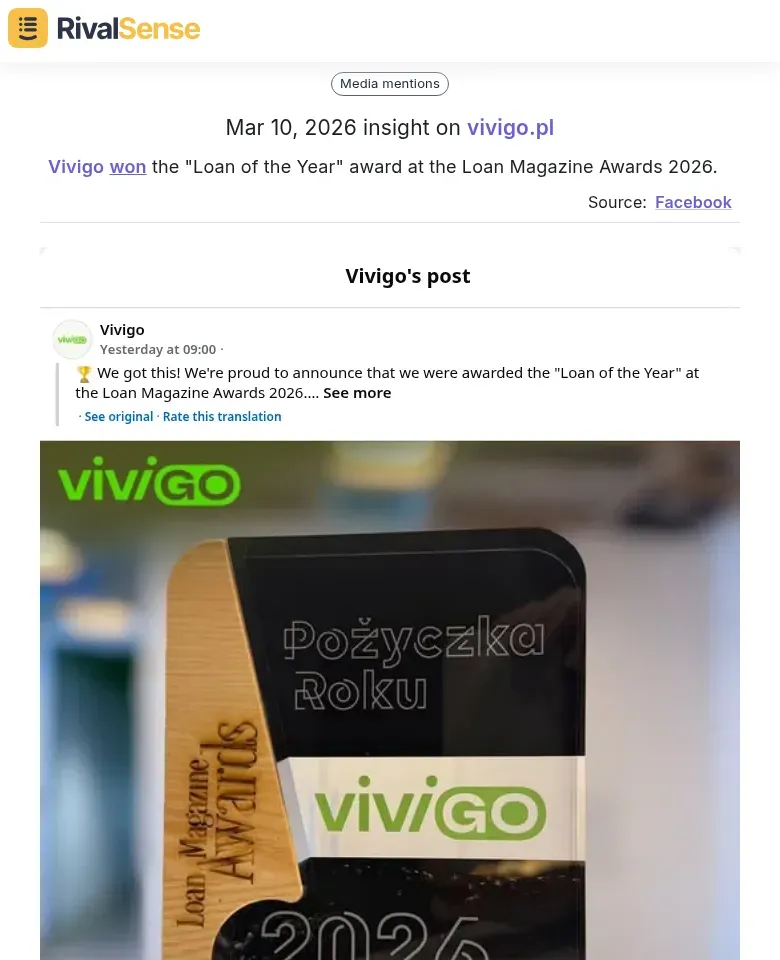
Monitoring awards is valuable for business strategy because it reveals what enterprise clients value and allows you to benchmark your successes. For instance, RivalSense tracked that Vivigo won the "Loan of the Year" award at the Loan Magazine Awards 2026. This insight highlights how competitors use awards to build trust and attract key accounts in competitive sectors.
Practical Checklist for Leveraging Recognition:
- Monitor Competitor Awards: Use tools like RivalSense to track which awards your competitors win and how they promote them
- Identify Industry Standards: Note recurring award categories—these reveal what enterprise clients value (innovation, customer satisfaction, growth)
- Position Your Successes: Frame key account wins using award criteria language (e.g., "Our enterprise implementation achieved 95% user adoption—exceeding industry benchmarks recognized by G2")
- Build Award Submissions: Document measurable outcomes from key accounts (ROI metrics, adoption rates, client testimonials) using competitor award submissions as templates
- Display Strategically: Feature relevant awards on enterprise sales collateral, case studies, and proposal templates
Key Insight: Only 0.6% of vendors win G2 awards—making such recognition exceptionally valuable. Competitors like Salesforce secure 30+ award inclusions annually, demonstrating how systematic award pursuit builds enterprise credibility. Use competitor recognition patterns to identify which third-party validations will resonate most with your target accounts.
Analyzing Thought Leadership and Industry Engagement Strategies
Analyzing how competitors leverage speaking engagements and industry forums reveals powerful authority-building strategies. Tracking their participation in events and conferences helps identify emerging market conversations and networking opportunities. Competitors use these platforms to establish credibility, connect with potential enterprise clients, and position their executives as subject matter experts.
Insights into industry engagement are valuable for business strategy because they allow you to anticipate trends and position your own thought leadership effectively. For example, RivalSense reported that Autodesk hosts the Design India Forward Forum on March 12, 2026, in Kochi, featuring Amit Joseph, Associate Director-Engineering at RDS Realties, as a speaker. This shows how competitors use events to engage specific regional markets and showcase expertise.

Practical steps for your thought leadership strategy:
- Monitor competitor speaking schedules using event tracking tools
- Analyze their presentation topics to identify market trends
- Identify gaps where your expertise can provide unique value
- Target events where your ideal clients are present
- Develop proprietary frameworks or methodologies to differentiate your message
Position your subject matter experts by creating authentic content that addresses industry pain points, securing speaking slots at relevant events, and engaging in industry discussions. Focus on providing actionable insights rather than promotional messaging. Measure impact through speaking invitations, media mentions, and audience engagement metrics to refine your approach continuously.
Building Data-Driven Response Playbooks for Key Account Protection
Transforming competitor insights into systematic account protection frameworks is crucial for defending your most valuable clients. Start by creating a 3-tier response system: 1) Immediate action templates for urgent threats, 2) Strategic response frameworks for market shifts, and 3) Proactive positioning guides for anticipated competitor moves.
This proactive approach ensures you're never caught off guard by competitor actions. By having pre-approved responses, you can swiftly address threats and reinforce your value proposition to key accounts.
Develop pre-approved response templates for common scenarios:
• Price Change Response: Include value reinforcement messaging, ROI calculators, and tiered discount authorization levels
• Product Launch Counter: Create feature comparison matrices, migration path guides, and customer success story banks
• Market Move Strategy: Build territory defense playbooks, partnership response frameworks, and executive briefing templates
Practical Implementation Checklist:
✓ Map competitor triggers to specific account segments
✓ Create escalation protocols with approval thresholds
✓ Develop measurement dashboards tracking response effectiveness
✓ Establish monthly playbook review cadences
✓ Train account teams on template usage and customization
Measurement Framework: Track competitor intelligence impact through 3 key metrics: 1) Account retention rate post-response, 2) Expansion revenue in defended accounts, 3) Competitive win rate improvement. Use tools like RivalSense competitor tracking to correlate market moves with account outcomes, creating a feedback loop that continuously refines your response strategies.
Implementation Framework: From Insights to Account Growth
Transform competitor insights into tangible account growth with this three-step implementation framework. By systematizing your intelligence gathering and response mechanisms, you can ensure consistent application across your organization.
-
Automated Monitoring Systems: Set up real-time alerts for competitor campaigns, content strategies, and engagement metrics. Use tools like RivalSense to track competitor targeting, ad spend fluctuations, and audience reactions. Create a dashboard showing competitor share-of-voice, engagement rates, and campaign frequency. 💡 Pro tip: Set alerts for competitor product launches or pricing changes that could impact your key accounts.
-
Quarterly Integration Process: During account planning cycles, review competitor intelligence reports alongside account performance data. Identify gaps where competitors are outperforming you with similar accounts. Create action plans to counter competitor strengths and exploit their weaknesses. Checklist: Analyze competitor messaging, identify underserved audience segments, benchmark your performance against theirs.
-
Cross-Functional Collaboration: Establish a weekly sync between sales, marketing, and account teams to share competitor insights. Marketing provides intelligence on competitor campaigns, sales reports on competitive objections heard in the field, and account management shares client feedback about competitor offerings. Actionable step: Create a shared competitive intelligence repository accessible to all teams, with clear protocols for updating and acting on new information.
Take Action with Competitor Intelligence
Leveraging competitor insights is no longer optional—it's a strategic imperative for protecting and growing your key accounts. By monitoring product launches, awards, industry engagements, and more, you can stay ahead of threats and seize opportunities.
To streamline this process, consider using a dedicated tool like RivalSense. It tracks competitor product launches, pricing updates, event participations, partnerships, regulatory aspects, management changes, and media mentions across company websites, social media, and various registries, delivering all in a weekly email report.
Ready to transform your competitor intelligence? Try out RivalSense for free at https://rivalsense.co/ to assist with the challenges described in this post. Get your first competitor report today and start making data-driven decisions for your key accounts!
📚 Read more
👉 AI-Driven Productivity for Digital Identity Companies: A Guide for Business Leaders
👉 Avoid These 5 Competitor Product Offering Mistakes That Drive Customer Churn
👉 Bright Data Shifts from Crawling to Live Discovery: A Competitor Analysis Case Study
👉 Key Account Tracking Integration: A Complete Guide for B2B Success in 2026
👉 2026 Brand Sentiment Analysis for Management Consulting Competitors