
Competitor Website Changes Cheat Sheet for Key Account Managers
In today's competitive B2B landscape, staying ahead requires more than just monitoring your own performance; it demands deep insight into your competitors' moves. Competitor websites are living documents that reveal strategic intentions long before official announcements. For key account managers, these digital footprints provide early warning signals about market priorities, competitive moves, and emerging threats. When a competitor quietly adds a new case study targeting your top client's industry or restructures pricing tiers, these changes telegraph their strategic direction months before sales teams knock on doors.
Practical monitoring starts with automated alerts for critical pages: pricing sections, product features, case studies mentioning your clients' industries, and leadership team updates. Set up tiered monitoring—Tier 1 for direct competitors of your top 5 accounts, Tier 2 for emerging threats. Create a simple checklist: document baseline pricing, track feature migrations between tiers, analyze timing patterns, and update competitive battle cards within 24 hours of detected changes.
Proactive website intelligence transforms reactive tracking into competitive advantage. When you spot a competitor removing a key feature, you can immediately target their dissatisfied customers. When they launch new locations, you can anticipate market expansion and reinforce your local expertise. This systematic approach turns digital footprint analysis into a weapon for key account retention, ensuring you're always one step ahead in protecting your most valuable relationships.
Decoding Product Strategy Shifts Through Feature and Content Updates
Product updates are clear indicators of where competitors are investing their resources. By systematically tracking these changes, you can anticipate market trends and adjust your strategy accordingly. When competitors announce new features, they're revealing their evolving value propositions and responding to market demands.
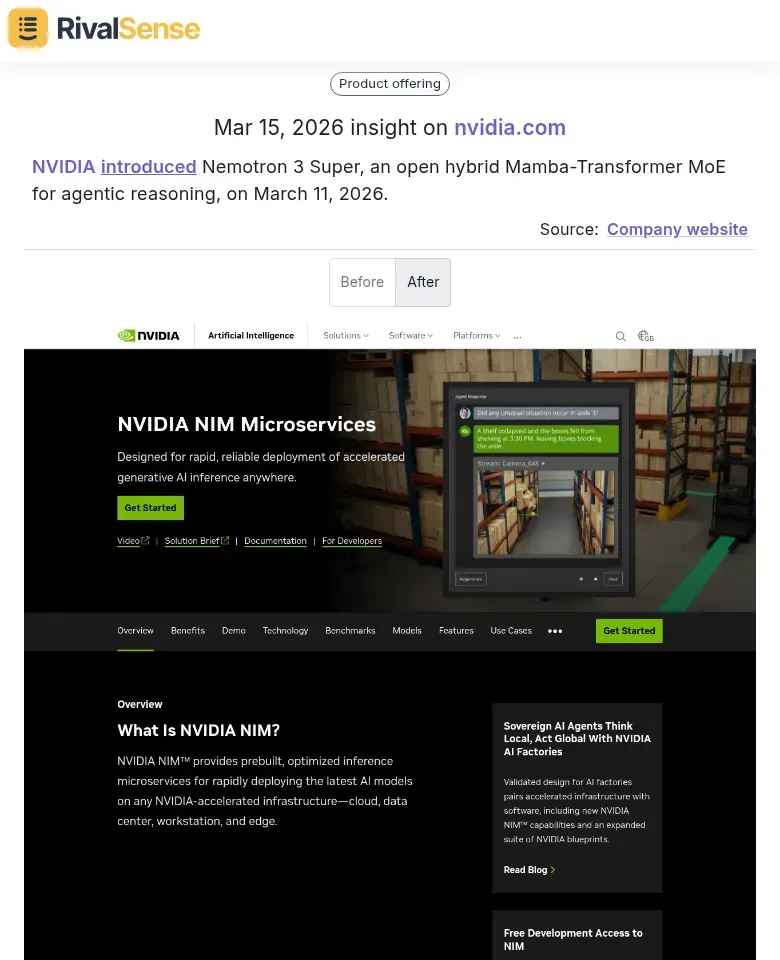
For example, RivalSense recently tracked that NVIDIA introduced Nemotron 3 Super, an open hybrid Mamba-Transformer MoE for agentic reasoning, on March 11, 2026. This type of product launch insight is valuable for business strategy as it reveals a competitor's focus on cutting-edge AI technologies, signaling potential market shifts and innovation priorities.
Track these announcements systematically: create a spreadsheet logging each feature, its launch date, target audience, and pricing implications. Look beyond the obvious—analyze what problems these features solve and which customer segments they address. For example, if a competitor adds AI-powered analytics, they're likely targeting data-driven enterprises seeking automation.
Website restructuring often signals product line expansions or contractions. Monitor navigation changes, new product categories, or removed sections. Set up automated alerts for competitor homepage and product page updates. When you see new product categories, ask: Are they entering adjacent markets? Are they consolidating offerings? This reveals strategic pivots before official announcements.
Case study updates are goldmines for identifying targeted enterprise segments. Create a quarterly review checklist: 1) Document new case studies by industry vertical, 2) Note company size and use cases mentioned, 3) Track testimonials from specific roles (CIOs vs. department heads). If competitors suddenly feature multiple healthcare case studies, they're likely doubling down on that vertical. Use this intelligence to anticipate competitive moves in your key accounts.
Uncovering Partnership and Integration Strategies from Website Updates
Partnerships and integrations are key drivers of ecosystem growth. Monitoring website updates in this area can uncover strategic alliances before they become public. Your competitors' website changes reveal their ecosystem expansion strategies before they're officially announced.
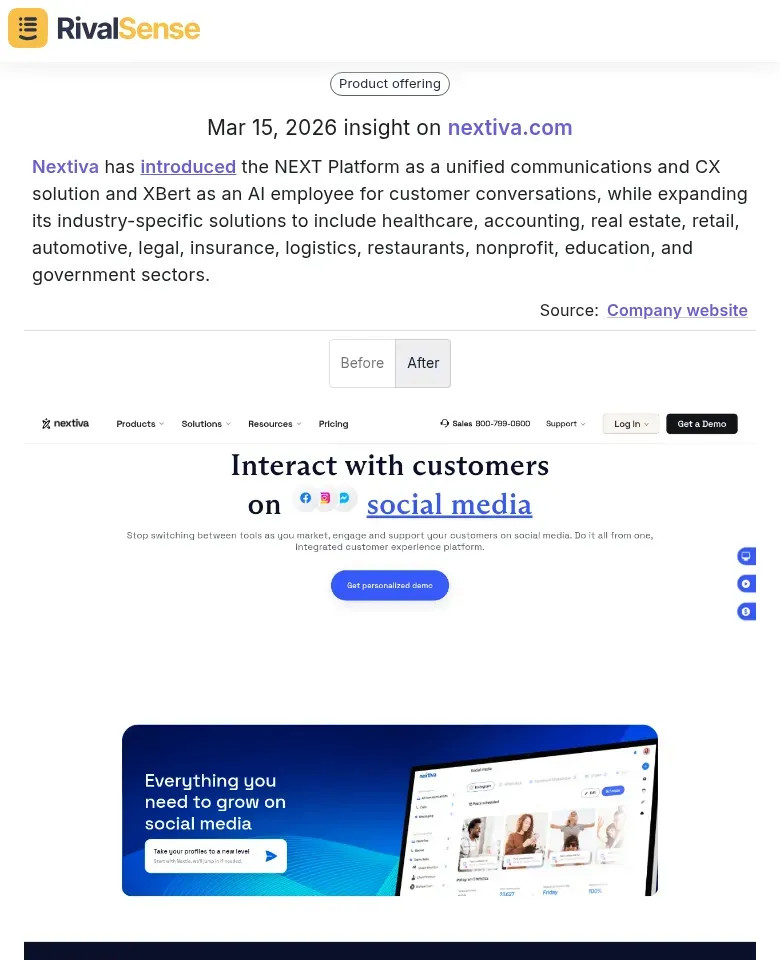
RivalSense captured that Nextiva introduced the NEXT Platform as a unified communications and CX solution and XBert as an AI employee for customer conversations, while expanding its industry-specific solutions to include healthcare, accounting, real estate, retail, automotive, legal, insurance, logistics, restaurants, nonprofit, education, and government sectors. This insight is valuable for business strategy as it shows how competitors are diversifying their offerings and targeting specific industries, which can inform your own market expansion plans.
Monitor integration announcements and API documentation updates—these signal platform plays and developer adoption strategies. When you see new API endpoints or developer portal launches, expect integration partnerships within 1-3 months.
Practical Checklist: ✅
- Set up automated monitoring for competitor integration directories (AppExchange, HubSpot Marketplace, Slack App Directory)
- Track API changelogs and documentation updates for infrastructure changes
- Create alerts for new partner logos and bundled service offerings
- Analyze integration velocity changes—sudden spikes indicate market response
Analyze new partner logos and bundled offerings to understand revenue diversification. When competitors add payment processors, CRMs, or industry-specific tools, they're targeting new customer segments. Track which categories they prioritize—this reveals their go-to-market strategy.
Industry-specific integrations expose vertical expansion. Watch for regional compliance features, currency options, or language support—these signal geographic expansion. Security feature sprints (SSO, audit logs) indicate enterprise targeting.
Pro Tip: Use AI filtering to categorize integrations by relevance—high priority (direct competition), medium (co-sell potential), low (reference only). Focus partnership team efforts on high-priority alerts while logging others for monthly review.
Extracting Pricing and Monetization Insights from Website Changes
Pricing changes often reflect broader market strategies and customer segmentation efforts. By analyzing these updates, you can gauge competitive pressures and monetization trends. Pricing page updates reveal market segmentation strategies. When competitors add new tiers or restructure plans, they're targeting specific customer segments.
Practical tip: Create a spreadsheet tracking feature changes across pricing tiers monthly. Look for patterns—are they adding enterprise features to mid-tier plans? This signals expansion into new markets.
Affiliate program commission changes indicate growth priorities. A sudden increase in commissions for specific products shows where competitors are focusing acquisition efforts. Checklist: Monitor commission rates quarterly, track new affiliate program announcements, and note seasonal commission adjustments. Higher commissions on annual plans suggest they're prioritizing customer retention.
Timing of pricing adjustments predicts market moves. Competitors often adjust prices before major industry events or product launches. Actionable step: Log all competitor pricing changes with dates. Cross-reference with industry events, product launches, and economic indicators. If multiple competitors raise prices simultaneously, anticipate broader market shifts. Set up alerts for pricing page changes to respond within 24-48 hours.
Key insight: Price increases often precede feature additions, while price decreases may signal upcoming competitive responses. Analyze the gap between pricing changes and feature announcements to anticipate their strategic timeline.
Building a Systematic Monitoring Framework for Key Account Intelligence
A structured approach to competitor monitoring ensures that no critical change goes unnoticed. Implementing automated tools and processes turns data into actionable intelligence. Building a systematic monitoring framework transforms competitor website tracking from reactive to strategic.
For instance, RivalSense detected that Canva has added audio transcription capabilities to its AI voice generator, enabling users to convert spoken content into written text. Monitoring such feature updates is valuable for business strategy as it highlights how competitors are enhancing user experience and addressing specific customer needs, which can prompt timely responses in your product roadmap.
Start with a comprehensive checklist of key elements to monitor: pricing pages (tier changes, promotions), product/feature pages (new capabilities, deprecations), homepage messaging (positioning shifts), careers pages (hiring patterns), and news/blog sections (announcements). Use tools like RivalSense to automate monitoring with keyword filters that alert only on substantive changes.
Set up automated alerts for critical changes: configure real-time notifications for pricing adjustments, daily alerts for product updates, and weekly digests for content changes. Route alerts strategically—pricing changes to sales teams, feature updates to product managers, messaging shifts to marketing. Create escalation protocols: email for minor changes, Slack/SMS for urgent competitive moves.
Develop structured processes to translate observations into account strategies: maintain a competitive intelligence log, update battlecards within 24 hours of significant changes, and conduct weekly review sessions. When a competitor launches new enterprise features, immediately assess impact on your key accounts and develop counter-messaging. If hiring patterns indicate market expansion, adjust account penetration strategies. This systematic approach ensures competitor intelligence directly informs account planning and execution.
Turning Competitor Insights into Key Account Success: Actionable Strategies
Transforming competitor website changes into key account wins requires deliberate and actionable steps. By leveraging insights effectively, you can strengthen relationships and secure competitive advantages. Here are practical strategies to implement:
Proactive Counter-Strategies Checklist: ✅
- Monitor competitor pricing changes weekly using automated tools like RivalSense
- When competitors lower prices, develop value-based counter-offers highlighting superior ROI
- Create "competitive response playbooks" for your team with pre-approved discounts and feature bundles
- Track feature launches and prepare comparison matrices showing your unique advantages
Product Roadmap Alignment Steps:
- Conduct quarterly competitor gap analysis focusing on missing features and user pain points
- Prioritize development based on competitor weaknesses that align with your key accounts' needs
- Create "competitive advantage roadmap" showing how you'll address gaps within 90-180 days
- Share roadmap previews with key accounts to demonstrate proactive innovation
Enhanced Value Proposition Framework:
- Map competitor user experience gaps to your superior solutions
- Develop case studies showing how your unique features solve specific key account challenges
- Create comparison calculators that quantify your solution's ROI advantage
- Implement quarterly value reviews with key accounts highlighting your differentiators
Practical Implementation Tips: ✅
- Set up automated alerts for competitor website changes affecting your top 5 accounts
- Schedule monthly competitive intelligence briefings with your account teams
- Create competitor response templates for common pricing and feature scenarios
- Track win/loss data to refine your competitive positioning continuously
By systematically converting competitor insights into strategic actions, you'll strengthen key account relationships and create sustainable competitive advantages.
Take Action with Automated Competitor Intelligence
To effectively implement the strategies outlined above, consider leveraging automated competitor intelligence tools. RivalSense tracks competitor product launches/updates, pricing updates, event participations, partnerships, regulatory aspects, management changes, and media mentions across company websites, social media, and various registries, delivering all in a weekly email report. Try out RivalSense for free at https://rivalsense.co/ to assist with the challenges described in this post, and get your first competitor report today.
📚 Read more
👉 Step-by-Step Guide to Tracking Competitor Partnerships in Public Transportation
👉 How to Conduct a Regulatory Competitor SWOT Analysis for Strategic Insights
👉 Decoding Competitor Moves: Lessons from Sennheiser's Audio Update
👉 The Ultimate Guide to Tracking Key Client Activity: Software Solutions & Strategic Insights for 2026
👉 Advanced Tactics: Track Competitor Sales for Supply Chain Optimization