
Competitor Website Changes: A Strategic Guide for Key Account Planning
Competitor website changes are more than cosmetic updates—they're early warning signals of strategic shifts that directly impact your key account planning. When competitors modify their digital footprint, they're revealing business priorities months before official announcements. These changes can indicate new target markets, product launches, or service expansions that threaten your key accounts.
For example, when a competitor adds case studies in a specific industry vertical or creates dedicated landing pages for enterprise clients, they're signaling where they're allocating resources. This digital intelligence allows you to proactively adjust your account strategies before competitors make inroads.
Practical steps for monitoring:
- 📍 Track homepage messaging changes weekly
- 📊 Monitor new service pages and case studies
- 💰 Analyze pricing page modifications
- 👥 Watch for new team member additions
- 🏆 Note changes in client testimonials or logos
By connecting website updates to your key account mapping, you can anticipate competitive moves, reinforce vulnerable accounts, and identify expansion opportunities before your competitors do.
Analyzing Product & Feature Launches for Market Positioning Insights
When competitors launch new products or features, it provides a window into their market positioning and strategic direction. These launches often respond to customer demands or competitive pressures, revealing where they see growth opportunities. By analyzing these changes, you can adapt your own offerings to stay ahead.
For instance, tracking feature rollouts helps you understand competitor priorities and customer segmentation. Let's look at a real-world example from RivalSense insights:
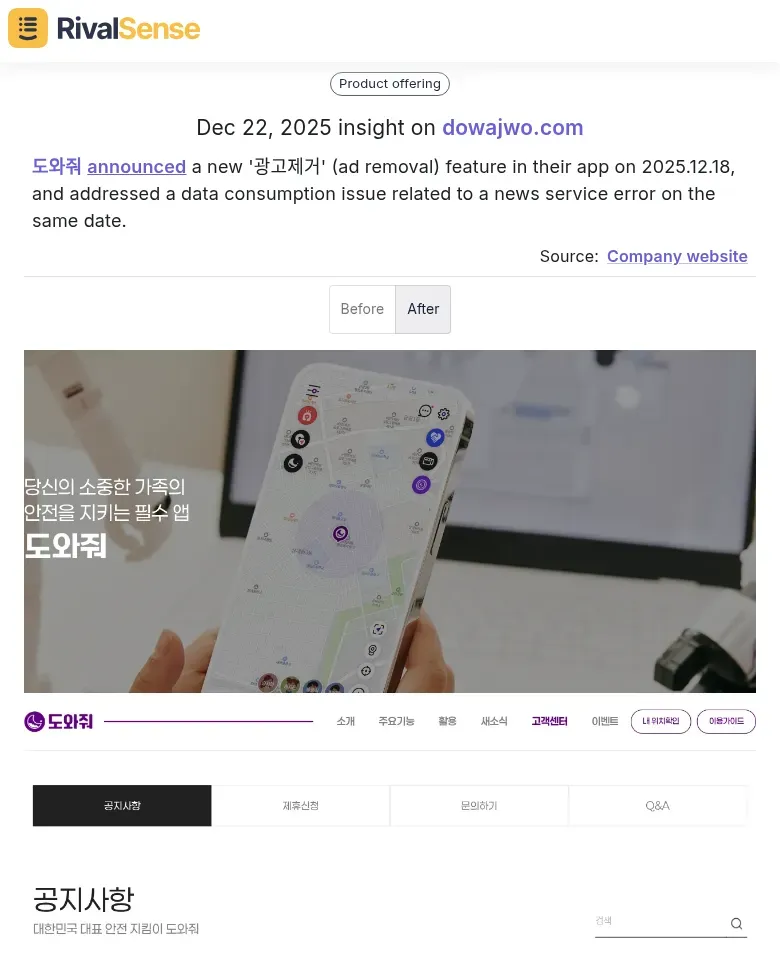
도와줘 announced a new '광고제거' (ad removal) feature in their app on 2025.12.18, and addressed a data consumption issue related to a news service error on the same date.
Why this insight is valuable: Monitoring such product updates helps you gauge competitor focus on user experience and problem-solving. If a competitor quickly addresses issues or adds popular features, it signals agility and customer-centricity, which you can benchmark against your own strategy.
Create a monitoring checklist:
- 🔄 Track release announcements, update logs, and changelogs weekly
- 🎯 Analyze feature descriptions for target customer language
- ⏰ Compare timing against industry events or your own launches
Learn from phased rollouts and regional launch strategies. Competitors often test features in specific markets before global release. Document their rollout patterns to anticipate their next moves.
Decoding Pricing, Terminology & Customer Experience Updates
Changes in pricing, account terminology, and customer support features are direct indicators of how competitors segment their market and prioritize customer experience. These updates can reveal shifts in value proposition or operational adjustments aimed at reducing churn. Understanding these signals helps you refine your own pricing and service models to better serve key accounts.
Consider this example from RivalSense:
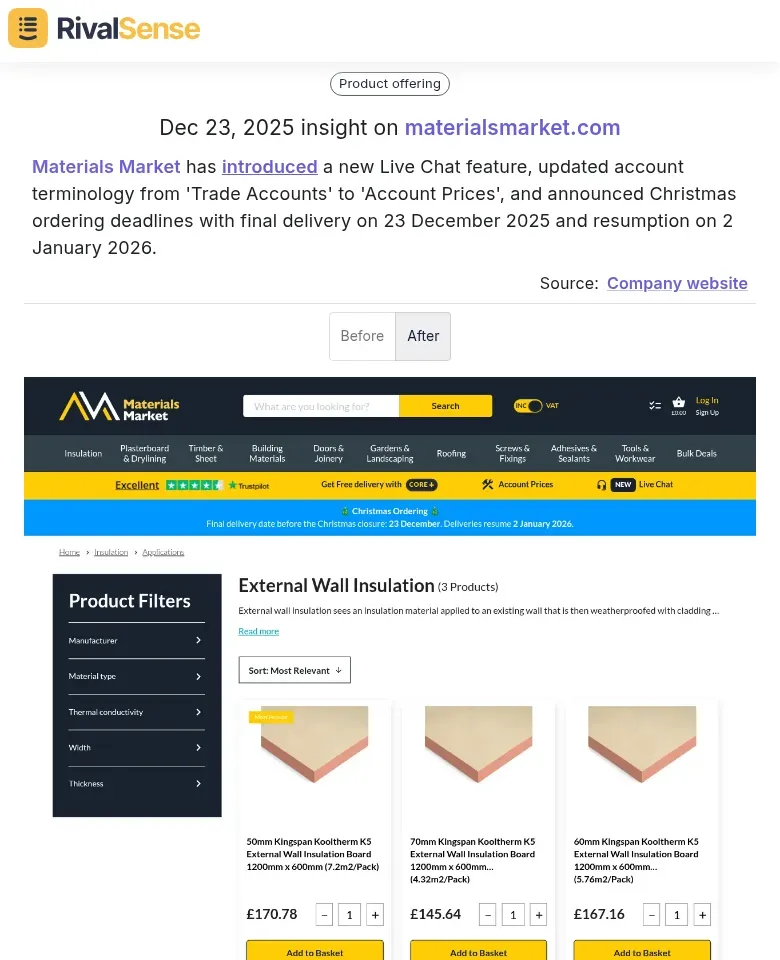
Materials Market has introduced a new Live Chat feature, updated account terminology from 'Trade Accounts' to 'Account Prices', and announced Christmas ordering deadlines with final delivery on 23 December 2025 and resumption on 2 January 2026.
Why this insight is valuable: Tracking terminology changes and support feature additions helps you understand competitor customer segmentation and service priorities. For instance, the shift from 'Trade Accounts' to 'Account Prices' might indicate a focus on transparency, while live chat additions signal improved customer engagement, which you can factor into your account planning.
Practical checklist for decoding updates:
- 💵 Document old vs new pricing pages and note terminology changes
- 🗓️ Monitor seasonal deadlines and operational changes quarterly
- 💬 Test live chat response times and analyze placement on the website
By correlating these areas, you gain actionable intelligence for enhancing your own customer experience strategy.
Tracking Geographic & Market Expansion Through Website Signals
Geographic expansion signals on competitor websites can unveil new market priorities and entry strategies. Localized content, regional events, and country-specific adaptations are clear indicators of where competitors are investing resources. Keeping an eye on these changes allows you to anticipate where they might compete for your key accounts and prepare accordingly.
Here's an insight from RivalSense that illustrates this:
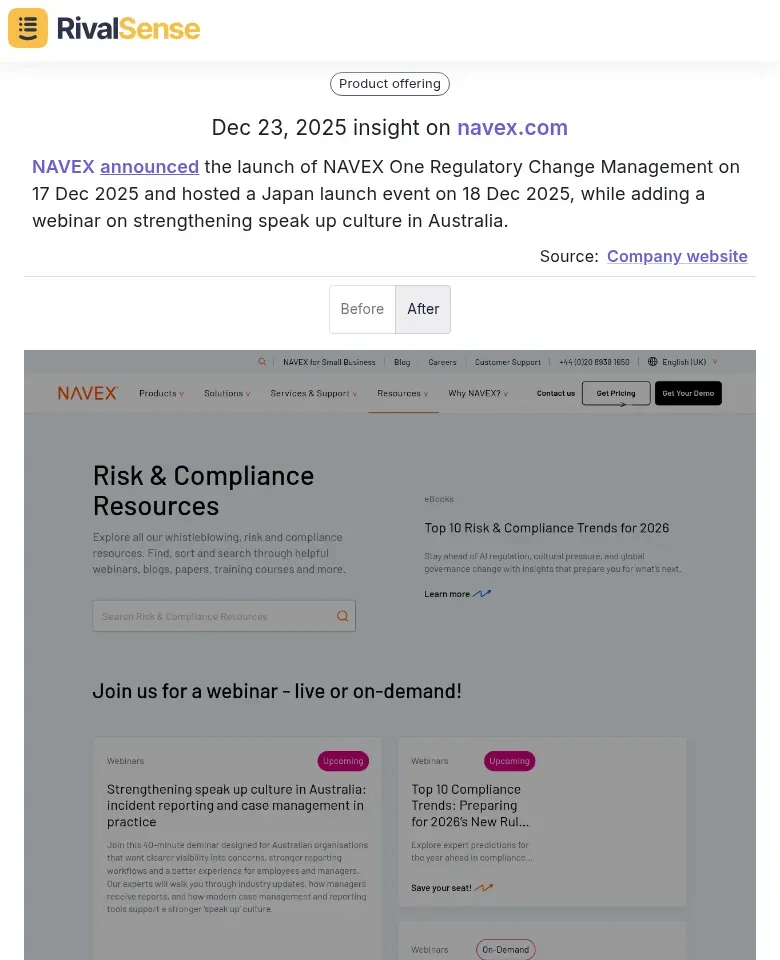
NAVEX announced the launch of NAVEX One Regulatory Change Management on 17 Dec 2025 and hosted a Japan launch event on 18 Dec 2025, while adding a webinar on strengthening speak up culture in Australia.
Why this insight is valuable: This type of insight shows how competitors orchestrate product launches with geographic targeting. The Japan event and Australia webinar indicate focused market penetration efforts, helping you anticipate where they might compete for key accounts in those regions.
Practical Checklist for Geographic Tracking:
- 🌐 Set up alerts for new country/language subdomains (e.g., .fr, .de, .co.uk)
- 📅 Track regional event calendars and webinar schedules by location
- 📝 Monitor localized content updates (case studies, testimonials, pricing)
- 👔 Analyze resource allocation through regional team hiring announcements
- 🚀 Identify phased market entry by observing feature rollouts by country
Key signals to watch include new localized landing pages, regional pricing structures, and partnership announcements in specific areas.
Monitoring Partnerships, Integrations & Ecosystem Developments
Partnerships and integrations are strategic moves that expand a competitor's ecosystem and enhance their value proposition. By monitoring these developments, you can identify alliances that might threaten your key accounts or reveal new market opportunities. These collaborations often signal deeper market penetration and customer retention strategies.
When competitors announce new integrations or co-host webinars, they're often targeting shared customer bases or addressing complementary needs. These actions can provide insights into their long-term business goals and competitive positioning.
Practical Checklist:
- 🤝 Set up Google Alerts for competitor names + "partnership" or "integration"
- 🔌 Monitor integration marketplaces like Zapier, Salesforce AppExchange
- 📰 Review competitor blog posts and press releases weekly
- 🎤 Track webinar collaborations and note target audiences
- 📊 Analyze joint event strategies for market penetration patterns
Ecosystem developments, such as API updates or developer community growth, show how competitors are building retention strategies. By staying informed, you can anticipate shifts in the competitive landscape.
Actionable Framework: Turning Website Intelligence into Key Account Strategy
Transform competitor website intelligence into strategic advantage with this actionable framework. Start by developing systematic monitoring checklists for different change categories, and integrate insights into your account planning cycles. This proactive approach ensures you're always one step ahead in safeguarding and growing your key accounts.
Systematic Monitoring Categories:
- Product/Service Updates: Track new features, pricing changes, and service bundles
- Content Strategy: Monitor new case studies, whitepapers, and thought leadership content
- Positioning Changes: Watch for messaging shifts, value proposition updates, and target audience adjustments
- Technical Updates: Note website redesigns, UX improvements, and new integrations
Response Frameworks for Key Accounts:
- Defensive Moves: When competitors add features you already offer, reinforce your unique value proposition and share relevant case studies.
- Offensive Moves: For new competitor offerings, analyze gaps and develop targeted counter-messaging.
- Pricing Changes: Adjust your value demonstration and ROI calculations accordingly.
Integrate into Planning Cycles:
- 🔄 Review competitor changes during quarterly account strategy sessions
- 🗺️ Map competitor moves against your account's specific pain points
- 📄 Update battle cards and objection handling guides monthly
- 👥 Share insights with sales teams in weekly tactical meetings
Pro Tip: Create a simple scoring system (1-5) for competitor changes based on threat level and urgency to prioritize responses effectively.
Conclusion: Stay Ahead with Continuous Monitoring
Consistently tracking competitor website changes is crucial for proactive key account planning. By leveraging insights from product launches, pricing updates, geographic expansions, and partnerships, you can anticipate moves and safeguard your accounts. Implementing a structured monitoring system turns raw data into actionable business strategy.
To streamline this process, consider using a tool like RivalSense. It tracks competitor product launches, pricing updates, event participations, partnerships, regulatory aspects, management changes, and media mentions across company websites, social media, and various registries, delivering all in a weekly email report.
👉 Try RivalSense for free at https://rivalsense.co/ to get your first competitor report today and gain a competitive edge in your key account strategy.
📚 Read more
👉 AI Platform Competitive Intelligence: Decoding Advertising Strategies for Strategic Advantage
👉 Predictive Regulatory Intelligence: Anticipate Competitor Moves for Key Account Wins
👉 Turning Competitor Moves into Business Opportunities: A Guide to Management Change Analysis
👉 Key Account Management Webinar: Transforming Strategy with Competitive Intelligence
👉 Optimizing Telecom Infrastructure Key Account Task Tracking: A Strategic Process Guide