
Competitor SWOT Analysis: Your Actionable Guide to Strategic Advantage
In today's hyper-competitive business landscape, understanding your competitors isn't just helpful—it's essential for survival and growth. A competitor SWOT analysis (Strengths, Weaknesses, Opportunities, Threats) provides the strategic intelligence you need to make informed decisions, anticipate market shifts, and identify your competitive edge. As a founder, CEO, or business leader, you're constantly making decisions that could make or break your company, and this framework turns vague worries into clear action plans.
The problem? Most competitive analysis advice is either too theoretical or too simplistic. You need actionable steps, practical checklists, and real-world examples that deliver results. That's why we've distilled this process into a straightforward, five-step framework designed for busy executives who need to move fast.
The 5-Step Framework for Effective Competitor SWOT Analysis
Executing a competitor SWOT analysis doesn't have to be a cumbersome, quarterly ordeal. By following a structured approach, you can gain insights that directly influence your product roadmap, marketing campaigns, and sales strategies. This framework ensures you cover all bases, from identification to action, without getting lost in data. Let's dive into each step with practical tools and tips you can use immediately.
Step 1: Identify Your True Competitors
Start by casting a wide net to understand the full competitive landscape. Many businesses focus only on direct rivals, but indirect and emerging players can be just as disruptive. This step is about mapping the battlefield so you know who you're up against now and who might challenge you tomorrow.
Practical Checklist:
- Direct Competitors: Companies offering similar products/services to the same target market
- Indirect Competitors: Businesses solving the same customer problem with different solutions
- Aspirational Competitors: Market leaders you aim to emulate or disrupt
- Emerging Threats: Startups or adjacent market players who could pivot into your space
Pro Tip: Don't limit yourself to obvious competitors. Use tools like RivalSense to track not just direct competitors but also companies making strategic moves in adjacent markets that could impact your business.
Step 2: Gather Comprehensive Intelligence
Gathering intelligence is the backbone of any SWOT analysis. Without accurate, up-to-date data, your analysis will be based on assumptions rather than facts. This step involves collecting information from multiple sources to build a complete picture of each competitor's operations, market position, and future intentions.
Information Sources Checklist:
- Product Intelligence: Features, pricing, updates, roadmap signals
- Marketing Intelligence: Campaigns, content strategy, social media presence
- Operational Intelligence: Hiring patterns, partnerships, management changes
- Market Intelligence: Customer reviews, media mentions, regulatory changes
The Manual Approach:
- Visit competitor websites and analyze their product pages
- Subscribe to their newsletters and follow social media accounts
- Purchase their products/services for firsthand experience
- Monitor review sites and industry publications
The Efficient Approach: Tools like RivalSense automate competitor tracking across 80+ sources—from company websites and social media to regulatory registries—delivering weekly email reports with actionable intelligence. This saves hundreds of hours while ensuring you never miss critical competitor moves.
Step 3: Conduct the SWOT Analysis
Now, organize your intelligence into the four SWOT quadrants. This is where you translate raw data into strategic insights. Be objective and evidence-based; avoid letting biases cloud your judgment. Each quadrant should highlight factors that can directly influence your business decisions.
Practical Framework with Examples:
Strengths (Internal Positive Factors):
- Example: Competitor has strong brand recognition in enterprise segment
- How to identify: Analyze their customer testimonials, media coverage, and market share data
- Actionable insight: If they dominate enterprise, consider targeting SMBs where they're weaker
Weaknesses (Internal Negative Factors):
- Example: Poor customer service ratings on review sites
- How to identify: Monitor customer feedback platforms and social media complaints
- Actionable insight: Position your superior customer service as a key differentiator
Opportunities (External Positive Factors):
- Example: Emerging market trend they haven't capitalized on
- How to identify: Track industry publications and analyze their product roadmap
- Actionable insight: Be first to market with trend-aligned features
Threats (External Negative Factors):
- Example: Regulatory changes affecting their core product
- How to identify: Monitor government registries and industry compliance updates
- Actionable insight: Develop compliant alternatives before regulations impact them
Step 4: Analyze and Prioritize Findings
With your SWOT matrix filled, it's time to prioritize. Not all insights are equally important; some require immediate action, while others are long-term considerations. This step helps you focus resources on what matters most, avoiding the trap of analysis paralysis.
Prioritization Matrix:
- High Impact, High Urgency: Immediate competitive threats or opportunities
- High Impact, Low Urgency: Strategic advantages to develop over time
- Low Impact, High Urgency: Quick wins for tactical advantage
- Low Impact, Low Urgency: Monitor but don't allocate significant resources
Practical Exercise: Create a 2x2 matrix plotting competitor weaknesses against your strengths. Focus on areas where you're strong and they're weak—this is your competitive sweet spot.
Step 5: Take Strategic Action
The final step is turning insights into action. A SWOT analysis is useless if it sits in a report. Develop a clear, time-bound action plan that leverages your findings to outmaneuver competitors. This is where strategy meets execution, driving real business outcomes.
Action Plan Template:
- Short-term (0-3 months): Quick wins based on competitor vulnerabilities
- Medium-term (3-12 months): Strategic initiatives to build competitive advantages
- Long-term (12+ months): Market positioning and innovation roadmap
Example Implementation:
If analysis reveals competitors have slow product update cycles, implement a rapid iteration strategy. If they're weak in content marketing, double down on your content strategy to capture market mindshare.
Real-World Competitor Insights: How to Leverage Them in SWOT Analysis
Seeing concrete examples of competitor moves can illuminate how to apply SWOT in practice. Here are recent insights from RivalSense, showing how different types of intelligence feed into strategic analysis. Each example highlights why tracking such moves is valuable for refining your business strategy.
1. Product Expansion as an Opportunity or Threat:

PayPal expands PayPal USD to Arbitrum to make digital dollars usable at scale.
This product expansion into new blockchain networks signals a strategic push into web3 payments. For competitors in fintech, this could represent a threat if it captures market share, or an opportunity if it reveals unmet customer needs in scalability. Tracking product launches helps you anticipate market shifts and adjust your own roadmap.
2. Acquisitions for Strategic Advantage:
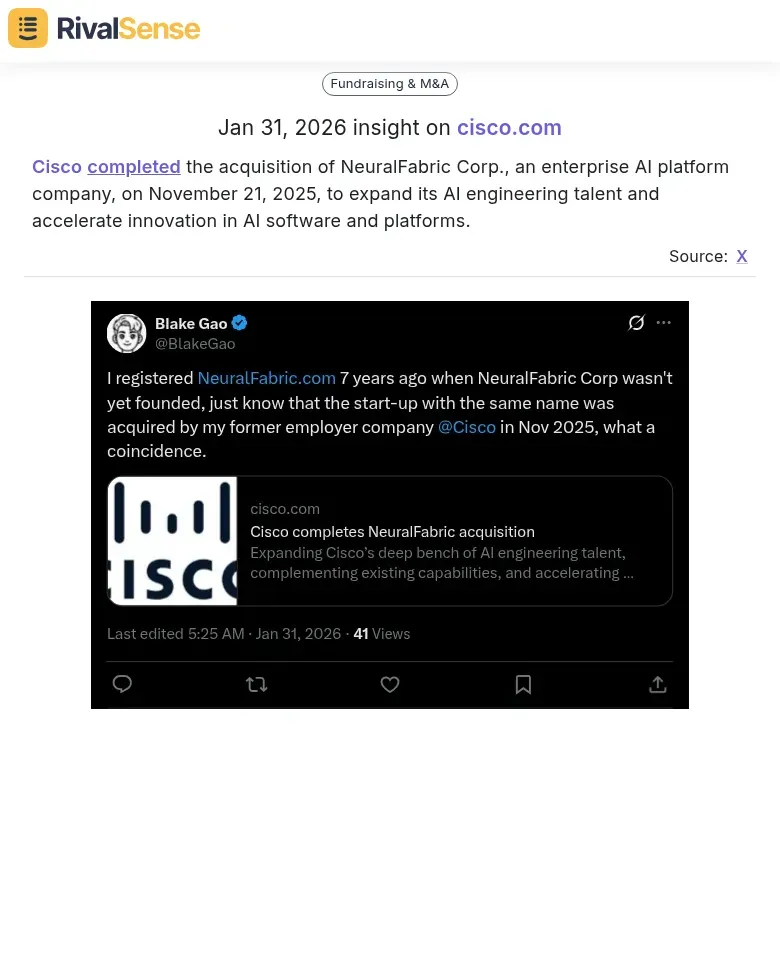
Cisco completed the acquisition of NeuralFabric Corp., an enterprise AI platform company, on November 21, 2025, to expand its AI engineering talent and accelerate innovation in AI software and platforms.
Acquisitions like this reveal a competitor's focus on bolstering internal capabilities. In SWOT, this could be a strength for Cisco, indicating investment in AI talent. For others, it's a threat if it accelerates their innovation cycle. Monitoring partnerships and M&A activity provides clues about future competitive strengths.
3. Market Launches and Geographic Expansion:

Waymo launched its autonomous technology in London earlier this week, emphasizing safety and responsibility in urban mobility.
This market launch into a new region highlights opportunities in urban mobility and threats to traditional transport services. For automotive or tech competitors, such expansions signal where to compete or differentiate. Tracking geographic moves helps you assess market saturation and identify gaps for your own growth.
Beyond the Basics: Advanced SWOT Techniques
To stay ahead, move beyond static analysis. Markets evolve rapidly, and so should your understanding of competitors. Advanced techniques ensure your SWOT remains relevant and predictive, giving you a proactive edge rather than a reactive stance.
Dynamic SWOT Analysis
Traditional SWOT is static—but markets aren't. Implement continuous monitoring to track how competitor SWOT profiles evolve over time. Tools that provide regular competitor intelligence updates transform SWOT from a one-time exercise into a living strategic framework.
Comparative SWOT Analysis
Don't analyze competitors in isolation. Create side-by-side SWOT comparisons to identify:
- Patterns across multiple competitors (industry-wide weaknesses you can exploit)
- Unique advantages of each competitor (what makes them different)
- Market gaps no competitor is addressing (your opportunity space)
Predictive SWOT Analysis
Use competitor intelligence to anticipate future moves:
- Product Launches: Track hiring patterns (new engineers = new features)
- Market Expansion: Monitor regulatory filings and partnership announcements
- Pricing Changes: Analyze financial performance and market conditions
Common Pitfalls and How to Avoid Them
Even with a solid framework, mistakes can undermine your SWOT analysis. Being aware of these pitfalls helps you steer clear and maintain the integrity of your insights. Here are the most common errors and practical solutions to overcome them.
Pitfall 1: Confirmation Bias
Only seeking information that confirms existing beliefs
Solution: Use objective data sources and automated intelligence tools that provide unbiased competitor updates.
Pitfall 2: Analysis Paralysis
Collecting too much data without taking action
Solution: Focus on actionable intelligence. Tools like RivalSense filter noise to deliver only relevant competitor moves that require your attention.
Pitfall 3: Static Analysis
Treating SWOT as a one-time exercise
Solution: Implement continuous monitoring. Markets change weekly—your competitor intelligence should too.
Integrating SWOT into Your Business Strategy
A SWOT analysis shouldn't exist in a vacuum. Integrate its findings across departments to drive cohesive strategy. This alignment ensures that everyone from product to sales is leveraging competitive insights to win in the market.
For Product Development:
- Use competitor weaknesses to prioritize feature development
- Analyze competitor strengths to identify must-have features
- Monitor competitor product launches to anticipate market trends
For Marketing Strategy:
- Identify messaging gaps in competitor positioning
- Analyze successful competitor campaigns for inspiration
- Use competitor weaknesses in your comparative marketing
For Sales Enablement:
- Arm sales teams with competitor SWOT profiles
- Develop competitive battle cards highlighting your advantages
- Train teams on handling competitor objections
The Modern Approach: Automated Competitor Intelligence
While manual competitor research has value, it's time-consuming and often incomplete. Modern businesses need automated solutions that provide real-time, accurate data to fuel continuous SWOT analysis. This approach frees up your team to focus on strategy rather than data collection.
Modern tools like RivalSense transform competitor SWOT from a quarterly exercise into a continuous strategic advantage by:
- Tracking 80+ sources including websites, social media, regulatory registries, and industry publications
- Delivering weekly intelligence reports with prioritized competitor updates
- Monitoring product launches, pricing changes, partnerships, and management moves
- Providing historical context to understand competitor evolution
Instead of spending hours each week manually tracking competitors, you receive curated intelligence that informs real-time decision making.
Implementation Checklist
✅ Week 1: Identify 3-5 key competitors and set up monitoring
✅ Week 2: Conduct initial SWOT analysis using multiple data sources
✅ Week 3: Develop action plan based on SWOT findings
✅ Week 4: Implement automated competitor intelligence solution
✅ Ongoing: Review weekly intelligence reports and adjust strategy
From Analysis to Advantage: Your Next Steps
Competitor SWOT analysis isn't about copying what others do—it's about understanding the competitive landscape so you can make better strategic decisions. The most successful businesses don't just react to competitors; they anticipate moves, identify opportunities, and execute with precision. Remember, the goal is to use competitive intelligence to strengthen your own position.
By implementing a systematic, continuous SWOT process—supported by modern intelligence tools—you transform competitor analysis from an academic exercise into a tangible competitive advantage. Start with a thorough SWOT analysis today, but don't stop there. Make competitor intelligence a core competency, and watch your strategic decision-making transform.
Ready to put this into practice? Try RivalSense for free at https://rivalsense.co/ to automate your competitor tracking. Get your first competitor report today and turn insights into action!
📚 Read more
👉 2026 Trend Analysis: Why Competitor Analysis Drives Digital Marketing Agency Success
👉 How Adidas' CLOT Partnership Served as a Competitive Intelligence Wake-Up Call
👉 Step-by-Step Guide to Facebook Competitor Insights for Key Account Management
👉 Web Scraping for Customer Service Excellence: Benchmarks, Benefits, and Implementation
👉 Real-World Competitor Insights: Hiring and Layoff Patterns for Key Account Strategy