
Competitor Product Insights: A Strategic Guide for Key Account Management
In key account management, competitor product changes aren't just market noise—they're direct threats to your most valuable relationships. When a competitor launches a new feature or lowers pricing, your key accounts face immediate pressure to reconsider their loyalty. This reality demands moving beyond reactive monitoring to proactive strategic planning.
Start by establishing a systematic tracking framework:
- Monitor competitor product announcements, feature updates, and pricing changes weekly
- Map these changes against your key accounts' specific needs and pain points
- Assess vulnerability levels for each account based on competitor alignment with their requirements
Connect these insights to account lifecycle stages for maximum impact. During onboarding, use competitor weaknesses to reinforce your value proposition. In growth phases, proactively address competitor strengths before they become account concerns. For at-risk accounts, develop targeted counter-strategies based on specific competitor offerings.
💡 Practical tip: Create a simple dashboard tracking competitor product changes alongside key account health metrics. This visual connection helps identify which accounts need immediate attention when competitors make strategic moves. Remember: The goal isn't just to know what competitors are doing, but to anticipate how those actions will influence your key accounts' decision-making processes.
Decoding Product Enhancement Signals: What Competitor Updates Reveal
When tracking competitor product updates, look beyond feature announcements to decode strategic signals. Feature additions and service expansions often validate emerging market needs—if multiple competitors add similar capabilities, it signals a validated customer pain point worth exploring. Understanding these signals helps you stay ahead of market trends and align your offerings accordingly.
Practical steps:
- Create a tracking matrix for competitor feature releases vs. customer segments served
- Note timing patterns—are updates clustered around industry events or fiscal quarters?
- Document which features get prominent positioning vs. quiet launches
Compliance and regulatory changes reveal shifting customer requirements. When competitors update for GDPR, SOC2, or industry-specific regulations, it indicates evolving buyer priorities. Track these as early warning signals for your own compliance roadmap.
Digital transformation initiatives show technology adoption patterns. Monitor:
- API expansions (indicates ecosystem strategy)
- Mobile app updates (signals user behavior shifts)
- Integration partnerships (reveals platform ambitions)
🔍 Tip: Set up alerts for competitor changelogs, release notes, and support documentation updates—these often contain subtle signals before official announcements. Cross-reference product updates with customer review trends to validate market impact.
Strategic Framework: Mapping Competitor Insights to Key Account Lifecycle Stages
A strategic framework aligns competitor insights with your key account lifecycle stages. By mapping insights effectively, you can proactively address competitive threats and opportunities at every touchpoint. This approach ensures that competitor intelligence directly informs your account strategy.
Prospecting Stage: Identify New Opportunities
- Monitor competitor product launches and feature updates to spot emerging market trends
- Analyze competitor customer case studies to identify underserved segments
- Use competitor pricing changes to gauge market willingness to pay
- ✅ Checklist: Track 3-5 competitor innovations monthly, document potential applications for your accounts
Onboarding Stage: Learn from Implementation Patterns
- Study competitor implementation timelines and resource requirements
- Analyze competitor support documentation and training materials
- Identify common integration challenges competitors face with similar accounts
- 💡 Tip: Create a "lessons learned" database from competitor implementation failures
Growth Stage: Anticipate Account Needs
- Monitor competitor expansion into adjacent services or verticals
- Track competitor upselling patterns and timing
- Analyze competitor customer success metrics and retention strategies
- 🛠️ Practical step: Set up alerts for competitor announcements about existing clients expanding usage
This framework transforms raw competitor data into actionable intelligence at each account stage, helping you stay ahead of evolving customer expectations and competitive pressures.
Practical Implementation: Building Your Competitor Product Intelligence System
Building an effective competitor product intelligence system requires three core components: automated monitoring, structured tracking, and intelligent alerts. Implementing this system ensures you capture relevant insights without manual overhead, allowing you to focus on strategic actions.
1. Automated Monitoring Setup:
- Use tools to continuously scrape competitor websites, marketplaces, and social media
- Monitor product pages, pricing, feature announcements, and release notes automatically
- Set up RSS feeds, webhooks, and API integrations for real-time data collection
- Track 3-5 key competitors with daily automated scans
2. Structured Tracking Matrix:
Create a centralized spreadsheet or database with these columns:
| Competitor Name | Product/Feature Category | Release Date | Impact Level | Key Account Relevance | Your Response Status |
|---|---|---|---|---|---|
| Example Competitor | Feature Update | 2025-12-01 | High | Account A | In progress |
3. Alert System Configuration:
- Set tiered alerts: immediate (price drops >15%), daily (new features), weekly (trend analysis)
- Configure Slack/email notifications for critical movements affecting key accounts
- Create automated battle cards when competitors launch features targeting your key clients
- Implement geographic-specific alerts for regional competitive threats
🚀 Pro Tip: Designate one team member to review automated findings weekly, ensuring strategic responses rather than reactive copying.
Actionable Insights: Turning Competitor Data into Strategic Advantages
Transform competitor product insights into strategic advantages with these actionable steps. By systematically analyzing competitor moves, you can identify opportunities to strengthen your position and protect your key accounts.
Identify Gaps in Competitor Offerings:
- Create a feature comparison matrix tracking 3-5 competitors across key account needs
- Monitor customer reviews on G2, Capterra for recurring complaints about missing features
- Analyze competitor support forums for feature requests they haven't addressed
- 💡 Tip: Focus on gaps that align with your key accounts' pain points to strengthen your value proposition
Anticipate Customer Needs via Roadmap Analysis:
- Track competitor job postings for new roles (AI specialists, integration engineers)
- Monitor patent filings and R&D investments for technology direction
- Analyze conference presentations and whitepapers for future focus areas
- ✅ Checklist: Quarterly review of competitor innovation signals, partnership announcements, and executive hires
Develop Counter-Strategies Based on Weaknesses:
- Map competitor limitations to specific key account segments
- Create targeted messaging highlighting your superior solutions
- Develop quick-win offerings that address competitor shortcomings
- 🛠️ Practical step: Implement a monthly competitive intelligence review with sales and product teams to align strategies
Real-World Examples: How Competitor Insights Drive Business Strategy
Seeing competitor updates in action clarifies their strategic value. Here are real insights tracked by RivalSense, highlighting how different types of intelligence can inform your key account approach.
1. Service Expansion for Customer Retention
Turkish Airlines now offers free transport for one set of golf clubs and ski/snowboard equipment on international flights until December 31, 2026, and for one bicycle on most network flights until the same date, with updated rules for sports equipment transport.
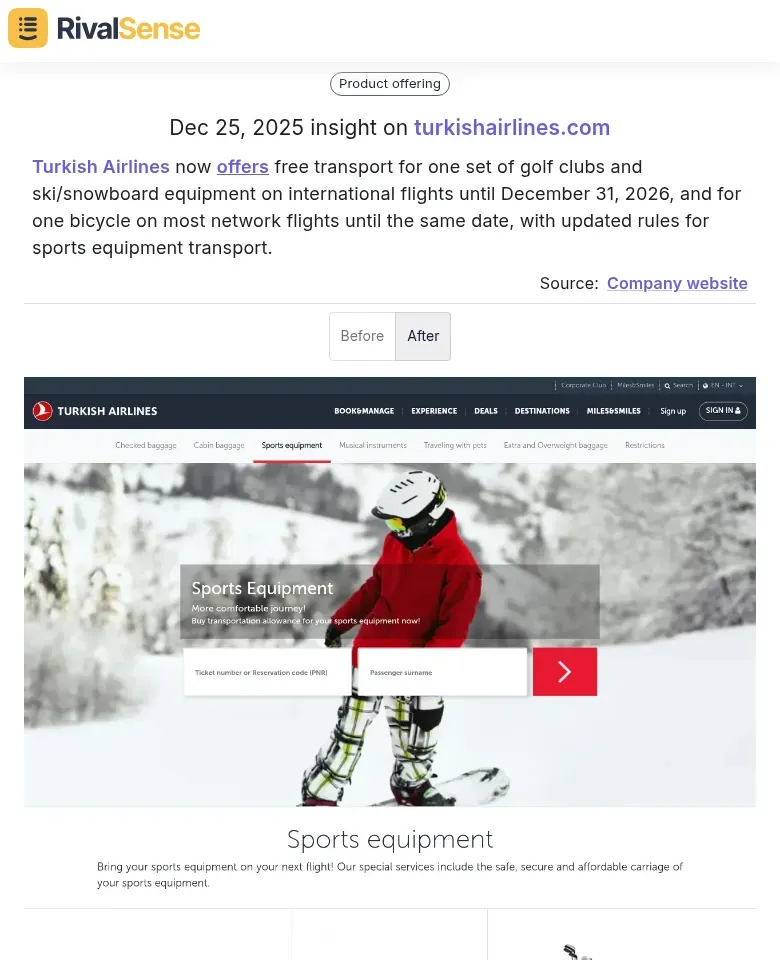
Why it matters: This type of insight reveals how competitors enhance services to retain and attract high-value customers. For B2B companies, tracking such expansions can signal shifting customer preferences or untapped market segments, helping you adjust your offerings proactively.
2. Compliance and Regulatory Shifts
Socure has added BCDR plans for India and the United States, while removing SOC 2 Type 2 and Certificate of Insurance - General Liability from its compliance documentation.
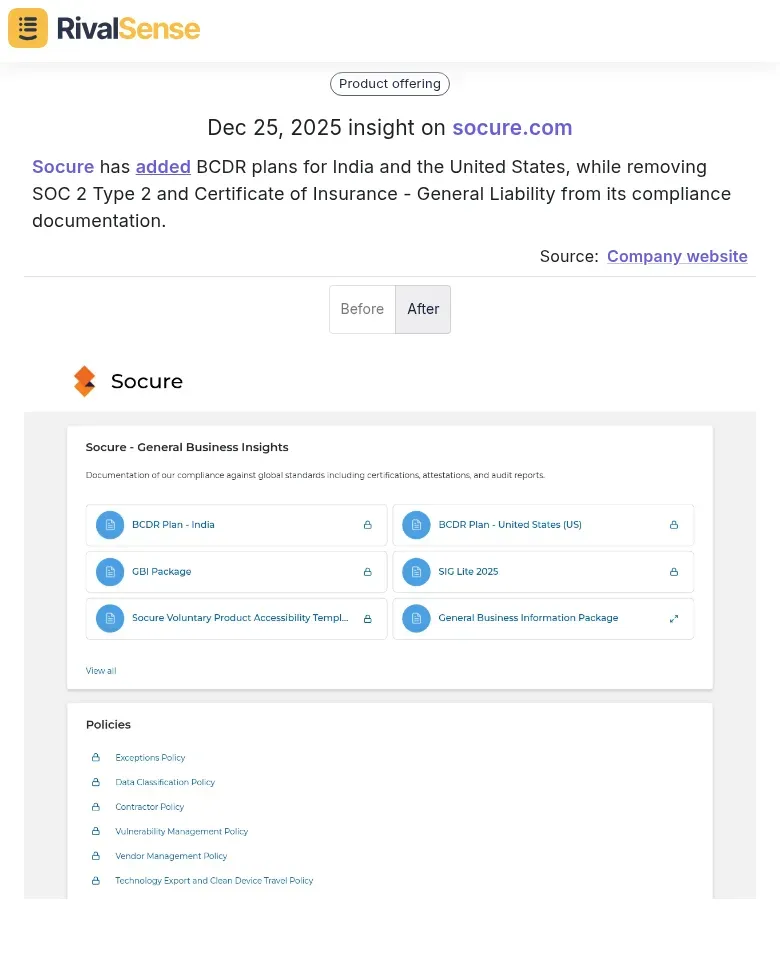
Why it matters: Compliance updates indicate evolving buyer priorities and regulatory landscapes. By monitoring these changes, you can anticipate new requirements for your key accounts, ensuring your product roadmap aligns with market demands and reduces risk.
3. Product Launches and Digital Innovation
Legends debuts new digital dasher boards at the BMO Center during a game on Saturday.
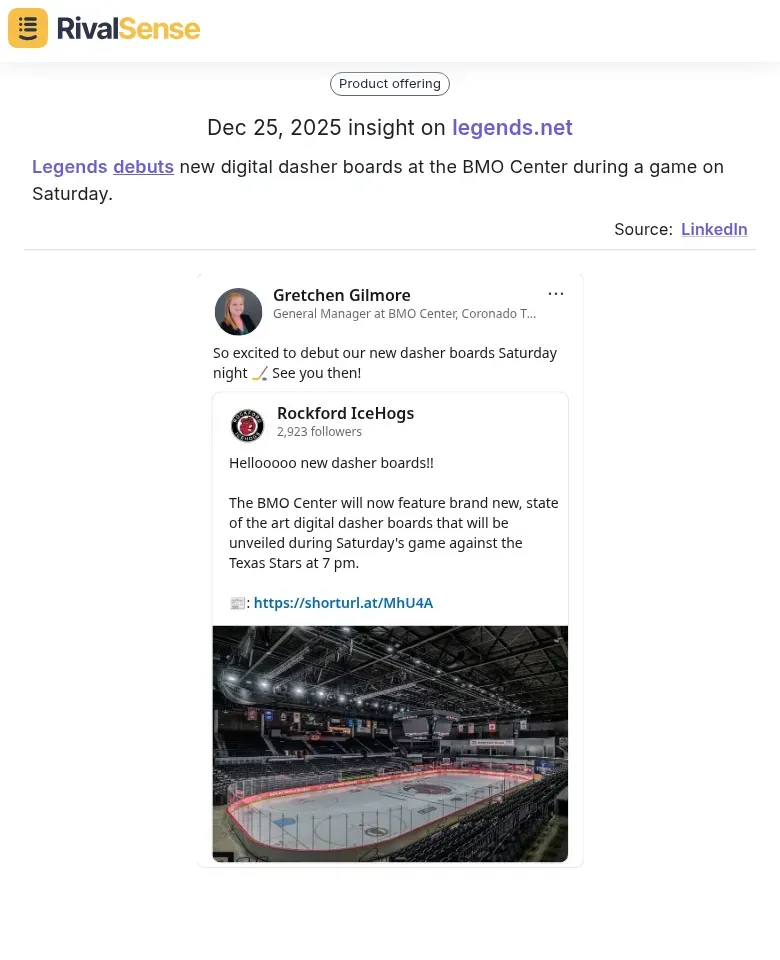
Why it matters: Product launches showcase competitor investment in technology and customer experience. For key account management, this signals areas where competitors are innovating, allowing you to assess threats to your accounts and explore similar enhancements or differentiators.
Conclusion: Mastering Continuous Competitive Intelligence for Account Excellence
Mastering continuous competitive intelligence transforms occasional insights into sustained account excellence. Establish a disciplined review cadence to ensure you're always prepared for competitor moves. This proactive approach safeguards your key relationships and drives growth.
Establish a disciplined review cadence: conduct weekly quick scans of competitor announcements, monthly deep-dive analyses of product updates, and quarterly strategic assessments of competitive positioning. Create a simple checklist: track feature releases, pricing changes, customer testimonials, and support improvements.
Integrate these insights directly into your key account planning. Before each quarterly business review, analyze how competitor developments might impact your client's priorities. Map competitor strengths against your account's pain points to proactively address potential vulnerabilities. Use competitive intelligence to tailor your value propositions and reinforce your unique advantages.
Measure impact systematically. Track metrics like competitive win rates, account retention improvements, and upsell success in competitive situations. Establish baseline measurements before implementing your intelligence program, then monitor changes quarterly. Document specific instances where competitor insights helped retain at-risk accounts or secure expansions.
💡 Practical tip: Create a 'competitive intelligence dashboard' for each key account that highlights relevant competitor movements and recommended actions. This ensures insights translate directly into account strategy rather than remaining as isolated data points.
Ready to streamline your competitor tracking? Tools like RivalSense automate the monitoring of competitor product launches, pricing updates, compliance changes, and more, delivering weekly reports straight to your inbox. This saves time and ensures you never miss a critical move. Try RivalSense for free at https://rivalsense.co/ and get your first competitor report today to start protecting your key accounts with actionable insights.
📚 Read more
👉 Decoding Competitor Strategy: How Safran's Air Show Move Reveals Innovation Priorities
👉 How to Track Competitor Podcast Appearances: The Complete Strategic Guide
👉 How Systems Software Leaders Win with Competitor Feature Gap Analysis
👉 How Early Regulatory Alerts Enabled VPN Competitors to Capture Market Share
👉 Competitor Website Changes: A Strategic Guide for Key Account Planning