
Competitor Pricing Workflow Breakdown: Strategic Account Tracking Tools
In today's hyper-competitive B2B landscape, real-time pricing intelligence isn't just valuable—it's essential for survival. Markets shift overnight, competitors adjust strategies in real-time, and pricing decisions made without current competitor data can cost you deals and market share. The strategic imperative is clear: you need to know what your competitors are charging, when they change prices, and how they position their offerings.
Strategic account tracking tools transform this challenge into opportunity by automating the entire competitor pricing workflow. Instead of manual price checking (which is time-consuming, error-prone, and reactive), these tools provide continuous monitoring of key competitors' pricing pages, product catalogs, and promotional offers. They convert raw pricing data into actionable insights through automated alerts, trend analysis, and competitive positioning reports.
Practical steps to implement:
- Identify your 3-5 most critical competitors to monitor
- Set up automated tracking of their pricing pages and product listings
- Configure alerts for price changes, new offerings, or promotional campaigns
- Establish a weekly review process of pricing intelligence reports
- Integrate findings into your pricing strategy meetings
This evolution from manual checking to automated workflow-driven intelligence enables proactive decision-making, faster response times, and data-driven pricing strategies that maintain your competitive edge.
🔍 Key Competitor Pricing Insights and Strategic Learnings
Competitor pricing analysis reveals three critical strategic insights that can transform your market positioning. By understanding these patterns, you can anticipate moves and refine your own strategies.
First, analyze promotional timing strategies by tracking extended promotional periods. When competitors maintain discounts for 30+ days, they're testing price elasticity or clearing inventory. Monitor these patterns to identify optimal timing for your own promotions. For example, RivalSense detected that Zapier extended the promotional period for free Lead Router tasks from January 29, 2026 to the end of March 2026. 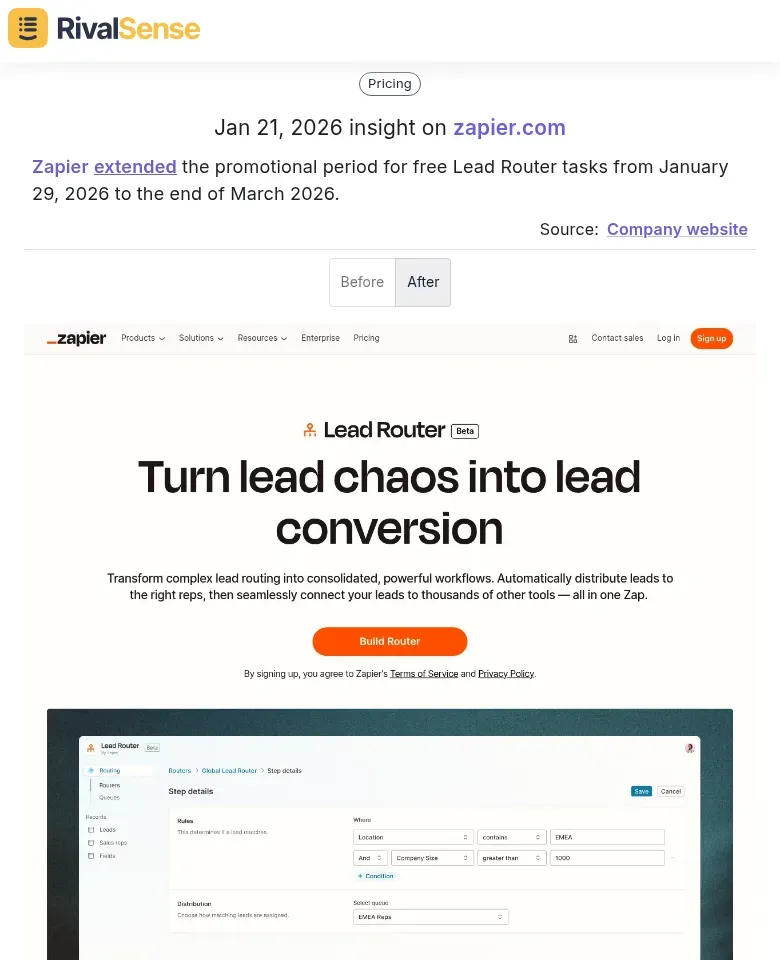 This type of insight is valuable because it reveals how competitors adjust promotion cycles, helping you plan your campaigns and avoid missed opportunities.
Second, understand category-wide pricing campaigns where competitors coordinate reductions across product lines. This signals strategic market share plays or responses to external pressures. Create a tracking matrix to map which product categories receive simultaneous discounts and identify vulnerable market segments. A real-world example: Meny cuts the price of Coca-Cola, Sprite, and Fanta by up to 77 percent in a campaign this week. 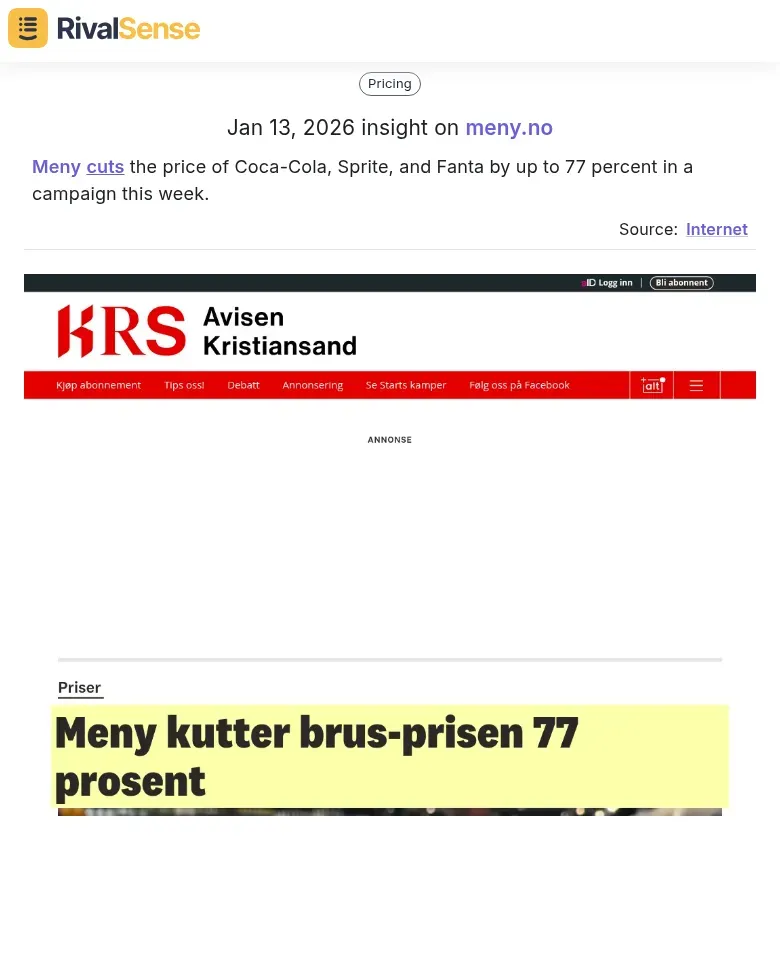 Tracking such category-wide moves is crucial as it highlights aggressive competitive tactics and can alert you to broader market shifts.
Third, decode limited-time promotional tactics by analyzing flash sales and special pricing events. These create urgency and disrupt market equilibrium. Track frequency, duration, and messaging patterns to anticipate market disruptions. Consider this insight: Akulaku Indonesia offers a special price of 9,000 rupiah for laptops and PCs in a promotion. 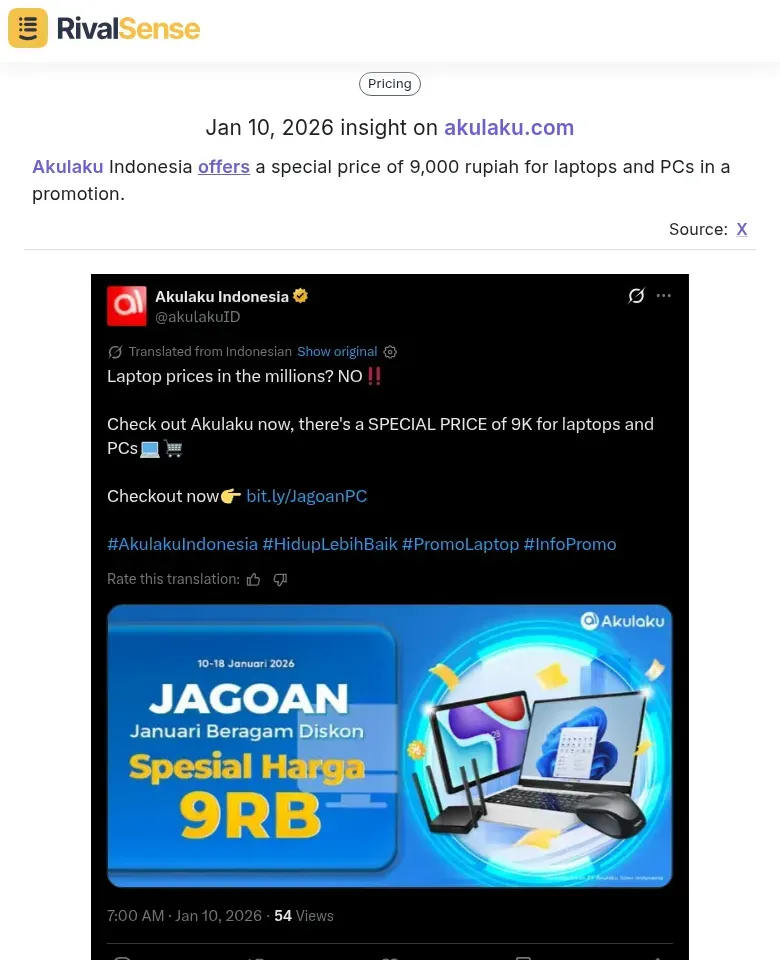 This insight is valuable because it shows how competitors drive short-term sales, allowing you to design effective counter-promotions and stay competitive.
Practical steps:
- Set up automated alerts for competitor price changes
- Create a promotional calendar mapping competitor timing patterns
- Analyze conversion lift during promotional periods
- Test your own limited-time offers based on competitor success patterns
- Monitor customer sentiment during price changes to gauge market reception
The key insight: competitor pricing isn't random—it's a strategic language revealing market positioning, inventory management, and competitive pressure points.
⚙️ Essential Components of a Strategic Pricing Tracking Workflow
A strategic pricing tracking workflow requires three essential components to ensure efficiency and accuracy. These components help you stay proactive rather than reactive in a dynamic market.
First, establish intelligent monitoring cadences based on product categories and competitive dynamics. For high-velocity SaaS products, implement daily monitoring, while monthly checks suffice for enterprise software. Create a tiered system: monitor disruptors weekly, established competitors bi-weekly, and emerging players monthly.
Use this checklist:
- [ ] Categorize competitors by threat level
- [ ] Map monitoring frequency to product lifecycle stage
- [ ] Adjust cadences quarterly based on market changes
Second, implement tiered alert systems that prioritize high-impact pricing changes. Create three alert levels: critical (pricing changes >15% or new pricing tiers), important (5-15% changes or feature adjustments), and informational (<5% changes). Set up automated notifications with escalation paths—critical alerts should trigger immediate executive notifications, while informational alerts go to weekly reports.
Tip: Use competitor tracking tools to automate this process and ensure rapid response to market shifts.
Third, create automated data validation processes to ensure pricing intelligence accuracy. Implement cross-verification by comparing data from multiple sources (websites, APIs, third-party tools). Set up automated sanity checks: flag price changes exceeding 50% for manual review, validate currency conversions, and verify date stamps. Establish a monthly audit process where team members manually verify 10% of automated data points. This ensures reliability while maintaining efficiency in your competitive intelligence operations.
🛠️ Advanced Tracking Tools for Strategic Account Monitoring
Strategic account monitoring requires sophisticated tools that go beyond basic price tracking. When evaluating solutions, consider your business needs: real-time monitoring platforms provide instant alerts for immediate response, while scheduled intelligence platforms offer periodic reports for strategic planning. Most businesses benefit from a hybrid approach.
Implement AI-powered change detection to filter noise. Look for tools that use machine learning to distinguish between routine fluctuations and meaningful pricing movements. For example, set thresholds where only price changes exceeding 5% trigger alerts, or configure the system to ignore temporary promotions under 24 hours.
Integrate multi-channel tracking for comprehensive visibility:
- Monitor competitor websites directly
- Track pricing on marketplaces (e.g., Amazon, eBay)
- Watch social media for promotional announcements
- Follow industry forums and review sites
- Subscribe to competitor newsletters
Practical checklist:
- [ ] Define what constitutes a "meaningful" price change for your industry
- [ ] Set up tiered alert systems (urgent vs. informational)
- [ ] Create competitor profiles with specific tracking parameters
- [ ] Schedule regular competitive landscape reviews (weekly/monthly)
- [ ] Integrate pricing data with your CRM for account-specific insights
Tip: Start with 2-3 key competitors and expand tracking as you refine your workflow. The most effective systems combine automated monitoring with human analysis for strategic decision-making.
🚀 From Data to Action: Building Response Frameworks
Transform competitor pricing data into strategic advantage with structured response frameworks. First, categorize pricing changes: minor adjustments (1-5%), strategic moves (5-15%), and market disruptions (15%+). For each category, develop specific protocols with clear triggers and response timelines.
Create an escalation matrix that aligns responses with business impact. For example:
| Impact Level | Revenue Change | Response Time | Approval Required |
|---|---|---|---|
| Low | <5% | Weekly review | Automated |
| Medium | 5-15% | 48 hours | Manager |
| High | >15% | 24 hours | Executive |
Implement tiered approval workflows that balance speed with governance. Use a three-tier system:
- Automated responses for minor changes (pre-approved ranges)
- Manager-level approval for moderate changes (with pricing committee oversight)
- Executive approval for major strategic shifts
Practical checklist:
- [ ] Define clear response thresholds and timeframes
- [ ] Establish escalation criteria based on revenue impact
- [ ] Create pre-approved response templates for common scenarios
- [ ] Set up automated alerts with severity levels
- [ ] Conduct quarterly framework reviews and simulations
Tip: Use your competitor tracking tool to set up real-time alerts that trigger specific workflows based on the type and magnitude of pricing changes detected.
📈 Optimizing Your Pricing Intelligence System
Optimizing your pricing intelligence system requires deliberate processes that evolve with market dynamics. Start by establishing quarterly review cycles where you systematically evaluate competitor targeting effectiveness and monitoring strategies. During these reviews, assess whether you're tracking the right competitors, if your data sources remain relevant, and whether emerging players warrant inclusion.
Create a checklist:
- [ ] Review competitor win/loss data
- [ ] Validate pricing change alerts accuracy
- [ ] Update feature-to-price matrices
- [ ] Assess market positioning shifts
Implement concrete performance metrics to measure ROI. Track win rate improvements in competitive deals, average contract value changes post-pricing adjustments, and sales cycle acceleration. According to industry research, companies with mature pricing intelligence frameworks see 23% higher revenue growth and 18% better profit margins. Calculate your pricing intelligence ROI using: (Revenue impact + Cost savings - Investment costs) / Investment costs × 100.
Create continuous improvement processes by establishing feedback loops between sales, marketing, and product teams. Use automated tracking systems to monitor competitor changes in real-time, but supplement with quarterly deep-dive analyses. Build adaptive processes that respond to market conditions: during economic downturns, focus on value-based positioning; during growth phases, emphasize competitive differentiation.
Implement monthly competitive briefings for leadership and quarterly strategic recommendations that tie pricing intelligence directly to business outcomes.
Ready to put these insights into practice? Try RivalSense for free at https://rivalsense.co/ to automate your competitor tracking and get your first competitor report today. It monitors product launches, pricing updates, events, partnerships, and more, delivering weekly insights straight to your inbox.
📚 Read more
👉 Turning Competitor Personnel Moves into Strategic Insights
👉 Renewable Energy Key Account Tracking: Master Spreadsheet Template and Cheat Sheet
👉 How TAG Heuer's Glassbox Launch Prompted Rivals' Strategic Pricing Shift
👉 Facebook Competitor Insights Framework: Templates for Key Account Tracking