
Competitor Pricing Cheat Sheet: Monitor Key Account Growth Insights
In today's hyper-competitive B2B landscape, competitor pricing intelligence isn't just about defense—it's the engine that drives key account growth. Real-time insights transform reactive firefighting into proactive expansion strategies, allowing you to anticipate competitor moves before they impact your most valuable relationships.
Every pricing change your competitor makes creates ripple effects across your key accounts. A price drop could signal an aggressive push into your territory, while a premium increase might reveal new value propositions you can leverage. The direct correlation is clear: when you monitor competitor pricing systematically, you uncover retention risks and expansion opportunities simultaneously.
Practical Setup Checklist:
- Identify 3-5 primary competitors targeting your key accounts
- Track their pricing pages, quote templates, and customer portal changes
- Set up alerts for price adjustments, discount structures, and packaging changes
- Map competitor moves to your key account renewal timelines
- Create a monthly pricing intelligence report for your sales leadership
By establishing this systematic approach, you'll move from guessing to knowing—turning competitor pricing data into actionable growth strategies for your most valuable clients.
Strategic Pricing Moves: Learning from Competitor Announcements and Timing
Strategic pricing moves require analyzing competitor announcements to anticipate market shifts. When competitors announce premium reductions or accessibility initiatives, they're signaling market expansion opportunities. Track these announcements systematically to understand client expectations before they shift.
Practical Steps:
- Monitor competitor press releases, blog posts, and social media for pricing changes
- Document announcement timing patterns (e.g., Q4 premium reductions, Q1 accessibility initiatives)
- Analyze seasonal patterns: SaaS companies often launch promotions before fiscal year-ends, while B2B tools frequently introduce tiered pricing during industry conference seasons
- Create a pricing change timeline for each major competitor
Key Insights:
- Competitor premium reductions often precede market share expansion attempts
- Accessibility initiatives (like lower-tier pricing) typically target new customer segments
- Major pricing announcements cluster around industry events and fiscal quarters
Real-World Example:
RivalSense tracked that Folksam increases pensions for 166,000 customers and reduces premiums for 2,600 employers starting January 2026. This type of insight is valuable for business strategy as it shows how competitors adjust pricing and benefits to retain customers and attract new segments, signaling market shifts that you can anticipate.

Actionable Tip: When a competitor announces significant pricing changes, immediately analyze their target audience messaging and adjust your positioning within 2-4 weeks to maintain competitive advantage.
Monitoring Key Account-Specific Pricing Changes and Their Implications
Monitoring competitor pricing changes specific to your key accounts' industries reveals critical opportunities. When rivals adjust pricing for healthcare, finance, or manufacturing segments, track these moves to identify retention risks and upsell potential. For example, if a competitor lowers enterprise pricing for financial services clients, your key accounts in that sector may question your value proposition.
Practical Checklist:
- Set up alerts for competitor pricing changes in your key accounts' verticals
- Map pricing adjustments to specific customer segments (enterprise vs. SMB)
- Analyze how competitor discounts create retention vulnerabilities
- Identify upsell opportunities where your premium features justify higher pricing
- Prepare value-based responses highlighting your unique differentiators
Real-World Example:
WeightWatchers announced a new promotion making Wegovy more accessible and affordable. This insight is valuable because it reveals how competitors use promotions to tap into new customer segments and adjust affordability, which can inform your pricing strategies for key accounts in similar industries.

When competitors offer aggressive pricing to specific customer groups, use this intelligence to anticipate client questions. Develop talking points that emphasize your superior ROI, support, or integration capabilities. This proactive approach transforms pricing threats into trust-building conversations that strengthen key account relationships and drive growth.
Turning Pricing Insights into Key Account Growth Opportunities
Competitor pricing intelligence isn't just about matching rates—it's about uncovering strategic growth opportunities within your key accounts. Here's how to transform pricing data into account expansion:
-
Identify Value Gaps: When competitors raise prices or eliminate features, position your solution as the superior value proposition. Example: If a competitor increases their enterprise plan by 20% while reducing support hours, highlight your unchanged pricing with enhanced support in your next quarterly business review.
-
Time Your Offers Strategically: Track competitor promotional cycles (Q4 discounts, summer sales) and schedule your counter-offers 2-3 weeks before their campaigns end. This captures accounts considering switches while maintaining your premium positioning.
-
Preempt Client Concerns: Create a pricing objection playbook. When you notice competitors adding hidden fees, proactively address this with key accounts: "Unlike [Competitor], our implementation fees are included, saving you 15% on total cost."
Real-World Example:
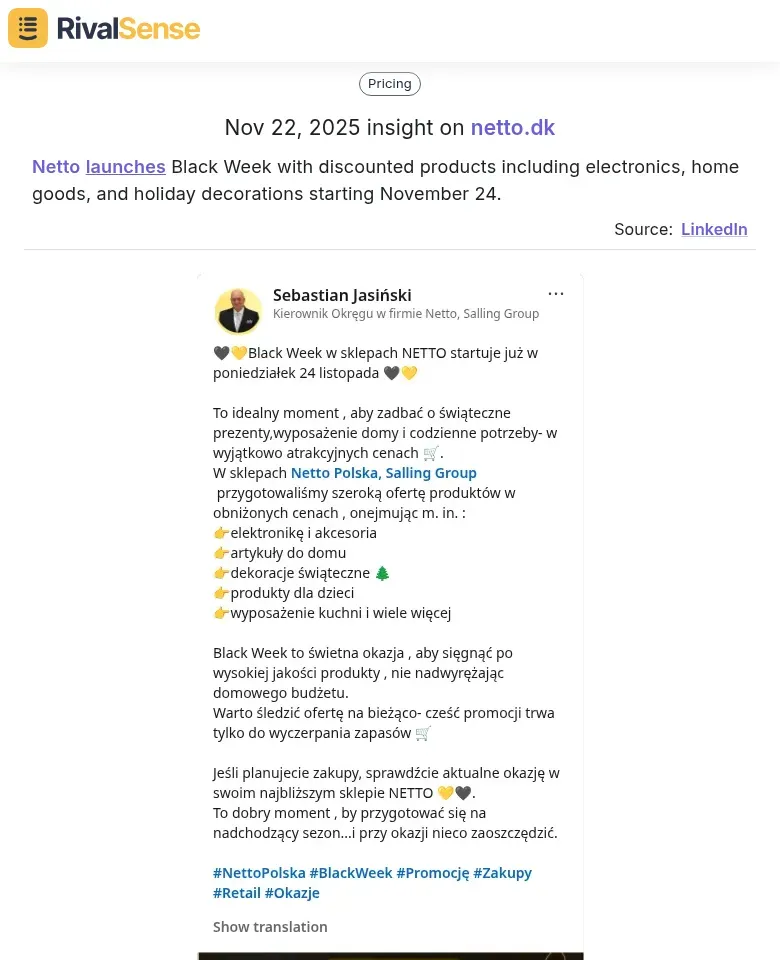
Netto launches Black Week with discounted products including electronics, home goods, and holiday decorations starting November 24. Monitoring such seasonal promotions is crucial for business strategy as it helps you anticipate competitor moves and time your counter-offers effectively to protect and grow key accounts.
Actionable Checklist:
- Weekly: Monitor 3-5 key competitors' pricing pages
- Monthly: Analyze feature-to-price ratios vs. your solution
- Quarterly: Review competitor discount patterns and plan counter-offers
- Annually: Audit your value messaging against competitor price changes
Pro Tip: Use pricing intelligence to identify accounts at risk of churn—when competitors undercut you significantly, engage those clients with personalized ROI calculators before they initiate conversations.
Building Your Competitor Pricing Monitoring System
Building an effective competitor pricing monitoring system requires automation, centralization, and action-oriented processes. Start by setting up automated alerts for competitor pricing changes that directly impact your key accounts. Use tools like RivalSense to track price adjustments, discounts, or bundling strategies targeting your top customers. Configure alerts for specific competitors, products, or account segments to ensure you never miss critical changes.
Create a centralized dashboard that aggregates pricing data with account-specific context. Include metrics like competitor price points, historical trends, win/loss rates, and customer feedback. Visualize how pricing shifts correlate with account health scores or renewal risks. This single source of truth enables your team to quickly assess implications for each key account.
Establish a weekly review process where sales, marketing, and leadership teams analyze pricing insights. Use a simple checklist: 1) Identify accounts most vulnerable to competitor pricing moves, 2) Assess potential revenue impact, 3) Develop tailored responses (price adjustments, value reinforcement, or retention offers), 4) Assign action owners and timelines. This transforms raw data into strategic account growth actions, ensuring you proactively protect and expand your most valuable customer relationships.
Action Plan: Implementing Your Competitor Pricing Cheat Sheet
Transform competitor pricing intelligence into actionable account strategies with this 4-step implementation plan:
-
Develop Account-Specific Response Playbooks: Create tiered response templates for different competitor scenarios. For example, when a key competitor drops prices for a specific client segment, have pre-approved discount thresholds and value-add bundles ready. Use RivalSense to track competitor pricing changes and correlate them with account characteristics.
-
Train Your Account Teams: Conduct monthly pricing intelligence workshops where teams practice using competitor data in client conversations. Role-play scenarios like: "When Client X mentions Competitor Y's lower price, here's how to highlight our superior features and justify our premium." Provide cheat sheets with key talking points and value propositions.
-
Implement Measurement Framework: Track these metrics monthly: (1) Account retention rate changes after pricing adjustments, (2) Expansion revenue from upsells/cross-sells using competitor insights, (3) Client satisfaction scores on pricing-related survey questions, and (4) Win rates in competitive situations.
-
Establish Feedback Loop: Create a simple form where account managers report competitor pricing mentions from clients. Review these weekly to identify patterns and adjust your response strategies. Use RivalSense alerts to stay ahead of market changes.
Pro Tip: Start with your 5 most vulnerable accounts first. Document baseline metrics, implement your new pricing intelligence approach for 90 days, then measure the impact before rolling out company-wide.
Ready to Turn Competitor Pricing Insights into Growth?
Leveraging competitor pricing intelligence is essential for protecting and expanding your key accounts. By monitoring strategic moves, timing your responses, and building a robust system, you can stay ahead of market shifts. However, manually tracking all competitor activities can be time-consuming and error-prone.
That's where RivalSense comes in. It automatically tracks competitor product launches, pricing updates, event participations, partnerships, and more across websites, social media, and registries, delivering concise weekly reports directly to your inbox. This saves you hours of manual research and ensures you never miss a critical change.
Try RivalSense for free today at https://rivalsense.co/ and get your first competitor report to start transforming pricing insights into key account growth opportunities.
📚 Read more
👉 Mastering Competitor Analysis: Lessons from Motive's AI Coach Launch
👉 How to Track Key Account Lifecycle: A Strategic Guide for B2B Leaders
👉 Data Processing Competitive Advantage Cheat Sheet: Outsmart Rivals
👉 How Bright Data's Price Cut Revealed Competitor Growth Strategy
👉 Case Study: API-Driven Competitor Insights for Key Account Tracking