
Competitor Partnership & Client Analysis Framework: Strategic Templates
In today's hyper-competitive B2B landscape, understanding your competitors' partnerships and client relationships isn't just market research—it's your strategic advantage. While traditional competitor analysis focuses on products and pricing, the real insights lie in the ecosystem connections your rivals are building. Competitor partnerships reveal market gaps and innovation opportunities that aren't visible through surface-level analysis. When you see which companies your competitors are aligning with, you're essentially reading their strategic roadmap.
Practical Tip: Create a partnership tracking matrix that maps competitor alliances by type (technology, distribution, co-marketing) and strategic intent. This reveals underserved market segments and potential white space opportunities.
Client case studies provide an unfiltered view of competitor strengths and implementation capabilities. These real-world examples expose what actually works in the market versus what's just marketing hype. By analyzing which clients choose your competitors and why, you gain insights into market preferences and implementation success factors.
Checklist Item: Review 3-5 recent client case studies from each major competitor, noting specific implementation challenges solved, ROI metrics cited, and integration capabilities demonstrated.
Ecosystem expansions offer crucial market positioning insights. When competitors enter new partnerships or expand their service offerings, they're signaling strategic shifts before they're publicly announced. Tracking these moves helps you anticipate market trends and position your company proactively rather than reactively.
Action Step: Set up automated alerts for competitor partnership announcements, client wins, and ecosystem expansions to stay ahead of market shifts. This intelligence becomes your early warning system for competitive threats and market opportunities.
Framework Component 1: Partnership Intelligence Analysis
Partnership Intelligence Analysis reveals how competitors leverage alliances to accelerate growth. By understanding these alliances, you can anticipate market shifts and identify collaboration opportunities. Start by categorizing partnership types: technology integrations (APIs, platform connections), co-marketing campaigns (joint webinars, content), and ecosystem expansion (channel partners, reseller networks).
Practical steps:
- Create a partnership matrix tracking each competitor's alliances by type, launch date, and announced goals
- Analyze timing patterns - do they partner before product launches, during funding rounds, or in response to market shifts?
- Assess impact by monitoring changes in market share, customer acquisition costs, and feature adoption post-partnership
Key insights to uncover:
- Strategic timing: Are they partnering during market consolidation or expansion phases?
- Positioning shifts: Do partnerships move them upmarket or into new verticals?
- Differentiation: Which unique capabilities do partnerships provide that competitors can't easily replicate?
Pro tip: Track partnership announcements alongside product roadmap updates and funding news to identify strategic patterns. Look for gaps where your company could form similar alliances more effectively.
Real-World Insight: Barco expands its ClickShare ecosystem through new partnerships with Sennheiser, Logitech, and Huddly to support certified room system bundles. 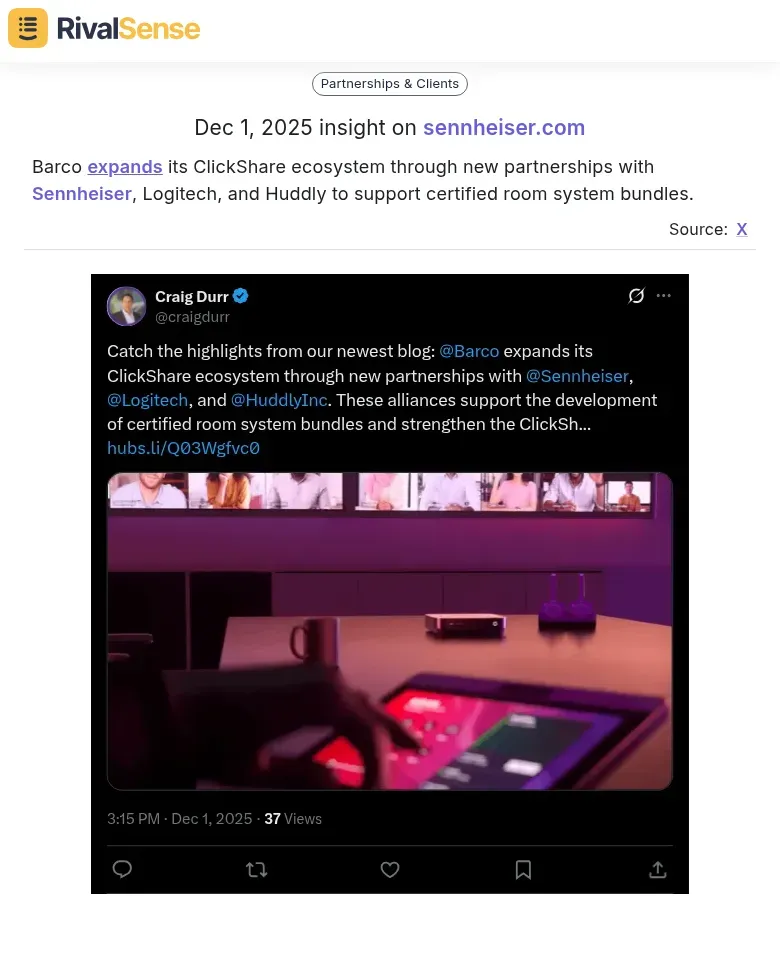
Why this matters: Tracking such ecosystem expansions helps you understand how competitors are bundling solutions to address specific market needs. This insight can reveal strategic moves towards integrated offerings and help you identify partnership opportunities in your own ecosystem.
Framework Component 2: Client Success Story Deconstruction
Deconstructing competitor client success stories reveals their implementation playbook and value proposition effectiveness. This analysis goes beyond surface-level claims to uncover the tangible results and processes that win clients. Start by extracting implementation methodologies from case studies: analyze their phased approach, integration timelines, team structures, and change management processes. For example, note whether they use agile sprints, dedicated implementation teams, or specific training methodologies.
Practical Checklist:
✅ Identify ROI metrics in case studies (cost savings, revenue increases, efficiency gains)
✅ Calculate implied ROI percentages from disclosed figures
✅ Compare metrics across different client sizes and industries
✅ Note which metrics competitors emphasize most frequently
Industry-Specific Analysis:
- Map case studies by vertical (healthcare, finance, manufacturing, etc.)
- Identify patterns in how solutions adapt to industry regulations
- Track which verticals receive most marketing attention
- Analyze pricing models by industry segment
Pro Tip: Create a spreadsheet tracking implementation timelines, team sizes, and ROI metrics across 10+ competitor case studies to identify patterns in their most successful deployments and industry penetration strategies.
Real-World Insight: Domo's client Yamaha presented at Domopalooza Japan 2025 on October 15 about using Domo's AI-powered platform to build a logistics control tower, optimizing its supply chain and saving 200 hours annually. 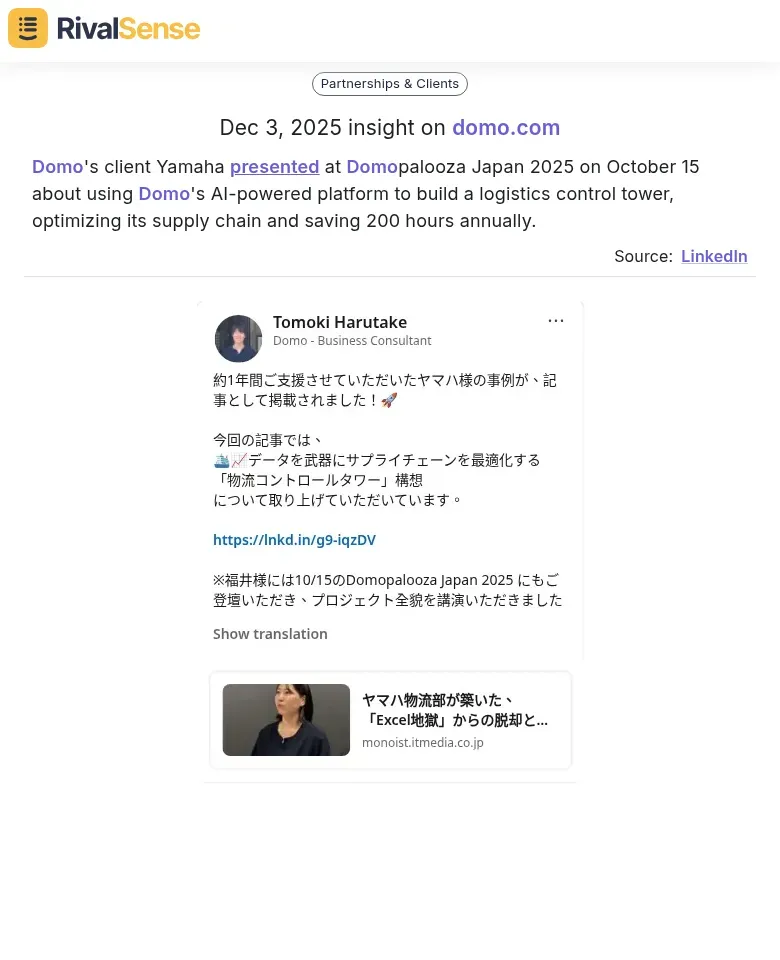
Why this matters: Client success stories like this provide concrete evidence of ROI and implementation effectiveness. Analyzing such presentations helps you benchmark against competitor capabilities and identify areas where you can differentiate your offerings.
Framework Component 3: Ecosystem & Integration Mapping
Ecosystem & Integration Mapping reveals how competitors build market dominance through strategic alliances. This mapping exposes the network effects that lock in customers and create barriers to entry. Start by tracking their technology stack integrations—document which APIs, platforms, and tools they connect with. Create a compatibility matrix showing integration depth (basic API vs. deep workflow integration).
Practical Checklist:
✅ Map all integration partners and compatibility developments quarterly
✅ Analyze certification program tiers (bronze/silver/gold) and partner requirements
✅ Document bundled solution packages and pricing tiers
✅ Track ecosystem expansion into new verticals or geographic markets
Key Insight: Competitors with tiered certification programs (requiring training, sales quotas, or technical expertise) create stronger ecosystem lock-in. Analyze how bundled offerings target specific market segments—for example, enterprise packages with premium support vs. SMB bundles with self-service tools. Monitor partnership announcements for clues about strategic direction and market segmentation strategies.
Strategic Templates for Implementation
Implementing the insights from competitor analysis requires structured templates. These templates help standardize your approach and ensure consistent tracking. Below are practical templates for partnership assessment, client benchmarking, and ecosystem mapping.
Partnership Opportunity Assessment Matrix
Create a 2x2 matrix evaluating competitors' partnerships against your own. On the X-axis, plot partnership depth (transactional to strategic). On the Y-axis, plot market coverage (niche to broad). Identify gaps where competitors have strategic partnerships in underserved markets. Actionable tip: Score each competitor partnership on a 1-5 scale for integration depth and customer overlap.
Client Success Benchmarking Template
Track 5 key metrics across 3 competitor case studies: implementation time, adoption rate, ROI timeline, support response time, and feature utilization. Create a side-by-side comparison table. Checklist: ✓ Document implementation methodologies ✓ Interview shared clients (where possible) ✓ Analyze public reviews for support patterns ✓ Track feature release-to-adoption cycles
Ecosystem Mapping Canvas
Visualize the competitive landscape with a concentric circle diagram. Place your company at the center, then map: 1) Direct competitors, 2) Complementary tools, 3) Integration partners, 4) Market influencers. Use color coding to indicate relationship strength and integration opportunities. Practical step: Quarterly review to identify new ecosystem players and partnership white spaces where competitors lack integrations.
Actionable Intelligence: Turning Insights into Strategy
Turning analysis into action requires a proactive mindset. Competitor partnerships reveal strategic priorities. Analyze their ecosystem alliances to identify market gaps you can fill. For example, if a competitor partners with a CRM provider, consider developing deeper integrations with complementary marketing automation tools. Create a partnership counter-strategy checklist: 1) Map competitor alliance networks, 2) Identify underserved partner segments, 3) Develop exclusive partnership offers, 4) Create joint value propositions that address gaps in competitor offerings.
Client success analysis provides implementation blueprints. Study competitor case studies to reverse-engineer their fastest implementation paths. Build accelerated playbooks by documenting: timeline benchmarks, key integration points, and critical success factors. Tip: Create a 'fast-track' implementation package that reduces typical onboarding time by 30-50%, directly addressing pain points revealed in competitor client stories.
Real-World Insight: Monumental's autonomous robotic systems completed masonry work for Dura Vermeer on Amsterdam's canals, including a pilot from a pontoon, to address maintenance challenges under tight deadlines. 
Why this matters: Insights into project completions and pilot programs highlight how competitors address specific client challenges and innovate in real-world scenarios. This can inform your own product development and service offerings to meet similar market demands.
Proactive ecosystem strategies prevent competitor market expansion. Monitor competitor hiring patterns, funding announcements, and geographic moves to anticipate their next targets. Develop preemptive strategies: establish local partnerships before competitors enter new regions, create specialized offerings for emerging verticals they're eyeing, and build referral networks in adjacent markets. Implement a quarterly ecosystem review to identify expansion opportunities 6-12 months ahead of competitors.
Ready to put these frameworks into practice? Try RivalSense for free at https://rivalsense.co/ to get automated competitor insights delivered weekly. Sign up today and get your first competitor report to start gaining a strategic advantage. 🚀
📚 Read more
👉 Leveraging Competitor Insights: OpenAI's Model Tests and Your Strategy
👉 The Ultimate Guide to Competitor Target Audience Analysis: 7 Steps to Uncover Hidden Opportunities
👉 Strategic Visioning Trends: How Dedicated Key Account Managers Drive Project Governance
👉 How RivalSense Alerted Competitors to Folksam's 2026 Pension and Premium Strategy
👉 Mastering Competitor Insights: A Digital Framework for Key Account Managers