
Competitor Insights Cheat Sheet: Mastering Key Account Lifecycle Tracking for B2B Success
In today's hyper-competitive B2B landscape, tracking competitors is no longer enough. The real advantage lies in understanding how your rivals navigate the entire key account lifecycle—from initial engagement to expansion and retention. This transforms reactive monitoring into proactive strategy, giving you the foresight to anticipate moves rather than just react to them.
Each stage of the account lifecycle reveals critical competitive positioning. When you see competitors aggressively targeting new logos in a specific vertical, it signals market validation. When they're deepening relationships with existing clients through expanded offerings, it reveals their retention strategy. By tracking these patterns across multiple key accounts online—through their website updates, content marketing, social media engagement, and hiring patterns—you can identify market shifts months before they impact your revenue.
Practical tip: Create a simple tracking matrix with columns for each key account lifecycle stage (acquisition, onboarding, growth, retention) and rows for your top 3-5 competitors. Monthly, note any observable changes in their online presence related to each stage. This simple framework helps you spot patterns and anticipate their next strategic moves.
Stage 1: Prospecting & Acquisition - Tracking Competitor Innovation Signals 🎯
In the prospecting stage, tracking competitor innovation signals reveals emerging opportunities before they become mainstream. Start by monitoring awards and recognition programs like XPRIZE finalists, industry accolades, or innovation grants. These signals often highlight technologies poised for market disruption. For example, a competitor winning a sustainability award might indicate a shift toward eco-friendly solutions in your sector.
Real-world example: Tools like RivalSense can automate this tracking. For instance, it captured that Phasecraft became a finalist in the $5 million XPRIZE Quantum Applications competition backed by Google Quantum AI, advancing from over 800 teams with its quantum algorithms for materials property computation. 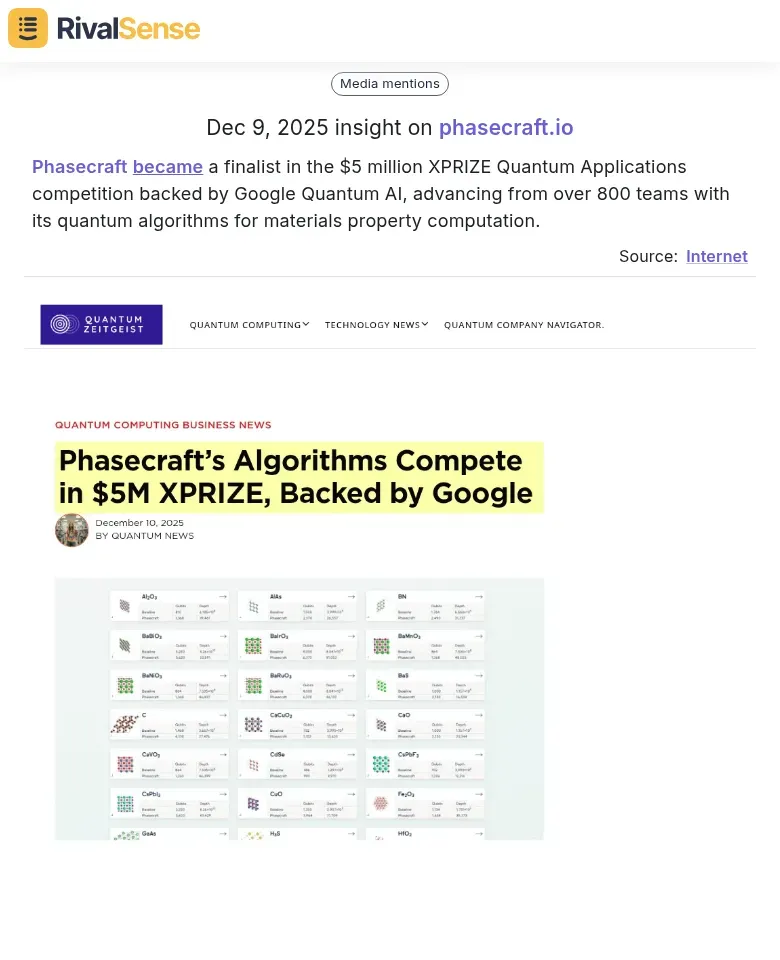 This type of insight is valuable because it shows where competitors are gaining recognition for innovation, indicating future product directions and R&D focus areas that could impact your market.
Next, analyze partnership announcements and integration launches. When competitors partner with complementary platforms or expand their API ecosystem, they're likely entering new markets or enhancing their value proposition. Create a tracking list of key competitors and their partner networks to spot expansion patterns.
Finally, track leadership changes and executive hires. New C-suite appointments in areas like AI, sustainability, or international markets signal strategic priorities. Set up alerts for competitor executive team updates on LinkedIn and company blogs.
Practical Checklist:
- ✅ Subscribe to industry award announcements and innovation competitions
- ✅ Monitor competitor press releases for partnership announcements
- ✅ Track integration launches in app marketplaces and developer portals
- ✅ Set up Google Alerts for competitor executive team changes
- ✅ Analyze new hire backgrounds to predict strategic focus areas
- ✅ Review quarterly earnings calls for innovation roadmap hints
Stage 2: Onboarding & Implementation - Learning from Competitor Technology Adoption ⚙️
During onboarding, study how competitors implement AI frameworks like OpenAI Evals for quality assurance. Track their GitHub repositories for evaluation scripts, monitor technical documentation for implementation patterns, and analyze case studies showing how they measure AI system performance against business objectives.
Real-world example: RivalSense insights can reveal how companies leverage advanced AI. For example, OpenAI's GPT-5 powers Scout24's conversational search assistant HeyImmo, with Scout24 using the OpenAI Evals framework to build a custom evaluation system for quality and collaborating closely with OpenAI Solutions Architects to improve safety and user experience.  This insight is valuable because it demonstrates how competitors are adopting cutting-edge AI to enhance product offerings, giving you clues about technology trends and implementation best practices you can emulate.
Study how competitors build custom evaluation systems for product safety and reliability. Look for:
- Custom scoring algorithms beyond standard metrics
- Real-time monitoring dashboards for system performance
- Automated testing frameworks for edge cases
- Third-party audit partnerships for validation
Practical Checklist:
- Map competitor technology partnerships (e.g., API integrations, co-marketing initiatives)
- Analyze their collaboration models with UX platforms like Figma or prototyping tools
- Monitor implementation timelines from announcement to customer deployment
Key Monitoring Areas:
- Technology stack announcements and migration patterns
- Implementation success metrics and customer testimonials
- Partner ecosystem expansion and integration depth
- Custom evaluation framework releases and open-source contributions
Track these signals to identify implementation best practices you can adapt while avoiding competitors' onboarding pitfalls.
Stage 3: Growth & Expansion - Leveraging Competitor Market Intelligence 📈
At the growth stage, competitor intelligence becomes your strategic advantage. Track geographic expansion patterns by monitoring competitor job postings in new regions, office openings, and local partnership announcements. Set up alerts for competitor funding rounds and investment patterns—these signal aggressive market entry plans.
Analyze how competitors leverage AI for agility: Are they using predictive analytics for customer churn? AI-powered personalization in their programs? Machine learning for dynamic pricing? These reveal their operational resilience.
Monitor ecosystem expansions through new integrations, API launches, and seasonal offerings. Create a quarterly checklist:
- Map competitor geographic moves
- Document AI/tech adoption patterns
- Track partnership announcements
- Analyze seasonal campaign timing
Practical tip: Use social listening tools to catch early signals of market testing before official launches. This intelligence helps you anticipate competitive moves and identify underserved market opportunities before they become crowded.
Stage 4: Maturity & Optimization - Benchmarking Against Industry Leaders 🏆
At the maturity stage, shift from reactive tracking to proactive benchmarking against industry leaders. Study award-winning competitors to reverse-engineer their connected program strategies. For example, analyze how top SaaS companies integrate customer success with product development through cross-functional teams and shared KPIs.
Real-world example: Events and awards can highlight industry trends. RivalSense tracked that MetricStream announced the winners of the 2025 Global GRC Journey Awards at its GRC Summit held November 17–18 in Las Vegas, with Co-founder and Vice Chairman Gaurav Kapoor highlighting AI's role in driving agility and resilience through connected GRC programs. 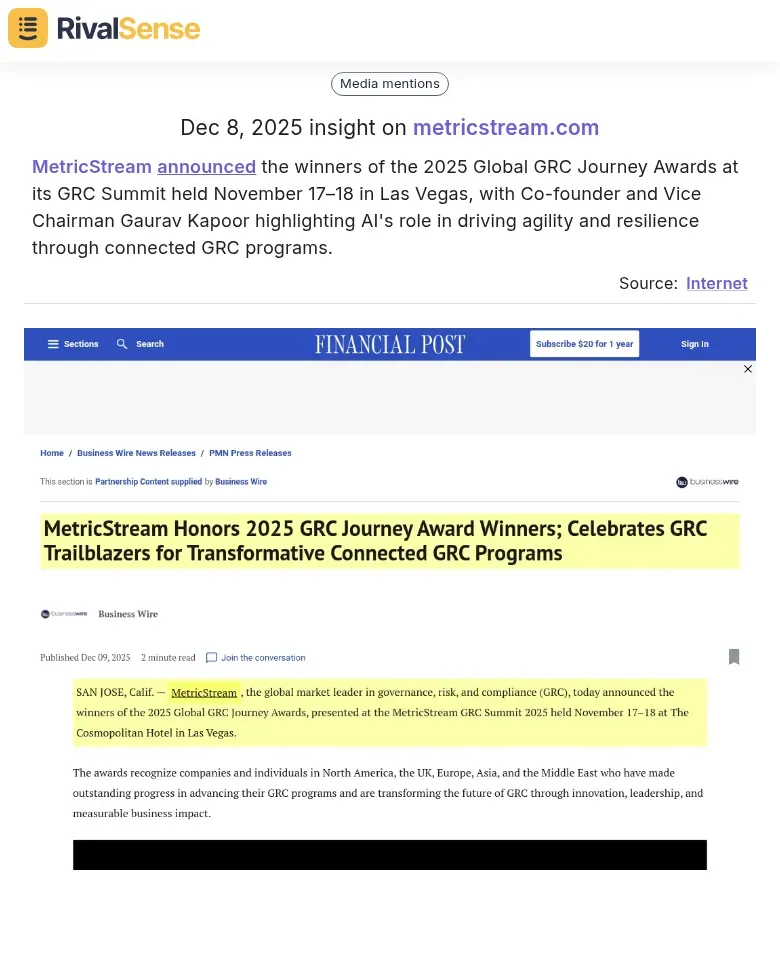 This type of insight is valuable because it shows how leaders are recognized for excellence and how they integrate AI into their strategies, providing benchmarks for your own optimization efforts.
Practical steps:
- Identify 3-5 award-winning competitors in your space
- Map their customer journey touchpoints across marketing, sales, and success teams
- Document their AI implementation patterns (predictive analytics, chatbots, personalization engines)
- Analyze retention metrics they publicly share (NPS, churn rates, expansion revenue)
Top performers leverage AI for strategic advantage by using predictive models to identify at-risk accounts before churn occurs. Study how they deploy AI-powered insights across departments to create unified customer intelligence.
Key optimization insights:
- Benchmark your customer success programs against industry leaders' tiered support models
- Analyze competitors' community-building strategies and educational content
- Track how top performers use data from mature accounts to inform product roadmaps
- Document their escalation protocols and premium service offerings
Create a quarterly benchmarking report comparing your metrics against industry leaders across retention rates, expansion revenue, and customer satisfaction scores.
Practical Implementation: Building Your Competitor Insights Cheat Sheet 🛠️
Building your Competitor Insights Cheat Sheet requires a systematic approach. Start by creating automated monitoring systems: use tools like RivalSense to track competitor website changes, pricing updates, content strategies, and social media activity in real-time. Set up alerts for key triggers like new product launches or pricing changes.
Develop specific KPIs to measure impact: track metrics like win/loss rates against competitors, deal cycle time reduction, customer retention improvements, and market share changes. Create a dashboard that connects competitor insights to account lifecycle outcomes.
Establish a regular review cadence: conduct weekly tactical reviews of competitor movements, monthly strategic analysis sessions, and quarterly deep dives. Use a structured framework:
- Collect competitor data
- Analyze patterns and gaps
- Identify opportunities/threats
- Develop counter-strategies
- Implement actions
- Measure results
Practical checklist:
- Set up automated alerts for 3-5 key competitor activities
- Define 2-3 KPIs linking insights to account outcomes
- Schedule recurring review meetings in your calendar
- Create a simple template to document insights and actions
- Assign ownership for monitoring specific competitors
Tip: Start small with 2-3 key competitors and 1-2 critical metrics, then expand as you refine your process.
Conclusion: Turn Insights into Action with RivalSense 🚀
Manually tracking competitors across the key account lifecycle can be time-consuming and prone to misses. Automating this process with a tool like RivalSense ensures you never miss a critical update. RivalSense tracks competitor product launches, pricing changes, event participations, partnerships, regulatory aspects, management changes, and media mentions across websites, social media, and various registries, delivering all in a weekly email report.
Ready to gain your competitive edge? Try out RivalSense for free at https://rivalsense.co/ and get your first competitor report today to start anticipating moves and strategizing proactively.
📚 Read more
👉 Facility Management Competitive Intelligence Workflow: Uncover Rival Insights
👉 Uncover Competitor Financial Moves: Monitor Press Releases for M&A Insights
👉 Decoding Competitor Strategies: Insights from Russell Reynolds Associates' CFO Event
👉 Key Account Tracking for Mobile Apps: A Strategic Guide to Monitoring Competitors
👉 Aviation Fuel Construction CRM Mistakes: Avoiding Key Account Tracking Pitfalls