
Competitor Financials & M&A Benchmarking: Key Account Growth Insights for 2026
Understanding competitor financial performance isn't just about numbers—it's about decoding market positioning and growth trajectories. When you analyze metrics like revenue growth, profit margins, and cash flow patterns, you gain insights into how competitors are allocating resources, which markets they're prioritizing, and where they're vulnerable. For instance, a competitor with declining margins but aggressive R&D spending might be preparing for a market shift.
M&A benchmarking reveals strategic opportunities and market consolidation trends. Track acquisition patterns to identify which companies are expanding through strategic purchases versus organic growth. This helps you anticipate market consolidation and spot potential acquisition targets or partnership opportunities before your competitors do.
Practical steps to get started:
- Identify 3-5 key competitors and gather their financial statements.
- Benchmark revenue growth rates and profit margins quarterly.
- Monitor M&A activity in your industry using tools like RivalSense.
- Connect financial metrics to key account strategies—if a competitor is losing high-value accounts, that's your opportunity.
- Create a quarterly competitive financial dashboard to track trends.
By linking financial intelligence to key account growth, you can proactively target accounts where competitors are weak, adjust pricing strategies based on competitor profitability, and anticipate market shifts before they happen.
Decoding Competitor Financial Communications: Insights from Earnings Announcements
Earnings announcements reveal more than just numbers—they're strategic communications that signal competitor priorities and investor relations sophistication. By decoding these announcements, you can anticipate moves and refine your own stakeholder engagements. Here’s how to extract maximum value from them.
Timing & Participation Patterns:
- Track when competitors schedule earnings webcasts (early morning vs. after-hours) and which executives participate. Early morning releases often indicate confidence, while CEO/CFO joint appearances signal transparency. Monitor if they include Q&A sessions—their length and tone reveal openness to scrutiny.
Growth Signals in Financial Metrics:
- Look beyond top-line revenue to segment performance and profitability trends. Note how competitors highlight specific revenue milestones (e.g., "first $100M quarter") or margin improvements. Analyze year-over-year vs. quarter-over-quarter growth rates to spot acceleration or deceleration patterns.
Framing & Messaging Analysis:
- Examine the narrative around results: Do they emphasize customer acquisition, retention, or expansion? Watch for strategic shifts in language (e.g., from "growth at all costs" to "profitable growth"). Compare their key messages across earnings calls, press releases, and investor presentations for consistency.
For example, Iute Group has invited investors and analysts to an earnings webcast on February 19, 2026, where CEO Tarmo Sild and CFO Kristel Kurvits will comment on its unaudited 12M 2025 results.
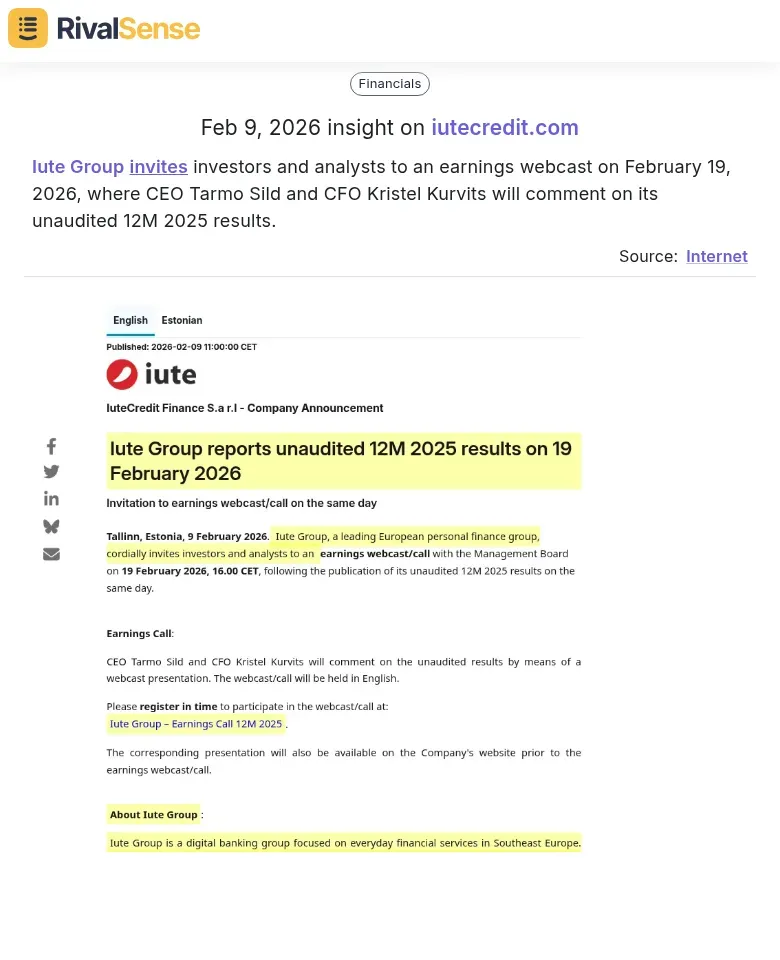
Tracking such events is valuable because it provides early insights into a competitor's financial health and strategic focus, allowing you to adjust your communications and account strategies accordingly.
Practical Checklist:
- 📅 Record webcast timing and executive lineup for each competitor quarterly.
- 📊 Extract and compare growth metrics (revenue, margins, customer metrics) across periods.
- 💬 Note recurring themes and buzzwords in management commentary.
- 🎯 Track guidance adjustments and how they justify variances.
- 🔄 Benchmark communication frequency and channels (e.g., earnings calls vs. investor days).
By systematically analyzing these elements, you can anticipate competitor moves, assess their financial health, and refine your own stakeholder communications.
M&A Benchmarking: Learning from Competitor Acquisition and Investment Patterns
M&A benchmarking reveals strategic priorities through competitor acquisition and investment patterns. By analyzing these activities, you can uncover where the market is heading and identify opportunities for your own growth. Major investment rounds signal market confidence—when competitors secure significant funding, they're likely expanding into adjacent markets or developing new product lines.
Acquisition patterns identify emerging segments. Track which technologies competitors acquire: AI startups? Data analytics platforms? These reveal focus areas. For example, if three competitors acquire customer data platforms within six months, CDP integration is becoming a competitive necessity.
Benchmark valuation multiples against industry standards. SaaS companies typically trade at 8-12x ARR. If competitors achieve 15x, investigate their growth metrics or proprietary technology justifying premiums. Analyze deal structures: all-cash vs. stock deals indicate confidence in integration or risk-sharing.
Consider Waymo's recent announcement: Co-CEO Dmitri Dolgov announced a $16B investment round on February 7, 2026 to fuel technical and commercial scale, noting its system reduces serious injury crashes by 90% compared to human driving.
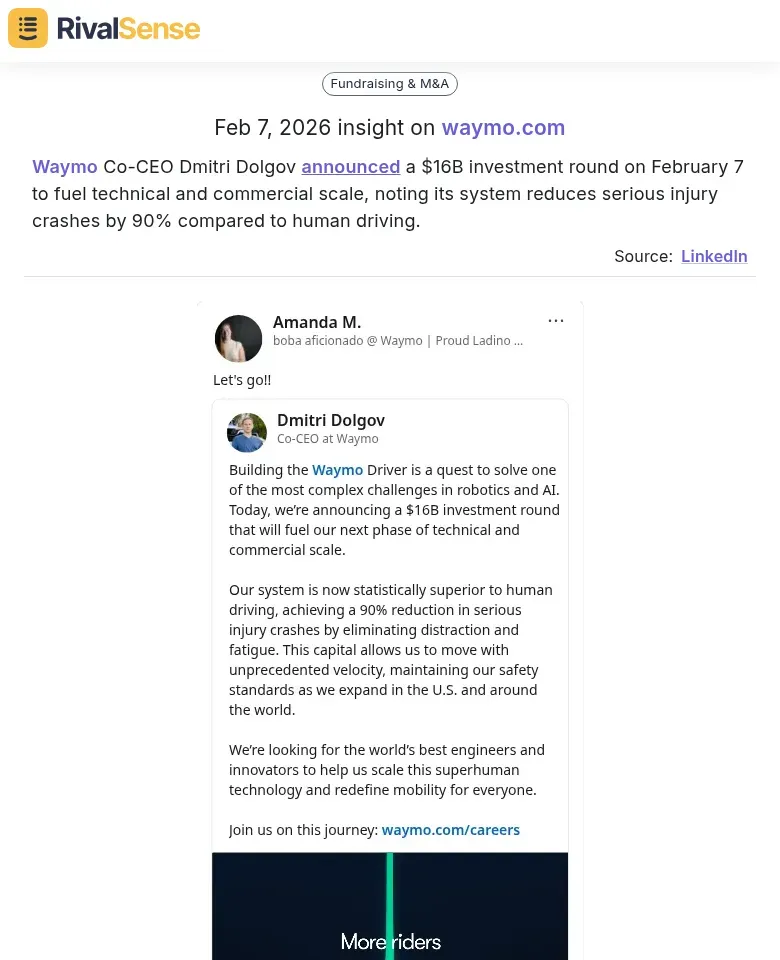
This insight is valuable because large investment rounds indicate strong market confidence and future expansion plans, helping you anticipate competitive threats and opportunities in the autonomous driving sector.
Practical Steps:
- Create a tracking spreadsheet with columns for: deal size, valuation multiple, target company technology, strategic rationale.
- Monitor data sources like Crunchbase, PitchBook, and SEC filings for real-time data.
- Compare your company's metrics against acquired companies—are you acquisition-ready?
- Identify patterns quarterly: are acquisitions concentrated in specific geographic regions or customer segments?
Key insight: The most successful companies don't just track M&A—they reverse-engineer the strategic thinking behind each deal to inform their own growth roadmap.
Key Account Growth Insights: Translating Financial Data into Strategic Actions
Competitor financial data reveals more than just revenue figures—it uncovers strategic opportunities for key account growth. By dissecting their financial successes and failures, you can pinpoint where to focus your efforts for maximum impact. Start by analyzing competitor profitability by segment to identify underserved markets where your solution can deliver superior value.
For example, if competitors show declining margins in enterprise accounts but strong growth in mid-market, pivot your expansion strategy accordingly. Look at real-world cases like Reddit's Q4 and FY 2025 earnings report, where they surpassed $2.2 billion in annual revenue and $530 million in net income, with CEO Steve Huffman, COO Jen Wong, and CFO Drew Vollero answering user questions.
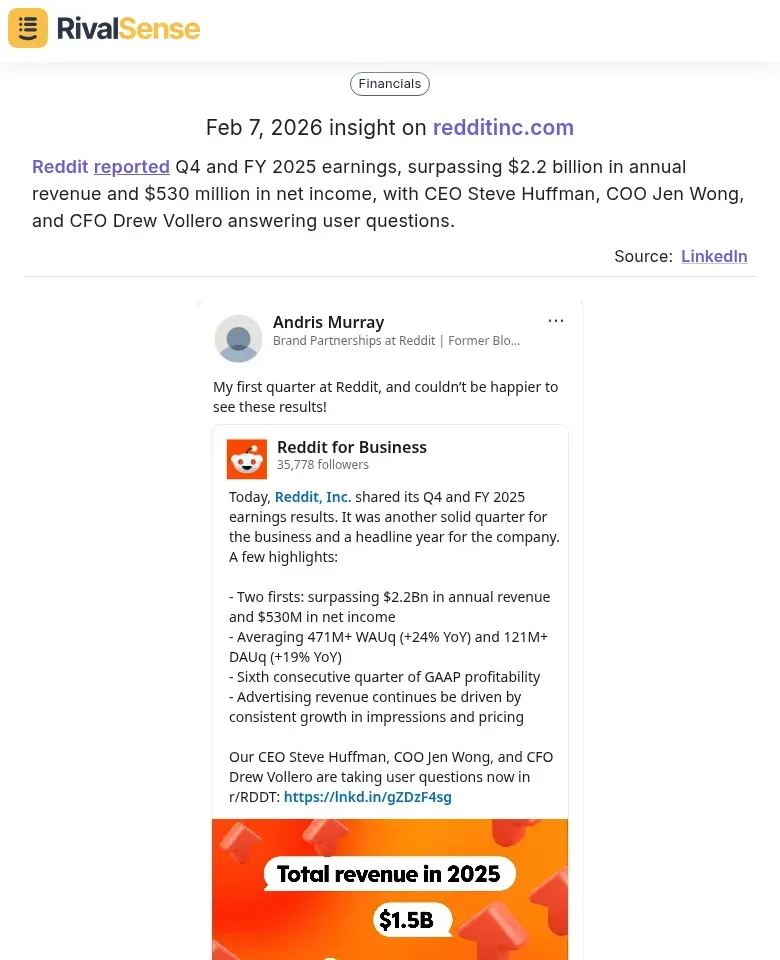
Understanding such financial milestones is valuable because it helps benchmark your own performance, identify growth trends, and refine key account strategies based on proven success factors.
Practical Steps:
- Benchmark pricing against competitor profitability ratios—if they maintain 40%+ margins with premium pricing, test value-based pricing models.
- Map competitor investment priorities (R&D, sales, marketing) to identify gaps in their service models you can exploit.
- Use M&A activity patterns to anticipate market consolidation and position your solution as the stable alternative.
Key Checklist:
- 🔍 Identify 3-5 competitor segments with declining service quality (rising support costs/revenue ratio).
- 🧮 Calculate your ideal account expansion ROI using competitor customer acquisition cost benchmarks.
- 📦 Develop tiered service packages aligned with competitor profitability sweet spots.
Pro tip: Track competitor quarterly earnings calls for hints about future account strategy shifts—these often precede pricing changes or service model adjustments by 6-9 months.
Operational Excellence: Learning from Competitor Performance Metrics
Operational excellence begins with understanding how competitors achieve superior performance. Benchmarking against industry leaders provides a roadmap for improving your own efficiency and customer outcomes. Start by benchmarking operational efficiency through cost structure analysis—compare your SG&A ratios, COGS percentages, and operating margins against top performers.
A 2024 study reveals companies with optimized cost structures maintain 15-20% higher EBITDA margins than industry averages. Identify best practices by analyzing competitor safety metrics (incident rates), quality indicators (defect rates under 2%), and customer outcomes (NPS scores above 50). Track how leaders achieve these results through technology adoption and process standardization.
Practical Steps for Key Account Managers:
- Calculate competitor gross margin ratios monthly to identify pricing advantages.
- Monitor accounts receivable turnover to benchmark collection efficiency.
- Compare customer acquisition costs to optimize sales investments.
- Analyze working capital ratios to improve cash flow management.
- Track return on assets to assess operational effectiveness.
Translate financial ratios into actionable improvements: If competitors show 30% higher asset turnover, implement lean inventory systems. When you see superior current ratios (2:1 vs. your 1.5:1), renegotiate payment terms with suppliers. Use competitor data to set realistic targets—aim for 10-15% improvement in key ratios within 12 months through targeted operational changes.
Future-Proofing Your Strategy: Predictive Insights from Competitor Financial Trends
To future-proof your strategy, leverage competitor financial trends for predictive insights. By proactively analyzing these trends, you can stay ahead of market shifts and make informed decisions. Analyze historical patterns like revenue growth rates, profit margins, and cash flow cycles to forecast competitor moves—e.g., if a rival consistently invests in R&D before launching new products, anticipate market shifts.
Develop early warning systems by monitoring key financial health indicators: debt-to-equity ratios (above 2.0 signals risk), liquidity ratios (below 1.0 may indicate cash crunches), and quarterly earnings surprises (sudden drops can precede aggressive pricing). Use tools like RivalSense to track these metrics in real-time, setting alerts for anomalies.
Create adaptive key account strategies by simulating competitor responses: if a competitor's financials show cost-cutting, expect them to undercut prices, so preemptively strengthen value propositions.
Steps to Implement:
- Benchmark financials quarterly against key competitors.
- Identify correlation patterns (e.g., high marketing spend precedes expansion).
- Build scenario plans for common triggers like M&A activity.
Tips: Focus on leading indicators over lagging ones, and integrate financial data with market intelligence for holistic foresight.
Put Insights into Action with RivalSense 🚀
Translating competitor financial intelligence into growth requires consistent tracking and analysis. Instead of manually scouring websites and filings, streamline the process with a dedicated tool.
RivalSense tracks competitor product launches/updates, pricing changes, event participations, partnerships, regulatory aspects, management changes, and media mentions across company websites, social media, and various registries. It delivers all this intelligence in a concise weekly email report, so you're always informed.
Why this matters: With real-time insights like the examples shared in this post, you can anticipate market moves, benchmark your performance, and seize opportunities before competitors do.
👉 Try RivalSense for free today and get your first competitor report to start unlocking key account growth insights: https://rivalsense.co/
📚 Read more
👉 Leveraging Competitor Insights: A Case Study on Spotify's Instagram Feature
👉 Key Account Management for Startups: A Practical Guide to Building Strategic Relationships
👉 A Practical Competitor Sales Tracking Framework for Commercial Insurance Brokers
👉 How Pfizer's Oncology Guide Reveals Patient Accessibility Gaps: A Competitive Intelligence Blueprint
👉 Mastering Competitor Differentiation: A Guide to Internet Intelligence for B2B Leaders