
Competitor Financial Analysis Templates: Fundraising & M&A Insights Framework
Competitor financial analysis is the strategic compass that guides both fundraising and M&A decisions. When raising capital, investors scrutinize how your financial performance stacks up against rivals—they want to see not just growth, but competitive advantage.
A comprehensive analysis reveals whether you're outperforming peers on key metrics like revenue growth, profitability, and market share, which directly impacts valuation and funding terms. For M&A, financial analysis frameworks help identify acquisition targets by evaluating their financial health, growth trajectory, and synergy potential.
Practical steps include:
- 🏗️ Create a competitor financial dashboard tracking revenue, margins, and cash flow trends
- 📊 Benchmark your financial ratios against industry leaders
- 💰 Analyze acquisition multiples paid for similar companies
- 🔄 Model synergy scenarios to quantify potential value creation
Tip: Use both quantitative metrics (DCF analysis, market share) and qualitative factors (strategic positioning, competitive moats) for a complete picture. This dual approach helps you negotiate better terms in fundraising and identify the most valuable acquisition targets in M&A scenarios.
Essential Components of a Competitor Financial Analysis Template
A robust competitor financial analysis template must capture both quantitative metrics and qualitative context. Without a structured framework, you risk missing critical insights that drive strategic decisions. Start with these essential components to build a comprehensive analysis.
Key Financial Metrics to Track:
- Revenue Growth: Track quarterly/yearly trends and growth drivers
- Profitability: Monitor gross/net margins, EBITDA, and cost structures
- Cash Flow: Analyze operating cash flow, burn rates, and liquidity positions
- Market Share: Estimate using revenue comparisons and industry reports
Comparative Analysis Framework:
Create standardized templates for side-by-side comparisons across 3-5 key competitors. Include:
- Financial ratio analysis (P/E, P/S, debt-to-equity)
- Growth trajectory charts (3-year projections)
- Benchmarking against industry averages
- Visual dashboards for quick pattern recognition
Qualitative-Quantitative Integration:
Combine hard numbers with strategic context:
- Link financial performance to product launches, pricing changes, or market expansions
- Note funding rounds, M&A activity, and leadership changes affecting financials
- Document competitive advantages visible in financial patterns
Practical Checklist:
✅ Update quarterly with latest earnings reports
✅ Normalize data for accurate comparisons
✅ Flag anomalies requiring deeper investigation
✅ Share insights across sales, marketing, and product teams
✅ Use templates to identify acquisition targets or fundraising benchmarks
Fundraising Insights: Using Competitor Analysis to Strengthen Your Pitch
When preparing your fundraising pitch, competitor financial analysis provides concrete evidence to strengthen your narrative. Investors are always looking for data-driven stories that showcase your market position and growth potential. Start by benchmarking key metrics against direct competitors: revenue growth rates, gross margins, customer acquisition costs, and burn rates.
If your SaaS company maintains 80% gross margins while competitors average 65%, highlight this efficiency advantage to demonstrate superior unit economics. Identify market gaps by analyzing competitor financial weaknesses. Review their quarterly reports for declining segments or high churn rates.
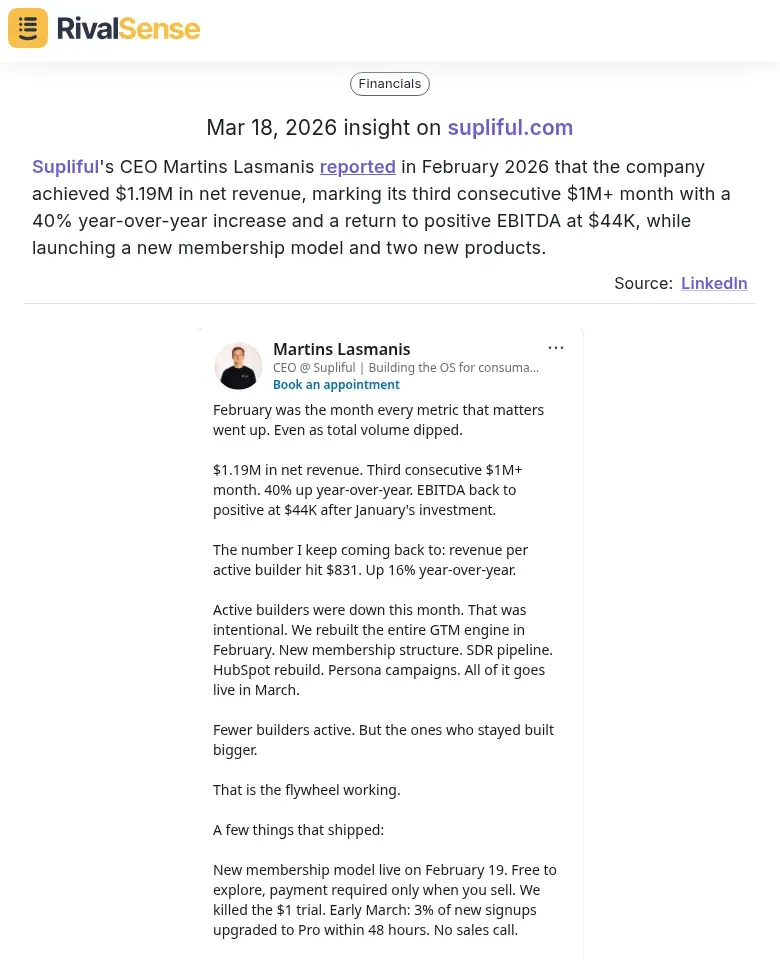
For example, RivalSense tracked Supliful's financial performance in February 2026, where the company achieved $1.19M in net revenue, marking its third consecutive $1M+ month with a 40% year-over-year increase and a return to positive EBITDA at $44K. This type of insight is valuable for fundraising as it shows real-time growth metrics and profitability trends, helping you benchmark against successful peers and validate your own projections.
Create a simple checklist:
- 📈 Gather competitor financial statements
- 🧮 Calculate key ratios
- 🔍 Identify performance gaps
- 🎯 Map weaknesses to your strengths
Validate market projections using competitor financial trends. If multiple competitors show 40%+ year-over-year growth in a specific vertical, use this data to substantiate your market size estimates. Track their R&D spending increases as signals of emerging opportunities.
Practical tip: Use tools like RivalSense to monitor competitor financial announcements in real-time, ensuring your pitch deck includes the most current market validation.
M&A Strategy: Financial Analysis for Target Identification and Valuation
Competitor financial analysis provides critical insights for M&A strategy by identifying undervalued targets and assessing integration feasibility. A thorough analysis can reveal hidden opportunities and risks that impact merger success. Start by screening competitors using financial health metrics: analyze debt-to-equity ratios (target < 1.5x), cash flow stability (3+ years positive), and margin trends (consistent or improving).
For synergy assessment, create comparative financial models mapping revenue overlaps and cost reduction potential. For instance, RivalSense captured Gjensidige and ERGO Lithuania employees celebrating their upcoming merger in Vilnius, aiming to unite into one larger company in the Baltic states by the end of 2026. This insight is valuable for M&A strategy as it highlights market consolidation efforts and employee integration, which are key factors in post-merger success and synergy realization.

Practical checklist:
- 🗺️ Map overlapping customer segments and product lines
- 💸 Calculate potential cost synergies (typically 10-30% of combined SG&A)
- 📈 Model revenue synergies from cross-selling opportunities
- 🏦 Assess capital structure optimization potential
Integration risk evaluation requires examining financial structures: analyze debt maturity schedules, pension liabilities, and off-balance sheet commitments. Companies with complex financial engineering or aggressive accounting practices signal higher integration risk.
Tip: Focus on competitors with clean balance sheets and transparent financial reporting for smoother post-merger integration.
Key metrics to track: EBITDA margins (benchmark against industry), working capital efficiency (days sales outstanding < 45), and capital expenditure patterns. Companies with consistent capital discipline typically integrate more successfully than those with erratic spending habits.
Real-World Applications: Learning from Competitor Financial Events
Real-world competitor financial events provide invaluable strategic insights beyond your immediate market. By analyzing broader economic and regulatory changes, you can anticipate shifts in competitor behavior and adjust your strategy accordingly.
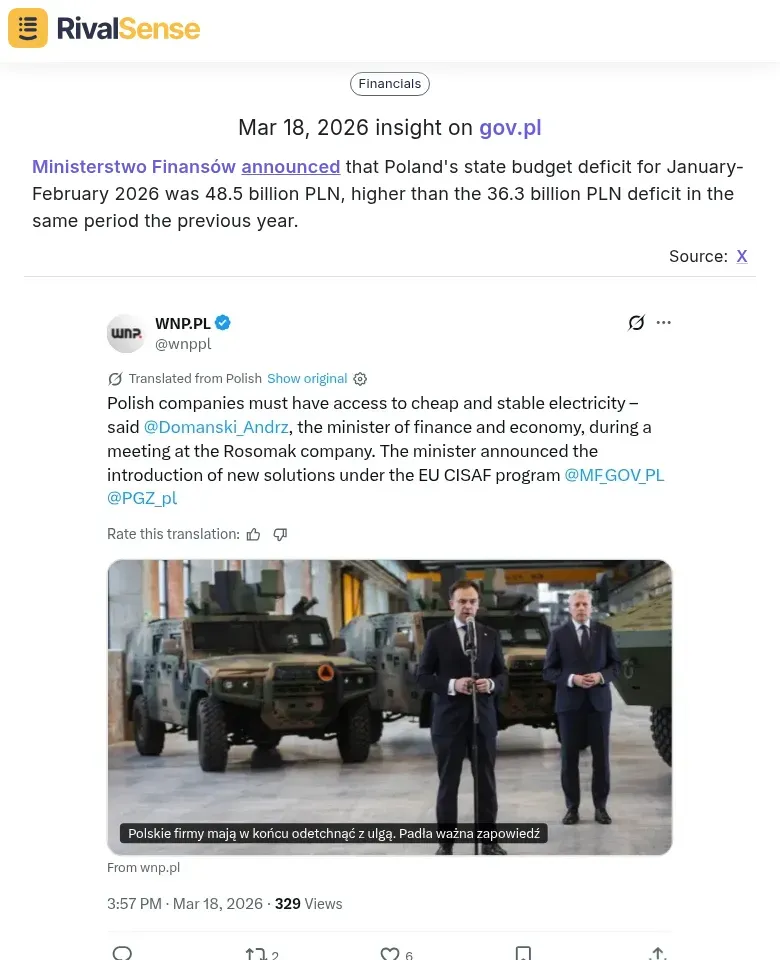
For example, RivalSense reported that Ministerstwo Finansów announced Poland's state budget deficit for January-February 2026 was 48.5 billion PLN, higher than the 36.3 billion PLN deficit in the same period the previous year. This type of insight is valuable for business strategy as it offers macroeconomic context that can affect competitor investments, pricing strategies, and market expansions, especially in sectors like defense, infrastructure, and technology.
Pro tip: Correlate public sector spending trends with competitor performance. When national fiscal policy shifts, track how competitors adjust their strategies, and use this intelligence to inform your own planning.
Create a financial event tracker with columns for:
- 📅 Transaction type
- 🎯 Strategic rationale
- 💰 Financial metrics impacted
- 🔄 6-12 month follow-up analysis
This framework transforms isolated financial news into actionable competitive intelligence.
Implementation Framework: Building Your Competitor Financial Analysis System
Building an effective competitor financial analysis system requires a structured approach and the right tools. Automating data collection saves time and ensures you never miss critical updates. Start by creating a centralized financial intelligence dashboard using tools like RivalSense, which automates data collection from SEC filings, earnings calls, and investor presentations.
Develop standardized templates tracking key metrics: revenue growth rates, profit margins, cash flow patterns, and valuation multiples (EV/EBITDA, P/E ratios).
Implementation Checklist:
- 🔔 Set up automated alerts for competitor financial announcements
- 📊 Create quarterly comparison spreadsheets with standardized metrics
- ⚖️ Establish benchmarking against industry averages
- 💼 Monitor funding rounds and M&A activity patterns
- 📈 Track key performance indicators (KPIs) relevant to your sector
Integrate insights into strategic planning by scheduling monthly review sessions where financial data informs decisions about pricing strategies, market positioning, and resource allocation. Use competitor valuation trends to benchmark your own fundraising targets and identify optimal timing for capital raises.
Pro Tip: Create a "red flag" system that triggers alerts when competitors show unusual financial patterns—sudden cash burn increases, margin compression, or aggressive capital raises—which may signal strategic shifts requiring immediate attention.
Take Action with RivalSense
To effectively implement the strategies outlined in this framework, you need timely and accurate competitor intelligence. RivalSense tracks competitor product launches, pricing updates, event participations, partnerships, regulatory aspects, management changes, and media mentions across various sources, delivering all in a weekly email report.
Ready to gain a competitive edge? Try out RivalSense for free at https://rivalsense.co/ and get your first competitor report today to start making data-driven decisions for your fundraising and M&A strategies.
📚 Read more
👉 Decoding Competitor Pricing Moves: A Real-World Analysis from Credifiel México
👉 The Strategic Advantage: 7 Key Benefits of a Dedicated Key Account Manager
👉 Beginner's Guide: Competitive Intelligence Software Benefits for IT Asset Management
👉 How Intel Countered NVIDIA's Visteon Deal with Edge AI Partnerships
👉 Best Practices: Analyzing Competitor Brand Perception on Facebook