
Competitive Edge in Professional Services: A Practical Guide to Monitoring Regulatory Filings
In professional services, regulatory filings are more than just compliance paperwork—they're strategic intelligence goldmines. 🏆 Understanding these documents can provide early warnings of market shifts and strategic moves by your rivals. SEC Form D filings, for instance, reveal competitor expansion plans through capital raises for new offices or service lines. When a consulting firm files for $10M in funding, you can track where they're expanding geographically and what services they're scaling.
Hiring patterns in regulatory disclosures signal strategic shifts. If a legal firm suddenly lists multiple AI compliance specialists, they're pivoting to tech regulation services. Monitor job titles in Form 10-K filings—new 'ESG Strategy Director' roles indicate sustainability consulting expansion. Product/service category changes in annual reports show strategic pivots; when an accounting firm adds 'cybersecurity advisory' to their offerings, they're entering a new market segment.
Practical Tip: Create a quarterly filing review checklist including SEC EDGAR searches for key competitors, tracking new service categories in annual reports, and monitoring executive team changes in proxy statements. Set up alerts for Form D filings to catch expansion moves before competitors announce them publicly.
Step 1: Identifying Key Regulatory Sources and Filing Types
Effective monitoring begins with mapping essential regulatory databases specific to your professional services niche. 📚 For accounting firms, the SEC's EDGAR database is crucial for monitoring 10-K, 10-Q, and 8-K filings. Law firms should track state bar association filings and court docket systems, while consulting firms need to monitor industry-specific bodies like FINRA for financial services consultants.
Differentiate between mandatory compliance filings and strategic disclosure documents. Mandatory filings, such as annual reports or license renewals, follow strict deadlines, while strategic disclosures—like merger announcements or leadership changes—reveal competitive positioning. This distinction helps prioritize your monitoring efforts.
Practical Checklist:
- SEC EDGAR for public company disclosures
- FINRA CRD for broker-dealer registrations
- State professional licensing databases
- Court and arbitration filing systems
- Industry association compliance portals
Monitoring Frequency Tips:
- Daily: SEC 8-K filings (material events) 📅
- Quarterly: 10-Q financial reports
- Annually: 10-K reports and license renewals
- Real-time: Court dockets and arbitration filings
- Monthly: State regulatory updates
Set up automated alerts for competitor names in key databases to stay ahead. Remember that regulatory cycles vary by industry—financial services have quarterly reporting, while legal filings follow litigation timelines.
Step 2: Setting Up Your Monitoring System and Tools
Once you've identified key regulatory bodies, establish a systematic monitoring approach for efficiency. 🔧 Choose between automated tools for real-time alerts or manual tracking for budget constraints, but prioritize consistency to avoid missing critical updates.
Create a structured competitor watchlist to focus your efforts:
- Primary competitors (direct service providers)
- Secondary threats (adjacent service firms)
- Emerging players (new market entrants)
Set up alert systems for:
✅ New filings (10-K, 10-Q, 8-K)
✅ Regulatory actions or investigations
✅ License renewals or disciplinary actions
✅ Ownership changes or M&A activity
Integration Strategy: Combine regulatory data with other intelligence sources for deeper insights. For example, cross-reference SEC filings with Glassdoor reviews for staffing insights, or map regulatory compliance against pricing strategy changes.
Practical Tip: Start with 3-5 key competitors and 2-3 critical filing types, then expand as your system matures. Use RSS feeds for manual monitoring or API integrations for automated tools, and set weekly review cadences.
Step 3: Analyzing Personnel Changes and Hiring Patterns
Personnel changes reveal strategic shifts long before they're publicly announced, offering a window into competitor priorities. 👥 Start by tracking executive appointments—a new CTO often signals tech investment, while a Chief Strategy Officer suggests market expansion. Analyzing hiring patterns can uncover emerging service lines or capability gaps.
For instance, monitoring tools like RivalSense provide valuable insights into personnel movements. Consider this example where RivalSense tracked a key hire:
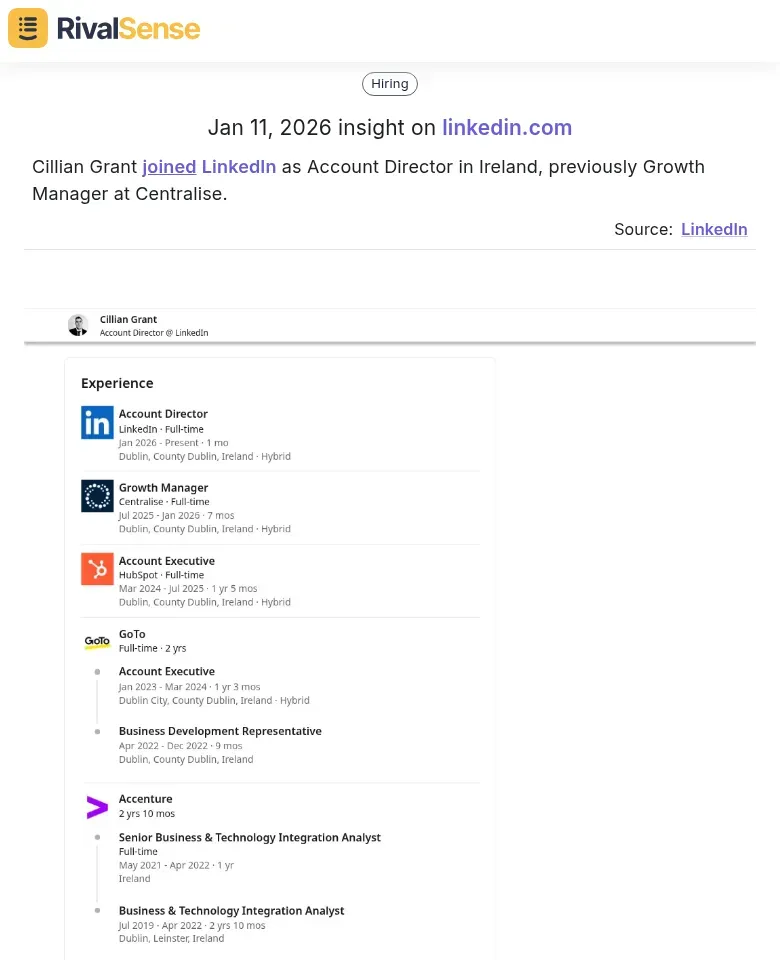
Why this insight matters: Tracking senior hires like Cillian Grant's move to LinkedIn as Account Director in Ireland signals the company's focus on strengthening its leadership in specific regions, hinting at market expansion strategies you might need to counter.
Similarly, hiring announcements can indicate strategic investments. RivalSense also captured this hiring insight:
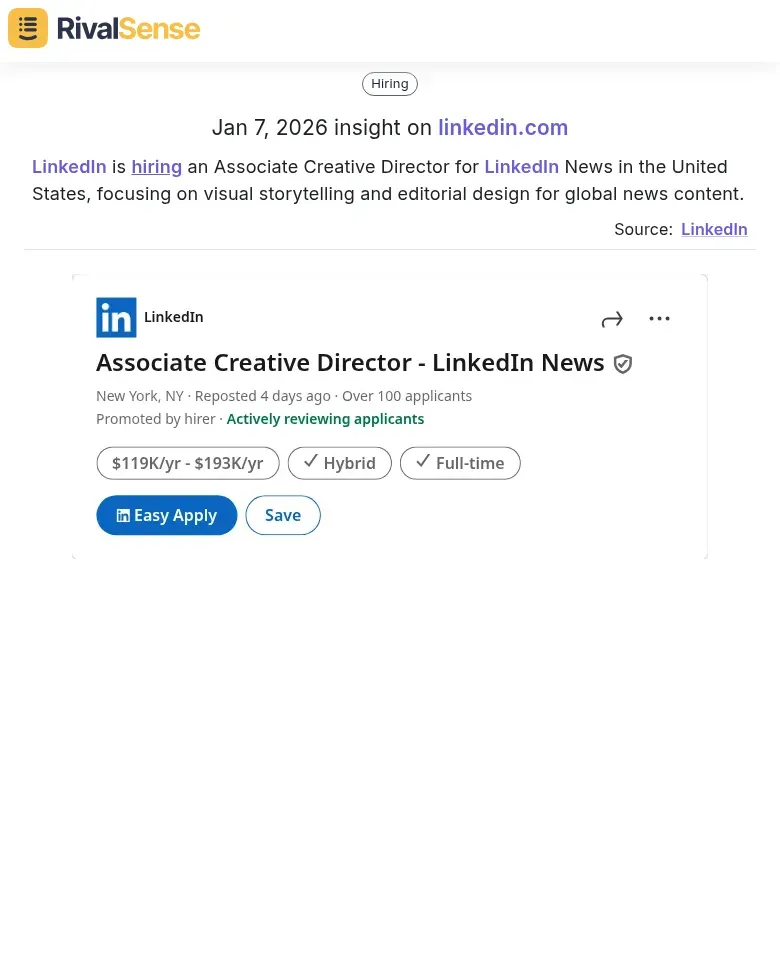
Why this insight matters: When LinkedIn posts a role for an Associate Creative Director focusing on visual storytelling for global news, it highlights their investment in content and media services. Such insights help you anticipate competitor moves into new service areas like digital content consulting.
Practical Checklist:
- Monthly review of competitor leadership pages
- Track job postings for new role categories
- Note talent sources—where competitors hire from
- Document skill sets in job descriptions
- Compare hiring velocity across departments
Remember: Sudden hiring spikes in a department often precede major initiatives by 3-6 months. Use this lead time to prepare your competitive response.
Step 4: Decoding Product and Service Category Changes
Product and service category changes in regulatory filings are clear indicators of strategic pivots and market adaptation. 🔍 Focus on Item 101 disclosures in 10-K and 10-Q filings, where companies describe their principal offerings. Subtle additions or removals can signal shifts in business focus.
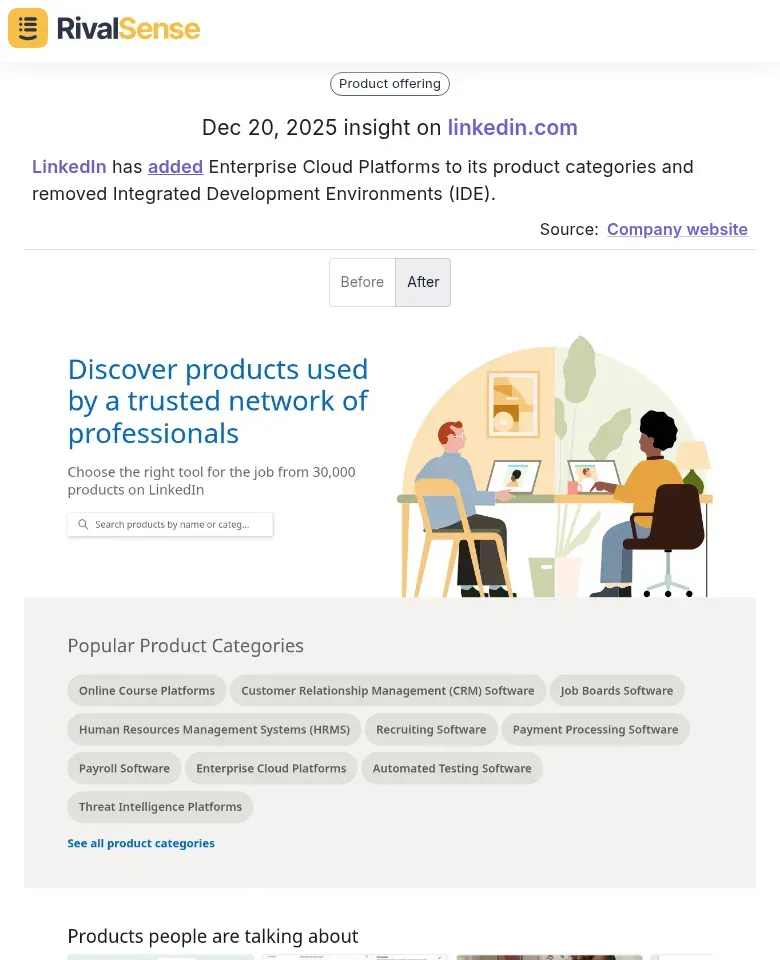
For example, RivalSense insights can highlight such changes effectively:
Practical Checklist:
- Track Additions/Removals: Create a spreadsheet comparing year-over-year service categories. Note timing and context when a competitor adds 'AI consulting' or removes 'legacy system support.'
- Analyze Market Signals: New categories like 'ESG advisory' indicate adaptation to emerging client demands and regulatory trends.
- Connect to Industry Trends: When multiple competitors simultaneously add similar service categories, it signals broader market shifts.
- Monitor Segment Reporting: Changes in financial segment grouping often precede formal category announcements.
Pro Tip: Use EDGAR's full-text search to track specific service terms across filings. If a competitor shifts from 'project-based consulting' to 'managed services,' they're likely moving to recurring revenue models—a critical insight for your business planning.
Step 5: Turning Insights into Actionable Business Strategy
Transforming regulatory intelligence into strategic advantage requires deliberate action and planning. 🚀 Start by developing response strategies based on competitor moves, then align your own filings to highlight competitive differentiators. This proactive approach turns compliance into a competitive weapon.
Create a competitive response matrix to categorize competitor moves as threats or opportunities. For example, if a rival files for a new service license in your core market, develop counter-strategies like enhancing your offerings or accelerating expansion into their territories.
Actionable Checklist:
- Map competitor regulatory timelines to your strategic planning calendar 📅
- Identify 2-3 key differentiators to emphasize in your next regulatory submission
- Schedule quarterly reviews of competitor filing patterns to adjust your positioning
- Create response protocols for common competitor regulatory moves
By systematically converting regulatory intelligence into actions, you can anticipate market shifts and stay ahead. To streamline this process, consider leveraging automated tools that consolidate insights from various sources.
Take Your Competitor Intelligence to the Next Level
Manually tracking regulatory filings, personnel changes, and service updates across multiple competitors can be time-consuming and prone to oversight. Instead, try out RivalSense for free at https://rivalsense.co/ to automate this process. RivalSense tracks competitor product launches, pricing updates, event participations, partnerships, regulatory aspects, management changes, and media mentions across websites, social media, and registries, delivering all insights in a weekly email report. Get your first competitor report today and transform how you monitor the competitive landscape! 📈
📚 Read more
👉 Boost Key Account Win Rates with Competitor Product Intelligence
👉 Turning Competitor Management Changes into Strategic Advantages: A Real-World Example
👉 How to Conduct Competitor Research in 2026: A Step-by-Step Guide
👉 Beginner's Guide to Key Account Health Dashboards for Commercial Laundry Services
👉 How Bentley Systems Accelerated BIM Adoption by Learning from Autodesk's Content Catalog