
Commercial Laundry Services: Key Account Sentiment Tracking Checklist
Introduction: Why Account Sentiment Tracking is Critical for Commercial Laundry Services
In commercial laundry services, customer sentiment directly impacts retention and revenue. Research shows retention rates increase 5% for every 1% improvement in satisfaction—critical when existing customers spend 67% more than new ones. Unlike traditional feedback (surveys, reviews), systematic sentiment tracking analyzes emotional tone across all touchpoints—delivery interactions, service quality comments, billing communications—providing real-time insights before issues escalate.
Practical tip: Monitor 5-10 key accounts across 3-5 platforms with automated alerts for sentiment shifts. This proactive approach creates competitive advantage by identifying at-risk accounts early, enabling personalized retention strategies, and benchmarking against competitors' sentiment performance. Start by implementing weekly sentiment scoring for top 20% revenue-generating accounts, tracking trends rather than isolated incidents.
Setting Up Your Account Sentiment Tracking Framework
To build a robust sentiment tracking system, begin by identifying your most critical accounts and mapping key stakeholders. This foundation ensures you focus resources where they matter most and capture insights from all decision-makers.
✅ Step-by-Step Framework Checklist:
- Identify Key Accounts: List 10-20 accounts with high revenue potential or strategic importance. Use CRM data to prioritize.
- Map Decision-Makers: For each account, identify procurement managers, facility directors, and operations staff using LinkedIn or internal records.
- Establish Baseline Metrics: Track CSAT, NPS, and review ratings from platforms like Google or Yelp over the past 3-6 months.
- Leverage Automation Tools: Use tools like RivalSense for automated sentiment analysis of social media mentions, review sites, and support tickets.
- Set Up Alerts: Configure alerts for sentiment shifts, such as negative review spikes, and assign team members to respond within 24 hours.
- Regular Reviews: Schedule weekly dashboard reviews to spot trends and adjust strategies for proactive relationship management.
By following this framework, you'll create a systematic approach to sentiment tracking that drives actionable insights.
Key Sentiment Indicators to Monitor Across Communication Channels
Effectively tracking account sentiment requires monitoring specific indicators across various channels. By focusing on these key areas, you can detect early warning signs and opportunities for engagement.
Email Tone & Language Analysis: Monitor for subtle shifts in client communication patterns. Look for changes in formality ("Hi John" vs. "Dear Mr. Smith"), urgency indicators ("ASAP" frequency), and emotional language (frustration vs. satisfaction).
✅ Checklist for Email Analysis:
- Track positive/negative word frequency
- Note subject line engagement rates
- Flag escalations to management
Response Time & Engagement Tracking: Measure touchpoint responsiveness systematically.
✅ Checklist for Engagement:
- Average email reply time (target < 4 hours)
- Meeting attendance rates
- Proposal review turnaround
Practical tip: Use a simple spreadsheet to log interactions and identify disengagement patterns before accounts churn.
Social Media & Review Sentiment: Monitor mentions across platforms with specific focus.
✅ Checklist for Social Media & Reviews:
- Daily review of Google Business, Yelp, and industry forums
- Track sentiment keywords ("reliable," "broken machine," "late delivery")
- Measure review response rate (aim for 100% within 24 hours)
Example: A cluster of "delayed pickup" mentions signals operational issues needing immediate attention.
Actionable Insight: Combine these indicators to create a sentiment scorecard. When 2+ channels show negative trends, trigger a proactive account check-in. Regular monitoring helps prevent churn and identifies upsell opportunities with satisfied clients.
Competitor Sentiment Analysis: Benchmarking Your Position
Benchmarking your account sentiment against competitors reveals relative strengths and uncovers opportunities. By analyzing competitor sentiment, you can identify gaps in the market and tailor your strategies accordingly.
Start by tracking sentiment across key dimensions: service reliability, pricing transparency, response times, and equipment performance. Use a 5-point scale (1=very negative, 5=very positive) to quantify feedback from customer reviews, support tickets, and direct surveys.
Analyze negative sentiment patterns to uncover competitor weaknesses. Look for recurring complaints about delayed deliveries, billing disputes, or maintenance issues. For example, if Competitor A shows consistent 2-star ratings on "emergency response," this reveals a vulnerability in their service reliability that you can exploit.
Leverage sentiment gaps for strategic account acquisition. Create targeted outreach campaigns highlighting your superior performance in areas where competitors underperform. Develop case studies showcasing how you resolved issues that plague competitors. Offer pilot programs to accounts expressing dissatisfaction with current providers.
✅ Checklist for Competitor Sentiment Analysis:
- Collect sentiment data from review sites, social media, and customer interviews
- Score competitors on 4-5 key service dimensions
- Identify patterns in negative feedback (frequency, severity, themes)
- Map sentiment gaps to your service differentiators
- Create targeted messaging addressing competitor weaknesses
- Track sentiment changes quarterly to measure competitive impact
Enhancing Analysis with Competitor Intelligence
To deepen your competitor sentiment analysis, integrate insights from tools like RivalSense. Tracking competitor activities such as product launches, strategic investments, and management changes provides context for sentiment shifts and informs your strategy.
For instance, RivalSense tracked that NiCE launched CXone Mpower Workforce Management, an AI-powered tool for contact centers. This product launch can influence customer expectations in the service industry, including commercial laundry. By monitoring such launches, you can anticipate how competitor innovations might affect sentiment and adjust your tracking focus.
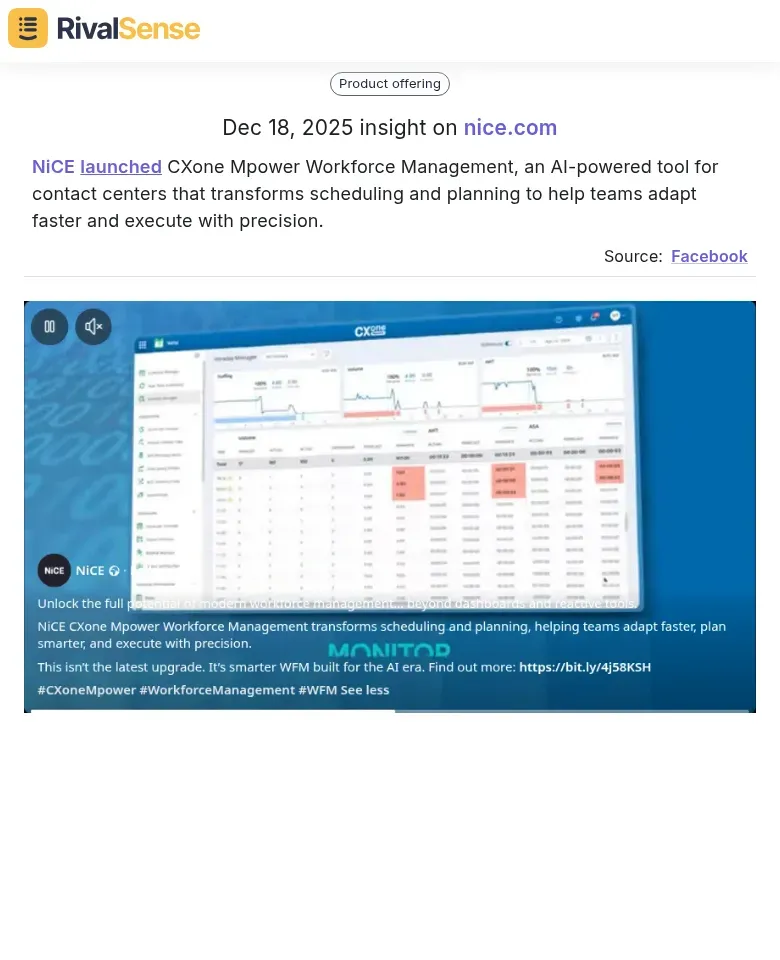
Why it's valuable: Product launch insights help you benchmark your offerings and prepare for changes in customer sentiment driven by new competitor features.
Similarly, NiCE CEO Scott Russell explained in a podcast that the company is spending close to a billion dollars to push AI deeper into customer service and fraud prevention. This strategic investment signals where competitors are allocating resources, which can impact market dynamics and customer perceptions.
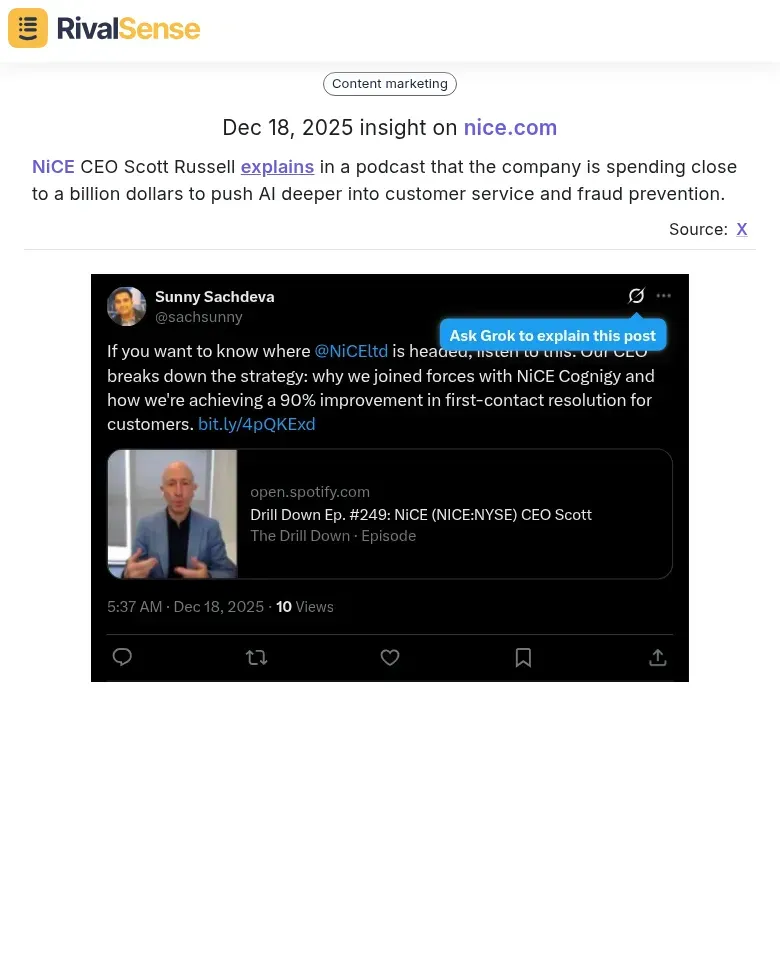
Why it's valuable: Understanding competitor investments allows you to anticipate industry trends and align your sentiment tracking with emerging areas of competition.
Lastly, Sunny Nanda, MBA joined NiCE as General Manager & Vice President of Sales, Healthcare CX - Americas. Management changes can indicate shifts in sales strategies or market focus, which may influence competitor behavior and customer relationships.
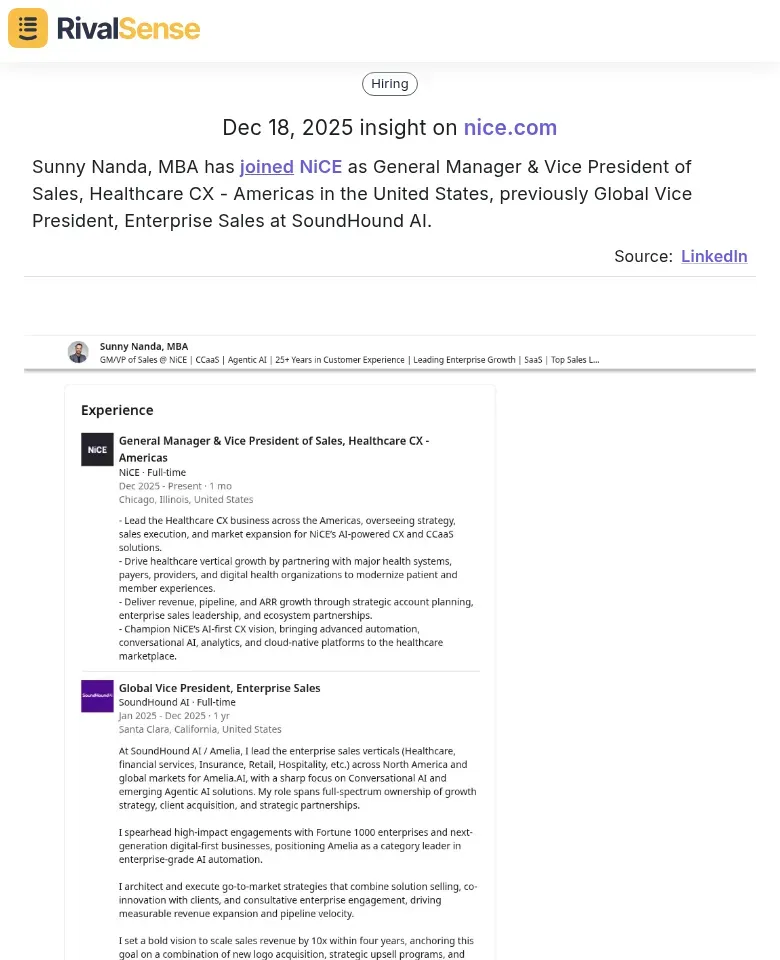
Why it's valuable: Tracking management changes helps you predict competitive moves and tailor your account sentiment strategies to counter new initiatives.
By combining sentiment data with competitor intelligence, you gain a holistic view of the competitive landscape, enabling proactive decision-making.
Actionable Strategies Based on Sentiment Insights
Once you've identified sentiment patterns, implement these actionable strategies to drive retention and growth. These steps turn data into direct business improvements.
-
Targeted Intervention Plans: For at-risk accounts showing negative sentiment trends, create tiered response protocols.
- Immediate action: Assign a dedicated account manager for accounts with 3+ consecutive negative mentions.
- Medium-term: Schedule service reviews for accounts with declining sentiment scores.
- Long-term: Develop retention offers for accounts showing consistent dissatisfaction.
-
Personalized Communication: Segment accounts by sentiment patterns.
- For frustrated accounts (mentions of "late," "broken"), use proactive, solution-focused messaging.
- For satisfied accounts ("reliable," "efficient"), request testimonials and offer loyalty rewards.
- For neutral accounts, implement educational content about service upgrades.
-
Service Improvement Alignment: Map specific feedback to operational changes.
- If multiple accounts mention "detergent residue," initiate equipment calibration checks.
- For "delivery delays," optimize routing schedules.
- Create a feedback-action matrix linking sentiment keywords to specific service adjustments.
✅ Quick Implementation Checklist:
- ✅ Weekly review of top 5 negative sentiment accounts
- ✅ Monthly sentiment pattern analysis by service type
- ✅ Quarterly alignment of service improvements with sentiment data
- ✅ Bi-annual communication strategy refresh based on sentiment trends
This ensures continuous alignment between sentiment insights and business actions.
Implementing and Measuring Your Sentiment Tracking Program
To implement an effective sentiment tracking program, establish clear KPIs and regular reporting cadences. This systematic approach ensures that insights lead to measurable business outcomes.
Start by setting key performance indicators (KPIs) such as customer satisfaction scores (CSAT), net promoter scores (NPS), and sentiment trends over time. Define specific targets, like reducing negative mentions by 20% quarterly or increasing positive feedback on service reliability by 15%.
Create a regular reporting schedule: generate weekly dashboards for operational teams and monthly executive summaries for leadership. Use automation tools like RivalSense to collect data from reviews, social media, and support tickets efficiently. Communicate findings through scheduled stakeholder meetings, highlighting key insights and action items.
Build continuous improvement loops by analyzing sentiment data to identify root causes of dissatisfaction. For example, if customers complain about turnaround times, implement process adjustments and measure impact in subsequent reports. Use competitive benchmarking to compare your sentiment scores against rivals, uncovering opportunities to differentiate.
✅ Measurement Checklist:
- Define and track CSAT, NPS, and sentiment scores
- Set quarterly targets for improvement
- Automate data collection with tools like RivalSense
- Review reports weekly and monthly
- Adjust strategies based on insights and competitor benchmarks
Finally, to streamline your sentiment tracking and competitor analysis, consider leveraging specialized tools. RivalSense tracks competitor product launches, pricing updates, event participations, partnerships, regulatory aspects, management changes, and media mentions across company websites, social media, and various registries, delivering all in a weekly email report.
Try out RivalSense for free at https://rivalsense.co/ to assist with the challenges described in this post. Get your first competitor report today and gain actionable insights to enhance your account sentiment strategy.
📚 Read more
👉 How Perplexity's iPad Move Prompted Rivals to Accelerate Mobile Strategy
👉 Data-Driven LinkedIn Competitor Insights for Key Account Tracking
👉 Actionable Audio Tech Key Account Strategies for Competitive Edge
👉 Actionable Pricing Strategies: Uncover Competitor Insights with Strategic Account Tracking
👉 How Media Mentions Unlock Competitor Insights: A Real-World Case