
Biotech Key Account Tracking Automation Checklist for Precision Medicine
In precision medicine's dynamic landscape, traditional manual key account tracking is fundamentally inadequate. Manual methods fail to capture real-time competitor movements, clinical trial updates, or regulatory shifts that occur daily across global markets. Spreadsheets become outdated within hours, and reactive approaches leave biotech companies vulnerable to competitive surprises.
Automation transforms this paradigm by enabling proactive strategy. Automated tracking systems continuously monitor key accounts, competitor pipelines, and market signals, providing actionable intelligence before opportunities are lost. This shift from reactive to proactive management allows for strategic positioning rather than defensive responses.
Systematic competitor intelligence gathering delivers critical competitive advantage. By automating tracking of competitor clinical trial phases, regulatory submissions, partnership announcements, and key opinion leader engagements, biotech companies can anticipate market shifts and position their precision therapies strategically.
Practical steps to begin:
- Identify your top 10-15 key accounts across research institutions, healthcare systems, and clinical sites
- Map competitor presence and activity within these accounts
- Establish automated alerts for clinical trial updates, publications, and regulatory milestones
- Track key opinion leader movements and affiliations
- Monitor competitor partnership announcements and funding rounds
This systematic approach ensures you're not just collecting data, but transforming it into strategic insights that drive precision medicine success.
Essential Components of a Biotech Key Account Tracking System
In the fast-evolving field of precision medicine, staying ahead requires a robust tracking system. An effective biotech key account tracking system requires three essential components for precision medicine intelligence. First, implement automated monitoring of competitor executive movements and organizational changes. Set up alerts for C-suite transitions, board appointments, and departmental restructuring using tools that scan SEC filings, press releases, and LinkedIn updates. This reveals strategic shifts before they impact the market.
Second, establish real-time tracking of competitor service expansions and product portfolio developments. Create automated workflows that monitor clinical trial registries, FDA submissions, and scientific publications. Track pipeline progress from Phase I through commercialization, with alerts for new indications or combination therapies. This enables proactive response to emerging competitive threats.
Third, implement systematic capture of competitor partnership activities and conference engagements. Automate monitoring of licensing deals, academic collaborations, and conference presentations. Use AI-powered tools to analyze partnership patterns and identify emerging ecosystems. Track which key opinion leaders competitors engage with at major conferences like ASCO or AACR.
Practical checklist:
- Configure automated alerts for executive changes
- Set up clinical trial monitoring workflows
- Create partnership activity dashboards
- Establish conference engagement tracking
- Implement regular competitive intelligence briefings
Tip: Combine automated monitoring with human analysis for nuanced insights in the complex precision medicine landscape.
Learning from Competitor Intelligence: Strategic Insights from Market Movements
Competitor intelligence is not just about data collection; it's about deriving actionable insights. Transform competitor tracking into strategic foresight with these actionable approaches:
1. Executive Hiring Patterns Analysis
Track C-suite appointments to anticipate market focus shifts. When competitors hire oncology specialists, expect precision cancer therapy expansions. Why it matters: Understanding executive moves can reveal strategic priorities and new market entries months in advance.
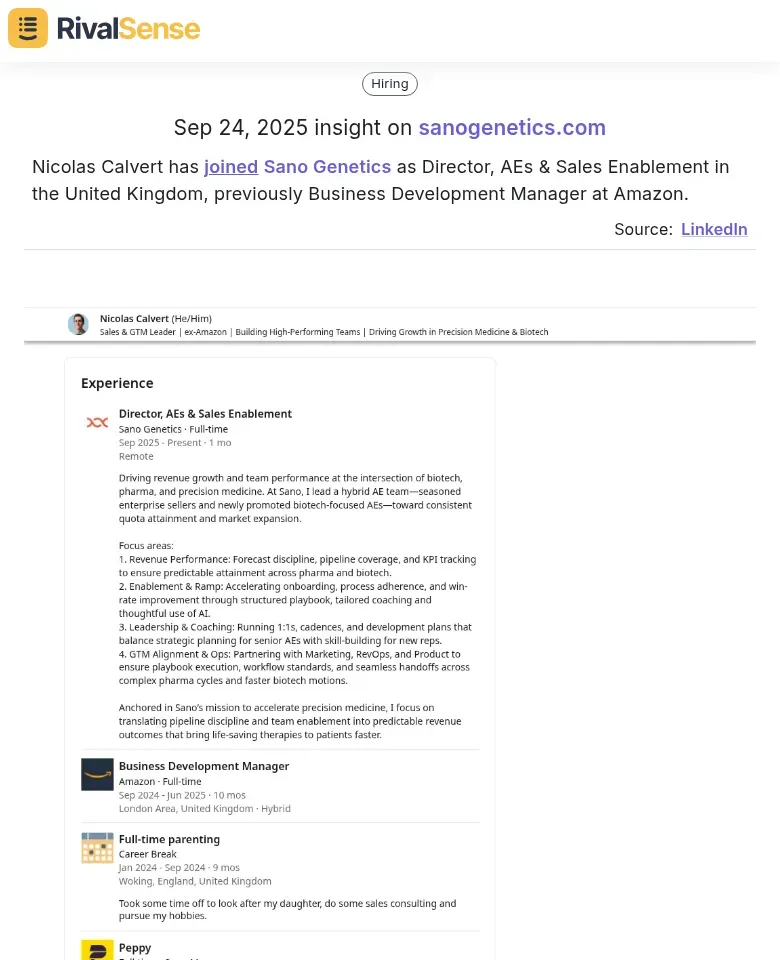
Example from RivalSense: Nicolas Calvert has joined Sano Genetics as Director, AEs & Sales Enablement in the United Kingdom, previously Business Development Manager at Amazon. This type of insight is valuable because it signals Sano Genetics' investment in sales enablement and expansion in the UK market, potentially indicating a push for growth or new service offerings.
Practical tip: Set automated alerts for executive moves at top 10 competitors using LinkedIn Sales Navigator and job board monitoring tools.
2. Service Expansion Monitoring
Identify emerging opportunities by tracking new service launches. When a competitor adds companion diagnostic services, they're likely targeting personalized medicine markets. Why it matters: Service expansions can uncover unmet needs and highlight areas where competitors are doubling down.
Checklist item: Monthly review of competitor websites, press releases, and regulatory filings for new service announcements.
3. Partnership Activity Tracking
Understand collaboration strategies by monitoring alliance formations. Academic partnerships signal early-stage research focus, while CRO collaborations indicate clinical trial acceleration. Why it matters: Partnerships can reveal strategic alliances that may impact market dynamics and competitive positioning.
Actionable step: Create a partnership matrix tracking competitor relationships with academic institutions, CROs, and diagnostic companies.
Automation Implementation:
- Use AI-powered tools to monitor competitor job postings, press releases, and partnership announcements
- Set up automated alerts for key personnel changes at competitor organizations
- Create dashboards visualizing competitor service portfolios and partnership networks
- Schedule quarterly competitive landscape reviews using automated data collection
Pro insight: The most valuable intelligence often comes from connecting seemingly unrelated data points—a new executive hire combined with a specific partnership can reveal strategic pivots months before official announcements.
Automation Tools and Technologies for Precision Medicine Account Management
Leveraging the right tools can make all the difference in account management. For precision medicine biotech companies, automating key account tracking requires specialized tools that transform raw data into strategic intelligence. Start with AI-powered platforms like RivalSense that continuously monitor competitor activities, clinical trial updates, and market movements, generating real-time alerts when key accounts shift strategies or new opportunities emerge.
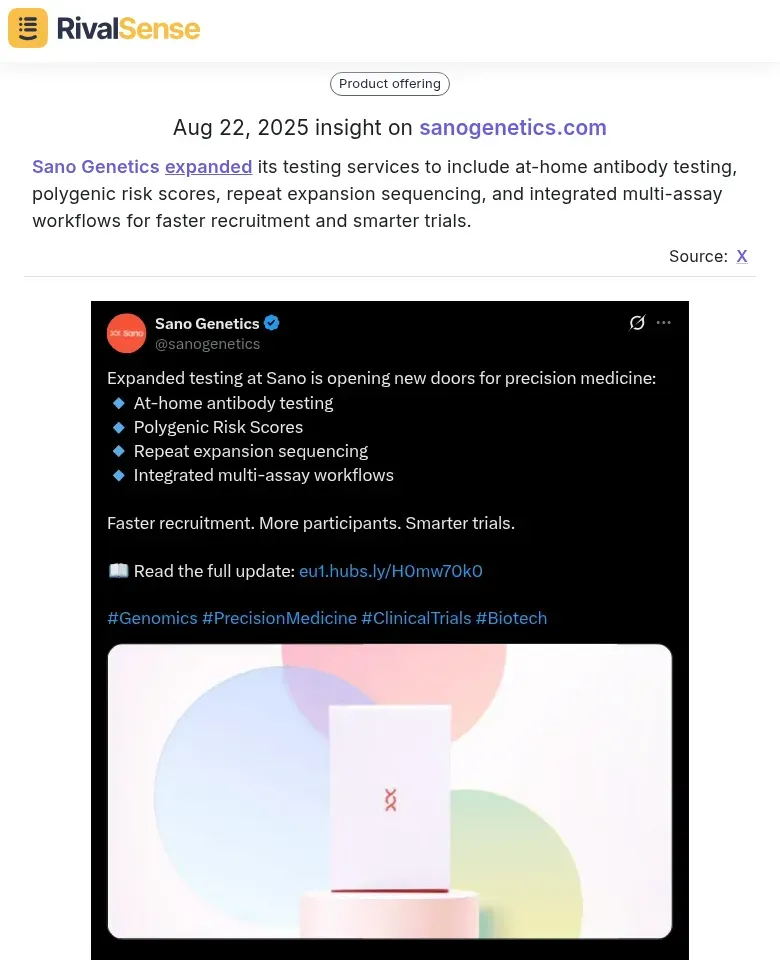
Example from RivalSense: Sano Genetics expanded its testing services to include at-home antibody testing, polygenic risk scores, repeat expansion sequencing, and integrated multi-assay workflows for faster recruitment and smarter trials. Monitoring such service expansions is crucial because it helps you understand competitor innovation and identify gaps in your own offerings.
Integrate these automated tracking systems directly with your CRM (Salesforce, HubSpot, etc.) to create a unified intelligence hub. This ensures sales teams receive actionable insights within their existing workflows—automatically tagging accounts with competitive intelligence scores and flagging at-risk relationships.
Implement workflow automation tools that process raw data through predefined rules: automatically categorizing competitor publications by therapeutic area, scoring account engagement levels based on digital footprint analysis, and generating weekly intelligence briefings.
Create checklists for implementation:
- Map key account intelligence requirements
- Configure alert thresholds for critical events
- Establish CRM integration points
- Design automated reporting templates
- Train teams on interpreting automated insights
Practical tip: Start with pilot accounts to refine automation rules before scaling. The goal is creating a self-updating competitive intelligence system that identifies precision medicine opportunities before they become obvious.
Implementation Checklist: Building Your Automated Tracking Framework
Building an automated tracking framework requires careful planning and execution. Follow this checklist to ensure you cover all critical aspects for precision medicine key account tracking.
1. Automated Alerts for Competitor Executive Changes & Hiring Patterns
- Setup: Configure AI-powered tools to monitor LinkedIn, press releases, and SEC filings for C-suite changes at target competitors
- Key Metrics: Track hiring velocity, department expansions, and leadership transitions signaling strategic shifts
- Actionable Tip: Set up tiered alerts - immediate for C-suite changes, weekly digests for team expansions
2. Systematic Tracking of Competitor Service & Product Developments
- Framework: Create a centralized dashboard monitoring clinical trial databases (ClinicalTrials.gov), patent filings (USPTO), and regulatory submissions (FDA/EMA)
- Checklist Items:
• Daily automated scans for new trial registrations
• Weekly patent application monitoring
• Monthly competitive benchmarking reports - Pro Tip: Use AI to analyze development timelines and predict launch windows
3. Protocols for Monitoring Partnership & Conference Activities
- System Setup: Automate tracking of partnership announcements, licensing deals, and conference presentations
- Key Sources: Monitor PMWC, BIO International, ASCO, and precision medicine conferences
- Implementation Steps:
- Create automated alerts for competitor presentations at key events
- Track partnership announcements through press release monitoring
- Analyze collaboration patterns to identify emerging alliances
Example from RivalSense: Charlotte Guzzo, Founder and COO at Sano Genetics, will meet with prospective partners in precision medicine and gene therapy in Basel from November 24–26. Tracking such event participations is valuable because it reveals networking strategies and potential partnership formations that could impact market alliances.

- Best Practice: Assign specific team members to review and action automated insights weekly
Integration Tip: Connect all tracking systems to your CRM for seamless key account strategy updates. Establish a monthly review cadence to validate automated findings and adjust tracking parameters based on competitive landscape shifts.
Measuring Success and Optimizing Your Automated Tracking Strategy
Tracking the effectiveness of your automated system is crucial for continuous improvement. To measure success and optimize your automated tracking strategy, focus on these key areas:
Key Performance Indicators:
- Coverage Rate: Percentage of key accounts tracked vs. total target accounts (aim for >95%)
- Alert Accuracy: False positive rate should be <5% to avoid alert fatigue
- Time-to-Insight: How quickly you detect competitor moves (target: <24 hours)
- Actionable Intelligence Ratio: Percentage of alerts leading to strategic decisions (benchmark: >30%)
Continuous Improvement Process:
- Weekly Review: Audit 10% of automated alerts for relevance and accuracy
- Monthly Calibration: Adjust tracking parameters based on competitor behavior patterns
- Quarterly Gap Analysis: Identify missed opportunities and update tracking rules
- Feedback Loop: Capture insights from sales and marketing teams to refine intelligence gathering
Scaling Your System:
- Phase 1 (Startup): Track top 20 accounts with basic automation
- Phase 2 (Growth): Expand to 100+ accounts with AI-powered pattern recognition
- Phase 3 (Enterprise): Implement predictive analytics for 500+ accounts with real-time dashboards
Practical Tips:
- Use tiered alerting (critical/important/informational) to prioritize responses
- Create competitor response playbooks for common scenarios
- Integrate tracking data with your CRM for seamless workflow
- Conduct quarterly "competitive war games" to test your intelligence effectiveness
Checklist for Optimization:
☐ Review KPI dashboard weekly
☐ Validate tracking rules monthly
☐ Update competitor profiles quarterly
☐ Train new team members on system usage
☐ Test new data sources every 6 months
Remember: The most effective tracking systems evolve with your precision medicine business. Start simple, measure rigorously, and scale intelligently based on data-driven insights.
Conclusion: Enhance Your Strategy with Automated Competitor Intelligence
In the competitive world of precision medicine, automated key account tracking is no longer optional—it's essential for survival and growth. By implementing the strategies and checklists outlined above, you can transform raw data into actionable intelligence that drives strategic decisions.
To get started with automated competitor tracking, consider using tools like RivalSense. RivalSense tracks competitor product launches/updates, pricing changes, event participations, partnerships, regulatory aspects, management changes, and media mentions across company websites, social media, and various registries, delivering all in a weekly email report.
Try RivalSense for free today at https://rivalsense.co/ and get your first competitor report to see how automated insights can enhance your precision medicine strategy.
📚 Read more
👉 Decoding Competitor Hiring and Layoffs: A Strategic Guide for Business Leaders
👉 Competitor Insight: Decoding Rivan Industries' Latest Filings
👉 The Ultimate Guide to Key Account Tracking Data Export: Practical Strategies for 2026
👉 Real-World SEO Mystery Shopping: How Top Agencies Outperform Competitors
👉 How Life360's No-Show Alert Insight Drove a Competitor's Proactive Safety Feature