
Best Practices: How Competitors Attract Customers in Convergent TV Advertising
Welcome to the convergent TV advertising landscape of 2026, where the lines between linear and streaming TV have blurred into a unified ecosystem. This convergence has fundamentally reshaped how brands connect with audiences, creating unprecedented opportunities for mid-market companies to compete alongside enterprise giants.
Key developments driving this transformation include:
-
'Easy Button' Advertising Models: Platforms now offer simplified campaign execution with automated buying, unified measurement, and AI-driven optimization. Practical tip: Look for providers offering single-dashboard management across all TV formats.
-
True Convergence: The distinction between linear and streaming TV has effectively disappeared. Audiences now flow seamlessly between live broadcasts and on-demand content, requiring unified targeting strategies. Checklist item: Ensure your media plan addresses both appointment viewing and binge-watching behaviors.
-
Democratization of Access: Advanced targeting capabilities once reserved for major brands are now accessible to mid-market companies. Step-by-step advice: Start with connected TV (CTV) to test creative and targeting before expanding to broader linear placements.
This landscape represents both challenge and opportunity. As competitors master these new dynamics, understanding their approaches becomes crucial for developing effective convergent TV strategies that attract and retain customers in today's unified viewing environment.
🤝 Strategic Partnership Models That Drive Market Access
Strategic partnerships are the cornerstone of convergent TV advertising success. By aligning with key players, companies can accelerate market access and enhance their offerings. Leading competitors build robust partnership ecosystems by first hiring specialized leadership roles like Head of Strategic Partnerships or VP of Agency Development. These executives create dedicated teams that transform complex data into accessible insights for agency partners through user-friendly dashboards and simplified reporting tools.
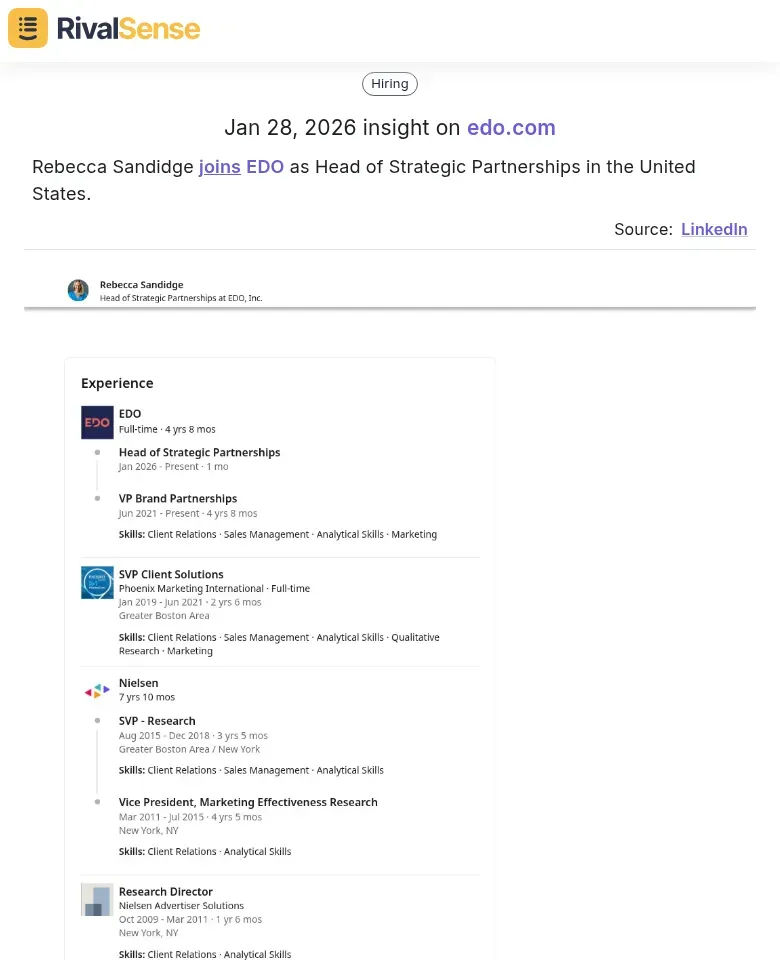
For instance, tracking competitor management changes can reveal strategic priorities. Insights like 'Rebecca Sandidge joins EDO as Head of Strategic Partnerships in the United States' signal expansion plans and hiring focus, which is valuable for anticipating market shifts and benchmarking your own partnership strategies.
Practical steps to implement:
- Create a dedicated partnership team with clear KPIs for market expansion
- Develop standardized data access protocols for agency partners
- Build tiered partnership frameworks (bronze, silver, gold) with escalating benefits
- Establish co-marketing agreements that enhance credibility through association
- Implement regular partner enablement sessions and training programs
Successful competitors use these frameworks to expand market reach by 40-60% while gaining third-party validation that accelerates enterprise sales cycles. The key is making your platform indispensable to partners' success through shared incentives and transparent data access.
📊 Data Integration and Accessibility Strategies
In convergent TV advertising, leading competitors excel by integrating data directly into partner platforms for seamless campaign delivery. This approach ensures that data is not only available but also actionable for all stakeholders. They establish strategic platform partnerships that make proprietary data accessible while maintaining control, creating unified data ecosystems that enhance audience insights and measurement capabilities.
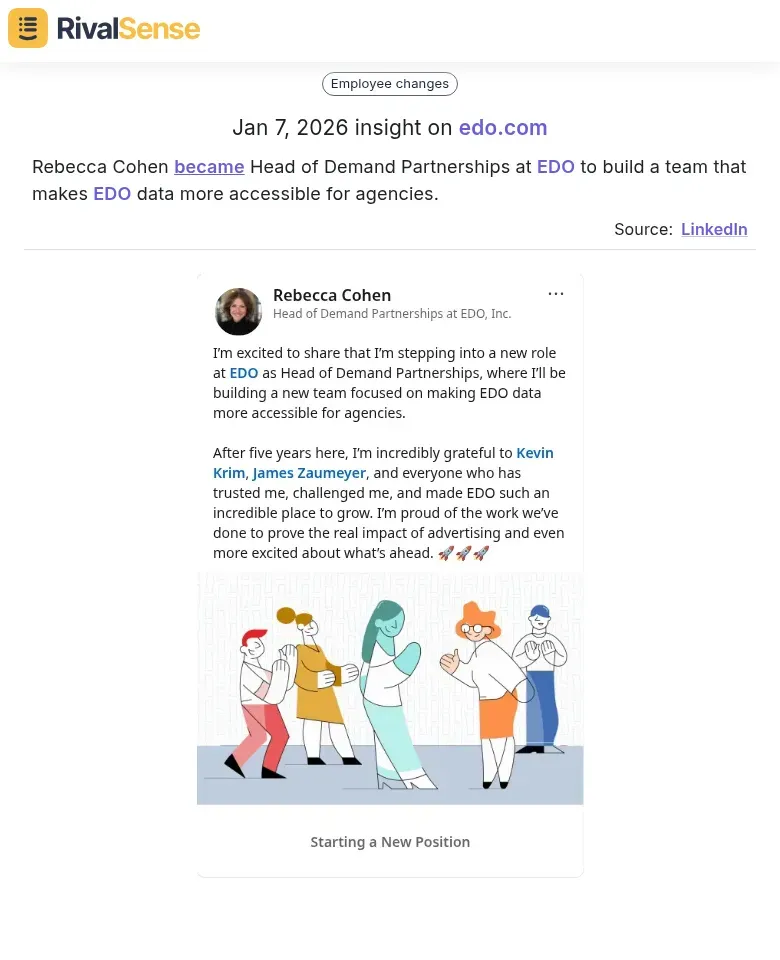
Monitoring organizational roles focused on data accessibility can provide competitive benchmarks. For example, 'Rebecca Cohen became Head of Demand Partnerships at EDO to build a team that makes EDO data more accessible for agencies' highlights how companies prioritize data democratization, which is crucial for informing your own data strategy and partnership models.
Practical Implementation Steps:
- API-First Integration: Build direct API connections with major CTV platforms (Roku, Amazon Fire TV, Samsung TV+) to enable real-time data sharing and campaign optimization
- Strategic Platform Partnerships: Form exclusive data-sharing agreements with 3-5 key CTV partners to create competitive moats while expanding reach
- Unified Data Layer: Implement a centralized data warehouse that aggregates first-party, second-party (partner), and third-party data for holistic audience profiling
- Measurement Framework: Develop custom attribution models that track cross-platform performance across linear TV, CTV, and digital channels
Key Checklist:
- ✅ Ensure GDPR/CCPA compliance in all data integrations
- ✅ Establish clear data governance policies with partners
- ✅ Create standardized data schemas for consistent analysis
- ✅ Implement real-time dashboards for campaign monitoring
- ✅ Develop automated reporting systems for partner transparency
Pro Tip: Start with 2-3 pilot partnerships to refine your integration approach before scaling. Focus on platforms where your target audience over-indexes for maximum impact.
🔗 Platform Integration and Technology Stack Partnerships
Platform integration and technology partnerships are critical for success in convergent TV advertising. These alliances enable companies to leverage existing ecosystems and provide enhanced value to clients. Leading competitors establish strategic alliances with major media companies to embed their data directly into existing tech stacks, creating seamless workflows for advertisers. This integration enables real-time campaign optimization across linear, streaming, and digital channels.
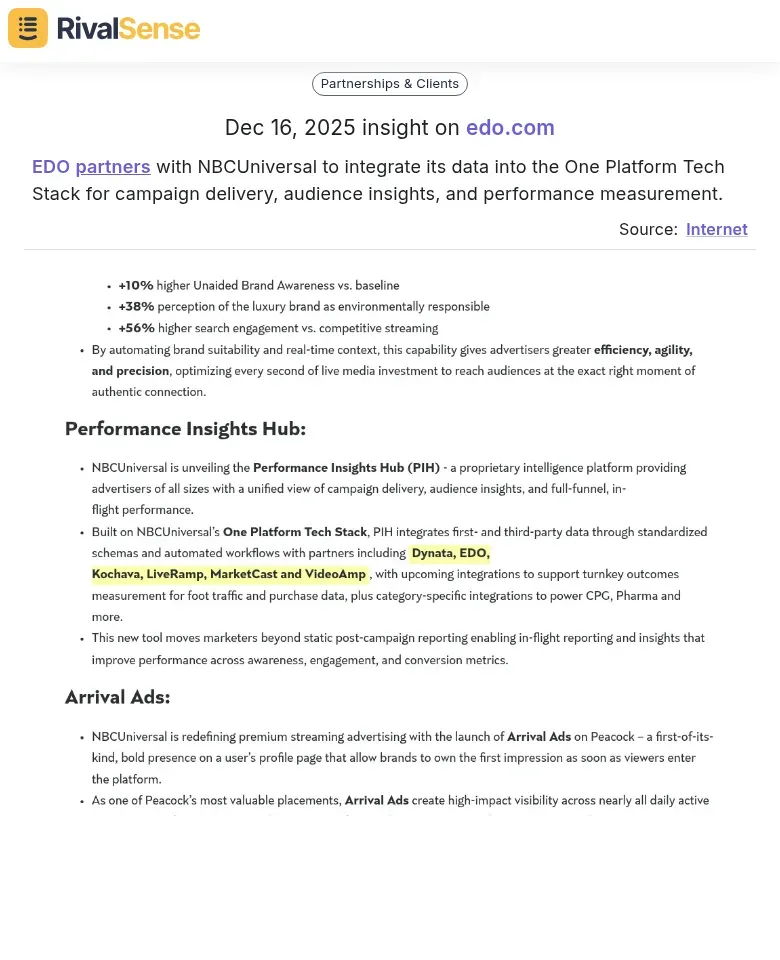
Tracking competitor partnerships can reveal integration trends and market moves. Insights like 'EDO partners with NBCUniversal to integrate its data into the One Platform Tech Stack for campaign delivery, audience insights, and performance measurement' demonstrate how strategic partnerships expand reach and capability, informing your own integration efforts and competitive positioning.
Practical Implementation Steps:
- Identify Complementary Partners: Map out media companies with strong audience data but limited measurement capabilities
- API-First Approach: Develop robust APIs that allow easy integration into partners' existing systems
- Co-Branded Solutions: Create joint offerings that combine your measurement expertise with partners' media reach
Key Benefits:
- Reduced implementation friction for advertisers
- Access to premium inventory through partner relationships
- Enhanced credibility through association with established media brands
Technology Integration Checklist:
✓ Ensure data compatibility between systems
✓ Establish clear data governance protocols
✓ Create joint go-to-market strategies
✓ Develop shared dashboards for campaign performance
✓ Implement automated reporting workflows
Successful competitors like Innovid and iSpot.tv have mastered this approach, partnering with major broadcasters and streaming platforms to embed their measurement solutions directly into media buying workflows. This creates stickier relationships and positions them as essential infrastructure rather than optional add-ons.
📈 Measurement and Attribution Innovation in Convergent TV
In convergent TV advertising, forward-thinking competitors are revolutionizing measurement by moving beyond traditional last-click attribution. They recognize that TV's impact spans multiple touchpoints, requiring more sophisticated approaches to capture true influence. They're shifting focus to mid-funnel behavioral metrics like brand recall, purchase intent, and content engagement that better reflect TV's influence on customer journeys.
Practical steps to implement this shift:
- Map customer touchpoints across social, retail, and TV channels
- Identify key behavioral indicators for each stage of your funnel
- Establish baseline metrics before campaign launch
Leading companies are creating unified measurement frameworks that bridge social media engagement, retail platform data, and TV viewership. This requires:
- Standardizing KPIs across all channels
- Implementing cross-platform tracking solutions
- Regular data reconciliation meetings between channel teams
For zero-click search environments, innovators are developing AI-driven attribution models that analyze:
- Search query patterns following TV exposure
- Voice assistant interactions
- Direct navigation to brand websites
Checklist for AI attribution implementation:
□ Integrate TV airing data with search analytics
□ Train models on historical campaign performance
□ Test attribution windows (1-hour to 7-day post-exposure)
□ Validate with controlled A/B testing
💡 Tip: Start with pilot campaigns using 20% of your TV budget to test new attribution approaches before full-scale implementation.
🚀 Implementation: Building Your Convergent TV Competitive Advantage
To build your convergent TV competitive advantage, start by developing strategic partnership roadmaps that align with market evolution. This proactive approach ensures you stay ahead of market trends and competitor moves. Map out 3-5 year partnership trajectories with key players like streaming platforms, data providers, and measurement firms. Create quarterly checkpoints to assess partnership performance against market shifts.
Next, implement data accessibility frameworks that serve diverse partner needs. Build tiered data access levels: basic (aggregated insights), advanced (segmented data), and premium (real-time feeds). Use APIs and secure data rooms to facilitate seamless sharing while maintaining control. Establish clear data governance policies covering usage rights, privacy compliance, and attribution models.
Finally, deploy integrated measurement systems that bridge traditional gaps. Combine traditional TV metrics (GRPs, reach) with digital metrics (CTR, conversion rates) into unified dashboards. Implement cross-platform attribution models using deterministic and probabilistic matching. Create standardized reporting templates that all partners can use, ensuring apples-to-apples comparisons across channels.
Practical checklist:
- Identify 3-5 strategic partners aligned with your target audience
- Develop tiered data access protocols with clear SLAs
- Implement unified measurement dashboards by Q2
- Establish quarterly partnership review cadences
- Create partner onboarding playbooks with standardized templates
🔑 Key tip: Start with pilot partnerships to test frameworks before full-scale implementation, allowing for iterative improvements based on real-world feedback.
🔍 Leveraging Competitive Intelligence with RivalSense
To effectively implement these strategies, staying informed about competitor activities is crucial. Tools like RivalSense can help by tracking competitor product launches, pricing updates, event participations, partnerships, regulatory aspects, management changes, and media mentions across company websites, social media, and various registries. As shown in the insights above, understanding competitor hires, partnership announcements, and data integration deals provides early signals for adjusting your business strategy and gaining a competitive edge.
Try out RivalSense for free at https://rivalsense.co/ to get your first competitor report today and gain actionable insights to enhance your convergent TV advertising strategy.
📚 Read more
👉 Competitor Pricing Workflow Breakdown: Strategic Account Tracking Tools
👉 Turning Competitor Personnel Moves into Strategic Insights
👉 Renewable Energy Key Account Tracking: Master Spreadsheet Template and Cheat Sheet
👉 How TAG Heuer's Glassbox Launch Prompted Rivals' Strategic Pricing Shift