
Best Practices: Extract Competitor Insights from Website Changes for Key Account Success
In today's hyper-competitive B2B landscape, your competitors' websites are living documents that reveal strategic intentions long before official announcements. Every homepage redesign, feature update, or content shift serves as an early warning system for market priorities and competitive moves. For key account teams, this digital footprint analysis isn't just about monitoring—it's about proactive relationship management.
Practical Tip: Set up automated alerts for competitor homepage changes, pricing page updates, and case study additions. These three areas consistently reveal strategic shifts before public announcements.
Consider this real-world scenario: A SaaS competitor quietly adds "enterprise security compliance" to their homepage navigation. This signals a push into regulated industries—information you can use to reinforce your own security credentials with key accounts in banking or healthcare before they're approached.
Website changes directly impact key account success by:
- Revealing competitor focus areas before sales teams are mobilized
- Uncovering new value propositions being tested in the market
- Exposing gaps in competitor offerings that you can address with existing accounts
Checklist: Monitor competitor websites weekly for navigation changes, new customer logos, updated messaging, and altered feature priorities. Document these changes alongside your key account conversations to anticipate competitive threats and opportunities.
Decoding Product Strategy Shifts Through Feature and Content Updates
Competitor website changes reveal strategic product direction before official announcements. When rivals add new features like ROI calculators or interactive tools, they're signaling enhanced value propositions targeting specific customer pain points. These additions often indicate competitive responses to market demands or attempts to differentiate in crowded segments.
For instance, RivalSense detected that Geotab added a Fleet ROI calculator to help reveal hidden savings and efficiency gaps, and expanded its product offerings to include AI dash cameras and asset trackers while removing the Enterprise Fleet Management electrification case study. 
This type of insight is valuable for business strategy as it shows how competitors are investing in tools that address direct customer ROI concerns, allowing you to benchmark your own value propositions and identify gaps in your offerings.
Practical steps for analysis:
- Monitor homepage and product pages weekly for new feature announcements
- Analyze feature positioning - are they emphasizing cost savings, efficiency, or integration capabilities?
- Track the evolution of existing features to understand product maturity
- Set up alerts for pricing page changes that accompany feature updates
Product line expansions or contractions become visible through website restructuring. When competitors add new service categories or remove existing offerings, they're revealing market focus shifts. Case study updates are particularly telling - newly featured key accounts indicate which enterprise segments competitors are actively targeting and winning.
Actionable checklist:
- Document all new features added within the last quarter
- Note which customer segments are highlighted in updated case studies
- Track navigation structure changes indicating service prioritization
- Compare feature sets across competitors to identify market gaps
- Analyze integration announcements for partnership strategies
These insights help anticipate competitor moves, allowing you to adjust your product roadmap and key account targeting strategies proactively. Regular monitoring transforms website observations into strategic advantages for winning and retaining enterprise clients.
Uncovering Partnership and Integration Strategies from Website Updates
Website updates often reveal strategic partnership moves before official announcements. Monitor integration announcements in blog posts, press releases, and product pages to uncover alliance strategies. For example, when a competitor adds new payment gateway logos or API documentation, they're signaling ecosystem expansion.
A practical example from RivalSense: Mapon added Repsol-Solred to its fuel card integrations. 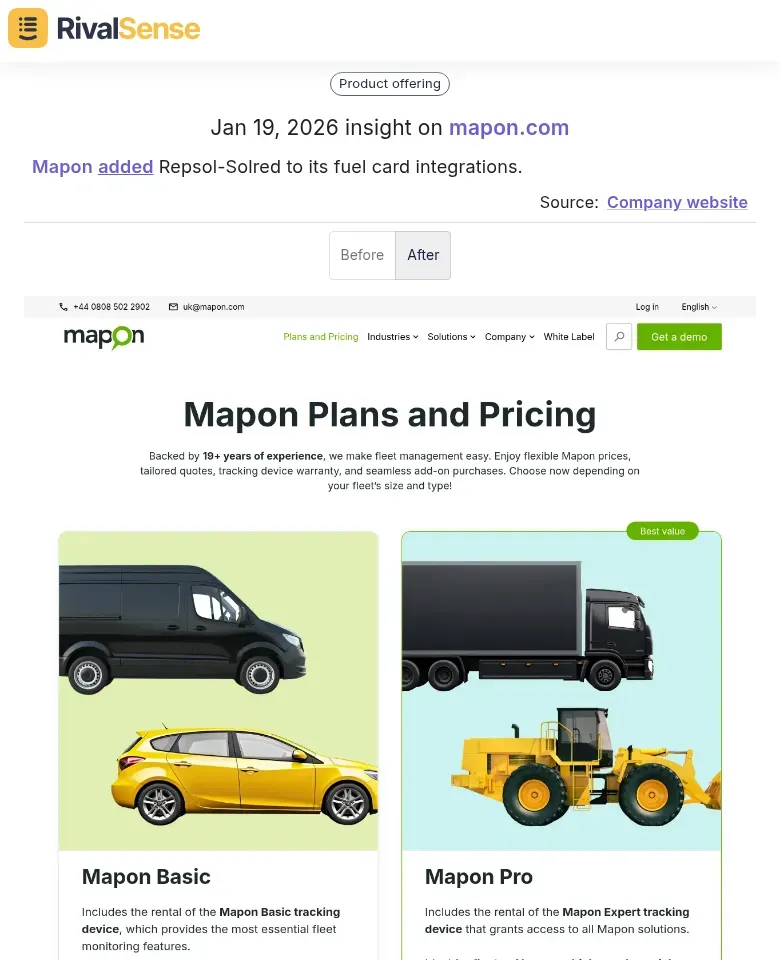
This insight reveals how competitors are expanding their ecosystem through strategic partnerships, which can indicate moves into new verticals or regions. Understanding these integrations helps you assess competitive threats in specific markets and adjust your own partnership strategies accordingly.
Practical steps:
- Set up alerts for competitor website changes in integration/partnership sections
- Track new logos in partner pages - each represents a revenue diversification channel
- Analyze how partnerships enhance customer retention (e.g., bundled services)
- Note cross-selling opportunities created through integrated solutions
Key insight: Fuel card integrations or payment partnerships often indicate B2B expansion into new verticals. When you see competitors adding industry-specific integrations, they're targeting new customer segments. Document these moves to understand their market positioning strategy.
Checklist for monitoring:
- Weekly review of competitor partner pages
- Track API documentation updates
- Monitor press release sections for alliance announcements
- Note changes in pricing pages reflecting bundled partner offerings
Pro tip: The timing of partnership announcements often correlates with quarterly earnings targets - use this to predict competitor growth initiatives.
Extracting Pricing and Monetization Insights from Website Changes
Website pricing changes reveal critical competitive intelligence. Track pricing page updates to understand how competitors position themselves in the market. When a competitor adds tiered pricing or introduces enterprise plans, they're signaling market segmentation strategies. For example, if a SaaS company adds a 'Starter' tier, they're likely targeting SMBs you may have overlooked.
Consider Apify's update to its affiliate program commission structure, reducing the Starter plan price from $39 to $29 per month and lowering the commission range from $7.80-$11.70 to $5.80-$8.70 per month. 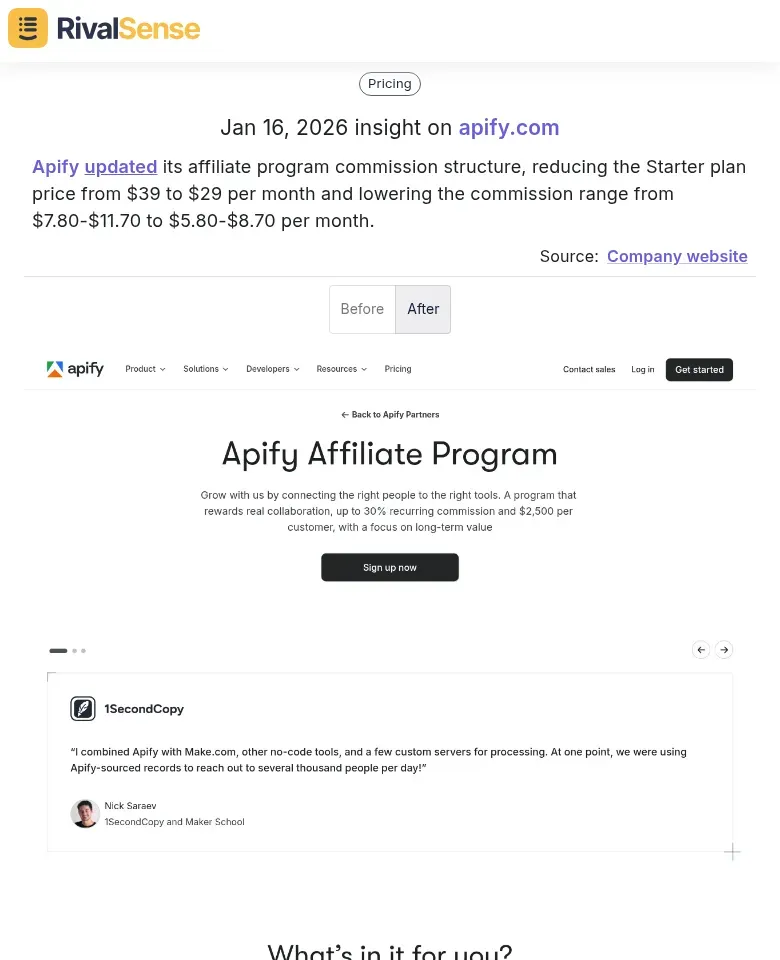
This insight helps you understand competitor monetization strategies and how they might be adjusting to market pressures or aiming for growth. Monitoring such changes allows you to anticipate pricing wars or shifts in customer acquisition tactics.
Monitor commission structure changes in affiliate programs. When competitors increase affiliate payouts, they're aggressively pursuing channel partnerships. This signals they're prioritizing growth over margins or facing customer acquisition challenges.
Analyze pricing adjustments to anticipate market moves. A 15% price increase across all tiers suggests confidence in market position or rising costs. Conversely, temporary discounts or 'limited-time offers' often precede permanent price reductions.
Practical steps:
- Set up automated alerts for pricing page changes
- Track at least 3-5 key competitors' pricing structures monthly
- Document changes in a competitive pricing matrix
- Analyze timing of changes (quarterly, seasonal, post-funding)
- Compare your pricing against adjusted competitor positioning
Pro tip: Look beyond the numbers. Changes in pricing page copy, feature comparisons, and value propositions reveal how competitors want to be perceived in the market.
Building a Systematic Monitoring Framework for Key Account Intelligence
Building a systematic monitoring framework transforms random website checks into strategic intelligence. Start by creating a comprehensive checklist of key website elements to monitor: pricing pages (tier structures, discounts), product/service pages (new features, positioning), case studies (client wins, use cases), leadership team pages (executive changes), career pages (hiring patterns), and blog/thought leadership content (strategic themes).
Set up automated alerts using tools like RivalSense to track these elements. Configure notifications for specific changes: when competitors update pricing, launch new products, publish case studies with your target accounts, or announce executive appointments. This ensures you catch strategic shifts early, before they impact your key accounts.
Develop a structured process to translate observations into actionable strategies. When you detect changes, analyze them through a key account lens: Does this pricing change affect our competitive positioning with specific accounts? Does this new feature address pain points our key clients have mentioned? Does this case study reveal competitor penetration into our target verticals? Create a simple framework: 1) Document the change, 2) Assess impact on key accounts, 3) Develop counter-strategies, 4) Schedule account team discussions. This systematic approach ensures website monitoring directly fuels your key account success.
Turning Competitor Insights into Key Account Success: Actionable Strategies
When competitor websites evolve, they reveal strategic shifts you can leverage for key account success. Here's how to transform website analysis into actionable strategies:
Proactive Counter-Strategies:
- Monitor competitor pricing page changes → adjust your enterprise pricing tiers
- Track new feature announcements → develop counter-features or highlight your existing superior capabilities
- Analyze case study updates → create targeted content addressing the same industries but with better results
Product Roadmap Alignment:
- Create a "competitor gap analysis" spreadsheet comparing your offerings vs. theirs
- Prioritize development based on competitor weaknesses your key accounts care about
- Schedule quarterly reviews of competitor website changes to inform roadmap adjustments
Enhanced Value Proposition:
- Identify missing competitor features → position these as your unique differentiators
- Note poor UX patterns on competitor sites → emphasize your superior user experience
- Track competitor support/service changes → highlight your dedicated key account support
Actionable Checklist:
- Set up automated monitoring for competitor homepage, pricing, and feature pages
- Document changes weekly in a shared competitive intelligence dashboard
- Map competitor changes to specific key account pain points
- Develop talking points for sales teams within 48 hours of significant competitor updates
- Test new messaging with a small group of key accounts before full rollout
By systematically converting website observations into strategic actions, you'll stay ahead in key account conversations and consistently demonstrate superior market awareness.
Take Action with RivalSense
To efficiently implement these strategies and stay ahead of competitor moves, consider using a dedicated tool like RivalSense. RivalSense tracks competitor product launches/updates, pricing changes, event participations, partnerships, regulatory aspects, management changes, and media mentions across company websites, social media, and various registries. It delivers all this intelligence in a weekly email report, saving you time and ensuring you never miss a critical update.
Try RivalSense for free today at https://rivalsense.co/ and get your first competitor report to start transforming website insights into key account success.
📚 Read more
👉 Competitive Edge in Professional Services: A Practical Guide to Monitoring Regulatory Filings
👉 Boost Key Account Win Rates with Competitor Product Intelligence
👉 Turning Competitor Management Changes into Strategic Advantages: A Real-World Example
👉 How to Conduct Competitor Research in 2026: A Step-by-Step Guide
👉 Beginner's Guide to Key Account Health Dashboards for Commercial Laundry Services