
Best Practices: Analyzing Competitor Brand Perception on Facebook
Understanding how customers perceive your competitors versus your brand on Facebook provides critical competitive intelligence that directly impacts your market position. When you analyze competitor brand perception, you're not just spying—you're uncovering strategic advantages that reveal market gaps and customer preferences. Facebook insights reveal what customers truly value—whether it's exceptional customer service, innovative product features, or compelling brand storytelling.
Practical Tip: Start by creating a competitor monitoring checklist: track their most engaging content types, analyze comment sentiment (positive/negative/neutral), monitor response times to customer inquiries, and identify recurring customer complaints or praise patterns. By monitoring competitor positioning, you can identify where they're vulnerable (slow response times, negative sentiment trends) and where they excel (highly-shared content formats, strong community engagement). This intelligence allows you to strategically differentiate your brand, address unmet customer needs, and position your messaging to capitalize on competitor weaknesses.
Actionable Step: Set up social listening alerts for competitor mentions, track their Facebook ad strategies, and analyze their top-performing content to understand what resonates with your shared target audience. This data-driven approach transforms reactive social media management into proactive market positioning.
Setting Up Your Competitor Brand Perception Analysis Framework
Building a systematic framework is essential for consistent and actionable insights. To set up your competitor brand perception analysis on Facebook, start by categorizing competitors into three tiers: direct (same products/services), indirect (different solutions for same customer needs), and aspirational (industry leaders you admire). Create a spreadsheet with their Facebook pages, follower counts, and engagement rates.
Establish key metrics across four dimensions: sentiment (positive/negative comment ratios), engagement (reactions, shares, comments per post), reach (impressions vs. audience size), and share of voice (mentions relative to competitors). Track branded hashtag usage and customer service response times.
Set up a systematic monitoring schedule: daily checks for major announcements, weekly analysis of engagement patterns, and monthly deep-dives into sentiment trends. Use Facebook's native analytics, social listening tools, and manual spot-checks for qualitative insights. Create a standardized data collection template with date, metric values, and notable observations.
Practical checklist:
- Identify 3-5 competitors per category
- Set up Facebook Page alerts for each
- Create a metrics dashboard with baseline measurements
- Schedule recurring calendar reminders for analysis sessions
- Document competitive responses to negative feedback
- Track competitor content themes and posting frequency patterns
Analyzing Product and Service Announcements for Market Positioning
Product and service announcements reveal how competitors position themselves in the market, offering clues about their strategic priorities. Track their Facebook posts about new launches, feature updates, or service expansions to understand their direction and target audiences. For example, if a competitor emphasizes "enterprise-grade security" in a product update, they're likely targeting B2B clients concerned with data protection.
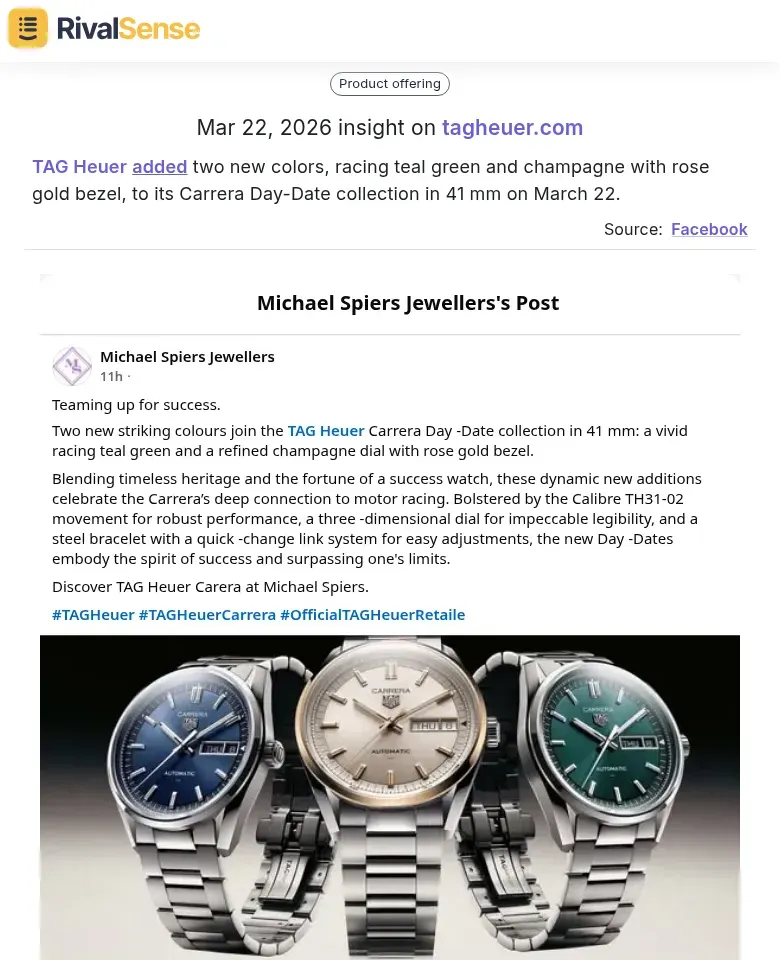
Analyzing such announcements can highlight market trends and gaps. For instance, tracking product launches like TAG Heuer's addition of new colors to its Carrera Day-Date collection can reveal how competitors refresh their offerings to maintain market relevance. This type of insight is valuable for anticipating consumer preferences and identifying opportunities for differentiation.
Practical steps:
- Create a tracking spreadsheet with columns for announcement date, product type, target audience, and key messaging
- Monitor Facebook posts weekly for launch patterns (e.g., quarterly releases before industry events)
- Note emotional triggers used - urgency ("limited-time launch"), exclusivity ("early access"), or problem-solving ("fixing your biggest pain point")
- Compare your own positioning gaps - if competitors consistently highlight integration capabilities you lack, that's a market expectation
Timing analysis matters: A competitor launching before major conferences is claiming thought leadership, while post-holiday releases might target budget-ready businesses. Their messaging cadence (single big announcement vs. phased feature reveals) indicates confidence levels and resource allocation.
Key insight: The gap between announcement hype and actual user reactions in comments reveals positioning effectiveness. Track whether promised benefits match customer discussions in follow-up threads.
Monitoring Thought Leadership and Executive Communication
Executive visibility on Facebook is a powerful brand-building tool that competitors use to shape perceptions and signal strategic intent. To analyze their approach effectively, start by identifying key executives from competitor companies and monitoring their Facebook activity for patterns in thought leadership, industry commentary, and partnership showcases.
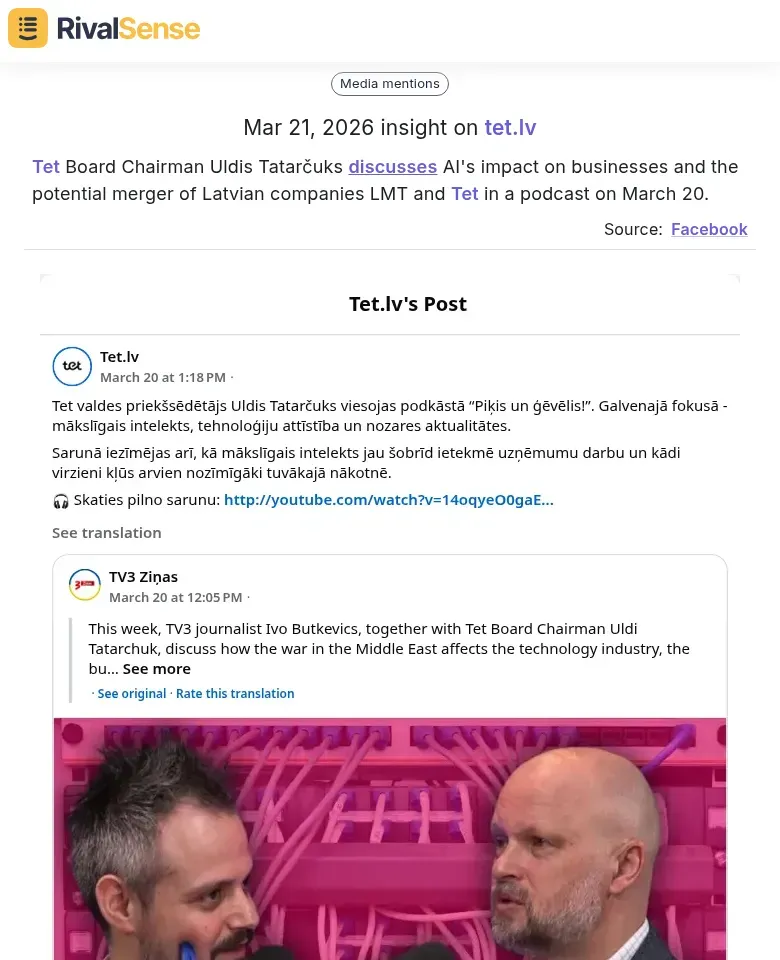
Executive communications often provide early warnings of strategic shifts. For example, when Tet Board Chairman Uldis Tatarčuks discusses AI's impact and potential mergers in a podcast, it offers insights into the company's future direction and priorities. Monitoring such insights helps in understanding competitor strategies and preparing for market disruptions.
Practical steps for monitoring:
- Create a list of competitor executives and their Facebook profiles
- Track their posting frequency, engagement rates, and content themes
- Note how they frame company announcements - do they emphasize innovation, customer impact, or market leadership?
- Monitor their commentary on emerging trends to understand positioning strategies
- Analyze partnership announcements for insights into strategic direction
Key indicators to watch include: consistency of messaging across executives, response to industry news, and how they humanize the brand while maintaining authority. Successful competitors often use executives to validate strategic moves, making leadership communication a window into their market positioning. Look for patterns in how they balance promotional content with value-added insights - the most effective approaches maintain 70-80% educational content versus direct promotion.
Evaluating Platform-Specific Strategies and Compatibility Messaging
When analyzing competitor brand perception on Facebook, pay close attention to how they leverage platform partnerships and integrations to expand their reach. Tracking co-branded content, joint announcements, and compatibility messaging reveals strategic alliances and technical capabilities that influence customer decisions.
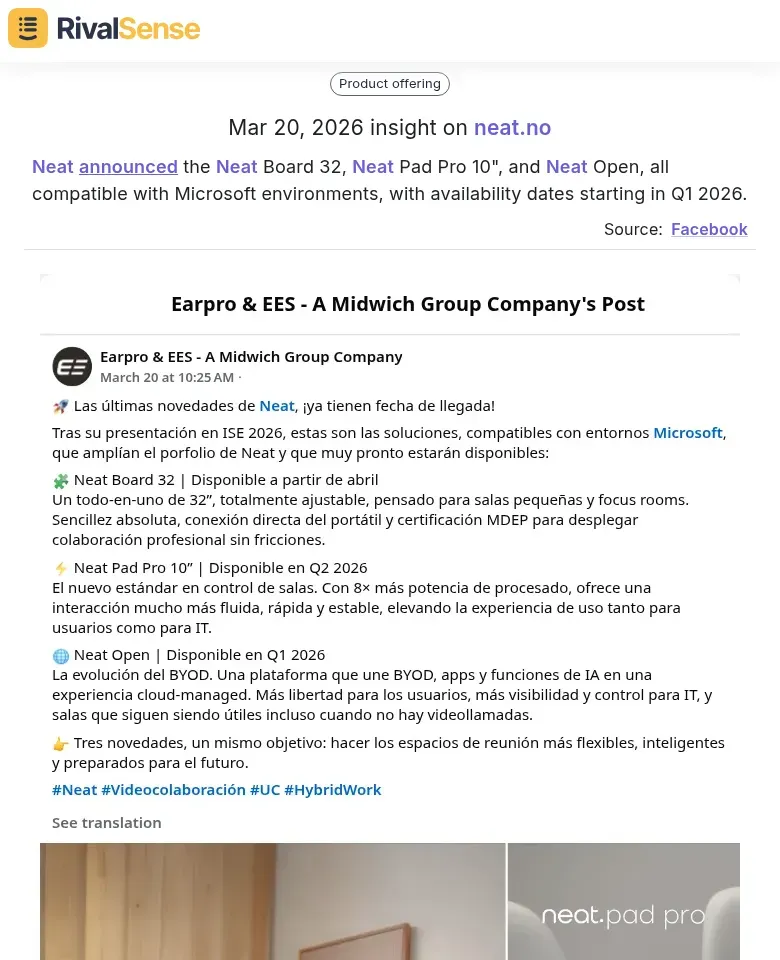
Announcements about platform compatibility can indicate key partnerships and market expansions. For instance, Neat's launch of new products compatible with Microsoft environments demonstrates how competitors align with major ecosystems to enhance their value proposition. Tracking these insights helps in assessing competitive moves in technology integration and partnership strategies.
Practical tip: Set up daily alerts for competitor Facebook announcements about new integrations - these often signal strategic shifts before formal sales outreach begins. Monitor compatibility announcements and ecosystem positioning by tracking how competitors communicate technical capabilities to different audiences.
Checklist for evaluation:
- Categorize technical announcements by audience segment (e.g., enterprise vs. SMB)
- Track engagement rates per segment to gauge messaging effectiveness
- Note announcement timing patterns relative to industry events
- Analyze comment sentiment on technical posts for customer reactions
Learn from how competitors communicate complex capabilities by observing their content format effectiveness. Do they use animated explainers for technical features? Webinars for deep dives? Map competitor content formats to audience segments, measure engagement rates per format, and identify gaps where they're not effectively reaching certain demographics.
Key insight: High engagement on thought leadership content often signals strong brand perception, while promotional technical content may generate less organic interaction.
Turning Insights into Actionable Competitive Strategy
Once you've analyzed competitor brand perception on Facebook, the real value comes from transforming those insights into decisive actions that strengthen your market position. Here's how to convert data into a competitive edge and continuously improve your strategy.
-
Identify Positioning Gaps: Look for underserved customer needs or emotional connections competitors are missing. For example, if competitors focus on price but customers crave premium service, that's your opportunity. Create a checklist: (a) What emotional needs are unmet? (b) Which customer segments feel neglected? (c) What values aren't being communicated?
-
Develop Counter-Strategies: Target competitor weaknesses directly. If a rival has negative sentiment around customer support, launch a "24/7 concierge service" campaign. If their messaging is inconsistent, emphasize your brand's reliability. Practical tip: Create a SWOT matrix comparing your Facebook perception against each competitor's.
-
Establish Continuous Improvement: Set up a monthly review cycle: (a) Track key perception metrics, (b) Analyze competitor shifts, (c) Test new messaging, (d) Measure impact. Use Facebook's own tools alongside competitive intelligence platforms to maintain real-time awareness.
Key action step: Within 48 hours of your analysis, implement one tactical change based on competitor gaps—whether it's adjusting ad copy, creating new content themes, or refining your response strategy to highlighted pain points.
Streamline Your Analysis with RivalSense
Manually tracking competitor activities across Facebook and other channels can be time-consuming. To save time and get comprehensive insights, try RivalSense for free at https://rivalsense.co/. It tracks competitor product launches, pricing updates, event participations, partnerships, regulatory changes, management shifts, and media mentions, delivering a weekly email report. Get your first competitor report today and stay ahead of the competition with actionable intelligence tailored to your business needs.
📚 Read more
👉 Advanced Tactics: Tracking Video Conferencing Leaders for Strategic Edge
👉 How Competitor Insights Solve Market Entry Challenges for Key Account Success
👉 Competitor Analysis in Action: Learning from Keatech's Partnership with EG
👉 HOW TO TRACK KEY ACCOUNT RENEWAL DATES: A STRATEGIC GUIDE FOR 2026
👉 Marine Port Services Key Account Risk Tracking Checklist 2026