
Benefits of Competitor Feature Gap Analysis: A Strategic Guide for B2B Leaders
In today's crowded B2B landscape, simply having a "good product" isn't enough. High-growth companies don't win by moving faster—they win by solving real problems that competitors overlook. This is where competitor feature gap analysis becomes your strategic advantage.
Competitor feature gap analysis is the systematic process of comparing your product's capabilities against competitors' offerings to identify specific areas where you can outperform them. Unlike traditional competitive analysis that looks at broad market positioning, feature gap analysis zooms in on the tangible capabilities that drive customer decisions.
The Real Cost of Guessing
Consider this: nearly one-third of startups fail within their first three years, often because they're solving problems that don't exist or competing in crowded markets where differentiation is minimal. Feature gap analysis removes the guesswork by providing data-driven insights into exactly where competitors are falling short.
🎯 5 Strategic Benefits of Competitor Feature Gap Analysis
1. Identify High-Impact Differentiators
Feature gap analysis helps you move beyond "me-too" features to identify capabilities that truly matter to customers. By analyzing competitor reviews, support tickets, and customer feedback, you can pinpoint which missing features cause real pain points. This focused approach ensures you invest in features that deliver real value.
Practical Tip: Create a feature matrix comparing your product against 3-5 key competitors. Use a table like this for clarity:
| Feature Category | Your Product | Competitor A | Competitor B | Competitor C |
|---|---|---|---|---|
| Core Functionality | ✅ | ✅ | ❌ | ✅ |
| Integration Capabilities | ✅ | ❌ | ✅ | ❌ |
| User Experience | ⭐ | ⭐⭐ | ⭐ | ⭐⭐ |
| Reporting & Analytics | ✅ | ✅ | ✅ | ❌ |
| Customization Options | ✅ | ❌ | ❌ | ✅ |
Legend: ✅ = Available, ❌ = Missing, ⭐ = Rating (1-5)
2. Prioritize Your Product Roadmap
Not every gap is worth closing. Feature gap analysis helps you prioritize development efforts based on multiple factors. It ensures that you allocate resources to features that will have the greatest impact on your market position and customer satisfaction.
Prioritize based on:
- Market demand: How many customers are asking for this feature?
- Competitive impact: Will this feature help you win deals?
- Development complexity: What's the effort-to-impact ratio?
- Strategic alignment: Does this align with your long-term vision?
Checklist for Prioritization:
- [ ] Size of affected customer segment
- [ ] Revenue impact if solved
- [ ] Time and cost to build
- [ ] Ability to create sustainable differentiation
- [ ] Alignment with core competencies
3. Uncover Hidden Market Opportunities
Sometimes the biggest opportunities aren't in what competitors are doing, but in what they're NOT doing. Feature gap analysis can reveal underserved segments and workflow inefficiencies. For instance, if all competitors lack a specific integration, building it could make you the go-to solution.
Feature gap analysis can reveal:
- Underserved customer segments that have unique requirements
- Workflow gaps where customers need to use multiple tools
- Integration opportunities that competitors have overlooked
- Pricing model gaps where customers feel they're not getting value
4. Improve Sales and Marketing Effectiveness
When you know exactly where competitors fall short, your sales team can have more effective conversations. Instead of generic "we're better" claims, they can provide specific, compelling reasons to choose your product. This targeted messaging increases conversion rates and shortens sales cycles.
Sales can say:
- "Unlike [Competitor], we offer [specific feature] that solves [specific pain point]"
- "While [Competitor] requires you to [workaround], we've built [solution] directly into our platform"
- "Our customers tell us that [feature] saves them [time/money] compared to [Competitor's solution]"
5. Reduce Development Waste
By understanding what features competitors have already validated (or failed with), you can avoid building features that customers don't value. This saves development resources and accelerates time-to-market for features that actually matter. It's about building smarter, not harder.
📋 A Practical 5-Step Framework for Conducting Feature Gap Analysis
Step 1: Define Your Competitive Landscape
Start by identifying both direct and indirect competitors. Don't just look at companies with similar products—consider any solution that customers might use to solve the same problem. This broad view ensures you don't miss disruptive threats.
Tools to Use:
- RivalSense automatically tracks competitor product launches, updates, and feature announcements across 80+ sources, giving you real-time intelligence without manual research
- Industry reports and analyst reviews
- Customer interviews asking "what else did you consider?"
Step 2: Create a Comprehensive Feature Inventory
Build a detailed spreadsheet comparing features across key categories. A structured inventory makes it easy to spot gaps and patterns. Involve cross-functional teams to ensure no feature is overlooked.
Categories to include:
- Core Features: Essential functionality
- Advanced Features: Differentiating capabilities
- Integration Features: API, webhooks, third-party connections
- Administrative Features: User management, permissions, security
- Reporting Features: Analytics, dashboards, exports
Step 3: Gather Customer Intelligence
Feature gaps only matter if customers care about them. Use multiple sources to gather authentic feedback. This step turns raw data into actionable insights about what users truly value.
Use multiple sources:
- Competitor reviews on G2, Capterra, TrustRadius
- Support forums and community discussions
- Social media mentions of competitor pain points
- Win/loss analysis from your sales team
Pro Tip: Tools like RivalSense can automate this process by tracking competitor mentions across social media, review sites, and forums, delivering insights in weekly reports.
Step 4: Analyze and Score Gaps
Use a scoring system to evaluate each gap objectively. This quantitative approach helps in making data-driven decisions and avoids biases. It transforms subjective opinions into clear priorities.
Score each gap on:
- Impact (1-10): How much does this matter to customers?
- Feasibility (1-10): How difficult is this to build?
- Differentiation (1-10): Will this set us apart?
- Urgency (1-10): How quickly do we need this?
Step 5: Create Your Action Plan
Turn insights into execution with a clear roadmap. A phased approach ensures that you address immediate needs while building for long-term advantage. Communicate this plan across the organization to align efforts.
Roadmap phases:
- Immediate wins (0-3 months): Quick fixes and obvious gaps
- Strategic differentiators (3-12 months): Features that create sustainable advantage
- Market expansion (12+ months): Features that open new segments
🔍 How RivalSense Insights Inform Feature Gap Analysis
Continuous monitoring is crucial for dynamic gap analysis. Here are real examples from RivalSense that show how different types of insights can shape your strategy:
Example: Tracking R&D and Funding Moves
Insight: Proxima Fusion published its Stellaris paper, raised €200 million in a Series A round, grew its team from 50 to over 100 members, scaled up industrial partnerships, and ramped up R&D for magnets and cables in 2025.
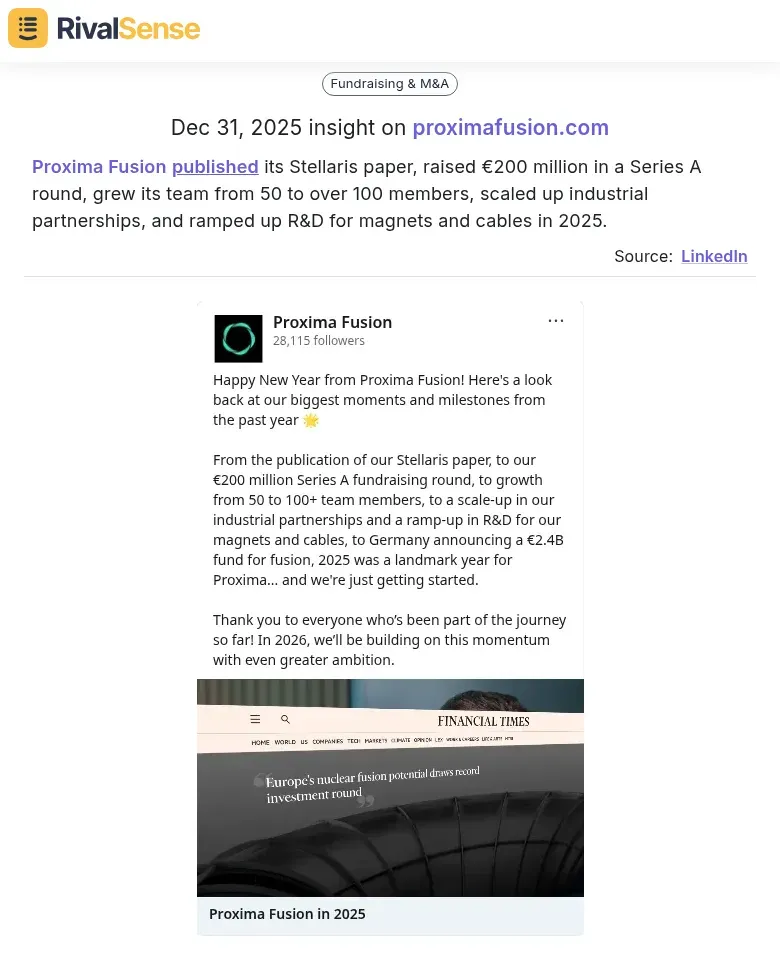
Why it matters for strategy: This type of insight reveals a competitor's investment in future capabilities. For a B2B company in a similar space, it signals potential new features or product lines. By monitoring such R&D activities, you can anticipate gaps in your own offerings and prepare competitive responses.
Example: Monitoring Product Launches and Pricing
Insight: Adidas launches a special Minecraft-inspired holiday collection featuring iconic models like Campus 00s and Samba XLG, priced between $40 and $95, to strengthen its connection with gaming culture and reach younger audiences.

Why it matters for strategy: Even in B2B, product launch and pricing insights are valuable. They show how competitors are positioning themselves and targeting new segments. For your feature gap analysis, this can highlight opportunities for differentiation in packaging, pricing tiers, or niche market features.
Example: Observing Innovation and Public Testing
Insight: Tesla launched Europe's first public shuttle service using Full Self-Driving (Supervised) in Germany's Eifelkreis Bitburg-Prüm region, with local officials testing it and praising its smooth, human-like driving on narrow country roads.

Why it matters for strategy: This insight demonstrates real-world validation of advanced features. For B2B tech companies, it underscores the importance of beta testing and public pilots. By tracking such events, you can identify feature gaps in reliability, safety, or user experience that competitors are addressing.
⚠️ Common Pitfalls to Avoid
1. Feature Checklist Mentality
Don't just copy competitor features. Understand WHY customers want them and build better solutions. Innovation comes from solving problems, not matching checkboxes.
2. Analysis Paralysis
Feature gap analysis should inform decisions, not delay them. Set time limits for your analysis phase. Aim for actionable insights, not perfection.
3. Ignoring Indirect Competitors
The biggest threats often come from companies solving the same problem differently. Always include indirect competitors in your landscape.
4. Static Analysis
Competitors don't stand still. What you learn today may be outdated tomorrow. Continuous monitoring is essential.
Solution: Implement continuous monitoring. Services like RivalSense provide weekly updates on competitor movements, ensuring your analysis stays current.
🌟 Real-World Examples of Feature Gap Analysis Success
Example 1: Slack vs. Email Clients
Slack didn't just build another communication tool. They analyzed the gaps in email and existing chat platforms:
- Gap identified: No platform combined threaded conversations, channel organization, and rich integrations
- Solution: Built a unified platform with searchable conversations and 2,000+ app integrations
- Result: Grew to 500,000 daily active users within two years
Example 2: HubSpot vs. Siloed Marketing Tools
HubSpot identified that marketing teams were using 5-7 different tools, creating data silos and manual work:
- Gap identified: No all-in-one platform for inbound marketing
- Solution: Unified content marketing, SEO, email automation, and CRM
- Result: Became the leading marketing platform for SMBs
📈 Making Feature Gap Analysis Sustainable
Feature gap analysis shouldn't be a one-time project. To maintain competitive advantage, embed it into your regular processes.
1. Establish Regular Review Cycles
- Quarterly deep dives
- Monthly competitor updates
- Weekly monitoring of key competitors
2. Build Internal Processes
- Designate a competitive intelligence owner
- Create standardized reporting templates
- Integrate insights into product planning meetings
3. Leverage Automation
Manual competitor tracking is time-consuming and error-prone. Consider tools that can automate data collection and reporting.
For B2B leaders, platforms like RivalSense offer automated competitor tracking across company websites, social media, registries, and 80+ other sources, delivering actionable intelligence in weekly emails without the manual effort.
✅ Key Takeaways for Implementation
- Start with customer pain points, not competitor features
- Focus on differentiation, not feature parity
- Prioritize based on impact, not just feasibility
- Make it continuous, not a one-time project
- Use the right tools to automate data collection
The Bottom Line
Competitor feature gap analysis isn't about copying what others are doing—it's about understanding where they're failing and building better solutions. In competitive B2B markets, this understanding can mean the difference between struggling for relevance and leading your category.
By systematically identifying and addressing feature gaps, you can:
- Build products that solve real customer problems
- Differentiate in crowded markets
- Optimize development resources
- Accelerate growth through clear value propositions
The most successful companies don't just track competitors—they understand them deeply enough to anticipate where the market is heading and position themselves to lead the way. Feature gap analysis provides the strategic clarity needed to make those moves with confidence.
Ready to implement feature gap analysis? Start by identifying your top 3 competitors and creating a simple feature comparison matrix. For ongoing competitive intelligence without the manual work, try RivalSense for free at https://rivalsense.co/ and get your first competitor report today to stay ahead of the curve.
📚 Read more
👉 Smart Building KAM vs Customer Success: Strategic Framework & Templates
👉 How Competitive Intelligence Uncovered Toggl's Mobile Gap and Created a Market Opportunity
👉 7 Website Change Monitoring Mistakes That Sabotage Competitor SWOT Analysis
👉 Healthcare AI Scribe Competitive Analysis: Gaining Strategic Advantage
👉 The Essential Guide to Tracking Competitor Media Mentions and Content Strategy