
Beginner's Guide to Competitor Pricing Insights and Key Account Sentiment Tracking
In today's hyper-competitive B2B landscape, understanding competitor pricing isn't just about matching numbers—it's about strategic market positioning. When you track how rivals price their offerings, you gain insights into their value propositions, target segments, and market confidence. For instance, a sudden price drop might signal a new feature launch or a bid to capture market share, while premium pricing could indicate a focus on enterprise clients. Practical tip: Start by monitoring 3-5 key competitors' pricing pages monthly, noting changes and correlating them with their marketing campaigns.
Equally critical is tracking key account sentiment—the emotional pulse of your most valuable customers. This reveals loyalty shifts, satisfaction levels, and emerging competitive threats. If a major client expresses frustration on social media or in reviews, it might hint at a competitor's aggressive outreach. Checklist item: Use tools to scan LinkedIn, review sites, and customer feedback for sentiment trends among your top 20 accounts quarterly.
By connecting pricing insights with sentiment data, you achieve holistic competitive intelligence. For example, if a competitor lowers prices and your key accounts show positive sentiment toward them, it's a red flag for potential churn. Step: Integrate pricing and sentiment dashboards to spot patterns—like price hikes coinciding with negative sentiment—and adjust your strategy proactively. This dual approach empowers founders to anticipate market moves, retain customers, and outmaneuver rivals with data-driven decisions.
Fundamentals of Competitor Pricing Analysis
Competitor pricing analysis starts with tracking core metrics across all competitor tiers. Creating a systematic approach helps you decode market dynamics and anticipate shifts. Begin by documenting baseline data to establish a reference point for future comparisons.
Create a spreadsheet tracking:
- Base pricing for each package tier
- Feature differentiation between tiers
- Annual vs monthly pricing differentials
- Enterprise/volume discount structures
For example, track how competitors price their basic vs premium tiers and what features justify price jumps. Monitor pricing structure changes quarterly to detect market positioning shifts. When a competitor adds a mid-tier package or bundles previously separate features, they're likely targeting a new customer segment. Document these changes with dates to identify patterns in market evolution.
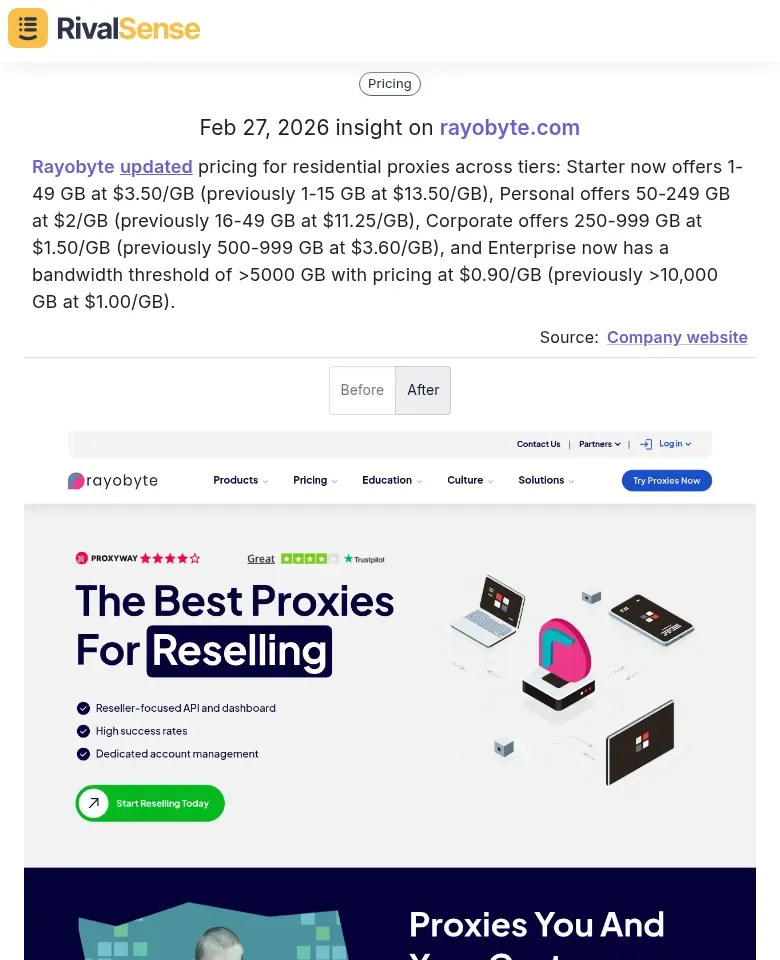
🔍 Real-World Insight: RivalSense detected that Rayobyte updated pricing for residential proxies across tiers, with significant reductions for smaller plans. This insight is valuable because it reveals a strategic pivot towards more aggressive pricing for SMBs, signaling increased competition in the proxy market.
Set up alerts for promotional strategies and limited-time offers. Track:
- Seasonal promotions (Black Friday, New Year)
- Free trial extensions
- Bundle discounts
- Referral program changes
📋 Checklist for Monitoring:
- ✓ Monitor competitor newsletters
- ✓ Track pricing page changes weekly
- ✓ Document offer expiration dates
- ✓ Analyze conversion rate impact of promotions
Practical tip: Use a 3x3 matrix comparing price points against feature richness to visualize market positioning. This reveals gaps where you can differentiate your pricing strategy while maintaining competitive value.
Advanced Pricing Insights from Real-World Examples
Advanced pricing insights go beyond simple tracking to interpret the strategic intent behind changes. Learning from real-world examples helps you anticipate market trends and refine your own approach. These insights often reveal hidden opportunities or threats.
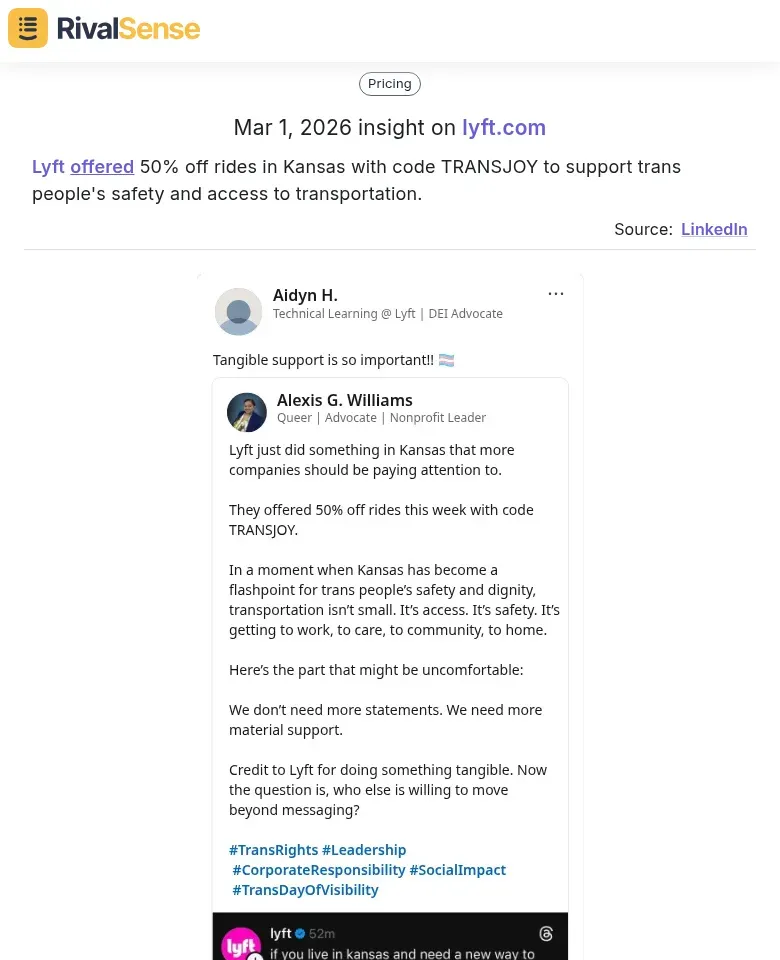
🎯 Promotional Pricing for Brand Positioning: Promotional offers can serve dual purposes of driving sales and enhancing brand image. For instance, Lyft offered 50% off rides in Kansas with code TRANSJOY to support trans people's safety and access to transportation. This insight is valuable for understanding how companies leverage pricing for social impact, which can strengthen customer loyalty and differentiate them in competitive markets.
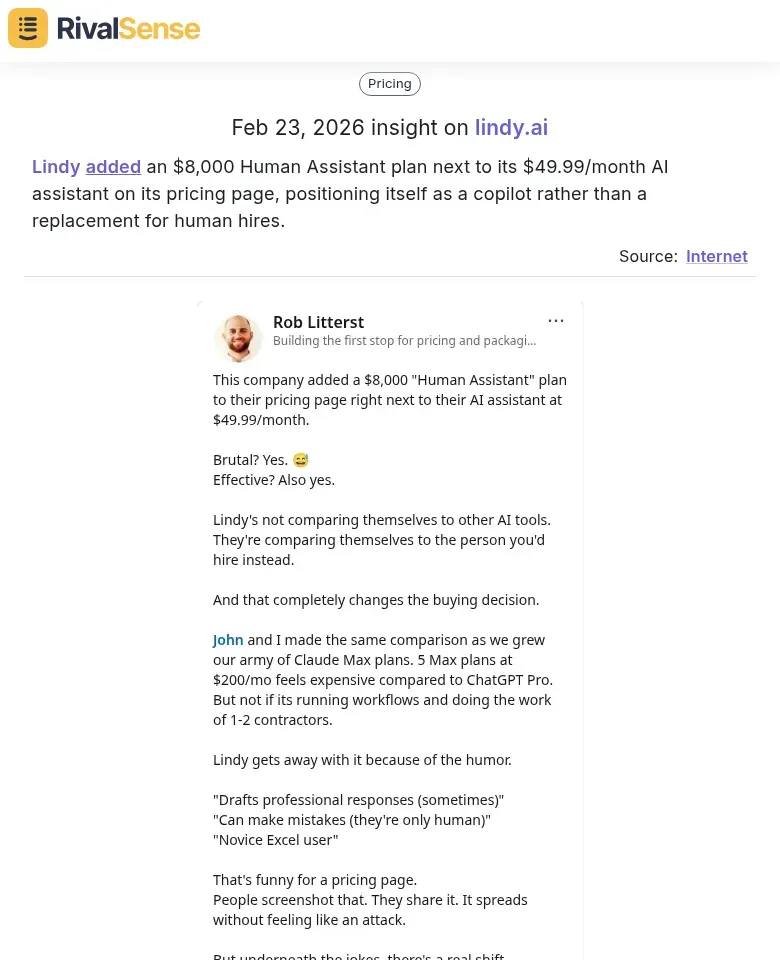
🔄 Hybrid Pricing Models: Combining different pricing structures can create unique value propositions. Lindy added an $8,000 Human Assistant plan next to its $49.99/month AI assistant on its pricing page, positioning itself as a copilot rather than a replacement for human hires. This insight is valuable for identifying how competitors are blending AI and human services, helping you craft a differentiated offering that addresses evolving customer needs.
📊 Tier Restructuring Signals: When competitors shift from flat-rate to volume-based pricing, they're often targeting enterprise growth. Adobe's 2025 Creative Cloud restructuring introduced Pro tiers with volume discounts, signaling enterprise market focus. Practical tip: Track tier changes quarterly using competitor monitoring tools to spot expansion patterns before they impact your market share.
Analyzing promotional pricing uncovers competitive positioning. Target's 2025 price-matching policy against Amazon and Walmart reveals defensive positioning in retail. When competitors offer targeted discounts to specific customer segments, they're likely defending market share or testing new segments. Checklist: Monitor discount frequency, target segments, and duration to identify whether promotions are defensive (short-term) or offensive (long-term market entry).
Key monitoring strategy: Set up alerts for pricing changes, track promotional patterns across seasons, and analyze tier restructuring announcements to anticipate market shifts before they impact your positioning.
Key Account Sentiment Tracking Essentials
Key account sentiment tracking is essential for proactive customer retention and competitive defense. By monitoring the emotional signals from your most valuable clients, you can detect early warnings of dissatisfaction or competitive encroachment. This process involves systematic observation and analysis across multiple channels.
Identifying and monitoring key accounts is foundational to competitive intelligence. Start by defining your top 20-30 strategic accounts—those with high revenue potential or market influence. Use tools like RivalSense to track their public sentiment signals across social media (LinkedIn, Twitter), review platforms (G2, Capterra), and industry forums.
Practical steps:
- Create a monitoring list with account names, decision-makers, and relevant keywords
- Set up alerts for mentions, reviews, and news about these accounts
- Analyze sentiment trends weekly—note positive/negative shifts in language
Track account mentions systematically. Look for patterns: Are they praising competitors? Expressing dissatisfaction? Discussing new initiatives? This reveals loyalty shifts before they happen. For example, if a key account suddenly mentions a competitor's new feature positively, it signals potential churn risk.
Analyze sentiment trends to predict threats. Use a simple scoring system: positive (+1), neutral (0), negative (-1). Track changes over time. A declining trend may indicate growing dissatisfaction, while positive spikes around competitor announcements suggest vulnerability.
Tip: Combine sentiment data with pricing insights. If a key account shows negative sentiment while competitors lower prices, act proactively with tailored retention strategies. Regular monitoring helps you anticipate moves and protect your most valuable relationships.
Integrating Pricing and Sentiment Data for Strategic Decisions
Integrating pricing and sentiment data transforms reactive monitoring into proactive strategy. This fusion allows you to correlate external market moves with internal customer perceptions, leading to more informed decisions. Here's how to connect these insights for competitive advantage.
Step 1: Establish Correlation Patterns
Track competitor price changes alongside key account sentiment shifts. When a competitor lowers prices, monitor if their key accounts show increased satisfaction or if your accounts express concern. Use a 30-day correlation window to identify meaningful patterns.
Step 2: Create Early Warning Indicators
Set up alerts for when pricing changes coincide with sentiment fluctuations exceeding 15%. This signals potential market shifts before they become obvious.
📋 Practical Checklist:
- Map competitor pricing tiers to your key account segments
- Monitor sentiment before/after competitor pricing announcements
- Track win/loss reasons when pricing is mentioned
- Document how pricing changes affect renewal discussions
Step 3: Develop Proactive Responses
When you detect a competitor lowering prices while losing key account sentiment, they may be struggling. Consider targeted value messaging to their vulnerable accounts. Conversely, if a competitor raises prices while maintaining positive sentiment, they've likely strengthened their value proposition - analyze what's working.
Key Insight: The most valuable intelligence emerges from the gap between what competitors charge and how their customers feel about it. This gap reveals vulnerabilities to exploit and strengths to emulate.
Actionable Tip: Create a monthly "Pricing-Sentiment Dashboard" showing competitor moves alongside account sentiment trends. Use this to anticipate quarterly competitor strategies and adjust your positioning accordingly.
Getting Started: Practical Implementation Steps
1. Set Up Automated Tracking Systems
Begin by implementing automated monitoring tools that continuously track competitor pricing and key account sentiment. For pricing, use web scraping APIs or dedicated price monitoring software to track competitors' product prices, discounts, shipping costs, and bundle deals across multiple regions. For sentiment tracking, deploy tools that monitor 80+ sources including LinkedIn discussions, Reddit threads, industry forums, and regulatory filings. Pro tip: Use semantic matching instead of simple keyword tracking to catch nuanced phrases like "frustrated with [your brand]" rather than just brand mentions.
2. Establish Regular Review Cycles
Create a structured review schedule:
- Daily: Check automated alerts for critical pricing changes or sentiment velocity spikes
- Weekly: Review consolidated reports comparing your pricing against competitors and analyzing sentiment trends
- Monthly: Conduct deep-dive analysis to identify pricing patterns and sentiment trajectories
- Quarterly: Assess strategic implications and adjust monitoring parameters
Set up tiered alerting: Level 1 for basic mentions, Level 2 for velocity-based alerts (50%+ discussion pace increase), Level 3 for strategic alerts involving C-level stakeholders or competitors.
3. Create Actionable Reports
Transform raw data into strategic recommendations with these report components:
- Executive Summary: Key findings and immediate actions
- Pricing Analysis: Your position vs. competitors, price trend visualizations
- Sentiment Dashboard: Account-by-account sentiment scores with trend arrows
- Competitive Context: How competitors are mentioned in your accounts' discussions
- Recommendations Section: Specific actions like price adjustments, promotional timing, or relationship interventions
📋 Implementation Checklist:
- ✓ Identify 3-5 key competitors and their pricing pages
- ✓ Map key accounts' digital footprints across professional networks and technical communities
- ✓ Configure automated tools with semantic matching and velocity-based alerting
- ✓ Establish baseline metrics for pricing and sentiment
- ✓ Create standardized report templates with clear action items
- ✓ Schedule regular review meetings with stakeholders
- ✓ Train team on interpreting insights and taking appropriate actions
Streamline Your Competitor Tracking with RivalSense
Mastering competitor pricing and sentiment tracking requires consistent effort and the right tools. To save time and gain actionable insights, try RivalSense for free at https://rivalsense.co/. RivalSense tracks competitor product launches, pricing updates, event participations, partnerships, regulatory aspects, management changes, and media mentions across company websites, social media, and various registries—delivering all in a weekly email report. Get your first competitor report today and start making data-driven decisions to outmaneuver your rivals!
📚 Read more
👉 Leveraging Social Clues for Competitor Analysis: A Case Study on Huel
👉 Mastering Competitor Intelligence: Leveraging Customer Reviews in Systems Software Development
👉 How BASF's Fungicide Registration in Italy Enabled Smarter Competitor Strategies
👉 Quick Website Monitoring Hacks for Key Account Intelligence