
Beginner's Guide to Analyzing Competitor Product Offerings for Market Share
In today's hyper-competitive B2B landscape, analyzing competitor product offerings isn’t just market research—it’s a direct lever for market share growth. Companies that systematically track competitor features, pricing, and product roadmaps capture 2-3x more market share than those who don’t. The reason is simple: understanding what your competitors offer reveals gaps in your own value proposition and identifies underserved customer needs you can address.
Strategic competitor analysis transforms reactive responses into proactive market positioning. Instead of playing catch-up when competitors launch new features, you anticipate market shifts and innovate ahead of them. This forward-looking approach allows you to shape market expectations rather than merely respond to them.
Practical steps to get started:
- 🗂️ Create a competitor feature matrix comparing your offerings against 3-5 key competitors
- 💰 Track pricing changes and packaging strategies monthly
- 📢 Monitor competitor release notes and product announcements
- 🔍 Analyze customer reviews to identify pain points competitors aren’t solving
- ⚙️ Set up alerts for competitor website changes and feature launches
By making competitor product analysis a systematic process, you’ll identify opportunities to differentiate your offerings, optimize pricing strategies, and accelerate feature development—all critical drivers for sustainable market share growth.
Identifying What to Analyze: Key Product Dimensions and Features
When analyzing competitor product offerings, focus on three critical dimensions: feature evolution, validation rigor, and platform expansion. Understanding these dimensions helps you decode competitor strategies and identify opportunities for differentiation. Each dimension provides unique insights that can inform your product roadmap and market positioning.
Feature Updates Analysis: Track granular changes like new features or improvements. For example, RivalSense recently tracked that IPRoyal introduced Invoice Page Updates, URL Checker for Web Unblocker, and Proxy Advisor in November and December 2025.
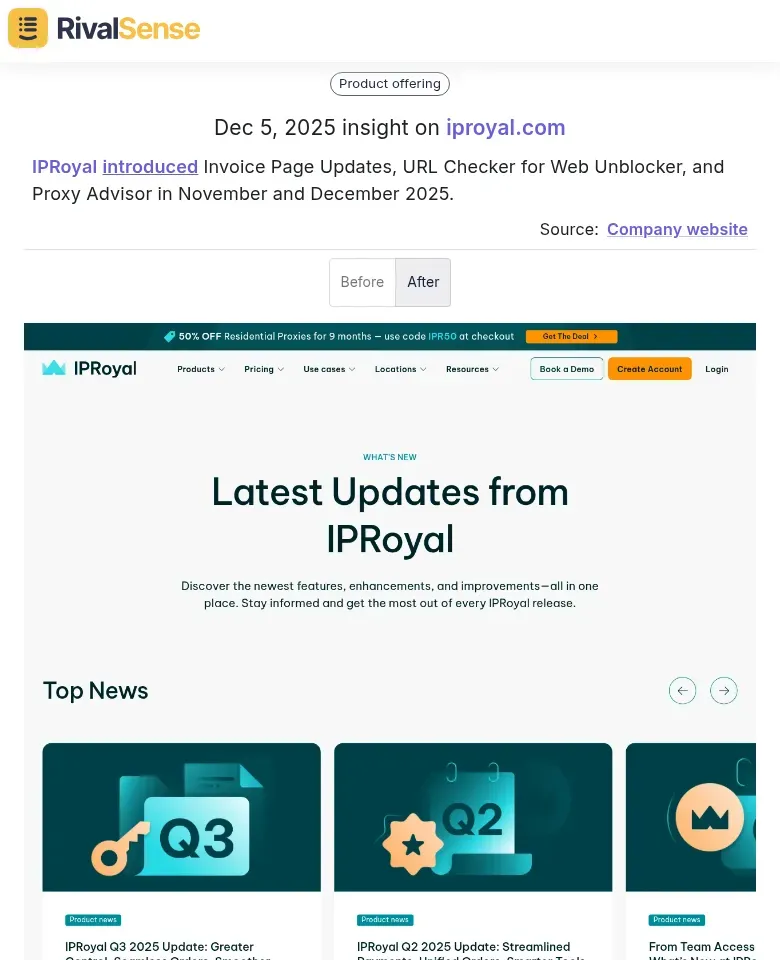
Monitoring such feature updates is valuable because it reveals UX priorities and technical differentiation, allowing you to anticipate market trends and adjust your product roadmap accordingly. Create a monitoring checklist:
- 📝 Document exact feature specifications
- 🎯 Identify target user segments
- ⚖️ Compare against your capabilities
- 🧪 Test new features via free trials
Validation Processes: Examine how competitors validate product quality. For instance, IDnow's Senior Product Owner Christophe Chaput tested the company's latest NFC chip reading solution with INTERPOL's Identity & Document Laboratory on December 4.
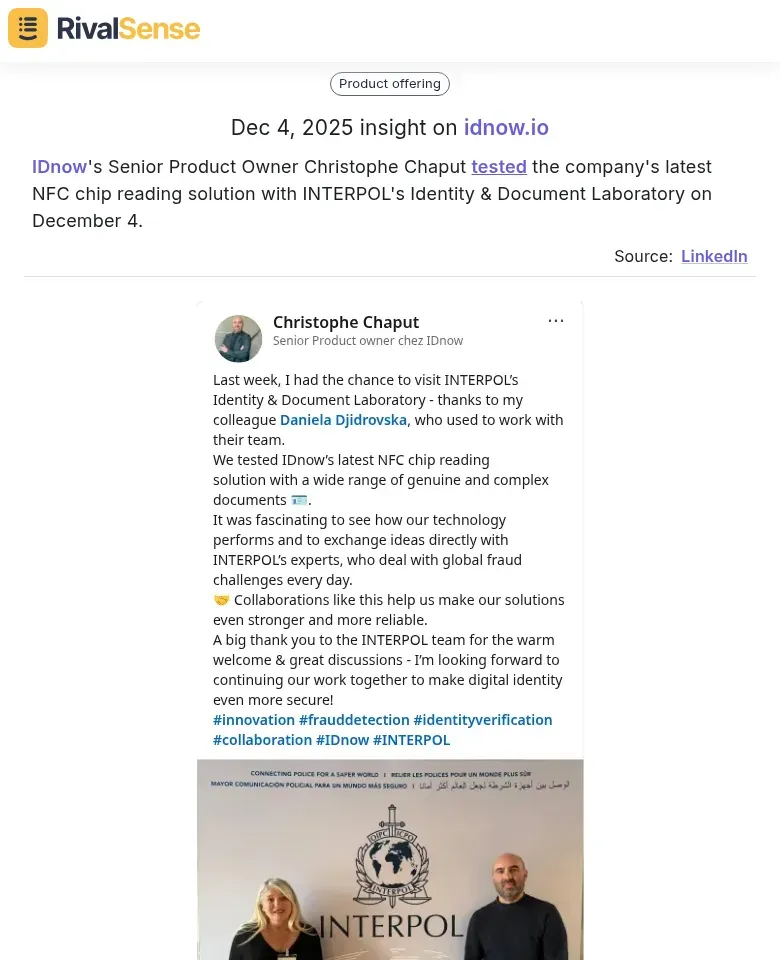
This type of insight into validation processes is crucial as it demonstrates enterprise-grade security validation, helping you understand competitor credibility and target market sophistication. Analyze their testing methodologies, certification partnerships, and compliance frameworks to gauge their risk tolerance and market appeal.
Platform Expansions: Monitor market entry strategies and new platform launches. A recent example is Fanatics launching Fanatics Markets, a sports and entertainment prediction app now available on iOS and Android in the US, as announced by JD Millwood, Chief Product Officer and Advisor at Fanatics, on December 4.
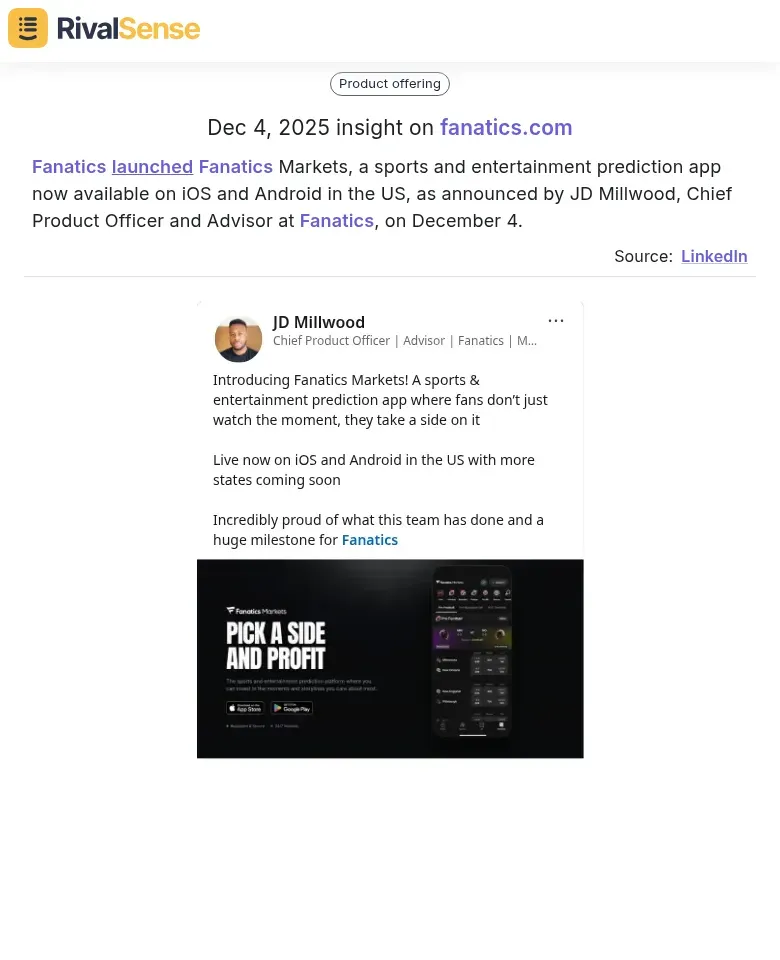
Tracking platform expansions like this helps you identify market entry strategies and growth trajectories, enabling you to spot vulnerabilities or opportunities in new segments. Key indicators include app store metrics, user acquisition channels, and integration partnerships.
Practical Framework: Implement a 4-step analysis:
- 🔧 Feature dissection – what changed technically?
- 📊 Positioning assessment – how does this compare to your offering?
- 📈 Impact projection – which customer segments will this attract?
- 🎯 Response planning – develop strategic countermeasures based on identified gaps
Regular competitor tracking prevents strategic surprises and reveals market trends before they become mainstream expectations.
Gathering Competitive Intelligence: Sources and Methods
Gathering competitive intelligence requires systematic monitoring across multiple channels. Effective intelligence gathering turns random observations into structured insights that drive decision-making. Start by tracking official sources: subscribe to competitor newsletters, follow their blogs, and monitor press releases for product announcements.
Set up Google Alerts for competitor names plus keywords like “launch,” “update,” or “feature.” For deeper insights, monitor executive leadership on LinkedIn and Twitter—product roadmap hints often appear in interviews or casual posts. Track product team activities on GitHub, Stack Overflow, or technical forums where early feature discussions may surface.
Analyze customer-facing materials systematically: compare documentation versions to spot feature additions, review support forums for common user requests (which may indicate upcoming solutions), and monitor pricing page changes. Create a competitive intelligence dashboard with tools like RivalSense to automate tracking across these channels.
Practical checklist:
✅ Document baseline product features quarterly
✅ Set up automated alerts for key competitors
✅ Review competitor help centers monthly for new tutorials
✅ Track executive speaking engagements for roadmap clues
Remember: subtle changes in marketing language often precede major feature releases. 🕵️♂️
Analyzing Product Strengths and Gaps: Turning Data into Insights
Once you’ve gathered competitor product data, the real value comes from transforming it into actionable insights. This analysis phase is where raw data becomes strategic ammunition for market share growth. Start by identifying feature gaps where competitors are investing heavily.
For example, if multiple rivals are enhancing payment processing capabilities, this signals market demand you may need to address. Create a feature matrix comparing your offerings against competitors, noting where they’re allocating R&D resources.
Next, analyze validation strategies that build credibility. Look for third-party testing partnerships, industry certifications, or case studies that demonstrate product reliability. These validation efforts often indicate which features or claims competitors feel need external verification to win customer trust.
Finally, spot market expansion patterns and platform strategies. Track whether competitors are adding integrations, expanding to new platforms (mobile/web/desktop), or entering adjacent markets. This reveals their growth trajectory and potential vulnerabilities.
Practical checklist:
- 📅 Map competitor feature investments over the last 6-12 months
- 🏆 Document all third-party validations and partnerships
- 🌍 Track platform expansion and integration announcements
- ⚠️ Identify gaps where you can differentiate or need to catch up
- 🎯 Prioritize insights based on customer impact and strategic alignment
Translating Insights into Market Share Strategy
Now that you’ve gathered competitor intelligence, it’s time to translate insights into actionable market share strategy. Strategic translation ensures that your insights directly influence product development and market positioning. Start by developing counter-features that directly address competitor advantages.
For example, if a rival excels with AI-powered analytics, create a more intuitive interface or add predictive modeling capabilities. Build a feature comparison matrix to identify gaps and prioritize development.
Next, create validation initiatives based on competitor successes. If competitors use case studies effectively, develop your own success stories with measurable ROI. Implement credibility-building tactics like third-party certifications, industry awards, or strategic partnerships that mirror what’s working for them.
Finally, plan market expansion informed by competitor movements. Track where competitors are launching new products or entering markets, then identify underserved segments or geographic gaps. Create a platform strategy roadmap that anticipates competitor moves 6-12 months ahead.
Practical tip: Use a quarterly competitor strategy review to adjust your approach based on their latest product releases and market positioning. 📊
Building a Continuous Competitor Tracking System
Establishing a continuous competitor tracking system is essential for sustained market intelligence. Without ongoing monitoring, insights quickly become outdated and strategies lose relevance. Set up a systematic monitoring cadence: weekly automated alerts for competitor websites, monthly deep-dive analysis sessions, and quarterly strategic reviews.
Use tools like RivalSense to track homepage changes, pricing updates, and new product pages automatically. Create structured analysis frameworks: develop a standardized template comparing features across 5 key dimensions: core functionality, pricing tiers, user experience, integration capabilities, and customer support.
Practical checklist:
- ⚙️ Set up automated monitoring for 3-5 key competitors
- 📊 Create a shared dashboard with real-time updates
- 🗓️ Schedule bi-weekly team reviews of competitor changes
- 📁 Document feature gaps and opportunities in a central repository
- 🔔 Establish alert thresholds for significant changes (price drops >10%, major feature launches)
Integrate insights into your roadmap: Map competitor features against your product timeline. Use a simple matrix: “Match” (we have it), “Gap” (they have it, we don’t), “Advantage” (we have it, they don’t). Prioritize roadmap items based on competitive urgency and strategic alignment.
Pro tip: Assign “competitive intelligence champions” in each product team to ensure insights flow directly into planning cycles. Regular competitor analysis should inform 20-30% of your product decisions, helping you anticipate market shifts rather than react to them. 🚀
Take Action with RivalSense
Turning competitor insights into market share growth requires consistent, accurate tracking. RivalSense automates this process by monitoring competitor product launches, pricing updates, event participations, partnerships, regulatory changes, management shifts, and media mentions across websites, social media, and various registries—delivering a concise weekly email report.
Ready to streamline your competitor analysis? Try RivalSense for free today and get your first competitor report to start identifying gaps and opportunities in your market. Visit RivalSense to sign up and gain a strategic edge! 🎯
📚 Read more
👉 Leveraging Management Changes for Competitive Advantage: A Case Study on Safran
👉 The Complete Guide to Competitor Patent Analysis: How to Decode Your Rivals' Innovation Strategy
👉 Maximizing Warehousing & Distribution Competitor Benchmarking: Best Practices for B2B Leaders
👉 How to Counter Competitor Advances Like Xometry's Formlabs SLA Partnership
👉 Track Key Account Team Changes: Website Monitoring Workflow for Competitor Insights