
Avoid These Instagram Competitor Insight Mistakes for Better Key Account Tracking
In 2025, Instagram competitor insights are no longer optional—they're essential for strategic decision-making in key account tracking. With over 2 billion monthly active users and evolving algorithms, Instagram offers real-time visibility into competitor moves, from product launches to customer engagement strategies. Yet, many businesses fall into common pitfalls: relying on vanity metrics like follower counts, ignoring competitor content themes and engagement patterns, or failing to track key account interactions with rivals. These mistakes undermine effective analysis and leave you vulnerable to market shifts.
Proper competitor insights transform key account management by revealing opportunities for differentiation and proactive strategy. For example, tracking competitor responses to key accounts' posts can highlight service gaps you can fill. Practical steps include:
- Use tools like RivalSense to monitor competitor hashtags and mentions of key accounts.
- Analyze engagement rates (not just likes) to gauge content effectiveness.
- Create a weekly checklist to review competitor stories, reels, and comments.
By avoiding these mistakes, you'll gain actionable intelligence to strengthen relationships and drive business growth.
Mistake #1: Focusing Only on Surface-Level Metrics Instead of Strategic Changes
Many businesses make the critical error of tracking only vanity metrics like follower counts and engagement rates. This approach completely misses the strategic shifts that truly impact market positioning. For instance, monitoring operational updates like scoring systems reveals how competitors are improving service quality and retention, which directly affects your competitive landscape.
Consider Uklon's recent update: on December 18, they updated their Karma driver activity system, renaming it to Activity, simplifying its logic, and introducing a new scoring system from 0 to 1000 points with three levels that affect order distribution and search methods.

Tracking such strategic changes is valuable because it uncovers where competitors are investing resources to enhance customer experience and operational efficiency, allowing you to anticipate market shifts. To avoid this mistake, focus on tracking platform and feature updates that reveal strategic direction. Look for major system overhauls, pricing model changes, or new service offerings.
Practical checklist to monitor strategic elements:
- [ ] Scoring systems, commission structures, and service tiers
- [ ] App updates, terms of service changes, and major announcements
- [ ] Implementation timelines and impact on key metrics over time
- [ ] How changes affect customer experience and market positioning
Remember: Strategic changes create lasting competitive advantages, while surface metrics only show temporary fluctuations.
Mistake #2: Ignoring Innovation Milestones and Technology Readiness
Ignoring innovation milestones is a critical oversight in competitor tracking. These announcements signal technology validation and real-world readiness that could disrupt entire industries. Monitoring competitor innovation progress helps you anticipate market disruptions before they happen, enabling strategic R&D adjustments and resource allocation.
For example, Rolls-Royce's methanol engine passed its first stress test this year, demonstrating readiness for real-world deployment at sea.
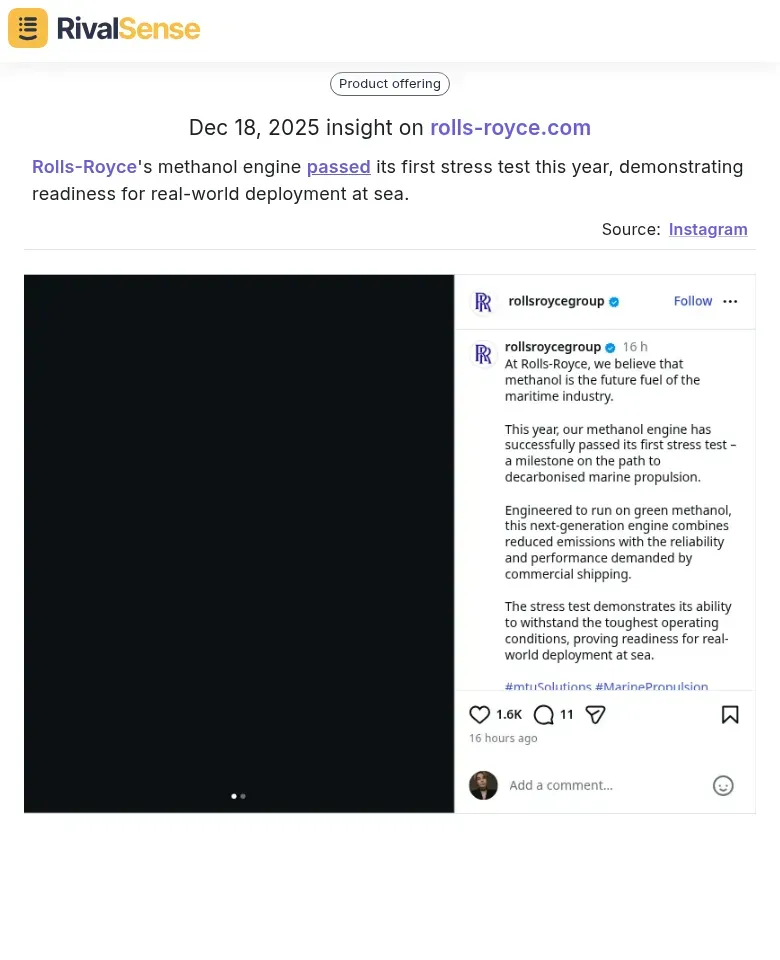
This type of insight is valuable because it gauges technology readiness levels (TRL), helping you assess how close competitors are to commercialization and prepare competitive responses. Practical steps for tracking innovation on Instagram:
- Create a dedicated innovation tracker spreadsheet to log milestones.
- Monitor for keywords like "validation," "pilot," "testing complete," and "real-world results."
- Assess technology readiness: Lab testing (TRL 3-4) vs. field validation (TRL 6-7).
- Track executive commentary for confidence indicators.
- Note partnership announcements with research institutions.
Use tools like RivalSense to automate tracking of competitor innovation posts and receive alerts for critical milestones.
Mistake #3: Missing Product Launch Details and Feature Enhancements
Missing product launch details and feature enhancements can leave you blindsided by competitor advances. Analyzing these announcements shows where rivals are investing resources and what customer pain points they're solving, revealing their strategic priorities and market positioning.
Take OpenAI's launch of ChatGPT Image on December 16, offering faster image generation, precise edits, and high resolution in its app.
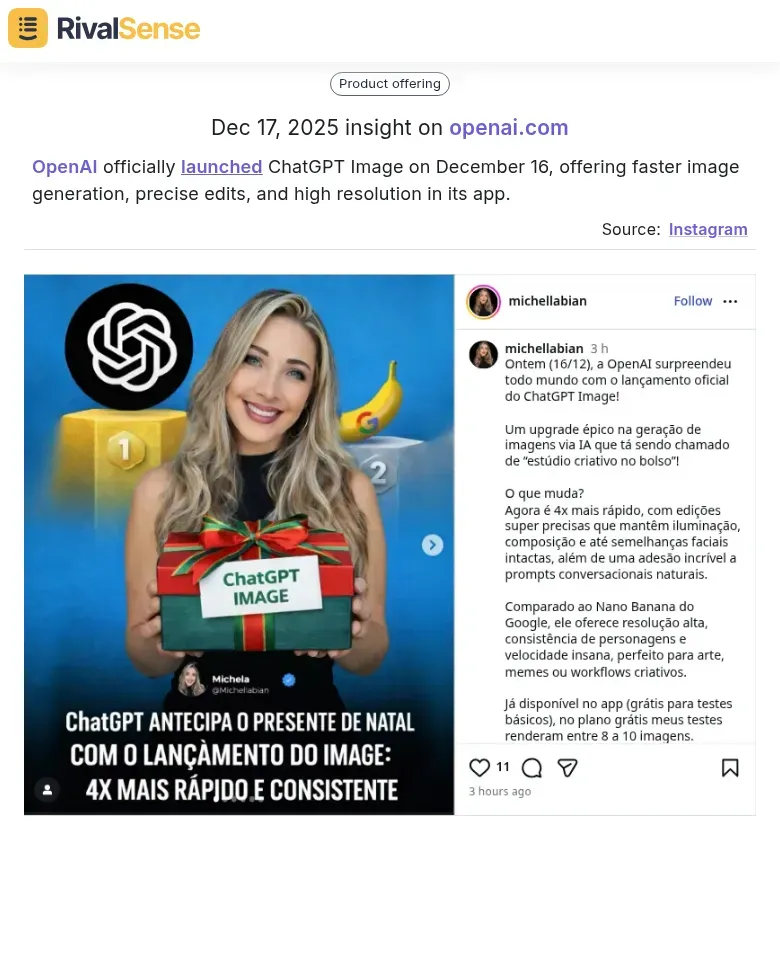
This insight is valuable because it highlights competitive advantages in speed, quality, and reliability, allowing you to identify feature gaps and refine your own offerings. Actionable steps to extract insights:
- Track quantitative improvements: Note specific metrics like "faster generation" or "enhanced resolution."
- Categorize enhancements: Group features into speed, quality, precision, or usability improvements.
- Map to customer needs: Connect each enhancement to potential customer pain points.
- Create a feature comparison matrix to document competitor evolution over time.
- Set up alerts using tools like RivalSense to monitor announcements and updates.
Pro tip: Don't just note what features exist—analyze how they're positioned to target specific user segments.
Mistake #4: Failing to Connect Competitor Moves to Your Key Account Strategy
The most dangerous mistake is collecting competitor insights but failing to connect them to your key account strategy. Without this connection, insights remain abstract data points rather than actionable intelligence. You might know a competitor launched a new feature, but if you don't analyze how this affects your top accounts specifically, you're missing opportunities to protect and grow relationships.
Actionable Steps:
- Map Competitor Moves to Account Vulnerabilities: When a competitor announces a partnership with a platform your key accounts use, immediately assess which accounts are most exposed.
- Create Account-Specific Alerts: Set up monitoring for competitor mentions, case studies, or job postings involving your key accounts' industries or technologies.
- Build a 2x2 Matrix: Plot your key accounts against competitor threat levels based on recent moves, pricing changes, or feature launches.
Systematic Approach:
- Weekly review: Which competitor activities this week impact which key accounts?
- Quarterly deep dive: How have competitor strategies evolved relative to your account portfolio?
Dashboard Focus: Your competitive intelligence dashboard should have an "Accounts at Risk" section showing:
| Metric | Why It Matters |
|---|---|
| Competitor wins/losses in your accounts' verticals | Identifies competitive pressure points |
| Feature gaps that matter to your specific accounts | Highlights areas for product development |
| Pricing changes affecting account renewal decisions | Informs negotiation and retention strategies |
Practical Tip: Assign each key account a "competitor exposure score" (1-10) based on recent competitor activity in their space, and review monthly.
Best Practices: Building a Proactive Instagram Competitor Tracking System
Effective competitor tracking requires a systematic approach. Building a proactive Instagram competitor tracking system ensures you stay ahead of market shifts and respond strategically to competitor moves. Start by establishing regular monitoring routines and integrating insights across platforms for a holistic view.
Develop a categorization framework to prioritize intelligence. Create a simple matrix with two axes: impact (high/medium/low) and urgency (immediate/strategic/long-term). For example:
- High impact/immediate: Competitor's new product launch announcement.
- Strategic: Gradual follower growth trends or content strategy shifts.
Tag content by themes: pricing changes, feature updates, content strategy shifts, or partnership announcements.
Integrate Instagram insights with your broader competitive intelligence system by creating a centralized dashboard. Connect Instagram metrics with data from other platforms (LinkedIn, Twitter, website traffic) to identify cross-channel patterns. Establish a weekly review process where Instagram findings inform your overall competitive strategy.
Alert triggers for immediate response:
- [ ] Competitor launches a product directly competing with yours
- [ ] Key accounts engage significantly with competitor content
- [ ] Competitor announces a partnership in your core market
By implementing these practices, you'll transform raw data into actionable strategies that drive business growth.
Ready to upgrade your competitor tracking? Try RivalSense for free to automate insights on product launches, pricing updates, partnerships, and more—delivered in a weekly email report. Get your first competitor report today and stay ahead of the curve!
📚 Read more
👉 Cybersecurity Competitive Intelligence: Key Account Tracking Software Comparison
👉 Data-Driven Competitor Product Insights: Track for Strategic Sales Wins
👉 Real-World Competitor Analysis: Insights and Actionable Strategies
👉 The Strategic Benefits of Real-Time Competitor Alerts: A Practical Guide for Business Leaders
👉 Commercial Laundry Services: Key Account Sentiment Tracking Checklist