
Avoid These 5 Financial & M&A Competitor Insight Mistakes That Cost Millions 🚨
In the high-stakes world of financial strategy and M&A, competitor intelligence isn't just helpful—it's mission-critical. Yet many organizations make fatal errors in how they approach this crucial function. Consider this: over 70% of M&A deals fail to deliver expected value, often due to inadequate competitor understanding during due diligence.
Common misconceptions abound. Many leaders believe financial competitor analysis is just about quarterly earnings reports, when in reality it encompasses everything from capital allocation patterns to hidden debt structures and strategic partnership networks. Others assume their investment bankers provide sufficient competitor insights, overlooking the fact that bankers have inherent conflicts of interest.
Poor competitor intelligence leads directly to failed deals and strategic missteps. Without understanding how competitors will react to your acquisition, you risk triggering price wars, regulatory challenges, or talent exodus. Financial missteps include overpaying for assets, missing emerging competitive threats, and failing to anticipate market consolidation patterns.
Practical tip: Start with a 3-point checklist before any major financial decision:
- 🗺️ Map competitor financial health beyond surface metrics
- 🔍 Analyze their M&A history and integration capabilities
- ⏳ Assess how they've responded to similar market moves in the past
Remember: In financial strategy and M&A, what you don't know about your competitors can cost you millions—or sink the entire deal.
Mistake 1: Ignoring Real-Time Strategic Moves (Like Microsoft's AI Acquisition)
Competitor acquisitions and partnerships are forward-looking indicators that reveal market consolidation trends and strategic priorities. Many companies treat these announcements as mere news, missing the early warning signals embedded in real-time moves. For instance, as tracked by RivalSense, Microsoft's Sr. Cloud & AI Solution Architect Sidney Cirqueira announced on January 31 that Microsoft acquired an AI company to automate engineering in Microsoft Fabric, as part of its monthly update.
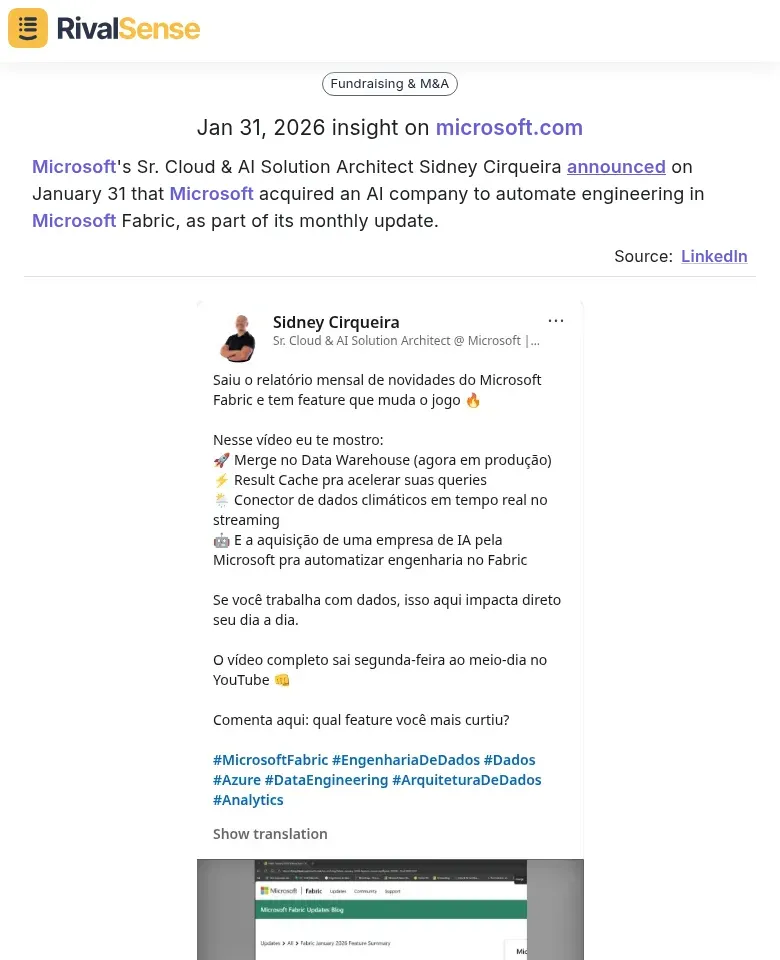
Why This Matters: This type of insight is valuable because it shows where competitors are investing in automation and AI integration, signaling strategic shifts that could impact your industry. By monitoring such moves in real-time, you can anticipate technology trends and adjust your own strategy accordingly.
Practical Steps to Avoid This Mistake:
- Set Up Real-Time Alerts: Use tools like RivalSense to monitor competitor SEC filings, press releases, and partnership announcements.
- Analyze Strategic Patterns: Don't just track individual moves—look for patterns across multiple competitors to identify market trends.
- Connect Dots to Your Strategy: Ask: "How does this move affect our competitive position? What technology shifts should we anticipate?"
- Create a Response Framework: Develop a playbook for different types of competitor moves (acquisitions, partnerships, product launches).
Key Insight: The most valuable intelligence isn't what competitors are doing today, but what their strategic moves reveal about where they're investing for tomorrow. By tracking these moves in real-time, you can anticipate market shifts before they become obvious threats.
Mistake 2: Overlooking Operational Efficiency Insights (From Innovaccer's AI Report)
Operational metrics like workflow automation and data integration reveal how competitors scale efficiency and overcome barriers. Ignoring these insights can leave you lagging in productivity and innovation. For example, Innovaccer's 2026 report shows most organizations run AI in live workflows, cutting documentation time by up to 40%, but fragmented data and point solutions are slowing scale.
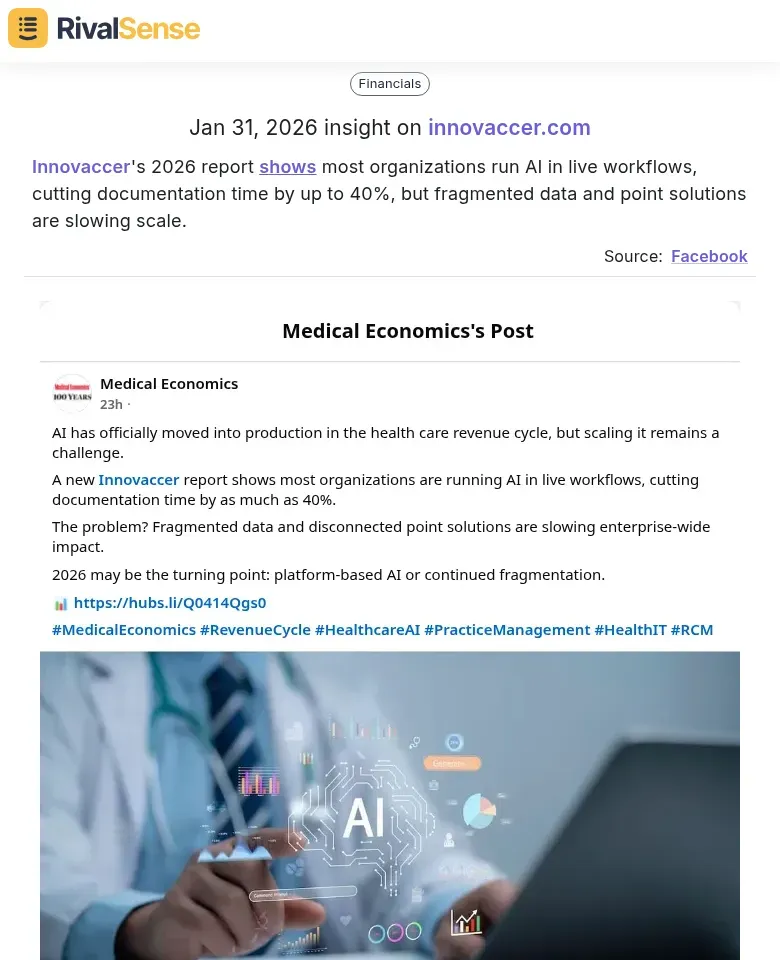
Why This Matters: Tracking operational efficiency insights is crucial because it helps benchmark your own processes, identify common pitfalls like data fragmentation, and learn from competitors' successes and failures in scaling AI.
Practical Steps to Avoid This Mistake:
- Track Implementation Challenges: Monitor how competitors handle data fragmentation, staffing constraints, and governance structures.
- Analyze Efficiency Gains: Look for metrics like documentation time reductions and workflow automation adoption rates.
- Learn Scale Limitations: Identify what prevents competitors from achieving enterprise-scale AI maturity.
Checklist for Operational Insight:
- ✅ Monitor data integration approaches
- ✅ Track workflow automation adoption rates
- ✅ Analyze governance structure maturity
- ✅ Benchmark documentation time reductions
- ✅ Identify fragmentation vs. platform consolidation strategies
Key Insight: The report frames 2026 as an architectural decision point—competitors either consolidate around unified platforms or accumulate disconnected tools that limit scale. Track which path your competitors choose to avoid similar pitfalls.
Mistake 3: Neglecting Financial Health Signals (Like Huntsman's Credit Downgrade)
Financial health signals such as credit rating changes provide early warnings of strategic vulnerabilities that competitors can exploit. These indicators go beyond surface metrics to reveal deeper operational and market risks. For instance, S&P Global Ratings lowered Huntsman's issuer credit rating to 'BB' from 'BB+' on January 30, 2026, due to continued weak credit metrics and a negative outlook.
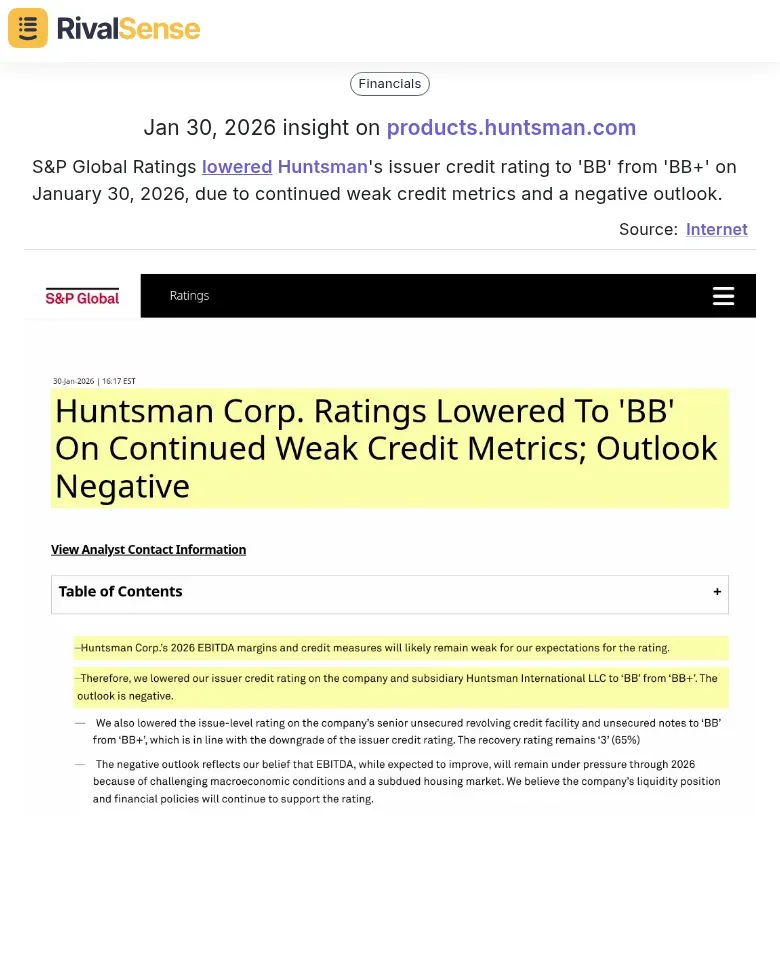
Why This Matters: This type of insight is valuable because it alerts you to potential financial distress, allowing you to anticipate competitor cutbacks in R&D or marketing, and identify opportunities for market share gains or strategic partnerships.
Track these key financial distress indicators:
• 📉 Credit rating changes (Moody's, S&P, Fitch)
• 📊 Debt-to-equity ratio trends
• 💰 Cash flow volatility
• 📈 Interest coverage ratios
• 📉 Bond yield spreads
Practical steps to leverage financial insights:
- Set up alerts for competitor SEC filings and credit agency reports.
- Correlate financial distress with operational metrics (market share, R&D spending).
- Identify acquisition targets showing financial strain but strong market position.
- Monitor supplier/customer concentration risks revealed in financial statements.
- Use financial stress timelines to predict competitor strategic shifts.
Key Insight: Financial distress often precedes strategic vulnerability—companies may cut R&D, reduce marketing, or exit markets. These moments create opportunities if you spot them early and act decisively.
Mistake 4: Failing to Connect Multiple Data Points Across Time
Many companies track competitor moves in isolation, missing the critical patterns that emerge when connecting dots over time. This oversight leaves you reacting to events rather than anticipating them, undermining strategic planning. For example, linking funding rounds with subsequent hiring sprees or product launches can reveal predictable cycles.
Practical steps:
- Build a competitor timeline using tools like RivalSense to track key events over 12-24 months.
- Look for correlations between financial events and subsequent operational moves.
- Identify recurring patterns (e.g., funding → hiring → product launch cycles).
- Use historical behavior to predict future actions—if they've acquired three SaaS companies in two years, expect more M&A.
Tip: Don't just track what competitors do; analyze why and when they do it. The timing between financial events and strategic moves often reveals their playbook.
Mistake 5: Underestimating Integration and Implementation Challenges
Many M&A deals fail because leaders underestimate the complexity of technology integration and system implementation. Research shows over two-thirds of acquisitions fail to realize intended value, often due to post-deal integration challenges. Don't make this mistake—learn from competitors who've navigated these waters successfully.
Practical Steps to Avoid This Mistake:
- Analyze Competitor Integration Patterns: Track how competitors handle data fragmentation across incompatible systems. Study their approaches to unifying ERP systems, data formats, and cloud platforms.
- Create Integration Checklists: Based on competitor analysis, develop checklists covering data unification protocols, system compatibility assessments, regulatory compliance transfers, and stakeholder communication frameworks.
- Benchmark Implementation Timelines: Use competitor implementation cycles to set realistic expectations rather than assuming quick fixes.
- Monitor Integration Success Metrics: Track how competitors measure integration success—system uptime, data accuracy rates, user adoption percentages, and cost overrun percentages.
Key Insight: The most successful companies treat integration as a strategic priority from day one, not an afterthought. They establish clear governance through Integration Management Offices (IMOs) and communicate proactively with all stakeholders.
Ready to Avoid These Mistakes? Try RivalSense Today! 🚀
Staying ahead in financial strategy and M&A requires timely, accurate competitor insights. RivalSense tracks competitor product launches/updates, pricing changes, event participations, partnerships, regulatory aspects, management changes, and media mentions across websites, social media, and registries—delivering everything in a weekly email report.
Why wait? Try RivalSense for free at https://rivalsense.co/ and get your first competitor report today to transform how you track and respond to competitor moves!
📚 Read more
👉 How Agorapulse's Comparison Page Update Reveals Key Competitor Moves
👉 How to Track Competitor Podcast Appearances: A Strategic Guide for B2B Leaders
👉 Predictive Analysis: Decoding Competitor Advertising Strategies for Insurance Brokers in 2026
👉 How TrustDecision's Soneri Bank Win Prompted Rivals to Accelerate Pakistan Market Entry
👉 Mastering Facebook Competitor Insights: A Cheat Sheet for Key Account Management