
Avoid These 5 Competitor Product Offering Mistakes That Drive Customer Churn
When competitors make poor product decisions, they're essentially handing you a roadmap to customer acquisition. According to Churnkey's 2025 State of Retention report, 33% of customers cite 'budget limitations' as their primary reason for churn—but this often masks deeper dissatisfaction with product value. Competitor missteps like overpricing, feature bloat, or poor user experience create immediate churn opportunities for your business.
To capitalize on these opportunities, you need a systematic approach. Here are practical steps to turn competitor weaknesses into your strengths:
- Monitor competitor pricing changes and feature announcements weekly 🔍
- Track customer complaints on review sites and social media about competitor products 📢
- Analyze competitor cancellation reasons through industry reports 📊
- Identify gaps where competitors underdeliver on promises ⚠️
- Position your product as the solution to their customers' frustrations 🎯
When competitors remove key features, increase prices unexpectedly, or deliver poor customer support, their dissatisfied customers become your ideal prospects. By systematically tracking these missteps, you can proactively address pain points before customers even consider leaving—turning competitor weaknesses into your retention strengths.
Mistake 1: Failing to Simplify and Modernize Core Offerings
Clinging to outdated product architectures is a silent killer that drives customers toward competitors' streamlined solutions. Legacy systems with complex interfaces, cumbersome workflows, and technical debt create friction that modern alternatives eliminate. When customers face convoluted onboarding processes or struggle with integrations, they'll inevitably seek simpler alternatives.
Example from RivalSense Insight: Bright Data recently introduced a new 'Discover API' offering free, always live web discovery for agents, replacing the previous 'Crawl API'. This move simplifies their offering and modernizes it for AI-driven workflows.
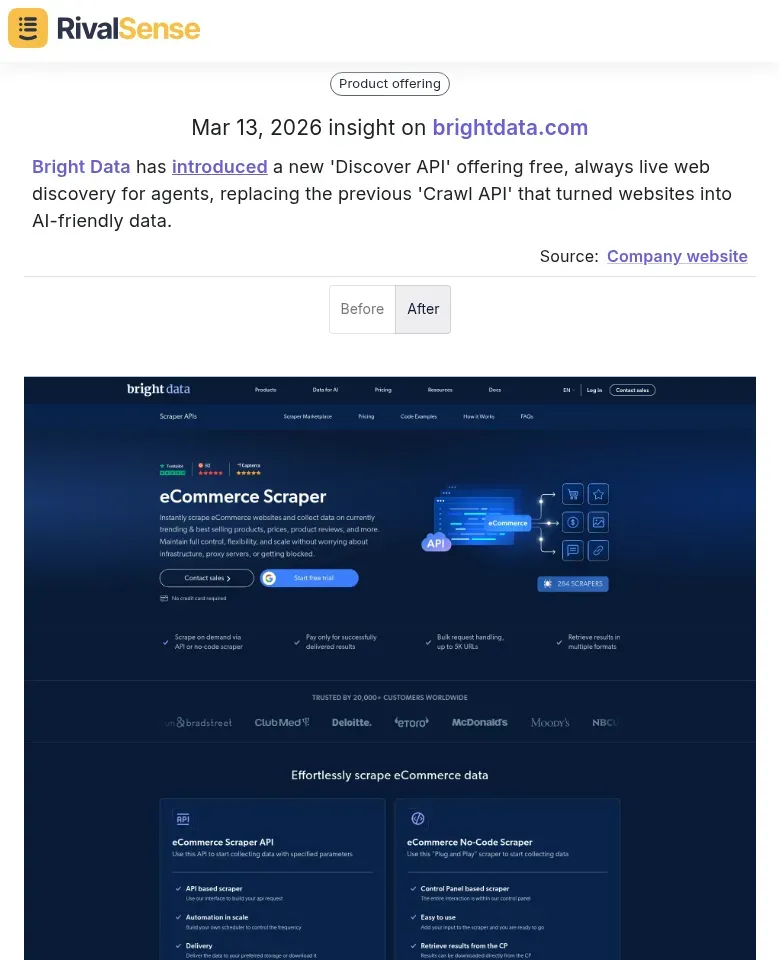
Why this insight is valuable: Tracking such product launches helps you see when competitors are simplifying and modernizing, which can signal market trends and inform your own product roadmap to avoid churn.
Practical Steps to Avoid This Mistake:
- Conduct competitive analysis - Map how competitors have simplified similar offerings
- Audit your product's complexity - Identify pain points through customer feedback and usage data
- Prioritize modernization - Create a phased roadmap to simplify core features
- Learn from successful transitions - Study companies like Adobe's shift from perpetual licenses to Creative Cloud
- Implement simplification checkpoints - Regularly review and remove unnecessary features
Key Insight: Customers don't leave for better features—they leave for better experiences. When competitors offer accessible, intuitive solutions, your complex legacy offering becomes a liability. Modernization isn't just about technology; it's about aligning with how customers want to work today.
Mistake 2: Ignoring Real-World Integration Gaps
When products look great on paper but fail in practice, customers churn. The biggest risk emerges when your solution doesn't address practical implementation challenges that customers face daily. According to recent B2B research, 73% of buyers want personalized experiences, but fragmented systems create workflow nightmares that drive them away.
Example from RivalSense Insight: Trimble Inc. released a new out-of-tolerance check in Tekla Structures 2026's Layout Manager to identify deviations between design and site measurements. This update directly addresses real-world integration gaps in construction workflows.
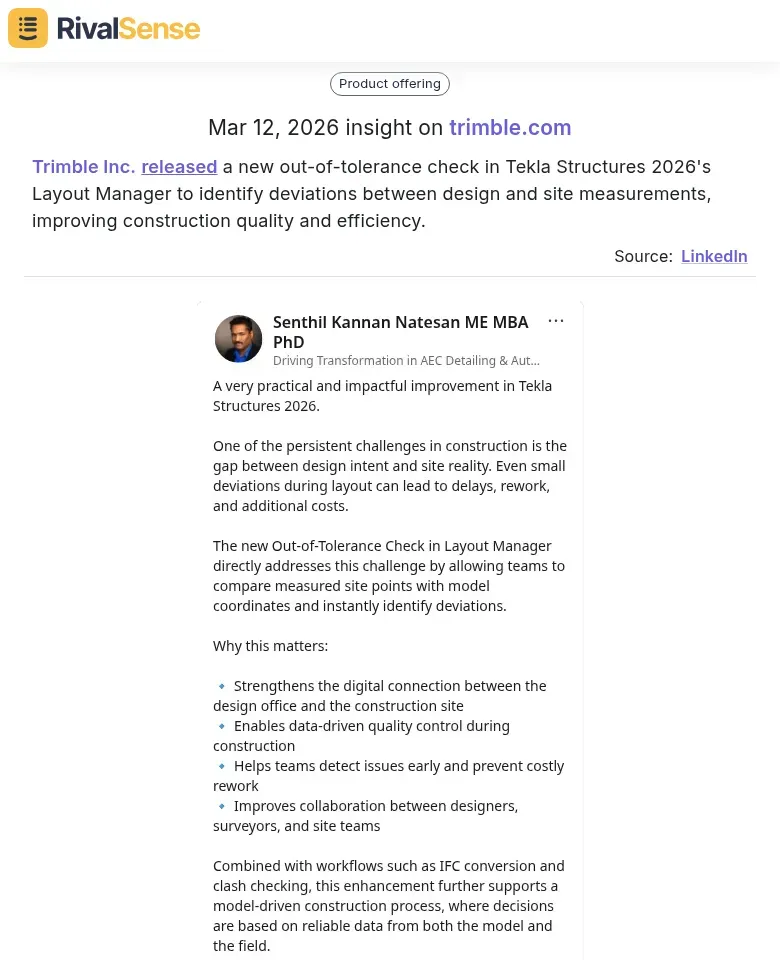
Why this insight is valuable: Monitoring competitor product updates like this reveals how they are solving specific integration problems, helping you identify gaps in your own offerings that could lead to customer churn.
The Churn Reality: Customers don't abandon products because of features—they leave when integration gaps create operational chaos. When pricing doesn't sync with ERP systems, when order workflows require manual intervention, or when data inconsistencies force teams to become "human integration layers," frustration builds. These real-world gaps create hidden costs that customers won't tolerate long-term.
How Competitors Win: Savvy competitors bridge the design-to-execution gap by solving workflow problems others overlook. They build products that understand B2B complexity—negotiated pricing, multi-person approval chains, channel-specific rules. By creating integrated systems that standardize orders across channels and validate against business rules before hitting ERP, they deliver reliability that builds customer loyalty.
Practical Checklist to Avoid This Mistake:
- ✅ Map Real Workflows: Document how customers actually use your product in their daily operations
- ✅ Test Integration Depth: Ensure your solution handles pricing, terms, and validation consistently across channels
- ✅ Solve Channel Conflict: Design for multi-channel unification to prevent internal resistance
- ✅ Validate Before Sync: Build systems that prepare and orchestrate data before hitting backend systems
- ✅ Measure Operational Impact: Track labor hours saved and errors reduced, not just feature adoption
Key Insight: Integration isn't about API connections—it's about understanding that B2B e-commerce is an operational system, not just a digital sales channel. Competitors who solve real workflow problems create products that customers can't afford to leave.
Mistake 3: Underestimating Ecosystem Integration Needs
Isolated product offerings create friction that drives customers toward integrated solutions. When your product operates in a silo, customers face inefficient workflows requiring manual data transfers, duplicate entries, and constant context switching. This frustration directly fuels churn as users seek competitors offering seamless connectivity.
Example from RivalSense Insight: Smartling launched its MCP Server, allowing users to access translation, glossary, and translation memory tools directly from AI tools like Claude and VS Code. This enhances ecosystem integration by embedding their services into popular development environments.
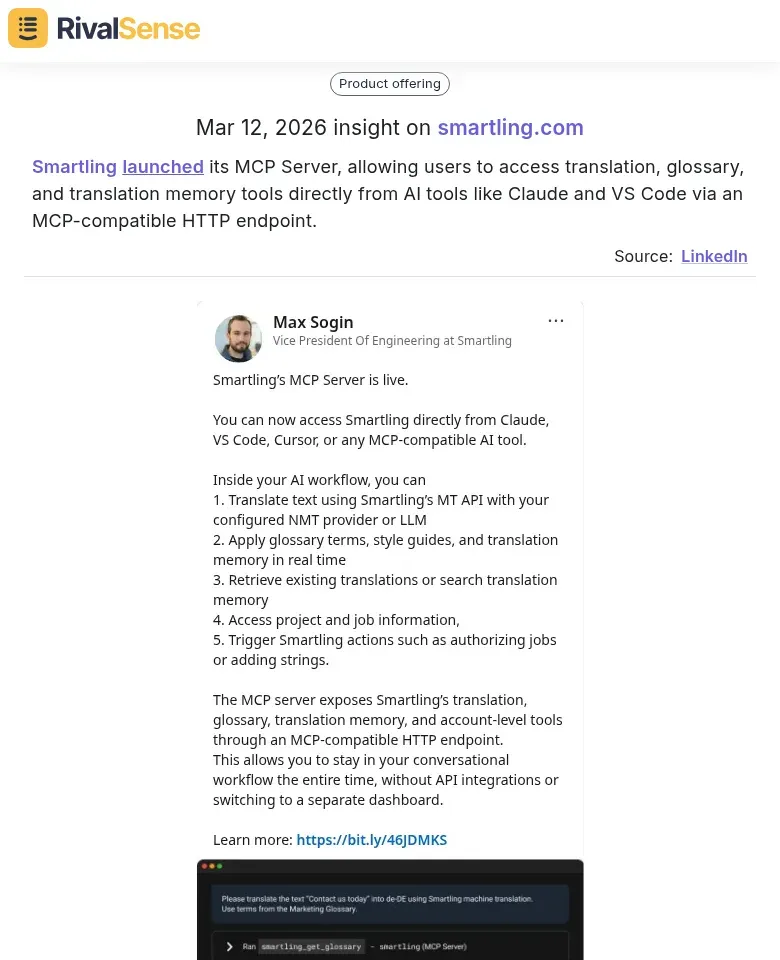
Why this insight is valuable: Insights into competitor ecosystem expansions show you how they are becoming indispensable parts of customer workflows, helping you anticipate churn risks and adapt your integration strategy.
Practical Integration Checklist:
- Map Customer Workflows: Identify the 3-5 core tools your customers use daily
- Prioritize High-Value Integrations: Start with market-leading CRMs, communication platforms, and productivity suites
- Build Two-Way Data Flows: Ensure integrations sync data bidirectionally, not just one-way exports
- Enable Custom Configuration: Allow customers to customize authentication, data mapping, and webhooks
- Monitor Integration Usage: Track which integrations drive highest engagement and retention
Why This Matters: Research shows customers using integrated products show 40% lower churn rates. When your product becomes embedded in existing workflows, it transforms from a standalone tool into an essential ecosystem component. The competitive advantage isn't just having integrations—it's providing seamless connectivity that makes switching to competitors costly and disruptive.
Key Insight: Customers don't churn because they dislike your product; they churn when they can't access services within their existing workflows. Integration gaps force them to choose between maintaining inefficient processes or finding a solution that fits their ecosystem.
Mistake 4: Overlooking Free Value Propositions That Build Loyalty
One of the most costly strategic errors in competitive positioning is failing to offer accessible entry points to premium services. Competitors who provide free value propositions—whether through limited-feature versions, trial periods, or educational resources—establish trust early in the customer journey. This approach reduces churn risk by demonstrating tangible value before requiring financial commitment.
Practical Steps to Implement:
- 🔍 Audit your competitor's free offerings – Document what they provide at no cost and how it leads to premium conversions
- 🛠️ Create a freemium tier – Offer core functionality that solves real problems while reserving advanced features for paid plans
- 📚 Develop educational content – Provide free resources that showcase your expertise and build credibility
- ⏳ Implement time-limited trials – Allow prospects to experience full functionality with clear upgrade paths
- 📊 Track conversion metrics – Monitor how free users transition to paying customers and optimize the journey
Customers stay with providers who demonstrate value upfront because they've already invested time and effort into learning the platform. This creates switching costs beyond just financial considerations. By overlooking free value propositions, you're not just missing acquisition opportunities—you're failing to build the loyalty foundation that keeps customers from exploring alternatives when challenges arise.
Mistake 5: Neglecting Continuous Competitor Monitoring and Adaptation
In today's fast-paced market, failing to keep a close eye on competitor moves can lead to sudden customer churn. Competitors are constantly evolving—launching new features, adjusting pricing, forming partnerships, and entering new markets. Without systematic monitoring, you might miss critical shifts that affect your customer base.
Regular competitor intelligence allows you to anticipate changes and adapt proactively. For instance, if a competitor lowers prices or adds a key integration, your customers might be tempted to switch. By tracking these developments, you can prepare responses, communicate your value, and retain customers.
Why Continuous Monitoring is Essential:
- 🚨 Early Warning System: Detect competitor moves before they impact your churn rates.
- 🎯 Strategic Insights: Understand market trends and customer preferences from competitor actions.
- ⚡ Proactive Adaptation: Adjust your product, pricing, or messaging to stay ahead.
How to Implement Effective Monitoring:
- Set Up Alerts: Use tools to get notified of competitor website updates, social media posts, and news mentions.
- Analyze Quarterly: Review competitor strategies and assess their impact on your market position.
- Engage Your Team: Share insights with sales, marketing, and product teams to align responses.
Key Insight: Competitor monitoring isn't a one-time activity; it's an ongoing process that fuels strategic decision-making. By staying informed, you can turn competitor innovations into opportunities for your own growth and customer retention.
Conclusion: Turning Competitor Insights into Churn Prevention Strategy
Turning competitor insights into churn prevention requires a systematic approach. First, implement a 3-step monitoring framework: 1) Track competitor feature releases, pricing changes, and customer communications weekly; 2) Analyze how these changes affect your customer segments; 3) Identify churn signals like increased competitor mentions in support tickets or declining engagement metrics.
Build proactive response strategies using this checklist:
- 🚀 When competitors launch new features, immediately assess if you need to match, differentiate, or communicate your unique value.
- 💰 For pricing changes, prepare tier adjustments or value-add packages.
- 📢 Create preemptive customer communications that highlight your strengths before customers consider switching.
Transform intelligence into retention advantages by: Creating competitor comparison dashboards for your sales team, developing targeted retention offers for at-risk segments, and establishing quarterly competitor response workshops. The key is moving from reactive defense to strategic offense—using competitor moves as opportunities to reinforce your value proposition and deepen customer relationships. Remember: Every competitor change is a chance to demonstrate why customers chose you in the first place.
Take Action with RivalSense
To effectively avoid these competitor product offering mistakes, you need reliable and timely competitor intelligence. RivalSense tracks competitor product launches, pricing updates, event participations, partnerships, regulatory aspects, management changes, and media mentions across company websites, social media, and various registries. It delivers all this in a weekly email report, giving you the insights you need to stay ahead.
Why wait? Try RivalSense for free today and get your first competitor report to start transforming competitor moves into your retention strategy. Visit https://rivalsense.co/ to get started.
📚 Read more
👉 Bright Data Shifts from Crawling to Live Discovery: A Competitor Analysis Case Study
👉 Key Account Tracking Integration: A Complete Guide for B2B Success in 2026
👉 2026 Brand Sentiment Analysis for Management Consulting Competitors
👉 How RivalSense Helped a Competitor Counter Lendermarket's Fee Elimination
👉 Best Practices for Instagram Competitor Loyalty Program Analysis