
Automating Key Account Intelligence: A Strategic Guide for HR Tech Leaders
In today's hyper-competitive HR technology landscape, manual competitor tracking has become a strategic liability. HR tech leaders who rely on sporadic Google searches, manual spreadsheet updates, and fragmented monitoring miss critical market signals that emerge daily across 80+ data sources—from product launches and pricing changes to executive moves and regulatory updates. This reactive approach leaves you vulnerable to surprise disruptions and strategic blind spots.
Automated key account intelligence transforms this reactive monitoring into proactive strategy. By implementing a systematic framework, you can:
- Identify your 3-5 most critical competitors – Create a competitor matrix ranking them by strategic importance 🎯
- Define intelligence priorities – Focus on product launches, pricing changes, partnerships, and executive moves 📊
- Establish automated monitoring – Use platforms that track 80+ sources including company websites, social media, and regulatory databases 🔍
- Integrate with existing systems – Connect intelligence directly to your CRM, BI tools, and dashboards 🔗
- Create review processes – Schedule weekly 30-minute sessions to discuss competitor movements 📅
The competitive advantage lies in real-time insights that inform leadership decisions. When a competitor launches a new AI-powered recruitment feature or announces a strategic partnership, automated intelligence delivers this information immediately—not weeks later. This enables you to accelerate product roadmaps, adjust pricing strategies, and make informed decisions about market positioning before opportunities vanish.
Practical Checklist for Implementation:
- ✅ Conduct competitor audit identifying 3-5 key accounts
- ✅ Define intelligence categories aligned with strategic goals
- ✅ Select tracking platform with API access and comprehensive source coverage
- ✅ Set up weekly review meetings with designated ownership
- ✅ Create response protocols for different competitor moves
By automating key account intelligence, HR tech leaders transform scattered information into strategic advantage, moving from reactive monitoring to proactive market leadership.
Building Your Automated Intelligence Framework: Core Components
An effective framework turns raw data into actionable strategy. By systematically organizing your intelligence efforts, you can stay ahead of market shifts. Building an automated intelligence framework requires three core components working in concert.
First, identify critical data sources: monitor competitor career pages, LinkedIn company pages, Glassdoor reviews, job boards (Indeed, LinkedIn Jobs), and HR tech industry publications. Set up automated alerts for key personnel changes using tools that track LinkedIn profile updates, executive departures, and new leadership appointments. For hiring patterns, configure alerts for specific job titles, departments, or skill requirements that signal strategic shifts.
Create structured workflows with these steps:
- Use RSS feeds and web scraping tools to collect data automatically
- Centralize intelligence in a CRM or competitive intelligence platform
- Schedule weekly reviews to analyze patterns and trends
- Establish escalation protocols for critical intelligence
Practical tip: Start with 3-5 key competitors and expand gradually.
Checklist:
- ✅ Automated data collection
- ✅ Centralized repository
- ✅ Regular analysis cadence
- ✅ Actionable reporting format
This framework transforms scattered data into strategic insights for HR tech leaders.
Learning from Market Moves: Strategic Insights from Competitor Actions
Competitor actions are windows into their strategic intentions. Automating the tracking of these moves provides early warning signals and opportunities for proactive response. HR tech leaders can transform competitor monitoring into strategic foresight by automating key account intelligence.
Start by analyzing hiring patterns: track new executive appointments, specialized role expansions, and geographic hiring spikes. These reveal market expansion plans before public announcements. For example, a competitor hiring multiple enterprise sales directors in Europe signals imminent international expansion.
Decode promotional offers and pricing strategies systematically. Monitor trial extensions, discount campaigns, and bundled offerings. Create a pricing matrix tracking changes over time to identify positioning shifts. When a competitor introduces a freemium tier, it often precedes a push into SMB markets.
Track thought leadership and conference participation to gauge market influence. Automate alerts for competitor executives speaking at major HR conferences, publishing research papers, or securing media features. High-profile speaking slots at events like SHRM or HR Tech indicate growing industry authority.
Practical Checklist:
- ✅ Set automated alerts for competitor job postings in key roles
- ✅ Create a pricing change log with date-stamped screenshots
- ✅ Monitor conference agendas 3-6 months in advance
- ✅ Track competitor content publication frequency and engagement metrics
- ✅ Analyze hiring pattern correlations with product launches
Pro tip: Combine hiring data with LinkedIn employee growth metrics to validate expansion signals. When you see both increased hiring AND rising employee counts in a region, confidence in expansion plans increases significantly.
AI-Enhanced Intelligence: Balancing Automation with Human Judgment
Artificial intelligence can revolutionize how you gather competitor data. However, the key is to balance automation with human expertise to ensure strategic relevance. For HR tech leaders managing key accounts, the sweet spot lies in leveraging AI to handle data collection while preserving human expertise for strategic analysis.
Practical Implementation Steps:
-
Automate Data Collection, Not Analysis: Use AI to continuously monitor competitor job postings, pricing changes, and product updates across 50+ sources. This eliminates manual research while ensuring comprehensive coverage.
-
Implement Smart Alert Systems: Configure AI to filter noise by setting thresholds for what constitutes "actionable" intelligence. For example, only alert when a competitor launches a new HR module affecting 3+ of your key accounts, or when pricing changes exceed 15%.
-
Create Human-in-the-Loop Checkpoints: Design workflows where AI surfaces insights but requires human approval before taking action. Example: AI identifies a competitor's new enterprise feature → flags it for your review → you decide whether to counter with your roadmap.
Actionable Checklist:
- ✅ Define clear confidence thresholds for automated alerts (e.g., 85%+ confidence for auto-tagging)
- ✅ Establish escalation paths for ambiguous signals
- ✅ Schedule weekly human review sessions of AI-generated insights
- ✅ Maintain audit logs of all AI-suggested actions vs. human decisions
Key Insight: The most effective systems use AI as a force multiplier—handling the 80% of routine monitoring while freeing your team to focus on the 20% of strategic decisions that drive competitive advantage. Remember: AI provides the data, but human judgment provides the context that turns information into actionable intelligence.
Operationalizing Intelligence: From Insights to Actionable Strategy
Turning insights into action requires a structured approach. Without clear processes, valuable intelligence can languish unused. Operationalizing intelligence requires systematic translation of insights into concrete actions.
Start by establishing a structured framework:
- Categorize competitor intelligence into product gaps, market positioning, and strategic moves
- Prioritize findings based on impact and feasibility
- Assign clear ownership for each action item
For product development, create a 'Competitor Feature Matrix' comparing your offerings against key rivals. Identify gaps where competitors excel but you lag, and opportunities where you can differentiate. Use this to inform your product roadmap, focusing on high-impact areas that address customer pain points competitors are solving.
In sales and marketing, develop 'Battle Cards' that translate intelligence into positioning advantages. When competitors announce new features, prepare counter-messaging highlighting your unique strengths. Track competitor pricing changes to adjust your value proposition accordingly.
Establish monthly intelligence review meetings where cross-functional teams (product, marketing, sales) discuss findings and decide on strategic adjustments. Create a feedback loop by measuring the impact of intelligence-driven decisions on key metrics like win rates, feature adoption, and market share.
Practical tip: Implement a 'Competitor Alert System' that automatically notifies relevant teams about significant competitor developments, ensuring timely response rather than reactive scrambling.
Future-Proofing Your Intelligence Operations: Best Practices for HR Tech Leaders
As your business and the market evolve, so must your intelligence operations. Establishing scalable practices ensures long-term competitiveness. To future-proof your intelligence operations, start by establishing scalable processes that grow with your organization.
Create a centralized intelligence hub where all competitive data flows, using automation tools to collect and organize information systematically. Implement tiered access so different teams get relevant insights without overwhelming them.
Integrate competitive intelligence into regular leadership meetings by making it a standing agenda item. Before quarterly planning sessions, provide executives with a concise competitive dashboard highlighting key market shifts, competitor moves, and emerging threats. This ensures strategic decisions are informed by real-time market context.
Continuously refine your framework by establishing feedback loops. After each major decision influenced by intelligence, track outcomes and compare against market developments. Conduct quarterly reviews of your intelligence processes, asking: What insights drove action? What data was unused? Where did gaps appear?
Practical Checklist:
- ✅ Automate data collection for top 5 competitors
- ✅ Create standardized reporting templates
- ✅ Schedule monthly intelligence briefings
- ✅ Assign intelligence champions in each department
- ✅ Measure ROI by tracking decisions influenced by intelligence
Remember: The most effective intelligence operations evolve alongside your business and the market they serve.
Real-World Competitive Intelligence: Insights from RivalSense
Seeing is believing. Here are real examples of how automated intelligence from RivalSense provides actionable insights for HR tech leaders:
-
Hiring and Scaling Insights:
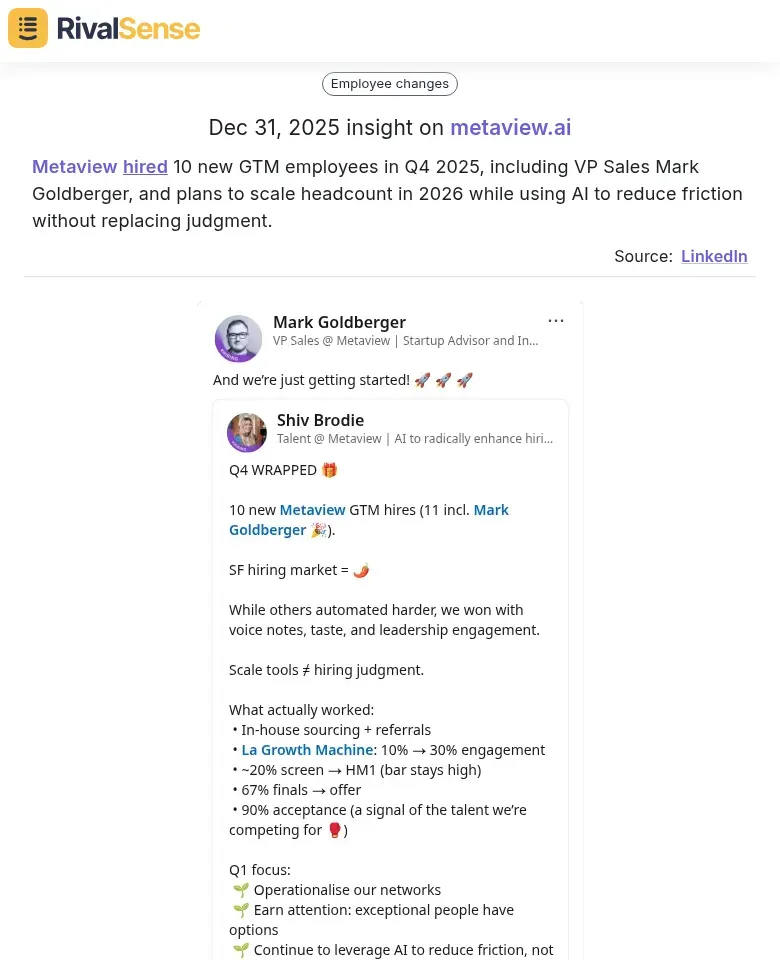
RivalSense tracked that Metaview hired 10 new GTM employees in Q4 2025, including VP Sales Mark Goldberger, and plans to scale headcount in 2026 while using AI to reduce friction without replacing judgment. Why it matters: Hiring patterns like this reveal strategic investments in growth areas, allowing you to anticipate market expansion and adjust your own talent strategy accordingly. -
Promotional and Pricing Moves:
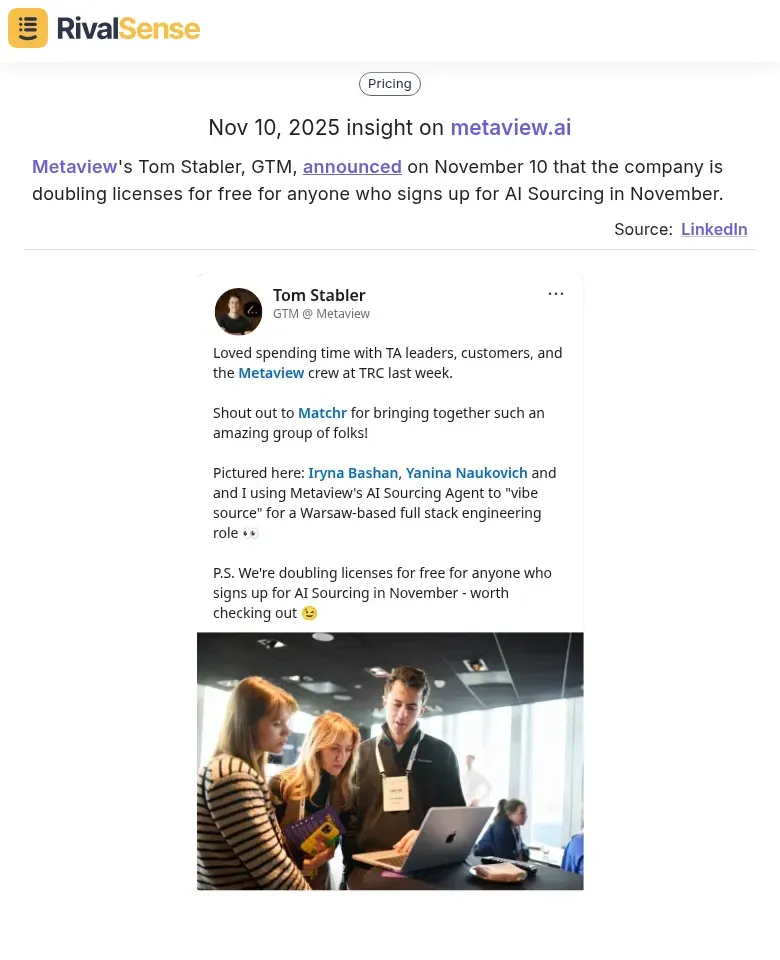
Metaview's Tom Stabler, GTM, announced on November 10 that the company is doubling licenses for free for anyone who signs up for AI Sourcing in November. Why it matters: Such promotional offers signal aggressive customer acquisition tactics, enabling you to refine your pricing and marketing campaigns to stay competitive. -
Thought Leadership and Event Participation:
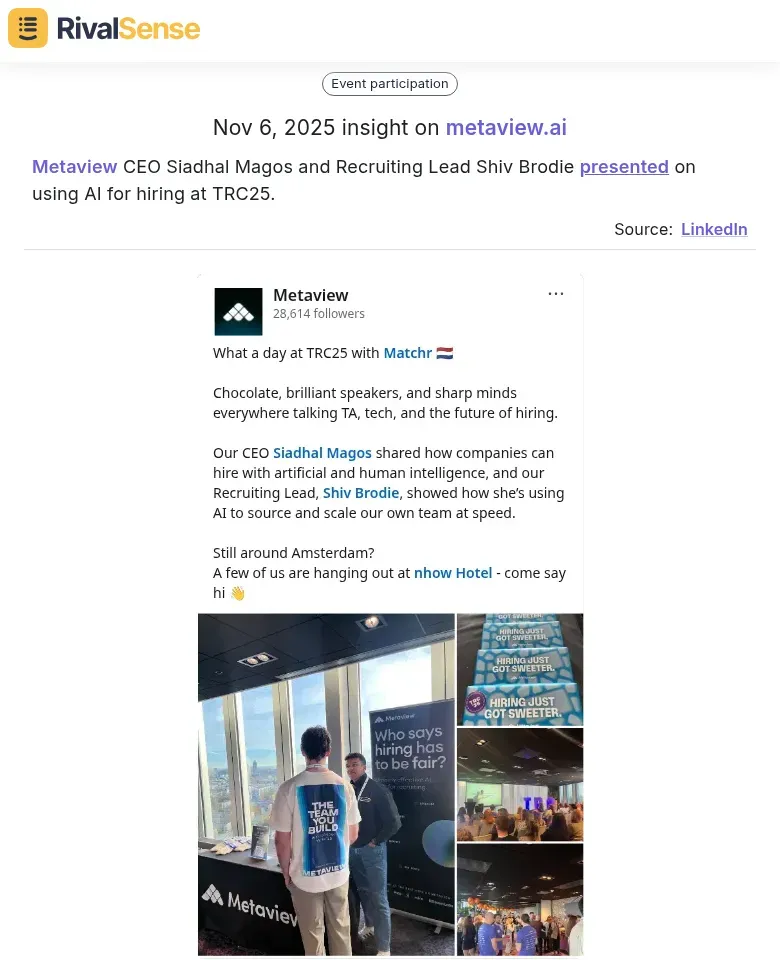
Metaview CEO Siadhal Magos and Recruiting Lead Shiv Brodie presented on using AI for hiring at TRC25. Why it matters: Conference presentations highlight where competitors are focusing their narrative and building authority, helping you identify emerging trends and position your own thought leadership effectively.
These insights demonstrate how automated tracking across websites, social media, and registries can deliver timely intelligence directly to your inbox.
Take the Next Step with RivalSense
Automating key account intelligence doesn't have to be complex. With tools like RivalSense, you can start tracking competitor product launches, pricing updates, event participations, partnerships, regulatory aspects, management changes, and media mentions across 80+ sources—all delivered in a weekly email report.
Ready to transform your competitor intelligence? Try RivalSense for free today and get your first competitor report to see how it can help you stay ahead in the HR tech market. Get started now and turn market moves into strategic advantages.
📚 Read more
👉 Free Tools for Tracking Competitor Hiring and Layoffs: A Practical Guide
👉 Decoding Competitor Moves: A Real-World Analysis of Orbital Materials' AI Cooling Breakthrough
👉 Benefits of Competitor Feature Gap Analysis: A Strategic Guide for B2B Leaders
👉 Smart Building KAM vs Customer Success: Strategic Framework & Templates
👉 How Competitive Intelligence Uncovered Toggl's Mobile Gap and Created a Market Opportunity