
Analyzing Competitor Loyalty Programs to Boost Warehouse Productivity
In today's competitive landscape, warehouse productivity isn't just about optimizing processes—it's about understanding how your competitors' customer-facing strategies impact your internal operations. Competitor loyalty programs reveal critical insights into supply chain demands, seasonal fluctuations, and customer behavior patterns that directly affect warehouse efficiency. By analyzing rival programs, you gain foresight into inventory needs, staffing requirements, and workflow adjustments before demand spikes hit your operations.
Forward-thinking companies recognize that competitor analysis extends beyond market share to employee retention strategies. When rivals implement successful loyalty initiatives, they often correlate with improved workforce stability and productivity metrics. Tracking these connections provides a competitive advantage in talent management and operational planning.
🚀 Practical steps to begin:
- Map competitor loyalty program structures and reward frequencies
- Correlate program launches with warehouse performance data
- Identify patterns between customer engagement and internal metrics
- Benchmark your retention strategies against industry leaders
This strategic intersection transforms competitor intelligence from a marketing exercise into a warehouse optimization tool, creating a feedback loop where external market insights drive internal productivity gains.
Real-World Competitive Intelligence: Learning from Market Moves
Monitoring competitor activities beyond loyalty programs can provide strategic insights for warehouse productivity. For instance, partnerships and licensing deals often signal new product launches or market expansions that impact supply chain dynamics. Here are examples from RivalSense insights that demonstrate the value of tracking various competitor moves:
-
Partnerships and Collaborations:
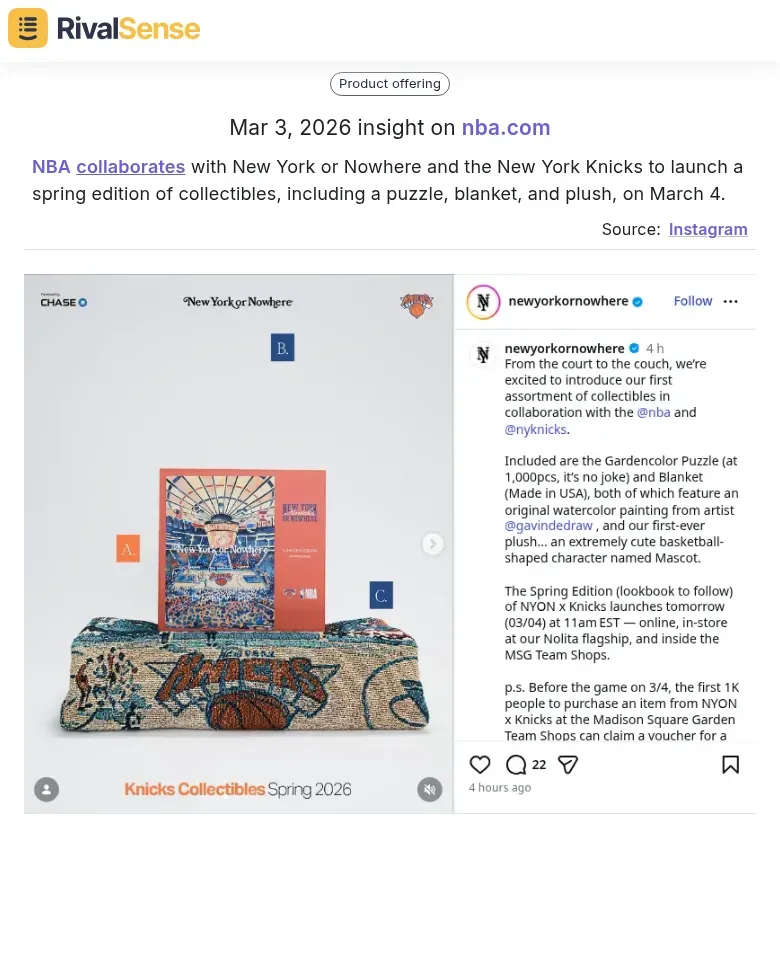
The NBA's collaboration with New York or Nowhere and the New York Knicks to launch spring collectibles indicates seasonal product launches. For warehouse operations, this type of insight helps anticipate inventory surges and plan staffing for peak periods, ensuring productivity isn't hampered by unexpected demand. -
Licensing and Brand Expansions:
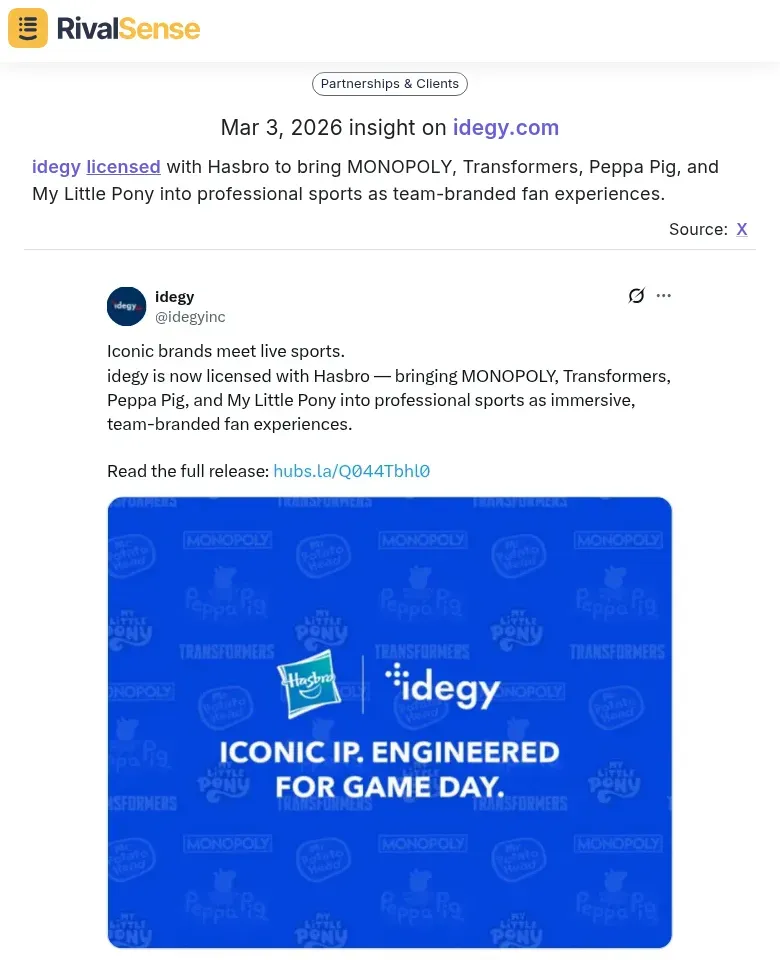
idegy's licensing deal with Hasbro to bring popular brands into professional sports fan experiences reveals strategic brand extensions. Tracking such moves can alert you to new competitive offerings that may affect customer loyalty and, consequently, warehouse order volumes and fulfillment requirements. -
Management and Hiring Trends:
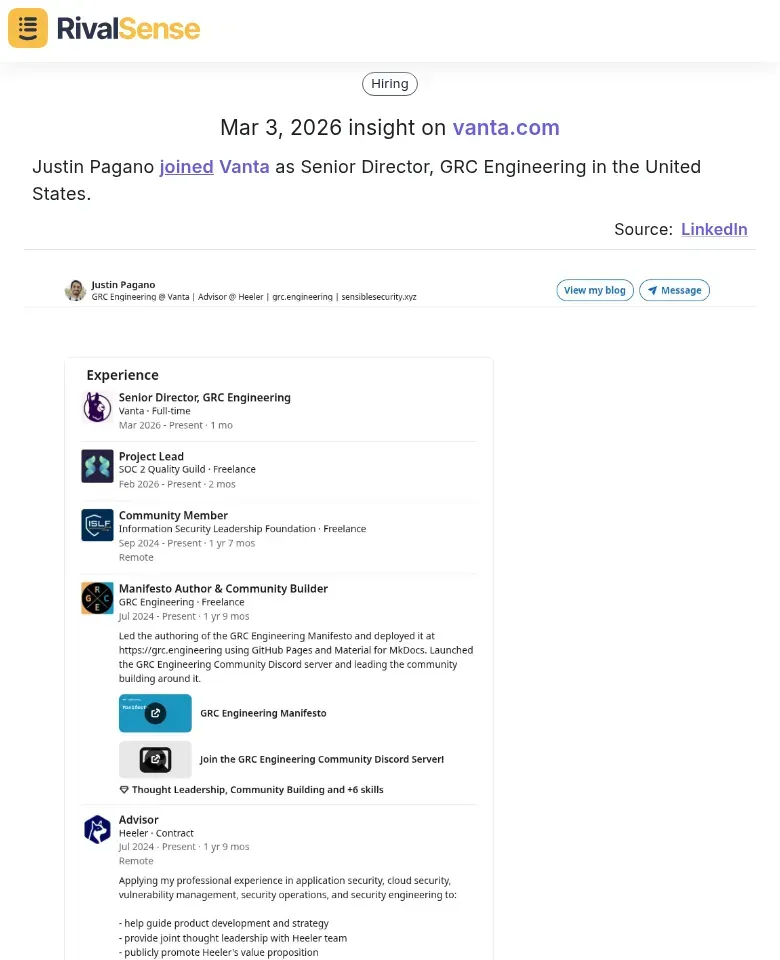
Justin Pagano joining Vanta as Senior Director, GRC Engineering highlights a focus on governance, risk, and compliance. In warehouse contexts, management changes like this can signal shifts towards stricter operational standards or new technology investments, prompting you to review your own processes for competitive alignment.
These insights showcase how tracking diverse competitor activities—from partnerships to personnel changes—can inform strategic decisions in warehouse management and loyalty program design.
Methodology: How to Systematically Analyze Competitor Loyalty Programs
Systematic analysis of competitor loyalty programs requires a structured approach. By following a clear methodology, you can extract actionable insights that directly enhance warehouse productivity. This process involves identifying key competitors, gathering intelligence, benchmarking metrics, and synthesizing findings for your operations.
📋 Follow this structured methodology:
-
Identify Key Competitors & Their Incentive Structures
- Create a competitor matrix including direct rivals and industry leaders
- Research their warehouse workforce programs through job postings, employee reviews, and industry reports
- Document incentive types: monetary bonuses, recognition programs, gamification elements, career advancement paths
- 💡 Tip: Use tools like Revelio Labs for workforce intelligence and LinkedIn for employee insights
-
Gather Competitive Intelligence
- Monitor competitor career pages and social media for program announcements
- Conduct anonymous surveys with former employees of competitor warehouses
- Analyze Glassdoor reviews for mentions of incentive programs and satisfaction levels
- 🔍 Practical step: Set up Google Alerts for competitor names + "warehouse incentives" or "employee rewards"
-
Benchmark Effectiveness Metrics
- Track key performance indicators across competitors:
• Retention rates (warehouse staff turnover)
• Productivity metrics (picks per hour, order accuracy)
• Program participation rates
• Redemption rates for rewards - Compare program costs vs. productivity gains
- ✅ Checklist: Create a scorecard with weighted metrics based on your warehouse priorities
- Track key performance indicators across competitors:
-
Analyze Program Design Elements
- Evaluate reward structures: immediate vs. long-term incentives
- Assess recognition frequency and visibility
- Examine integration with warehouse management systems
- 🎯 Hint: Look for gamification elements that could boost engagement without increasing costs
-
Synthesize Insights for Your Program
- Identify gaps where competitors are underperforming
- Adapt successful elements to your warehouse context
- Test pilot programs based on competitor learnings
- 🔄 Remember: The goal isn't to copy but to innovate based on market intelligence
Key Findings: What Top Competitors Are Doing with Warehouse Loyalty Programs
Our analysis of leading warehouse operations reveals critical loyalty program strategies that directly impact productivity. Understanding these trends can help you design more effective initiatives. Here are three key findings with actionable takeaways.
First, tiered reward systems show a clear correlation with picking accuracy: companies implementing bronze/silver/gold tiers with escalating accuracy-based rewards (e.g., 99%+ accuracy = premium tier) saw 15-22% improvement in error rates within 6 months. 💡 Practical tip: Start with 2-3 tiers based on measurable KPIs like order accuracy and damage rates.
Second, performance-based incentives tied to throughput metrics (orders/hour, units processed) demonstrated 18-25% productivity gains. Top performers use real-time dashboards showing individual/team performance against targets, with weekly bonuses for exceeding benchmarks. ✅ Checklist: 1) Define clear throughput metrics, 2) Set achievable but challenging targets, 3) Provide real-time visibility, 4) Offer immediate rewards.
Third, innovative recognition programs combining peer nominations, 'employee of the month' spotlights, and skill development opportunities reduced turnover by 30-40% in high-stress logistics roles. Example: One 3PL company's 'Warehouse Warrior' program featuring monthly recognition ceremonies and career path visibility cut turnover from 45% to 28% in one year. 🚀 Action step: Implement peer-to-peer recognition platforms and tie recognition to specific productivity behaviors.
Implementation Framework: Adapting Competitor Insights to Your Warehouse
To adapt competitor loyalty insights to your warehouse, a phased approach ensures successful integration. This framework helps you customize, integrate, and scale programs based on real-world data, driving tangible improvements.
🔧 Start with this 3-step implementation framework:
-
Customization Phase: Analyze competitor programs but tailor them to your specific warehouse needs. For example, if a competitor rewards pallet moves, adapt it to your unique workflows like cross-docking efficiency or inventory accuracy.
- ✅ Create a checklist: (a) Map competitor program elements to your KPIs, (b) Identify gaps in your current productivity tracking, (c) Prioritize 2-3 key metrics that align with your operational goals.
-
Integration & Measurement: Connect productivity tracking directly to reward systems. Use warehouse management system (WMS) data to automatically trigger rewards for hitting targets like order accuracy rates or reduced picking times.
- 📊 Practical tip: Start with a pilot program measuring ROI on one department before scaling. Track metrics like productivity gains vs. reward costs to demonstrate measurable ROI.
-
Scalable Structure Design: Build loyalty tiers that grow with operations. Create entry-level rewards for individual performance, team-based incentives for departmental goals, and facility-wide bonuses for overall productivity improvements.
- 🏗️ Hint: Design flexible reward categories (monetary bonuses, extra time off, skill development opportunities) that remain relevant as your warehouse expands to multiple shifts or locations.
Key implementation advice: Begin with a 90-day pilot, gather employee feedback, and iterate based on data rather than assumptions. This ensures your adapted loyalty program drives tangible productivity improvements while remaining cost-effective.
Measuring Impact: KPIs for Evaluating Warehouse Productivity Improvements
Effectively measuring the impact of competitor loyalty program insights is crucial for continuous improvement. By tracking the right KPIs, you can validate strategies and make data-driven adjustments to boost warehouse efficiency.
📈 Focus on these key KPI categories:
| KPI Category | Specific Metrics | Measurement Frequency |
|---|---|---|
| Order Fulfillment | Order processing time, Picking accuracy rates, Error reduction percentages | Monthly |
| Employee Performance | Retention rates, Training hours per employee, Competency assessment scores | Quarterly |
| Efficiency Benchmarks | Cost-per-order, Space utilization percentages, Inventory accuracy vs. industry standards | Annually or semi-annually |
🔍 Practical Checklist for Measurement:
- Establish baseline metrics before implementing changes
- Set up automated data collection systems from WMS or other tools
- Create a dashboard with weekly/monthly trend views for quick monitoring
- Conduct quarterly competitive benchmarking analysis using public data or reports
- Document process improvements and cost savings for leadership reviews
💡 Tip: Look beyond obvious metrics—track 'time to competency' for new hires and 'process adherence rates' to identify training gaps. Use competitor loyalty program structures to reverse-engineer their productivity incentives, then adapt successful elements to your operations while tracking corresponding efficiency gains.
Strategic Recommendations: Building a Competitive Advantage Through Loyalty
Building a competitive advantage through warehouse loyalty programs requires innovation and continuous learning. By analyzing competitor gaps and leveraging gamification, you can create unique differentiators that enhance productivity and employee engagement.
🎯 Start by analyzing competitor gaps: Most programs focus on transactional rewards, but research shows gamification boosts productivity by 50% and engagement by 60%. Create unique differentiators like team-based competitions with normalized metrics across roles, peer coaching models, and real-time digital leaderboards that track efficiency, safety, and accuracy.
🔄 Establish continuous improvement cycles using competitive intelligence:
- Monitor competitor program changes quarterly through tools like RivalSense
- Benchmark your engagement metrics against industry leaders from associations like WERC
- Conduct employee feedback surveys to identify pain points and opportunities
- Test new gamification elements in pilot locations before full rollout
- Analyze performance data to refine rewards and ensure alignment with goals
🏆 Build long-term competitive moats through superior workforce engagement: Implement transparent measurement systems employees trust, offer meaningful rewards (e.g., extra days off, special parking, team celebrations), and create career progression paths tied to loyalty achievements. Remember: 84% of workers are more likely to stay with companies that develop workplace competitions around fulfillment tasks. Focus on creating a level playing field where employees see their progress and believe rewards are worth chasing.
Take Action with Competitive Intelligence
Integrating competitor insights into your warehouse loyalty programs can transform productivity and retention. However, manually tracking all competitor moves—from partnerships to management changes—is time-consuming and often incomplete.
🚀 Ready to streamline your competitor analysis? Try RivalSense for free to get automated weekly reports on competitor product launches, pricing updates, event participations, partnerships, regulatory aspects, management changes, and media mentions. This tool helps you stay ahead by delivering actionable insights directly to your inbox.
👉 Get your first competitor report today and start turning competitive intelligence into warehouse productivity gains!
📚 Read more
👉 How LinkedIn's AI Hiring Insight Helped Competitors Accelerate Recruitment Innovation
👉 Uncover Competitor Secrets: A Step-by-Step Guide to Twitter Content Marketing Intelligence
👉 Mastering Key Account KPIs for Enterprise AI Platform Success
👉 Beginner's Guide to Competitor Pricing Insights and Key Account Sentiment Tracking
👉 Leveraging Social Clues for Competitor Analysis: A Case Study on Huel