
Airbnb vs Hotels: Real-World Content Marketing Advantages Revealed
In the competitive hospitality landscape, content marketing has evolved into a critical battleground. Strategic insights derived from competitor analysis can unveil distinct advantages that drive business growth. By tracking competitor moves, businesses can identify market positioning opportunities that traditional approaches miss. Airbnb’s content strategy demonstrates this perfectly—their focus on user-generated content (UGC) and authentic travel experiences creates differentiation that traditional hotels struggle to match. While hotels often emphasize amenities and standardized services, Airbnb leverages community storytelling to build emotional connections.
Practical competitive intelligence steps:
- 📊 Monitor competitor content themes and formats monthly
- 📈 Analyze engagement metrics across platforms
- 🔍 Identify content gaps where you can provide unique value
- 🎯 Track how competitors respond to market changes
- 🏆 Benchmark your content performance against industry leaders
Real-world example: When Airbnb launched “Live There” campaigns emphasizing local experiences, hotels could have countered with content showcasing their local partnerships and insider access. The key insight? Content strategy isn’t just about promotion—it’s about positioning your unique value proposition against competitors’ weaknesses.
Social Impact Storytelling: Building Brand Purpose Through Content
Airbnb’s social impact storytelling demonstrates how purpose-driven content builds authentic brand trust. Through initiatives like Airbnb.org, they transform corporate social responsibility into compelling narratives that foster deep customer loyalty. Their focus on real stories and measurable outcomes sets a benchmark for competitors.
For instance, RivalSense tracked this insight: Airbnb.org is partnering with WA 211 to offer free emergency housing for people displaced by flooding in Washington.
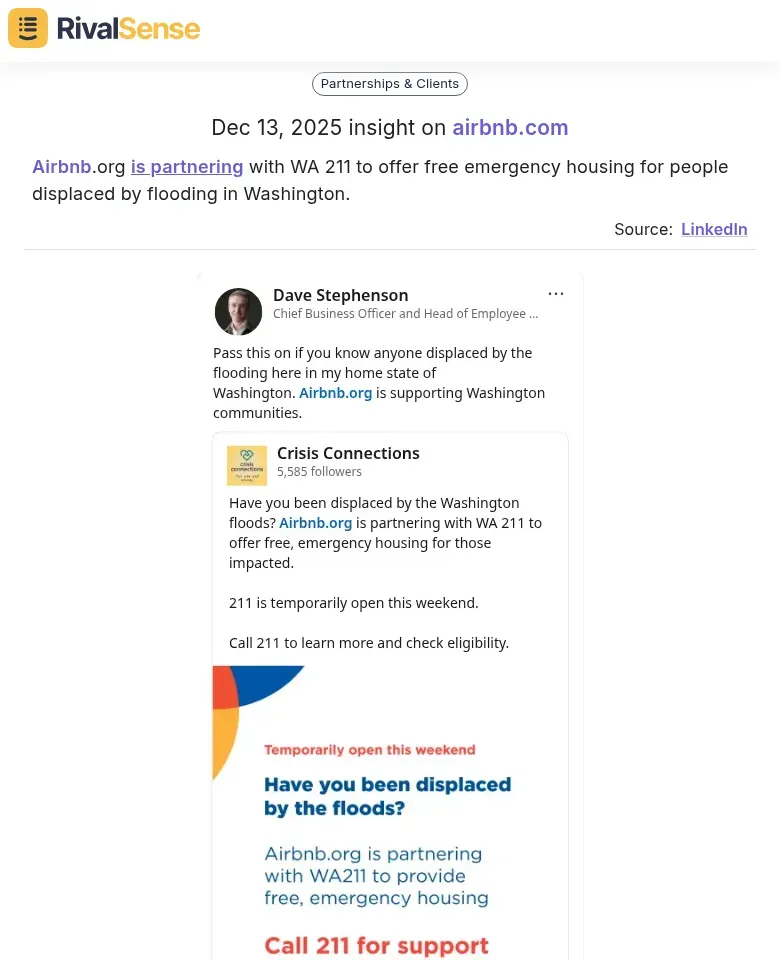
Monitoring such partnerships is valuable for business strategy because it reveals how competitors leverage social impact to enhance brand reputation and community engagement. This intelligence can inspire your own purpose-driven content initiatives.
Practical Steps for Social Impact Content:
- 🤝 Partner Authentically: Collaborate with established nonprofits (like Airbnb’s ShelterBox partnership) rather than creating standalone initiatives
- 📖 Document Real Stories: Feature actual beneficiaries with permission and sensitivity
- 📊 Create Impact Reports: Publish annual reports with concrete metrics
- 🚨 Leverage Crisis Moments: Develop rapid response content frameworks for disasters while maintaining appropriate tone
- 👥 Involve Community: Use advisory boards to identify causes and create authentic local narratives
- 🔄 Show Process: Document partnerships from initial response through implementation to demonstrate genuine commitment
Airbnb’s Community Fund ($100M by 2030) creates content around local initiatives like Bogota’s women empowerment or Kenya’s coastal conservation, building trust through hyperlocal relevance. Their content avoids generic CSR statements by focusing on specific partnerships, measurable outcomes, and authentic stakeholder voices.
Talent Acquisition as Content Strategy: Showcasing Industry Leadership
Talent acquisition isn’t just HR—it’s powerful content marketing that signals market leadership to competitors. Announcing key hires strategically can broadcast your company's direction and attract top talent while keeping competitors on their toes. This creates a dual advantage: attracting top talent while making competitors question their own positioning.
Consider this RivalSense insight: Anna Balkrishna joined Airbnb as Director of UX Writing in the United States.

Tracking management changes like this provides valuable strategic intelligence. It helps you understand a competitor’s investment in specific areas, such as user experience, allowing you to anticipate their content focus and adjust your own talent acquisition messaging accordingly.
Practical steps for leveraging talent as content:
- 🎯 Strategic Announcements: Frame new hires as strategic moves, not just personnel changes.
- 💡 Expertise Showcases: Create content featuring new team members’ insights—interviews, thought leadership articles, or webinar sessions.
- 📢 Competitive Signaling: Use hiring announcements to reveal focus areas.
- 🏅 Credibility Building: Feature team credentials prominently—decades of combined experience, previous roles at industry leaders, or specialized certifications.
Key tip: Time announcements strategically around product launches or market entries to maximize impact. This approach turns recruitment into competitive intelligence that keeps rivals reacting rather than leading.
Regulatory Intelligence: Turning Policy Changes into Content Opportunities
Regulatory intelligence transforms policy changes into powerful content opportunities. By staying ahead of legislative developments, you can create timely content that positions your brand as an industry authority. Monitoring regulations allows you to address stakeholder concerns proactively and showcase your expertise.
Here’s an example from RivalSense: A new City Council bill introduced on November 1, 2025, would allow homeowners to rent out their properties on a short-term basis without the host present, sparking debate over Airbnb in New York City.
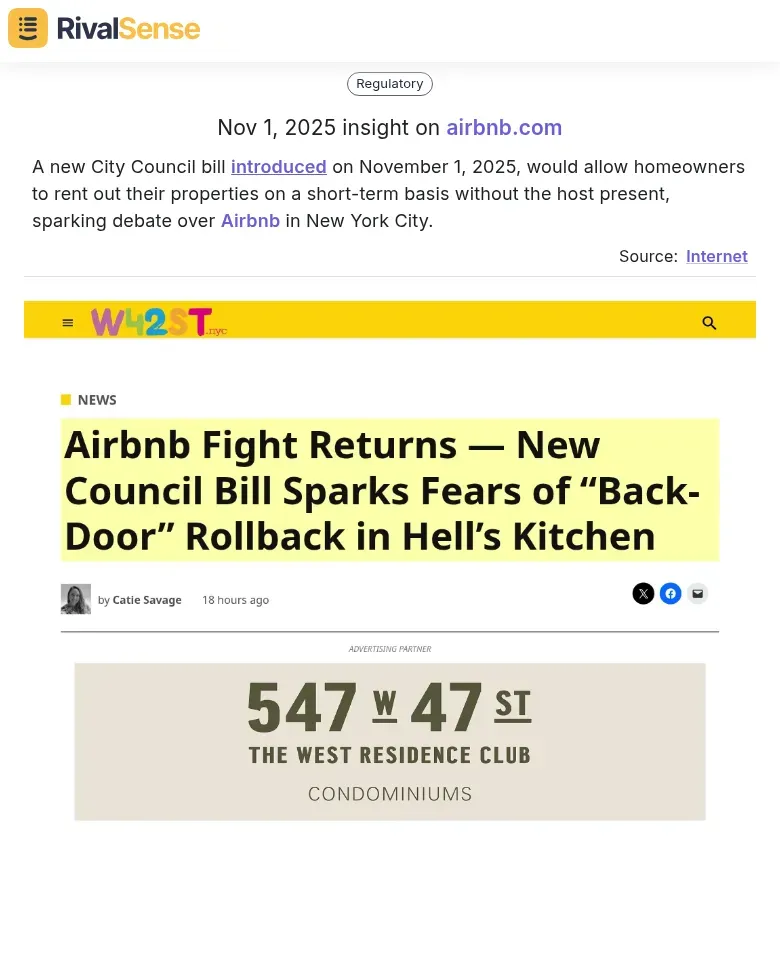
This type of insight is crucial for business strategy as it enables you to produce relevant content that educates your audience on regulatory impacts. It helps you position your brand as a trusted source of information during policy debates.
Practical Steps for Regulatory Content Creation:
- 📋 Establish Monitoring Systems: Set up alerts for legislative databases, industry association updates, and regulatory agency announcements.
- ⏱️ Create Timely Analysis: Quickly produce explainer content that breaks down complex policies into accessible insights.
- 🏛️ Position as Industry Experts: Develop whitepapers, webinars, and thought leadership pieces that analyze regulatory impacts.
- 👥 Engage Stakeholders: Create content that addresses policy debates from multiple perspectives.
- 📚 Build Educational Resources: Transform regulatory requirements into checklists, templates, and compliance guides.
Pro Tip: Maintain a regulatory content calendar aligned with legislative cycles. Anticipate upcoming policy discussions and prepare content frameworks in advance, allowing for rapid deployment when changes occur.
Comparative Content Strategies: Airbnb vs. Hotels in Action
Airbnb and hotels employ distinctly different content strategies. Airbnb excels at authentic storytelling and community-driven experiences, whereas hotels often emphasize brand consistency and direct booking incentives. This divergence highlights opportunities for each to learn from the other’s strengths.
Airbnb’s content strategy centers on user-generated content and “live like a local” narratives that hotels often miss. Hotels like Hilton’s “Stop Clicking Around” campaign effectively target price-conscious travelers but lack Airbnb’s emotional connection.
Practical Checklist for Competitive Content Analysis:
- 🗺️ Map competitor content themes (Airbnb: authenticity, hotels: convenience)
- 🔎 Identify gaps where competitors underperform (hotels often miss local experience content)
- 💡 Develop unique angles based on your positioning (Airbnb’s advantage: personal stories)
- ✍️ Create content that addresses competitor weaknesses
- 📊 Monitor engagement metrics across platforms
Actionable Tip: Use tools like RivalSense to track how Airbnb’s “Live Anywhere” campaign (223M impressions) outperforms hotel campaigns in social engagement, then create content that bridges their experiential gap with your operational strengths.
Actionable Insights: Building Your Competitive Content Strategy
To build a competitive content strategy, systematic competitor tracking is essential. By analyzing competitor moves, you can identify gaps and opportunities to outperform them in the market. Implement these steps to stay ahead.
First, use competitive intelligence tools to monitor content across channels. Create a tracking spreadsheet with columns for content type, topic, engagement metrics, and publication date. This reveals patterns in successful content themes.
Next, develop content pillars based on competitive intelligence. Analyze top-performing content to identify recurring themes. Build 3-4 core pillars around these insights, ensuring they align with your brand’s unique value proposition.
Finally, measure performance against competitor benchmarks. Track metrics like organic traffic growth, social shares, and conversion rates for similar content types. Set quarterly reviews to adjust strategy based on what’s working.
Quick Implementation Checklist:
- ✅ Weekly competitor content scans
- ✅ Monthly pillar performance analysis
- ✅ Quarterly benchmark comparisons
Ready to elevate your content strategy? Try RivalSense for free at https://rivalsense.co/ to get comprehensive competitor insights delivered weekly. Sign up today and get your first competitor report to start making data-driven decisions!
📚 Read more
👉 Competitor Product Benchmarking: Actionable Insights for Key Account Management
👉 Decoding Competitor Pricing Moves: A Real-World Example from EmpMonitor
👉 Optimizing Key Account Management for Investment & Wealth Management Firms
👉 How Process Templates Became Autenti's Competitive Advantage: Insights from RivalSense