
Air Freight Case Study: How Competitor Partnerships Build Winning Ecosystems
The air freight industry faces unprecedented pressures in 2025-2026: capacity constraints with only 4-5% growth versus 6% demand surge, volatile fuel costs, and shifting trade lanes as China+1 strategies reshape global networks. Traditional competitive approaches struggle to address these complex challenges, leading forward-thinking companies to embrace 'coopetition'—strategic collaboration between competitors.
At Frankfurt Airport, 97+ competing companies (airlines, forwarders, handlers, truckers) have formed an ecosystem partnership that demonstrates coopetition's power. They share best practices, standardize processes like CommonPre Check truck slot booking, and collectively enhance the hub's competitiveness. This shift from pure competition to collaborative competition creates value beyond traditional models through shared infrastructure, knowledge exchange, and collective innovation.
Practical steps for implementing coopetition:
- Identify complementary capabilities where competitors can create mutual value
- Establish clear compliance frameworks and shared rules upfront
- Start with non-core operational areas (like truck slot standardization)
- Build trust through small, transparent pilot projects
- Focus on ecosystem-level benefits that ultimately boost all participants
By transitioning from 'competition' to 'coopetition,' companies can address industry-wide challenges more effectively while maintaining competitive advantages in their core businesses.
Case Study: Frankfurt Airport's Air Cargo Community - A Blueprint for Success
Frankfurt Airport's Air Cargo Community demonstrates how 97+ competing companies transformed rivalry into collaboration through a structured ecosystem framework. This blueprint for success shows that even fierce competitors can create shared value when guided by common goals.
Key initiatives driving this success include:
- CommonPre Check Project: A unified digital platform where all stakeholders share shipment data in advance, reducing processing times by 40% and cutting costs across the entire supply chain.
- Standardized Import Processes: Competitors agreed on uniform documentation and handling procedures, eliminating redundant steps and creating seamless cargo flows.
Practical Implementation Steps:
- Start with a neutral facilitator to build initial trust
- Identify 2-3 high-impact pain points affecting all players
- Create clear compliance frameworks with measurable KPIs
- Establish regular cross-company working groups
- Implement shared technology platforms with equal access
Critical Success Factors:
- Trust Building: Regular face-to-face meetings and transparent communication channels
- Compliance Frameworks: Clear rules for data sharing, pricing, and operational boundaries
- Shared Vision: Focus on ecosystem growth rather than individual market share
Pro Tip: Begin with non-competitive areas like sustainability initiatives or regulatory compliance where collaboration benefits all parties without threatening core business interests.
This case proves that structured competitor collaboration creates win-win outcomes, turning individual strengths into collective competitive advantages that benefit the entire industry.
Strategic Benefits of Competitor Partnerships in Air Freight
Competitor partnerships in air freight deliver transformative strategic advantages that go beyond simple cooperation. The AeroLogic joint venture between DHL Express and Lufthansa Cargo demonstrates how operational efficiency gains are achieved through shared infrastructure and standardized processes. By pooling Boeing 777-200LRF freighter aircraft and utilizing Leipzig/Halle Airport as a shared hub, both companies reduced capital expenditure while achieving higher aircraft utilization rates (weekday flights for DHL, weekend flights for Lufthansa).
Enhanced market position emerges through collective strength—together, the partners created a network covering 20+ destinations across Europe, Asia, and North America that neither could efficiently serve alone. This collective hub competitiveness at Leipzig/Halle Airport positioned them as a formidable alternative to FedEx and UPS in key trade lanes.
Innovation acceleration occurs through knowledge sharing and joint problem-solving. The partners combined DHL's express logistics expertise with Lufthansa's airline operations knowledge to develop optimized flight schedules and cargo handling processes. This cross-pollination of capabilities enabled them to participate in the high-yielding express cargo market segment while maintaining conventional air cargo operations.
Tracking Competitor Product Updates for Strategic Advantage
Monitoring competitor product launches and updates can reveal opportunities for collaboration or differentiation. For example, RivalSense recently tracked that OnPress Book Printing has expanded its thesis and dissertation printing services to include binding options, added support for both paperback and hardcover printing, and introduced a new FAQ section covering paper types, color options, binding choices, order quantities, custom covers, turnaround times, and file requirements.
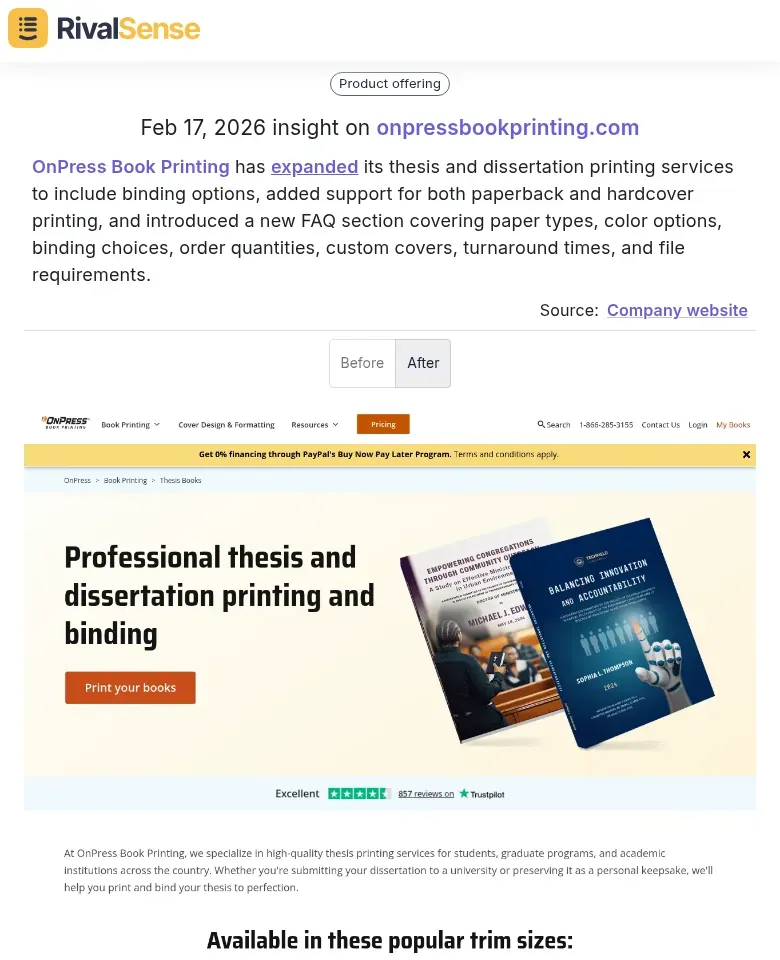
This type of insight is valuable because it shows how competitors are enhancing their offerings to meet customer needs, which can inform your own product development or partnership strategies in air freight, such as identifying service gaps or co-developing solutions.
Practical steps for implementing competitor partnerships:
- Identify complementary capabilities where your weaknesses align with competitors' strengths
- Establish clear governance structures with defined operational responsibilities
- Create standardized processes for shared infrastructure utilization
- Develop joint performance metrics that benefit both partners
- Implement knowledge-sharing protocols while protecting proprietary information
- Regularly review partnership ROI and adjust strategies based on market changes
Key tip: Successful partnerships require cultural compatibility and trust—start with smaller pilot projects before scaling to full joint ventures.
Implementation Framework: Building Your Own Winning Ecosystem
Building a winning ecosystem requires a structured approach. Start by identifying potential partners who complement your capabilities rather than directly compete. Look for companies with adjacent services, different geographic coverage, or specialized expertise that enhances your air freight offering. Define shared objectives that create mutual value beyond transactional relationships.
Establish clear governance structures with defined roles, decision-making processes, and communication protocols. Create compliance frameworks addressing data sharing, liability, and regulatory requirements specific to air freight partnerships. Document everything in formal agreements to prevent misunderstandings.
Monitoring Events and Partnerships for Ecosystem Building
Competitor events and partnerships are critical for identifying collaboration opportunities. For instance, RivalSense detected that Lumia is hosting a private CISO dinner in Chicago on February 24 in partnership with Lema AI to discuss securing agentic AI and using agents for risk management.

Insights like this are valuable as they show how companies are engaging key stakeholders and forming alliances, which can inspire similar initiatives in air freight, such as hosting industry roundtables or forming strategic partnerships to address common challenges like security or sustainability.
Design value exchange mechanisms that benefit all participants. Consider revenue-sharing models, capacity optimization arrangements, or joint service offerings. Implement performance metrics tracking efficiency gains, cost reductions, and customer satisfaction improvements for all partners.
Practical checklist:
- Map your value chain gaps and identify complementary partners
- Conduct due diligence on potential partners' capabilities and reputation
- Define clear partnership objectives with measurable KPIs
- Establish governance committees with balanced representation
- Create data sharing protocols and compliance documentation
- Develop transparent value exchange models
- Implement regular performance reviews and adjustment mechanisms
- Build escalation procedures for conflict resolution
Tip: Start with pilot partnerships before scaling to full ecosystem integration. Focus on creating win-win scenarios where all participants see tangible benefits from collaboration.
Challenges and Solutions in Competitor Collaboration
Competitor collaboration in air freight presents unique challenges that require strategic navigation. The DHL-Lufthansa AeroLogic joint venture demonstrates how to manage competitive tensions while fostering cooperation through clear operational boundaries: DHL uses aircraft on weekdays for express cargo, while Lufthansa utilizes them on weekends for general cargo. This structured separation prevents direct competition while maximizing asset utilization.
Practical Checklist for Managing Competitive Tensions:
- Define clear operational boundaries and market segments
- Establish governance committees with equal representation
- Create escalation protocols for conflict resolution
- Maintain separate sales and marketing functions
- Schedule regular strategic alignment meetings
Protecting Proprietary Information:
The AeroLogic model shows how to share best practices while safeguarding core IP. Partners established a lean joint venture company with its own AOC and operational structure, allowing knowledge exchange without exposing proprietary systems. Implement "Chinese walls" between collaborative and competitive areas, use non-disclosure agreements for specific initiatives, and create shared databases with tiered access permissions.
Measuring Success & Maintaining Momentum:
Successful partnerships require quantifiable metrics and regular review cycles. Track aircraft utilization rates, cost savings from shared operations, market share growth in collaborative segments, and customer satisfaction scores. Establish quarterly business reviews with predefined KPIs, create joint innovation funds for new initiatives, and rotate leadership roles to maintain fresh perspectives. The AeroLogic partnership maintained momentum by gradually expanding route networks and adding new destinations based on shared performance data, demonstrating how continuous evolution sustains long-term collaboration value.
Future Outlook: The Evolution of Air Freight Ecosystems
The air freight industry is undergoing a fundamental transformation where competitive advantage will increasingly stem from ecosystem thinking rather than isolated operations. Digital transformation is enabling unprecedented collaboration through technologies like IATA's ONE Record initiative, which creates unified digital ecosystems for data sharing. Practical step: Implement API integrations with at least 3 key partners within 12 months to enable real-time data exchange.
Financial and Management Insights for Long-Term Strategy
Understanding competitor financial health and management changes is crucial for future planning. RivalSense reported that DelfinGroup Chairman Didzis Admidins and CFO Andrejs Aleksandrovics will present the audited 2025 financial results and key developments in a virtual conference call on March 3.
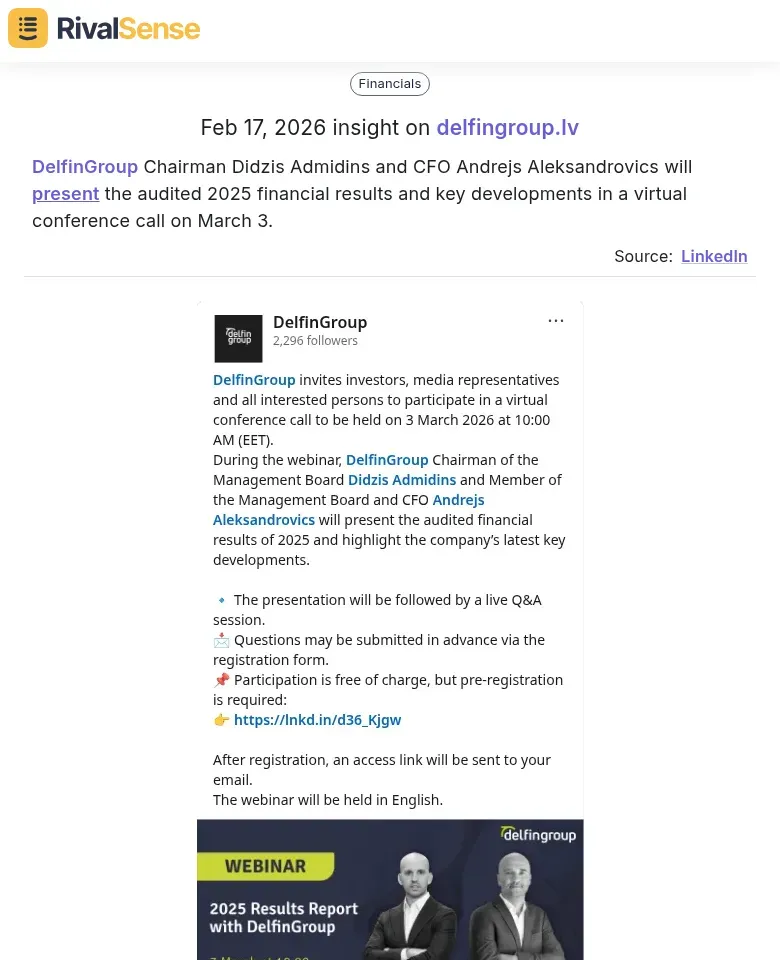
This type of insight helps assess competitor stability and strategic direction, informing your ecosystem decisions in air freight, such as selecting reliable partners or anticipating market shifts based on financial performance.
Sustainability initiatives are becoming powerful catalysts for industry-wide partnerships. The push toward Sustainable Aviation Fuel (SAF) adoption requires collaboration across airlines, fuel producers, and cargo owners. Companies like DHL and Air France KLM Martinair Cargo are pioneering these partnerships.
Checklist for Future-Proofing Your Ecosystem:
- Join an SAF consortium
- Set measurable decarbonization targets
- Partner with at least one competitor on shared sustainability goals
Ecosystem thinking will reshape competitive advantage by shifting focus from individual capabilities to network value. Future winners will be those who build interconnected platforms where airlines, freight forwarders, ground handlers, and technology providers collaborate seamlessly. Tip: Map your current ecosystem and identify 2-3 strategic gaps where competitor partnerships could create mutual value. The most resilient air freight companies will be those who recognize that in complex global networks, collaboration often creates more value than competition alone.
Take Action with Competitor Intelligence
To successfully implement competitor partnerships and build winning ecosystems, you need timely insights into what your rivals are doing. Tools like RivalSense can help by tracking competitor product launches, pricing updates, event participations, partnerships, regulatory aspects, management changes, and media mentions across company websites, social media, and various registries, delivering all in a weekly email report.
Ready to enhance your strategy? Try RivalSense for free at https://rivalsense.co/ and get your first competitor report today!
📚 Read more
👉 How RivalSense Empowered Placet Group to Defend Against E-Invoicing Disruption
👉 Competitor Brand Perception Mastery: The Ultimate Internet Insights Guide
👉 Mastering Key Account Management in Kazakhstan's Auto Lending Sector: A Practical Guide
👉 How to Track Competitor Pricing for Key Account Success: A Step-by-Step Guide