
AI Platform Competitive Intelligence: Decoding Advertising Strategies for Strategic Advantage
In the AI platform landscape, competitor advertising intelligence isn't just about tracking ads—it's about decoding strategic intent. By analyzing where and how competitors advertise, you uncover their market positioning, target audience priorities, and growth ambitions. When a rival shifts from technical feature-focused ads to business outcome messaging, they're signaling a move upmarket. When they suddenly appear on new platforms, they're testing expansion strategies.
Advertising messaging evolution directly mirrors product development. A competitor emphasizing "no-code AI" in campaigns likely has simplified interfaces in development. When they pivot from "fastest inference" to "most accurate models," they're revealing technical roadmap shifts. These advertising signals provide early warnings about competitive threats and market opportunities.
For AI platforms, continuous monitoring is non-negotiable. Set up alerts for competitor ad copy changes, track their channel expansion patterns, and analyze seasonal campaign patterns.
Create a simple checklist:
- [ ] Monitor top 5 competitors weekly
- [ ] Document messaging shifts monthly
- [ ] Correlate ad changes with product releases quarterly
This systematic approach transforms advertising data into actionable competitive intelligence that keeps you ahead in the rapidly evolving AI market.
Decoding Product Evolution Through Advertising Signals
When competitors upgrade their AI platform templates, they're revealing strategic shifts in market focus. Template evolution from general-purpose to industry-specific solutions signals deeper customer segmentation. For example, a shift from 'AI chatbot builder' to 'Healthcare AI assistant template' indicates targeting specialized verticals with higher-value use cases.
Advertising implications are profound: specialized solutions command premium pricing, enabling competitors to run higher-budget campaigns targeting niche audiences. Watch for keyword expansion from broad terms ('AI platform') to specific pain points ('HIPAA-compliant patient engagement').
Practical steps for tracking:
- Monitor competitor template libraries quarterly for new vertical-specific offerings
- Analyze ad copy changes when specialized templates launch - note new value propositions
- Track keyword bidding shifts toward industry terminology
- Use product announcements to anticipate upcoming advertising focus areas
Key insight: Competitors typically launch advertising campaigns 2-4 weeks after specialized product releases, giving you a window to prepare counter-strategies. Create alerts for competitor template updates to stay ahead of their advertising pivots.
RivalSense Insight Example:
Recently, Vellum introduced a new AI agent template for healthcare: Personalized Care Plan Agent, which generates personalized care plans from EHR, replacing the previous Population Health Insights Reporter template.
Tracking such product launches is valuable because it reveals competitors' focus on high-value verticals and allows you to anticipate their advertising shifts towards specialized markets.
Analyzing Strategic Pivots in Competitor Messaging
Major version launches often signal strategic repositioning in competitor advertising. When a competitor releases a "2.0" or "Enterprise Edition," analyze their ad messaging for shifts from features to outcomes, or from technical audiences to business decision-makers. For example, a platform moving from "AI model training" to "enterprise AI transformation" indicates a strategic pivot toward larger enterprise deals.
Product simplification initiatives create distinct advertising patterns. Watch for competitors shifting from feature-heavy messaging to simplified value propositions. Key indicators include: fewer technical specifications in ads, increased focus on user benefits, and simplified pricing structures. Track how they communicate complexity reduction—whether through "no-code" positioning or streamlined workflows.
Timing analysis reveals when competitors announce strategic shifts. Monitor these patterns:
- Quarterly earnings periods for public companies
- Industry conference seasons (Q1 and Q3)
- Following major funding rounds
- Before key hiring announcements
Practical steps for tracking:
- Set up alerts for competitor press releases and version announcements
- Create a timeline of their messaging evolution
- Compare ad spend patterns before/after strategic announcements
- Analyze keyword shifts in their PPC campaigns
Checklist for strategic pivot detection:
- [ ] Major version number changes (v1→v2)
- [ ] Messaging shift from features to outcomes
- [ ] Target audience expansion or change
- [ ] Pricing model restructuring
- [ ] Partnership announcements with strategic implications
RivalSense Insight Example:
Vellum's CEO Akash Sharma announced that the company will launch Vellum 2.0 in early 2026 after simplifying its product to improve user engagement and activation.
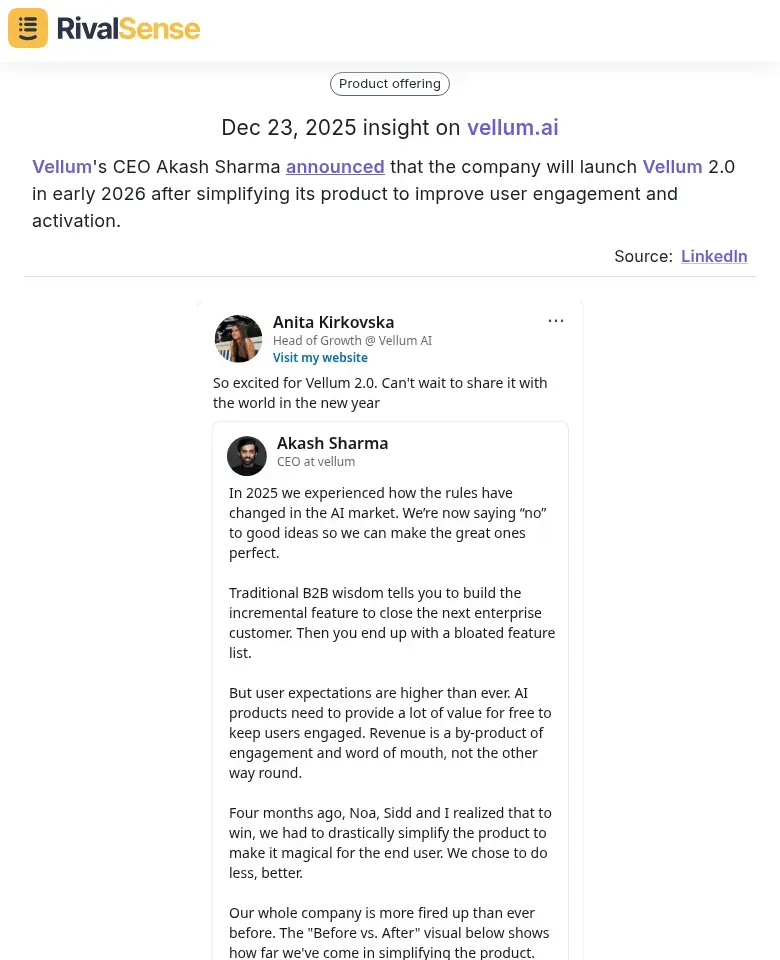
Monitoring CEO announcements like this is crucial for business strategy as it provides early warnings of major strategic pivots, allowing you to adjust your positioning and counter-messaging before the full launch.
Competitive Advertising Channel and Tactical Analysis
Competitive advertising analysis reveals strategic channel allocation patterns. Most AI platforms prioritize LinkedIn for enterprise messaging and executive thought leadership, while using Google Ads for feature-specific targeting. Twitter/X serves as the primary channel for rapid announcements and community engagement.
Product launch campaigns typically feature multi-channel saturation with coordinated press releases, executive interviews, and targeted display ads. In contrast, feature updates rely more on owned channels (email newsletters, blog posts) supplemented by retargeting campaigns for existing users.
Executive leadership plays a crucial role in competitor narratives. CEOs often front major product launches with personal LinkedIn posts and industry publication contributions, while CTOs handle technical feature announcements through developer forums and technical blogs.
Practical Checklist:
- [ ] Map competitor messaging to specific channels (LinkedIn for enterprise, Twitter for announcements)
- [ ] Track executive social media activity during campaign periods
- [ ] Analyze ad creative variations between product launches vs. feature updates
- [ ] Monitor press release distribution patterns across industry publications
- [ ] Document retargeting strategies for existing customer segments
Tip: Use competitive intelligence tools to track ad spend allocation across channels and identify seasonal campaign patterns that reveal strategic priorities.
Actionable Insights: Turning Analysis into Competitive Advantage
Once you've analyzed competitor advertising patterns, the real value comes from turning insights into action. Here's how to build competitive advantage:
Develop Counter-Strategies:
- Identify gaps in competitor messaging and create targeted campaigns to fill them
- If competitors focus on enterprise features, highlight your platform's ease-of-use for mid-market
- Create content that directly addresses weaknesses in their positioning
Time Your Advertising Strategically:
- Launch campaigns when competitors reduce ad spend (check historical patterns)
- Capitalize on their product launch gaps - advertise heavily 2-3 weeks after their major releases
- Use seasonal patterns: if competitors scale back in Q4, increase your presence
Build an Early Warning System:
- Monitor 3 key metrics: ad spend changes (+/- 30%), messaging shifts, and new channel testing
- Set up alerts for competitor job postings (often precede strategic shifts)
- Track their content themes monthly - sudden changes indicate new positioning
Action Checklist:
- [ ] Map competitor ad spend patterns by quarter
- [ ] Identify 2-3 messaging gaps to exploit
- [ ] Set up automated alerts for competitor strategic changes
- [ ] Create contingency campaigns ready to deploy within 48 hours of detecting shifts
- [ ] Quarterly review: adjust your strategy based on competitor evolution
Pro tip: The most effective counter-strategies address customer pain points that competitors overlook, not just mirror their approach.
Conclusion: Building a Sustainable Competitive Intelligence Framework
Integrating competitor advertising analysis into your strategic planning cycles transforms reactive monitoring into proactive strategy. Start by scheduling quarterly deep-dives into competitor ad campaigns, analyzing messaging shifts, channel allocation, and audience targeting.
Create a simple checklist:
- [ ] Track 3-5 key competitors
- [ ] Document their value proposition changes
- [ ] Note new product features advertised
- [ ] Identify emerging customer pain points they're addressing
The ROI of systematic competitor tracking for AI platforms is substantial. For every dollar invested in competitive intelligence, companies typically see 3-5x returns through faster feature development, improved positioning, and reduced customer acquisition costs. Document specific wins: Did you identify a market gap competitors missed? Did you adjust pricing based on their promotions? These tangible outcomes justify ongoing investment.
Future-proof your competitive strategy by monitoring three evolving AI landscape signals: regulatory changes affecting AI deployment, emerging technical architectures (like agentic AI or multimodal models), and shifting enterprise adoption patterns. Set up automated alerts for competitor funding rounds, executive hires, and patent filings. Remember: sustainable competitive intelligence isn't about copying—it's about anticipating market movements and positioning your platform where competitors won't be for 6-12 months.
Ready to decode your competitors' strategies? Try out RivalSense for free at https://rivalsense.co/ to get your first competitor report today. RivalSense tracks competitor product launches, pricing updates, event participations, partnerships, regulatory aspects, management changes, and media mentions across company websites, social media, and various registries, delivering all in a weekly email report. Start transforming competitive intelligence into actionable insights now.
📚 Read more
👉 Predictive Regulatory Intelligence: Anticipate Competitor Moves for Key Account Wins
👉 Turning Competitor Moves into Business Opportunities: A Guide to Management Change Analysis
👉 Key Account Management Webinar: Transforming Strategy with Competitive Intelligence
👉 Optimizing Telecom Infrastructure Key Account Task Tracking: A Strategic Process Guide
👉 How Nextiva's EHR Integration Strategy Enabled Competitors to Counterattack