
AI-Driven Productivity for Digital Identity Companies: A Guide for Business Leaders
🚀 Introduction: The AI Revolution in Digital Identity Key Account Management
The AI revolution is fundamentally transforming how digital identity companies manage key accounts. Traditional relationship-based approaches are being augmented by intelligent systems that handle compliance complexity, detect sophisticated fraud patterns, and streamline customer verification workflows with unprecedented efficiency. AI-powered key account managers can now process thousands of identity verification requests simultaneously while maintaining 99.9% accuracy rates, dramatically reducing false positives and manual review workloads.
Practical steps to start your AI transformation:
- 🔍 Audit your current verification workflows to identify bottlenecks
- 🤖 Implement AI-powered fraud detection that learns from emerging patterns
- ⚖️ Automate compliance monitoring with real-time regulatory updates
- 📊 Deploy predictive analytics to anticipate client needs before they arise
- 📈 Establish clear metrics to measure AI ROI on productivity gains
Digital identity companies that fail to adopt these AI-powered techniques risk falling behind competitors who can deliver faster, more secure, and more cost-effective solutions. The competitive imperative is clear: AI isn't just an efficiency tool—it's becoming the foundation of modern digital identity management.
AI-Powered Cross-Functional Team Optimization
Effective cross-functional collaboration is crucial for delivering seamless customer experiences in digital identity. AI-driven tools can synchronize teams and automate workflows, ensuring that sales, marketing, and technical units are aligned. By leveraging AI, companies can optimize their go-to-market strategies and respond swiftly to customer needs.
For instance, tracking competitor organizational changes can provide insights into their strategic focus. Consider this real-world example from RivalSense: Socure's Head of GTM for Workforce Fraud and Identity Solutions, Zach C., announced on February 25 that the company is launching a new cross-functional GTM team for its Workforce vertical to improve customer experience and support.
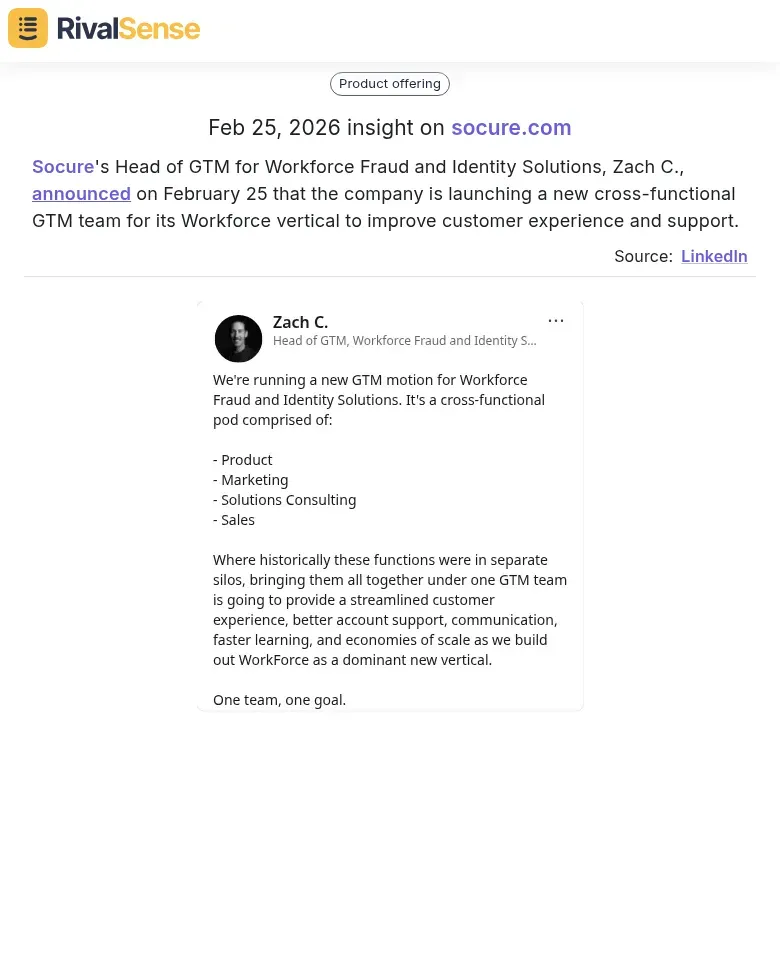
Why it matters: Monitoring such team launches helps you understand competitors' internal priorities and adapt your own cross-functional strategies accordingly.
Practical tip: Implement AI-driven collaboration platforms like Microsoft Teams with Copilot or Slack with AI features to enhance team coordination. These tools automatically sync customer data across departments, ensuring everyone works from the same real-time information.
Checklist for AI-powered team optimization:
- ✅ Map all customer touchpoints
- ✅ Identify decision bottlenecks
- ✅ Implement AI workflow automation
- ✅ Establish escalation protocols
Use AI to streamline customer experience workflows by implementing intelligent routing systems. When an issue arises, AI can automatically route it to the right specialist, reducing resolution time by up to 40%.
Intelligent Product Tiering and Customer Segmentation
AI transforms how digital identity key account managers match customers with optimal product tiers. By analyzing usage patterns, integration complexity, and security requirements, AI algorithms can recommend the right tier with high accuracy. This ensures that customers get the solutions they need without overpaying or underutilizing resources.
Keeping an eye on competitor product developments can inform your own tiering strategies. For example, RivalSense tracked that Socure has introduced two new product tiers: Socure Enterprise for complex organizations needing customized RiskOS deployments, and Socure Launch for builders wanting self-serve, production-ready workflows.
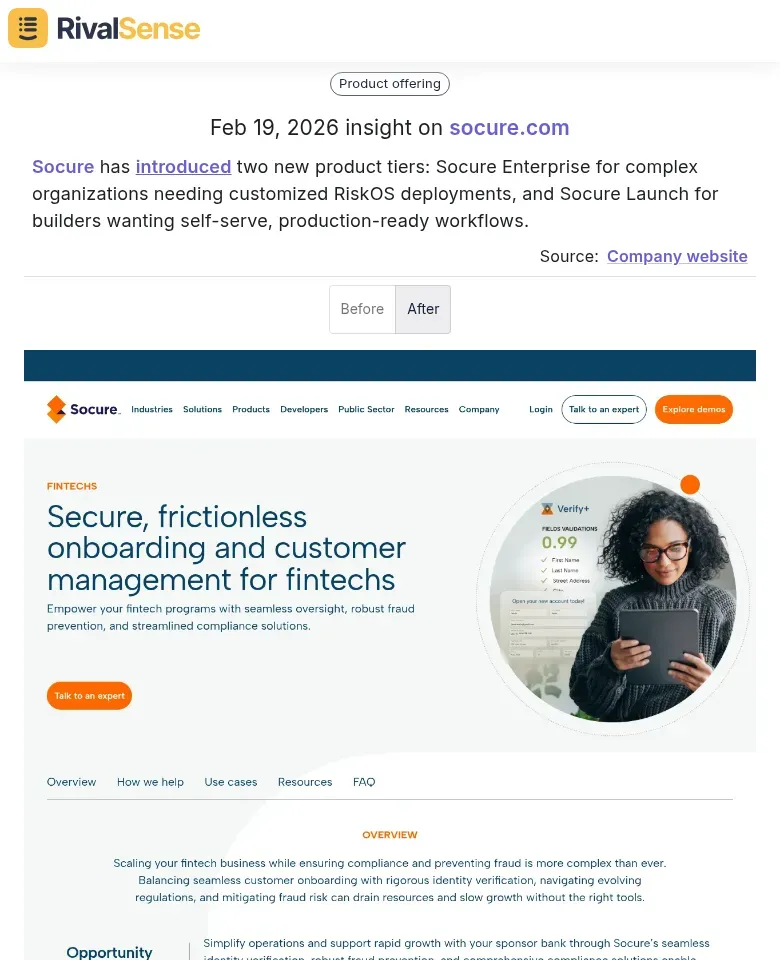
Why it matters: Insights into competitor product tiers help you benchmark your offerings and identify gaps in your market positioning.
Practical steps for AI-driven tiering:
- 📊 Implement AI analytics to track customer usage metrics, security incidents, and integration requests
- 🔮 Create predictive models that flag when customers exceed 80% of their current tier's capacity
- ⚡ Set up automated alerts for account managers when upgrade readiness scores exceed threshold
Predictive modeling identifies upgrade opportunities 30-45 days before customers realize they need them. AI analyzes expansion signals like increased API calls or new user onboarding.
Checklist for implementation:
- ✅ Integrate AI analytics with your CRM and usage tracking systems
- ✅ Define clear thresholds for tier migration triggers
- ✅ Train AI models on historical upgrade/downgrade patterns
- ✅ Create automated recommendation workflows for account managers
- ✅ Monitor AI accuracy monthly and refine models quarterly
For deployment scenarios, AI-driven workflow recommendations guide customers toward self-serve vs. customized implementations, reducing implementation time by 40%.
AI-Enhanced Relationship Intelligence and Risk Management
Proactive relationship management and risk mitigation are essential for retaining key accounts in the digital identity space. AI tools can analyze communications and behaviors to detect early signs of churn or fraud. By deploying these technologies, companies can stay ahead of issues and strengthen client relationships.
Start by using AI sentiment analysis tools to monitor stakeholder communications. Set up automated alerts for declining response rates or negative sentiment patterns—these are early warning signs of account churn.
Practical tip: Use tools like Brandwatch or Level AI to analyze email, chat, and meeting transcripts, creating a sentiment dashboard for each key account.
Checklist for AI-powered risk management:
- ✅ Integrate historical fraud data
- ✅ Train models on industry-specific patterns
- ✅ Set up real-time monitoring thresholds
- ✅ Establish automated reporting workflows
Automate relationship mapping using AI tools that analyze communication patterns and organizational charts to identify hidden influencers. This ensures you're engaging the right people at the right time to maximize account security and growth.
Strategic Thought Leadership and Market Positioning
For digital identity companies, establishing thought leadership is key to market differentiation. AI can transform this effort from reactive to proactive by identifying opportunities and analyzing competitive landscapes. By leveraging AI, you can position your executives as authorities and stay ahead of industry trends.
One valuable strategy is to track competitor speaking engagements. For instance, RivalSense identified that Matthew Thompson, President & Chief Commercial Officer at Socure, will speak at the Safeguard AI Deep Dive Retreat in May.
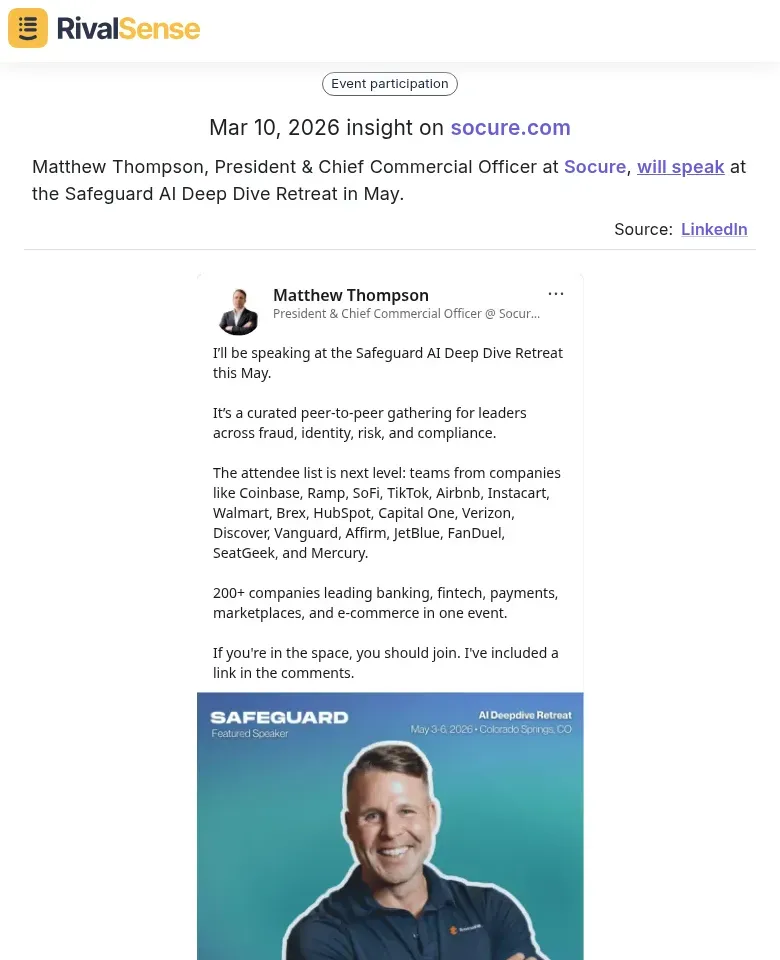
Why it matters: Knowing where competitors are speaking helps you identify event opportunities for your own team and understand their thought leadership focus.
AI-Powered Techniques for Market Positioning:
- 🎤 AI-Powered Speaking Opportunity Identification: Use tools to monitor industry events and identify perfect-fit speaking opportunities for your executives.
- 📝 Content Analysis for Thought Leadership: Implement AI to scan industry publications and identify trending topics where your company can contribute.
- 🔍 Competitive Intelligence for Market Positioning: Track competitor announcements and adjust your strategies accordingly.
Key implementation: Start with AI tools that integrate with your CRM and marketing platforms. Focus on identifying high-impact opportunities quarterly and create content addressing knowledge gaps.
Implementation Roadmap: Building Your AI-Powered Productivity Stack
Successfully integrating AI into your workflows requires a structured approach. Start by auditing current processes and gradually introduce AI tools to enhance productivity. This phased implementation ensures smooth adoption and measurable results.
Begin by identifying repetitive tasks like data entry or report generation that consume significant time. Integrate AI tools in phases: start with CRM enhancers, then add meeting assistants, and layer in predictive analytics.
Measure ROI with these key metrics:
- ⏱️ Reduction in manual task time (aim for 40% decrease)
- ⚡ Client response time improvement (target 50% faster)
- 📈 Upsell/cross-sell conversion rates from AI-generated insights
Track quarterly and recalibrate if needed.
Change management is critical. Create an 'AI champion' program to train team members and showcase quick wins. Use sandbox environments for risk-free experimentation and regularly review tool efficacy.
Leverage Competitive Insights with RivalSense
To stay ahead in the fast-evolving digital identity market, you need timely intelligence on competitor movements. Tools like RivalSense track competitor product launches, pricing updates, event participations, partnerships, and more, delivering insights in a weekly email report.
By monitoring examples like Socure's team launches, product tiers, and speaking engagements, you can adapt your strategies proactively. Try RivalSense for free today at https://rivalsense.co/ to get your first competitor report and start making data-driven decisions for your business.
📚 Read more
👉 Avoid These 5 Competitor Product Offering Mistakes That Drive Customer Churn
👉 Bright Data Shifts from Crawling to Live Discovery: A Competitor Analysis Case Study
👉 Key Account Tracking Integration: A Complete Guide for B2B Success in 2026
👉 2026 Brand Sentiment Analysis for Management Consulting Competitors
👉 How RivalSense Helped a Competitor Counter Lendermarket's Fee Elimination