
AI Agent Productivity: Analyzing Competitor UX for Enterprise Advantage
In today's enterprise landscape, AI agent UX isn't just about user satisfaction—it's a direct driver of measurable productivity gains. 🚀 As AI agents become integral to daily operations, their user experience (UX) determines how effectively employees can leverage these tools for productivity. Superior interfaces reduce cognitive load, minimize training time, and accelerate task completion, translating to tangible ROI. For every minute saved per employee interaction, enterprises gain thousands of productive hours annually.
Competitive advantage now hinges on systematic UX analysis. By benchmarking competitor interfaces, you identify adoption barriers they've overcome and workflow optimizations you can replicate. This intelligence reveals where competitors excel (intuitive onboarding) and where they falter (complex multi-step processes), allowing you to leapfrog their solutions.
Practical steps for enterprise leaders:
- ✅ Map competitor user journeys for common enterprise tasks
- ✅ Time task completion across competing platforms
- ✅ Document friction points and intuitive features
- ✅ Analyze onboarding flows and learning curves
- ✅ Track user satisfaction metrics from public reviews
Prioritize UX insights alongside technical specs. The most powerful AI engine fails if employees struggle to use it effectively. Evaluate solutions through the lens of actual user experience, not just feature checklists. This strategic approach ensures your AI investments deliver maximum productivity impact.
Learning from Competitor Industry Specialization: Vertical UX Patterns
Analyzing competitor UX adaptations across different industries reveals universal enterprise patterns that can inform your strategy. For example, banking interfaces prioritize compliance and security with multi-factor authentication flows, while healthcare platforms emphasize HIPAA-compliant data visualization and patient privacy controls. Retail competitors showcase personalized recommendation engines and streamlined checkout processes, offering insights into user engagement.
Take a real-world insight from RivalSense: Kore.ai introduced new AI applications for banking, healthcare, retail, IT, HR, and recruiting, along with platform modules for multi-agent orchestration, AI engineering tools, search and data AI, AI security and governance, and no-code and pro-code tools. 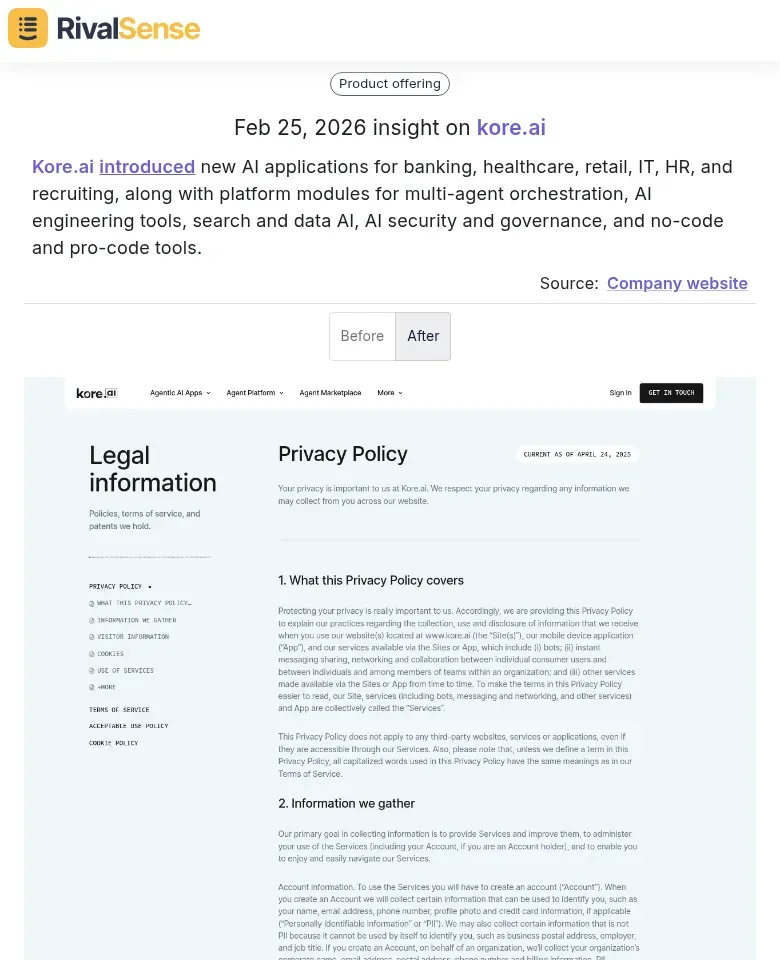
This type of insight is valuable because it shows how competitors are expanding their vertical offerings and enhancing platform capabilities. By tracking such developments, you can identify emerging trends and ensure your product strategy aligns with market demands across industries.
Practical Checklist for Industry UX Analysis:
- 🔍 Map competitor workflows across 3+ verticals
- 🔍 Identify common navigation patterns (dashboard layouts, search functionality)
- 🔍 Document industry-specific compliance integrations
- 🔍 Analyze how pre-built accelerators evolve into comprehensive apps
Key Insights:
- Banking UX emphasizes audit trails and approval workflows
- Healthcare platforms integrate telemedicine with EHR systems
- Retail competitors optimize for mobile-first shopping journeys
- Enterprise patterns emerge: contextual help systems, role-based permissions, and progressive disclosure of complex features
Actionable Tip: Create a competitive UX matrix comparing 5+ competitors across industries to identify transferable patterns. Focus on how industry-specific adaptations reveal broader enterprise principles: friction reduction through automation, personalization through AI-driven recommendations, and optimization through data visualization dashboards. These universal patterns can be adapted to your enterprise AI agent platform for cross-industry advantage.
Platform Architecture Insights: Multi-Agent Orchestration and Tool Integration
Understanding how competitors design UX for complex platform features is crucial for staying competitive. When analyzing competitor approaches to multi-agent orchestration UX, examine how platforms like Microsoft AutoGen and IBM watsonx Orchestrate manage complex workflows through visual workflow designers and role-based agent assignment interfaces. These leaders use drag-and-drop workflow builders that show agent interactions as nodes in a graph, making complex orchestration visually intuitive.
Practical tip: Create a competitor UX audit checklist covering workflow visualization clarity, agent communication transparency, and error handling visibility. Learn from AI engineering tools by studying how platforms implement contextual memory displays and zero-trust security dashboards.
Actionable Advice: Implement a three-layer UX approach:
- Visual workflow design for business users
- Detailed configuration panels for technical teams
- Governance dashboards for compliance officers
Analyze no-code and pro-code integration strategies by examining how platforms balance accessibility with advanced functionality. Successful competitors use progressive disclosure—starting with simple drag-and-drop interfaces for common tasks, then revealing advanced configuration options through expandable panels. They implement role-based interfaces where business users see simplified views while developers access full API documentation and debugging tools.
Key Insight: The most effective platforms maintain a single codebase while dynamically adjusting UI complexity based on user roles and expertise levels. Practical step: Create user personas for each stakeholder type and map their specific UX requirements to your platform's interface layers.
UX Evolution Analysis: From Accelerators to Comprehensive Solutions
Tracking how competitor UX evolves over time provides strategic foresight into market trends. Successful AI agents often start as focused accelerators solving specific pain points, then expand into comprehensive solutions with omnichannel touchpoints. Monitor how competitors transition from single-purpose tools to full-featured platforms integrating across departments.
A prime example from RivalSense: Kore.ai updated its AI for Retail offering from a pre-built accelerator focusing on personalized interactions and employee insights to a pre-built app emphasizing frictionless shopping, optimized operations, and instant personalized support across all touchpoints. 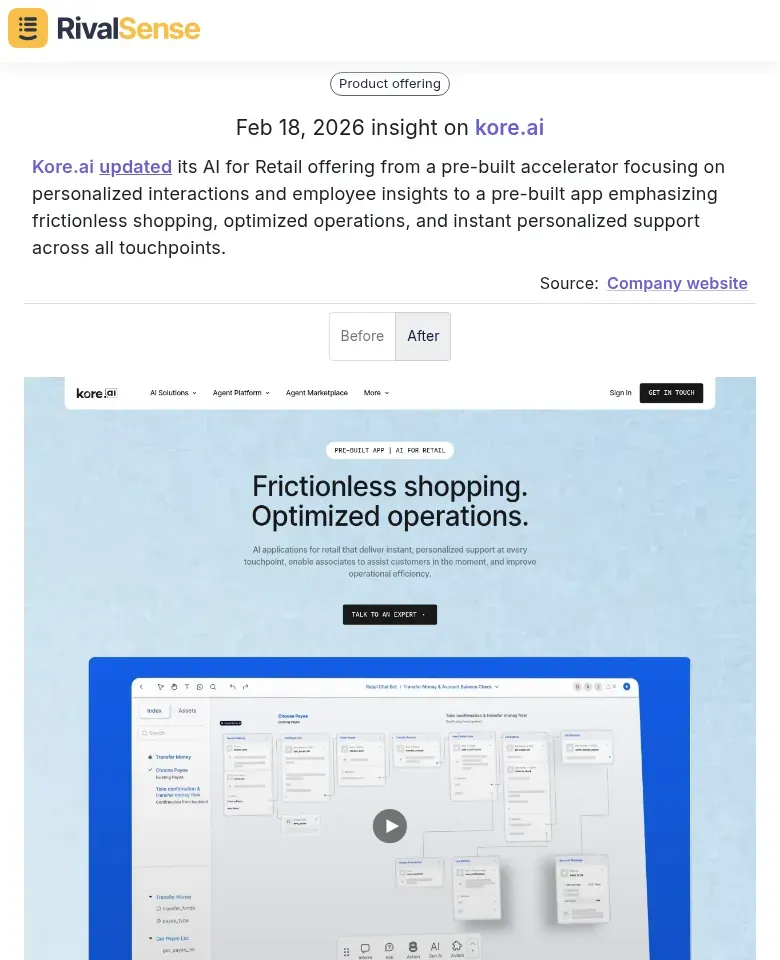
This evolution insight is valuable because it reveals how competitors mature their solutions, indicating where the market is heading—from niche tools to integrated platforms. By understanding these patterns, you can anticipate future developments and adapt your strategy accordingly.
Practical Checklist for UX Evolution Analysis:
- 📈 Map competitor's initial accelerator use cases vs. current feature set
- 📈 Identify touchpoint expansion patterns (web → mobile → API → integrations)
- 📈 Track personalization evolution: from basic preferences to context-aware interactions
- 📈 Monitor support experience transitions: from delayed responses to instant omnichannel assistance
Key Patterns to Watch:
- Employee Insights → Optimized Operations: Competitors who started with employee productivity tools now offer automated workflow orchestration
- Personalized → Instant: Early personalization features evolve into real-time, context-aware interactions across channels
- Focused → Comprehensive: Single-function accelerators expand into enterprise-wide platforms with multiple integration points
Actionable Tip: Create a timeline visualization showing how top competitors evolved their UX touchpoints over the last 2-3 years. Look for inflection points where they added significant new channels or expanded use cases. This reveals their strategic roadmap and helps anticipate their next moves.
Strategic Positioning Insights: Event and Market Focus Analysis
Analyzing competitor event participation offers critical market intelligence that can shape your strategic decisions. Track which industry conferences your rivals prioritize and how their messaging evolves across events to understand shifting market priorities. For example, if a competitor shifts from "digital transformation" to "AI-powered customer experience" themes, this signals emerging enterprise demands.
Consider this RivalSense insight: Kore.ai updated its upcoming event from NRF Show in New York City on 13 Jan to CCW Berlin in London on 4 Feb, focusing on customer experience, AI, and digital transformation. 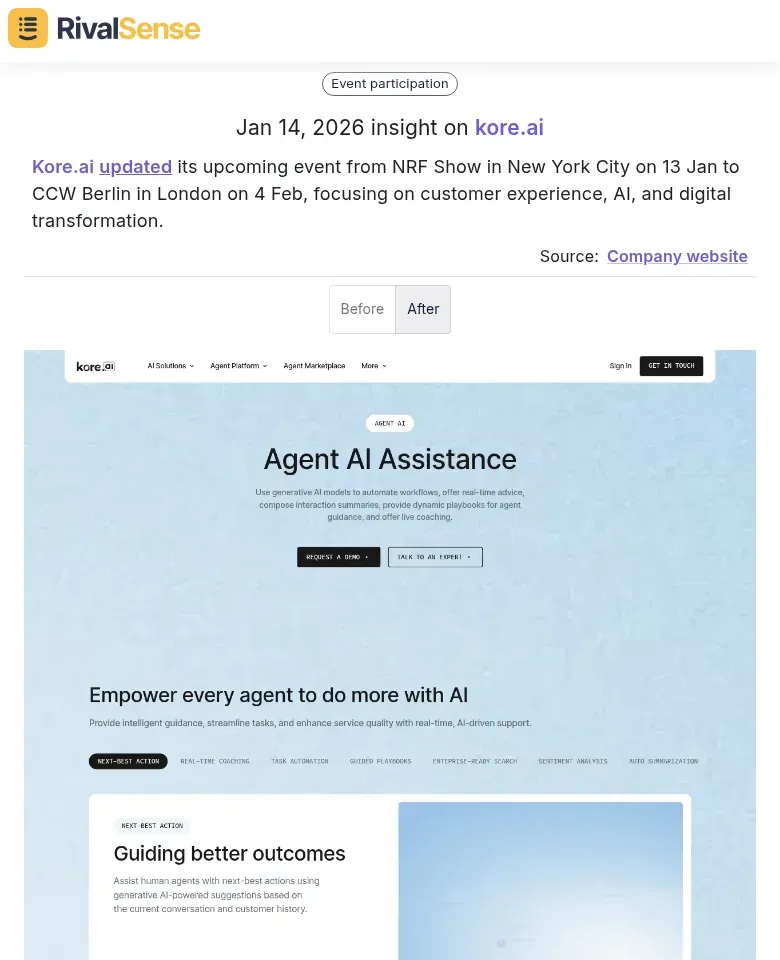
Monitoring such event changes is valuable because it provides strategic intelligence on competitor priorities and shifting market themes. This allows you to adjust your messaging, event participation, and product focus to stay aligned with industry trends.
Practical Checklist:
- 🗓️ Monitor competitor event calendars and speaking engagements quarterly
- 🗓️ Analyze presentation titles, abstracts, and social media coverage
- 🗓️ Track messaging shifts between customer experience, AI innovation, and digital transformation themes
- 🗓️ Note which events attract C-level vs. technical audiences
- 🗓️ Compare your event strategy against competitor positioning gaps
When competitors increase participation in AI-focused events while reducing digital transformation presence, this indicates market demand shifting toward AI integration. Extract insights by analyzing their case studies, demo priorities, and partnership announcements. These patterns reveal unspoken enterprise UX requirements before they become mainstream demands.
Pro Tip: Use AI monitoring tools to track competitor event content across platforms. Set alerts for keyword shifts in their messaging to identify emerging trends 3-6 months before they impact your market.
Actionable Framework: Implementing Competitor UX Insights for Enterprise Advantage
To systematically implement competitor UX insights for enterprise advantage, follow this actionable framework. Start by establishing a structured approach to collect, analyze, and apply insights from competitor UX analysis.
-
Systematic Analysis Framework: Create a cross-industry competitor matrix tracking 5-7 key AI agent platforms. Document UX patterns across onboarding, task execution, error handling, and customization. Use tools like RivalSense to automate data collection on interface changes, feature rollouts, and user feedback trends.
-
Insight Translation Process: Convert findings into prioritized UX improvements using a scoring system (1-10) for impact vs. effort. For example, if competitors use progressive disclosure to reduce cognitive load, implement similar patterns in your enterprise workflows. Create A/B test scenarios based on competitor successes.
-
Continuous Monitoring Strategy: Establish quarterly UX audit cycles with automated alerts for competitor interface changes. Track metrics like task completion time reduction, error rate improvements, and user satisfaction scores. Maintain a living document of competitor UX evolution to anticipate trends.
Practical Checklist:
- ✅ Map 3+ competitor onboarding flows
- ✅ Document error recovery patterns
- ✅ Benchmark task completion benchmarks
- ✅ Set up automated change detection
- ✅ Schedule quarterly competitive UX reviews
Focus on adapting, not copying—translate competitor strengths into context-specific enterprise productivity gains.
Leverage Competitor Insights with RivalSense
Implementing a robust competitor UX analysis strategy requires timely and accurate data. Tools like RivalSense can automate the tracking of competitor product launches, pricing updates, event participations, partnerships, and more, delivering insights directly to your inbox.
By using RivalSense, you can stay ahead of market shifts and competitor moves without manual effort. For example, the insights shared in this post—from industry expansions to event changes—were detected by RivalSense, showcasing how automated monitoring can provide strategic advantages.
Ready to enhance your competitor analysis? Try RivalSense for free at https://rivalsense.co/ and get your first competitor report today to start gaining actionable insights for your enterprise strategy.
📚 Read more
👉 Predictive Analysis: Forecast Competitor Churn via Media & Content Insights
👉 Decoding Competitor Moves: How Hiring Insights Reveal Strategic Shifts
👉 Mastering Competitor Trade Show Strategy for 2026 Business Growth
👉 A Step-by-Step Guide to Comparing Key Account Management Tools for Industrial Machinery Maintenance
👉 How n8n's Pricing Shift Let Competitors Capture Enterprise Clients