
Advanced Tactics: Tracking Video Conferencing Leaders for Strategic Edge
🎯 Introduction: Why Video Conferencing Leaders Demand Advanced Tracking
In the hyper-competitive video conferencing landscape, tracking market leaders like Zoom, Microsoft Teams, and Google Meet isn't just about keeping tabs—it's about strategic foresight. This rapidly evolving industry sees constant innovation, pricing shifts, and feature rollouts that can redefine market dynamics overnight. Advanced competitor tracking provides the intelligence needed to anticipate moves rather than react to them.
By monitoring these leaders' event participation—from major conferences like Zoomtopia to developer summits and partner roadshows—you uncover their market positioning and expansion priorities. Are they focusing on enterprise security, AI integrations, or global expansion? Event patterns reveal strategic direction.
Practical steps for effective tracking:
- Create a competitor event calendar tracking all major industry conferences
- Analyze speaker topics and session themes for strategic insights
- Monitor partnership announcements and integration launches
- Track geographic expansion through regional event participation
- Benchmark your own event strategy against market leaders
This intelligence connects directly to your business strategy, helping you identify gaps in your offerings, anticipate competitive threats, and discover partnership opportunities before they become mainstream.
🔍 Decoding Event Participation: What Competitor Appearances Reveal
In the fast-paced world of video conferencing, every move by market leaders signals their next strategic play. Event participation, in particular, offers a window into their priorities and future directions. Event participation reveals competitors' strategic priorities through three key dimensions. First, analyze event types: trade shows signal product commercialization focus, while thought leadership forums indicate innovation positioning. For example, a video conferencing leader at CES demonstrates hardware ambitions, whereas TEDx appearances suggest brand elevation.
Second, decode geographic patterns. Track regional event clusters to identify expansion priorities. If competitors consistently appear in APAC tech summits but skip European conferences, they're likely prioritizing Asian market penetration.
Third, monitor timing and frequency. Sudden event activity spikes often precede product launches. A competitor speaking at three consecutive AI conferences likely has AI features launching within 90 days.
For instance, RivalSense recently tracked that Neat will be featured at a live technology event about the future of meeting rooms hosted by Radiant Technology Group in Columbus, Ohio on March 26, 2026.
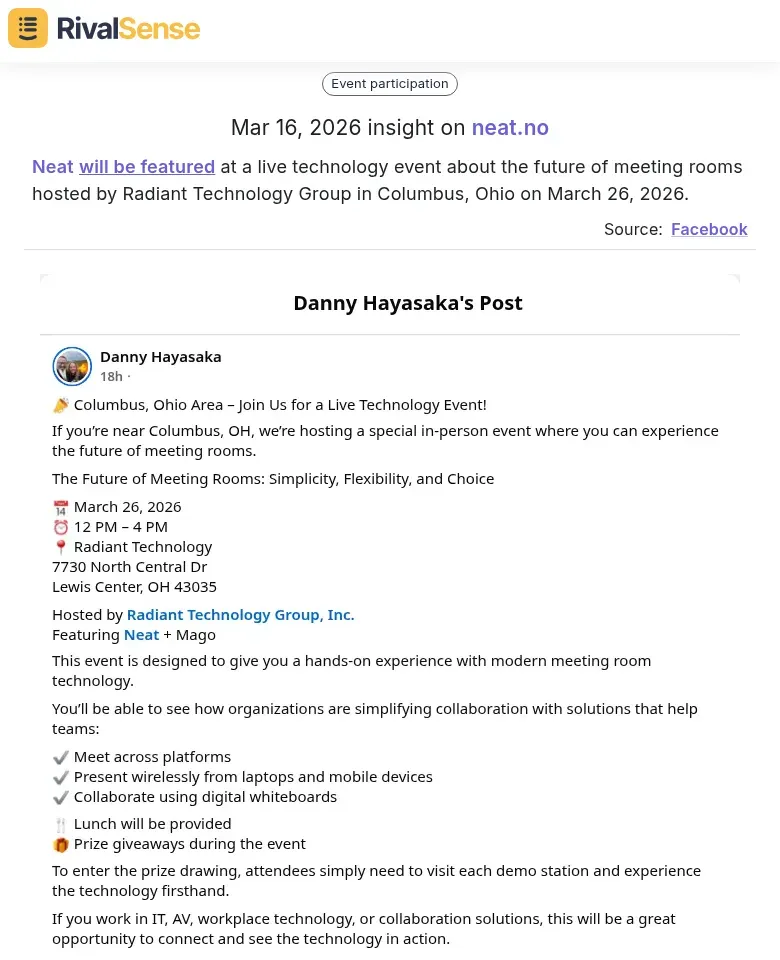
This insight is valuable because it highlights Neat's strategic focus on the meeting room segment and their geographic targeting in Ohio, helping you anticipate regional market expansions and adjust your own event participation accordingly.
Practical Checklist:
- ✅ Categorize events by type (trade show, webinar, summit)
- ✅ Map geographic participation density
- ✅ Track frequency changes month-over-month
- ✅ Note speaker vs. sponsor roles (thought leadership vs. sales focus)
- ✅ Record presentation themes for pattern analysis
Pro Tip: Use tools like RivalSense to automate tracking and receive alerts when competitors register for key industry events, giving you 30-60 day advance notice of strategic moves.
🤝 Strategic Partnership Intelligence: Learning from Alliance Patterns
Strategic partnerships reveal more than just collaboration—they expose network expansion patterns and credibility-building efforts. By analyzing who competitors team up with, you can uncover hidden growth avenues and credibility indicators. Track partnership announcements systematically: create a monitoring list of key players (Zoom, Microsoft Teams, Google Meet, Cisco Webex) and their ecosystem partners. When a video conferencing leader announces a new integration (like Zoom with Salesforce or Microsoft Teams with Adobe), analyze the partnership scale: is it a lightweight API integration or deep platform embedding? This indicates market validation strength.
Co-presentation patterns at industry events offer intelligence gold. When executives from Zoom and Slack present together at Dreamforce, or Microsoft Teams and SAP share a stage, note the technology integrations discussed. These reveal strategic priorities beyond press releases.
Consider this RivalSense insight: Neat will feature at a live technology event on March 26, 2026, hosted by Radiant Technology Group in Columbus, Ohio, showcasing meeting room solutions with Mago.
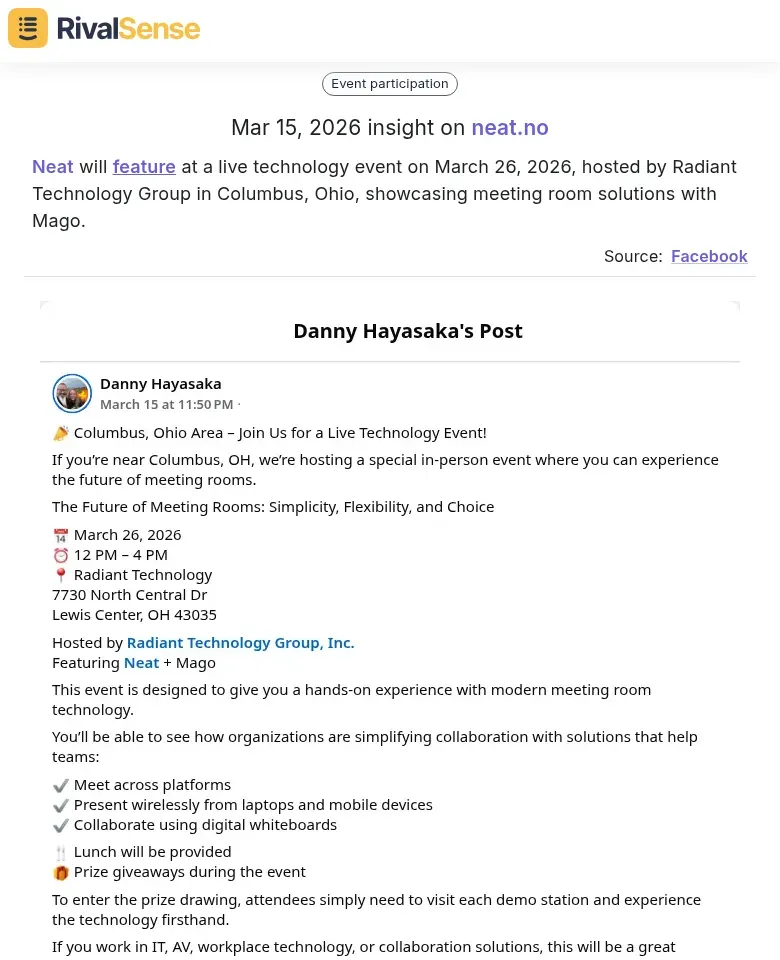
This type of insight is crucial as it reveals partnership dynamics and co-marketing efforts, allowing you to assess competitive alliances and identify potential collaboration opportunities or gaps in your own partnership strategy.
Practical steps:
- Set up Google Alerts for "[competitor] partnership" and "[competitor] integrates with"
- Monitor competitor blogs and press release sections weekly
- Analyze partnership announcements for credibility signals (Fortune 500 clients mentioned?)
- Track webinar co-hosting patterns between competitors and their partners
- Evaluate audience reach: does the partnership target enterprise IT teams or frontline workers?
Key insight: Partnerships with CRM/ERP giants signal enterprise expansion, while productivity app integrations indicate SMB focus. The frequency of new partnership announcements (monthly vs. quarterly) reveals aggressive vs. measured network building strategies.
📊 Event-Specific Campaign Analysis: Extracting Tactical Insights
Event-specific campaign analysis provides tactical insights that transform industry gatherings into competitive intelligence goldmines. These insights go beyond mere attendance, delving into the execution and impact of competitor campaigns. By dissecting their tactics, you can refine your own event strategies. Start by monitoring video conferencing leaders' promotional tactics and booth designs at major events like Zoomtopia, Microsoft Ignite, or WebexOne. Document their engagement strategies: Do they use interactive demos, VR experiences, or gamification? Track booth traffic patterns and identify which designs attract the most qualified leads.
For example, RivalSense reported that Neat presented new products at a Microsoft event organized by IsiCom Nordic on March 13.
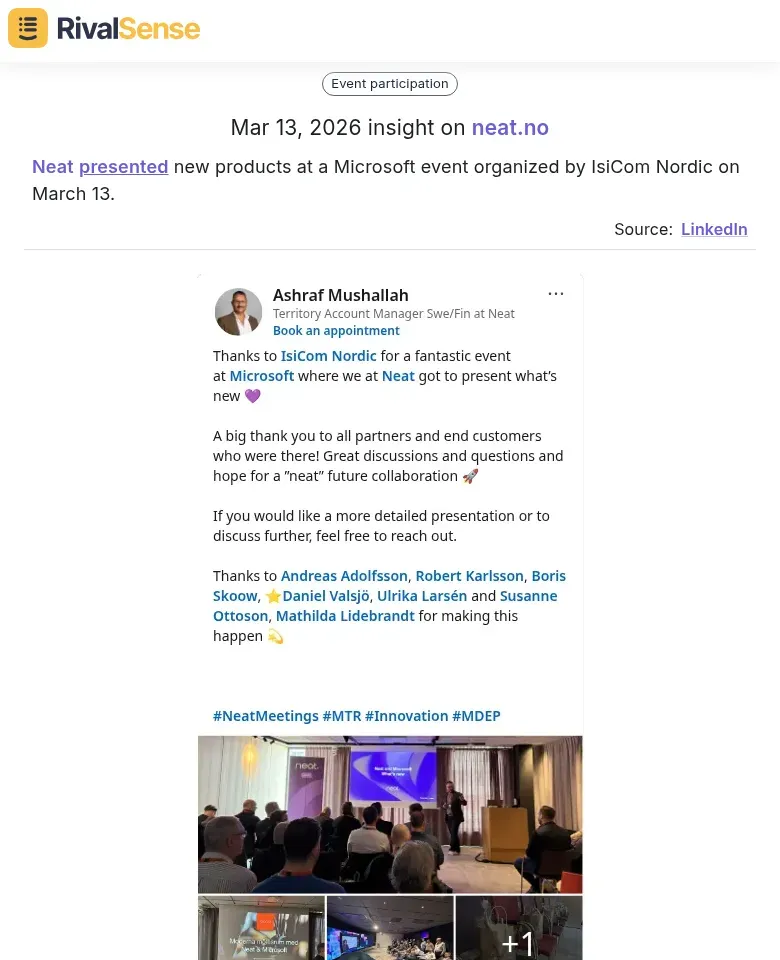
Tracking such product launch events is valuable for understanding innovation timelines and competitive positioning, enabling you to time your own launches strategically and benchmark your product announcements against industry leaders.
Practical Checklist:
- ✅ Create an event monitoring template capturing booth design elements, promotional giveaways, and engagement tactics
- ✅ Set up real-time social media monitoring for event hashtags and competitor mentions
- ✅ Track lead generation metrics: booth traffic, demo sign-ups, and qualification rates
- ✅ Document follow-up sequences by signing up for competitor communications
- ✅ Analyze engagement patterns to identify best practices for your next event
During events, monitor social media engagement metrics including share of voice, sentiment analysis, and influencer mentions. Tools like RivalSense can track real-time competitor activity across platforms. Post-event, analyze their follow-up sequences - how quickly do they contact leads, what content do they send, and what conversion tactics do they use? This tactical intelligence helps you benchmark your performance and identify gaps in your event strategy.
🏗️ Systematic Tracking Framework: Building Your Intelligence Infrastructure
Building an effective intelligence infrastructure requires systematic tracking frameworks. Without a structured approach, data can overwhelm rather than inform. A well-designed framework turns raw information into actionable intelligence. Start by creating structured event tracking systems with standardized data collection templates. For video conferencing leaders, develop templates capturing key data points: product launch dates, feature announcements, pricing changes, partnership deals, and market expansion moves. Use consistent formats for easy comparison across competitors.
Implement automated monitoring tools for real-time alerts. Set up Google Alerts for competitor names and keywords like "Zoom new feature" or "Microsoft Teams update." Use social listening tools to track announcements on LinkedIn, Twitter, and industry forums. Consider specialized competitor tracking platforms that aggregate multiple data sources into unified dashboards.
Develop analysis frameworks to transform raw data into strategic insights. Create a monthly competitor intelligence report template with sections for: product feature comparisons, pricing analysis, market positioning shifts, and strategic partnership impacts. Use SWOT analysis (Strengths, Weaknesses, Opportunities, Threats) to identify competitive gaps you can exploit. Track announcement patterns to predict competitor roadmaps.
Practical checklist:
- ✅ Create standardized data collection templates
- ✅ Set up automated monitoring alerts
- ✅ Schedule weekly data review sessions
- ✅ Develop monthly competitor intelligence reports
- ✅ Establish quarterly strategic analysis meetings to translate insights into action plans
Remember: Consistency in data collection enables meaningful trend analysis over time.
⚡ Turning Insights into Action: Strategic Implementation for Competitive Edge
Transform event intelligence into strategic advantage with these actionable steps. The real value of tracking lies in how you apply the insights to outmaneuver competitors. Here’s how to operationalize your findings.
Developing Counter-Strategies: When competitors dominate specific conferences, create targeted counter-campaigns. For example, if Zoom consistently sponsors major tech events, launch a competing webinar series during those same dates to capture their audience. Use a competitor event tracking spreadsheet to identify patterns in their participation frequency, sponsorship levels, and geographic focus.
Strategic Timing Alignment: Align your product launches with identified market gaps. If competitors focus on Q1 enterprise events, schedule your SMB-focused launch for Q2 when attention shifts. Track competitor announcement timing through tools like RivalSense to anticipate their moves and position your offerings strategically.
Integration Checklist:
- ✅ Map competitor events against your strategic goals quarterly
- ✅ Set up automated alerts for competitor event announcements
- ✅ Analyze post-event engagement metrics to identify effective tactics
- ✅ Cross-reference event intelligence with product roadmap planning
- ✅ Involve sales and marketing teams in event analysis reviews
Proactive Positioning: Integrate event data into broader competitive analysis by creating an event matrix categorizing competitor activities by type, scale, and audience. This reveals market trends and partnership opportunities, enabling you to anticipate industry shifts rather than react to them. For instance, if multiple video conferencing leaders pivot toward AI-focused events, adjust your R&D priorities accordingly.
🚀 Ready to Get Started?
Advanced competitor tracking is no longer a luxury—it's a necessity for staying competitive in the video conferencing industry. By implementing the tactics outlined above, you can gain a strategic edge and anticipate market moves before they happen.
To streamline your efforts, try RivalSense for free at https://rivalsense.co/ and get your first competitor report today. RivalSense tracks competitor product launches, pricing updates, event participations, partnerships, and more, delivering all insights in a weekly email report to keep you informed and ahead of the curve.
📚 Read more
👉 How Competitor Insights Solve Market Entry Challenges for Key Account Success
👉 Competitor Analysis in Action: Learning from Keatech's Partnership with EG
👉 HOW TO TRACK KEY ACCOUNT RENEWAL DATES: A STRATEGIC GUIDE FOR 2026
👉 Marine Port Services Key Account Risk Tracking Checklist 2026
👉 How ScraperAPI's New Tech Hire Revealed Competitor Expansion Plans