
Advanced Tactics: Track Competitor Sales for Supply Chain Optimization
In today's volatile market, competitor sales tracking is the missing link that transforms supply chain optimization from guesswork into precision strategy. While most companies focus on internal metrics, real-time competitor sales data reveals market demand shifts before they impact your operations. This intelligence enables you to move from reactive inventory management to proactive strategic planning. By monitoring competitor sales patterns, you can anticipate product demand surges, identify emerging trends, and optimize inventory levels accordingly.
For example, if a competitor's sales spike for a particular product category, you can adjust your procurement and distribution before shortages occur. This integration of sales intelligence with supply chain operations creates a significant competitive advantage.
Practical steps to get started:
- Identify key competitors and their primary sales channels – Focus on direct rivals in your niche.
- Set up automated tracking for their product sales and promotions – Use tools to monitor price changes and discounts.
- Correlate competitor sales data with your inventory metrics – Look for patterns that affect your stock levels.
- Create alerts for significant sales pattern changes – Stay ahead of market shifts.
- Integrate insights into your demand forecasting models – Refine predictions based on external data.
💡 Tip: Focus on tracking not just sales volumes but also pricing strategies and promotional timing to gain comprehensive market intelligence.
Advanced Methods for Tracking Competitor Sales Data
To optimize your supply chain, you need sophisticated competitor sales tracking that goes beyond basic monitoring. Advanced methods provide deeper insights into market dynamics and competitor movements. Here are three advanced approaches with practical implementation steps to enhance your strategy.
1. Digital Footprint Analysis
Monitor competitors' online presence to gauge sales momentum and identify early signals. Track website traffic patterns using tools like Similarweb to identify seasonal spikes or new market entries. Analyze social media engagement rates—sudden increases often precede product launches or promotions that could impact demand.
Practical Checklist for Digital Analysis:
- ✅ Use Semrush or Ahrefs for keyword gap analysis to see what terms competitors rank for.
- ✅ Monitor competitor job postings for expansion clues in logistics or sales roles.
- ✅ Track review volume changes on platforms like Amazon or G2 to assess customer sentiment shifts.
- ✅ Set up visual monitoring with tools like Visualping for website changes that indicate new products or pricing.
2. AI-Powered Market Intelligence Platforms
Implement automated tracking systems that monitor multiple data sources for real-time insights. Platforms like Crayon or Klue use NLP to analyze earnings calls, press releases, and social media for sales signals, helping you stay ahead of competitor moves.
Implementation Steps for AI Platforms:
- Identify 3-5 key competitors to monitor – Prioritize those with overlapping product lines.
- Set up automated data collection from websites, review sites, and regulatory filings.
- Configure AI-powered relevance scoring to filter noise and highlight critical updates.
- Integrate battlecards directly into your CRM for sales team alignment.
- Establish a weekly review cadence for AI-generated insights to inform supply chain decisions.
3. Sales Channel Monitoring
Track competitors across e-commerce platforms, distributor networks, and retail partnerships to understand their distribution strategies. Use tools like 42Signals to monitor Amazon rankings, Walmart inventory levels, and distributor pricing changes.
Channel Tracking Tips:
- 📊 Map competitor distribution networks using LinkedIn Sales Navigator to identify new partners.
- 📊 Monitor marketplace share of search (SOS) metrics to gauge visibility.
- 📊 Track quick commerce platform availability and pricing for speed-based advantages.
- 📊 Analyze retail partnership announcements for expansion patterns that might affect your logistics.
- 📊 Use price monitoring tools for MAP violation detection to anticipate competitive pricing shifts.
🔍 Pro Tip: Combine these methods into a unified dashboard. Set thresholds for automated responses—for example, when a competitor's Amazon ranking improves for key keywords, automatically optimize your listings and adjust pricing. This creates a 24/7 competitive monitoring system that informs supply chain decisions in real-time.
Integrating Competitor Data into Supply Chain Forecasting
Integrating competitor sales data into supply chain forecasting transforms traditional demand planning from reactive to predictive. By analyzing competitor sales patterns, you can identify market trends before they impact your own operations, allowing for proactive adjustments. For instance, when a competitor experiences a sales surge in specific product categories, this often signals broader market demand shifts that will affect your supply chain within weeks.
Practical Implementation Steps:
- Data Collection: Use tools like RivalSense to track competitor sales volumes, pricing changes, and promotional activities across key product categories. This data provides a baseline for forecasting.
- Pattern Analysis: Identify correlations between competitor promotions and market demand fluctuations. For example, a price drop by competitors might lead to increased market demand that you can anticipate.
- Model Development: Build predictive models that weight competitor data alongside your historical sales data for optimal forecasting accuracy, typically with a 30-40% weight on competitor signals.
Key Integration Checklist:
- 📈 Monitor competitor inventory levels and stockouts as leading indicators of supply chain stress.
- 📈 Track competitor pricing changes and correlate with market demand spikes to adjust your pricing strategy.
- 📈 Analyze competitor promotional timing and duration for seasonal planning insights.
- 📈 Use competitor sales velocity to adjust safety stock levels and prevent shortages.
- 📈 Incorporate competitor market share shifts into capacity planning for long-term adjustments.
💡 Pro Tip: Create a "competitor demand index" that weights competitor sales data by market proximity and product similarity. This index, when integrated with your existing forecasting models, can improve accuracy by 18-25% according to recent supply chain studies. The most effective implementations use competitor data as a complementary signal that enhances overall predictive power.
Optimization Strategies: From Data to Actionable Insights
Transform competitor sales data into supply chain advantages with these actionable strategies that bridge intelligence with execution. By leveraging insights, you can optimize inventory, supplier relationships, and logistics for sustained competitive edge.
Dynamic Inventory Management: Monitor competitor stock levels and sales velocity to optimize your own inventory. When competitors experience stockouts, increase your safety stock to capture demand; when they have excess inventory, reduce yours to avoid overstocking. Track seasonal patterns to anticipate demand shifts before they impact your supply chain.
Supplier Relationship Optimization: Analyze competitor sourcing patterns to identify alternative suppliers or negotiate better terms. If competitors shift to new suppliers, investigate why and evaluate those suppliers for your own operations. Use competitor procurement data to benchmark your supplier performance and identify cost-saving opportunities.
Logistics Network Adjustments: Study competitor fulfillment strategies to optimize your distribution network. If competitors open new fulfillment centers in specific regions, analyze whether similar expansion would benefit your delivery times and costs. Monitor competitor shipping methods and delivery promises to identify areas for improving your own logistics efficiency.
Actionable Checklist:
- ✅ Set up alerts for competitor stock level changes to react quickly.
- ✅ Track competitor product launches and discontinuations to adjust your inventory mix.
- ✅ Monitor competitor shipping times and delivery promises for benchmarking.
- ✅ Analyze competitor supplier announcements and partnerships for sourcing insights.
- ✅ Benchmark your fulfillment costs against competitor strategies to identify gaps.
🚀 Pro Tip: Combine competitor data with your own sales analytics to create predictive models that anticipate market shifts before they occur, giving you first-mover advantage in supply chain optimization. For example, tracking competitor feature launches can inform your inventory planning for related products.
Leveraging Specific Competitor Insights for Strategic Advantage
Beyond general sales data, specific types of competitor insights can provide targeted value for your business strategy. Here are real-world examples from RivalSense that illustrate how different insights can inform supply chain decisions.
Product Launch Insights
Tracking product updates helps you anticipate component demand and competitive responses. For instance, RivalSense detected that Sennheiser says its Signature Sound System in the Smart #5 can now deliver Dolby Atmos playback via an OTA update, enabling immersive audio through a 20-speaker in-car system and Amazon Music. This type of insight is valuable because it signals technological advancements that may drive demand for related audio components or affect competitor positioning in the automotive sector.

Event Participation Insights
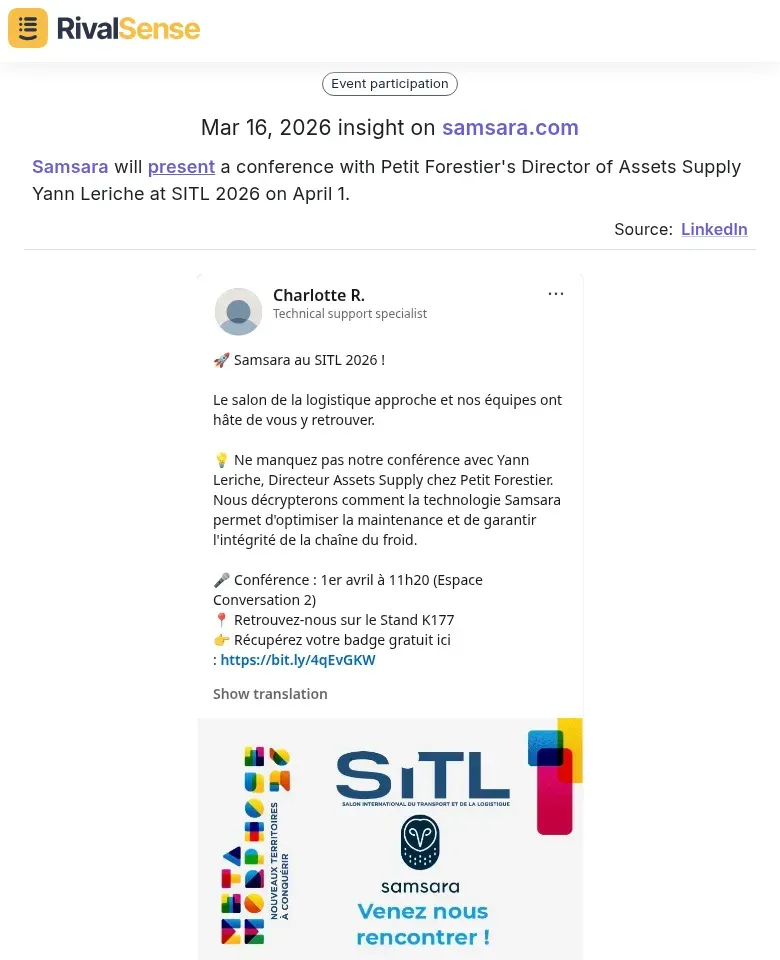
Monitoring competitor events reveals strategic partnerships and market focus areas. For example, Samsara will present a conference with Petit Forestier's Director of Assets Supply Yann Leriche at SITL 2026 on April 1. This insight is valuable as it highlights industry collaborations and thought leadership that could influence supply chain trends or reveal new logistics strategies you might adopt.
Feature Launch Insights
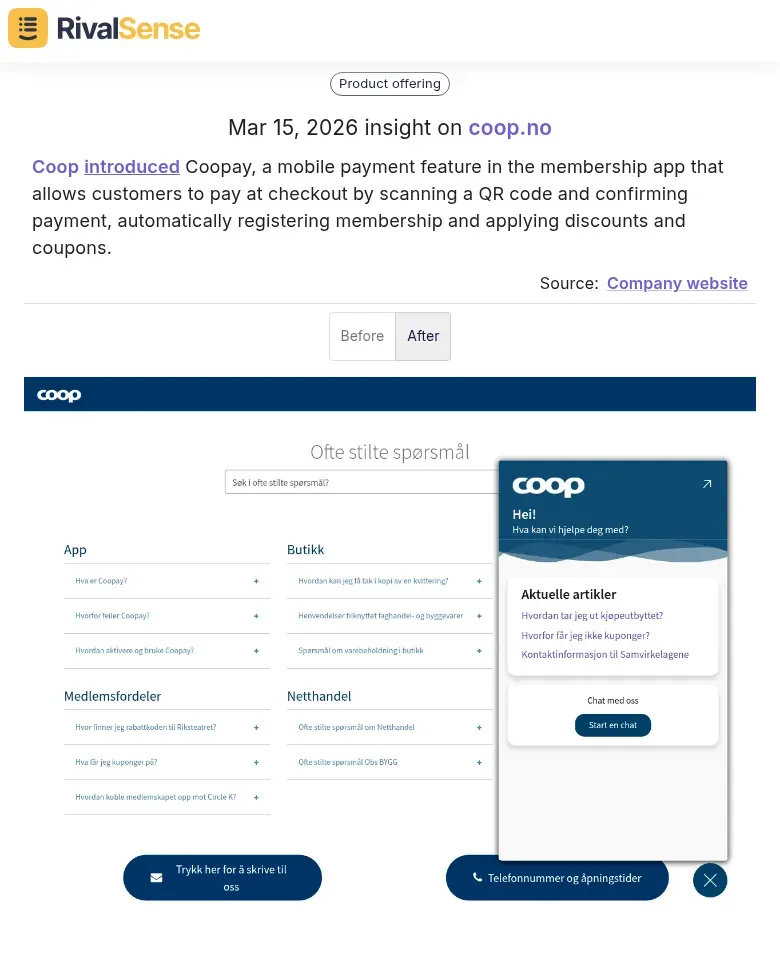
Keeping an eye on new features can inform your own product development and inventory planning. For instance, Coop introduced Coopay, a mobile payment feature in the membership app that allows customers to pay at checkout by scanning a QR code and confirming payment, automatically registering membership and applying discounts and coupons. This insight is valuable because it shows innovation in customer experience that may shift sales channels or require adjustments in your payment processing supply chain.
Technology Stack for Competitive Supply Chain Intelligence
To build a robust competitive supply chain intelligence system, you need a technology stack that integrates monitoring, analysis, and automation. Start with specialized platforms that provide real-time insights and scale with AI-driven tools for deeper pattern recognition. This approach ensures you can respond swiftly to competitor movements.
Begin with monitoring platforms like Crayon and Klue that track competitor pricing, inventory changes, and distribution patterns. These tools offer alerts on key supply chain moves. For advanced insights, implement AI/ML algorithms to analyze historical competitor data, identifying patterns in seasonal demand, supplier relationships, and logistics bottlenecks. A practical tip: Train models on competitor shipping data to predict their inventory replenishment cycles and adjust your own accordingly.
Integration Checklist:
- ✅ Map competitor data points to your supply chain KPIs for relevance.
- ✅ Establish automated data pipelines between intelligence tools and your ERP/WMS systems.
- ✅ Set up alert triggers for significant competitor changes, such as price drops or stockouts.
- ✅ Create visualization layers for comparative analysis in dashboards like Tableau or Power BI.
Consider middleware solutions like Zapier or custom API connectors for seamless data flow. This integrated setup enables proactive optimization based on competitive movements rather than reactive responses.
Implementation Roadmap and Best Practices
Implementing a competitor sales tracking system requires a structured approach to ensure success and measurable ROI. Follow this step-by-step roadmap to integrate insights into your supply chain effectively.
Step-by-Step Implementation Approach:
- Data Integration Phase: Start by integrating competitor sales data from tools like RivalSense with your supply chain management systems. Focus on tracking inventory levels, pricing changes, and promotional activities.
- Analytics Layer: Build predictive models that correlate competitor sales patterns with your supply chain metrics. For example, when competitors run promotions, anticipate increased demand for similar products.
- Automated Response System: Implement automated triggers that adjust your inventory levels, production schedules, and logistics based on competitor movements.
Key Performance Indicators (KPIs) to Track:
- Competitive Inventory Ratio: Compare your inventory turnover against competitors' sales velocity.
- Market Share Velocity: Track how quickly you're gaining or losing market share relative to supply chain adjustments.
- ROI Metrics: Calculate cost savings from optimized inventory levels and reduced stockouts versus implementation costs.
- Perfect Order Rate Improvement: Measure how competitor insights improve your on-time, in-full delivery performance.
Continuous Improvement Processes:
- Monthly Competitive Intelligence Reviews: Analyze competitor supply chain changes and adjust your strategies.
- Quarterly Benchmarking: Compare your supply chain KPIs against industry leaders and direct competitors.
- Automated Alert System: Set up notifications for competitor pricing changes, new product launches, or inventory shifts.
- Cross-Functional War Rooms: Bring together sales, marketing, and supply chain teams to respond to competitive threats collaboratively.
Pro Tips for Success:
- 🎯 Start with 2-3 key competitors rather than tracking everyone to avoid overload.
- 🎯 Focus on competitor sales data from your top 20% revenue-generating products first for maximum impact.
- 🎯 Use A/B testing to validate supply chain adjustments based on competitor insights.
- 🎯 Build a feedback loop where supply chain improvements inform competitive positioning.
Final Checklist:
✓ Integrate competitor sales data with inventory management systems.
✓ Establish baseline KPIs before implementation to measure progress.
✓ Create automated response protocols for common competitor scenarios.
✓ Schedule regular competitive intelligence reviews.
✓ Measure ROI quarterly and adjust strategies accordingly.
Conclusion: Elevate Your Supply Chain with Competitor Insights
Integrating competitor sales tracking into your supply chain optimization is no longer optional—it's essential for staying competitive in dynamic markets. By leveraging advanced methods, specific insights, and a robust technology stack, you can transform data into actionable strategies that reduce costs, improve efficiency, and capture market opportunities. Remember, the goal is to move from reactive adjustments to proactive planning based on real-time intelligence.
Ready to put these tactics into practice? Try RivalSense for free at https://rivalsense.co/ to start tracking competitor product launches, pricing updates, event participations, and more—all delivered in a weekly email report. Get your first competitor report today and gain the insights needed to optimize your supply chain with precision!
📚 Read more
👉 How LinkedIn's Product Shift Revealed a $2B Market Gap for Competitors
👉 Data-Driven Competitor Intelligence: Key Account Success Strategies
👉 AI-Driven Productivity for Digital Identity Companies: A Guide for Business Leaders
👉 Avoid These 5 Competitor Product Offering Mistakes That Drive Customer Churn
👉 Bright Data Shifts from Crawling to Live Discovery: A Competitor Analysis Case Study