
Advanced Semiconductor Competitor Pricing Intelligence Tactics for Strategic Edge
In today's semiconductor landscape, pricing has emerged as the primary competitive battlefield, with the industry projected to reach $697 billion in 2025 sales. As generative AI chips drive 20% of total revenues and command premium pricing, companies face unprecedented pressure to optimize pricing strategies. Pricing intelligence directly determines market share capture in high-growth segments like AI accelerators (projected at $150 billion in 2025) and influences profitability margins that fund critical R&D investments (now consuming 52% of EBIT).
Practical steps for immediate implementation:
- 📈 Monitor competitor pricing across AI chip categories (data center vs. edge devices)
- 🌍 Track regional pricing variations influenced by geopolitical factors and tariffs
- ⚖️ Analyze pricing-to-performance ratios for different semiconductor architectures
- 🔔 Establish real-time alerts for competitor price changes in key product segments
Strategic pricing decisions directly impact business resilience by enabling companies to navigate cyclical downturns, maintain wafer capacity utilization, and secure supply chain stability. Companies that master pricing intelligence can better withstand market volatility while capturing premium positions in high-value segments.
Multi-Dimensional Competitor Monitoring: Beyond Price Tags
Beyond monitoring price tags, advanced semiconductor companies employ multi-dimensional competitor monitoring to anticipate strategic shifts. This involves tracking a wide range of signals that can indicate upcoming changes in competitor behavior. For example, when a competitor hires a new VP of Pricing Strategy or restructures their sales organization, it often signals upcoming pricing model changes.
To illustrate, consider an insight like Thu Trang Nguyen joining Broadcom as EMEA Executive Communications in France. 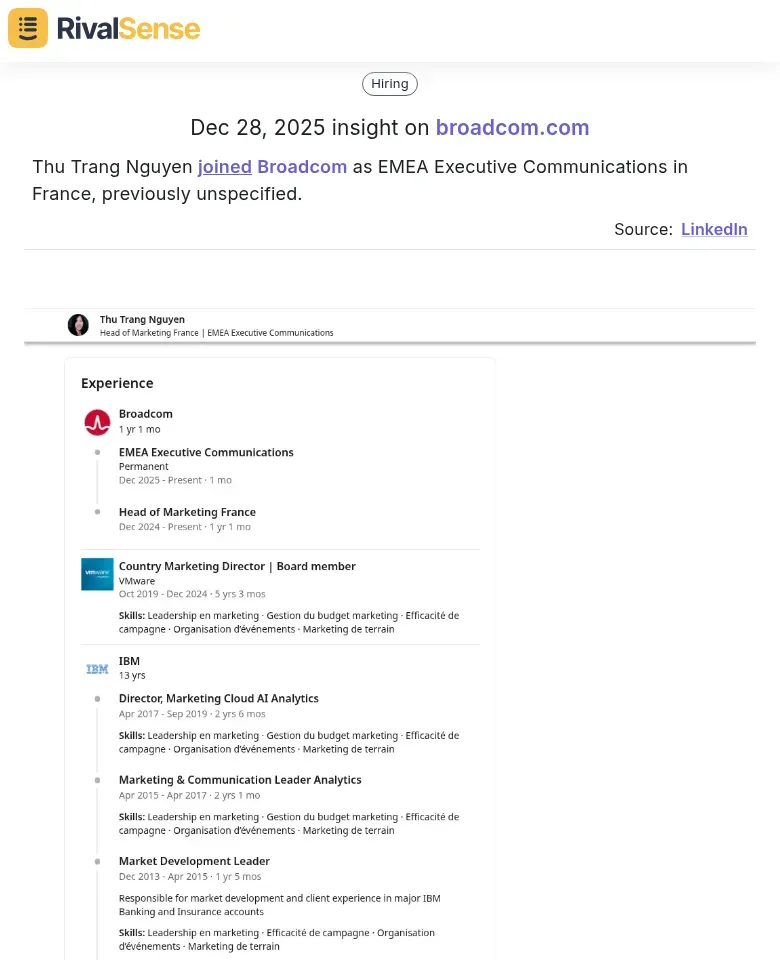
This type of executive movement insight is valuable because it can signal a competitor's increased focus on specific regions or functions, allowing you to anticipate and prepare for potential pricing or market strategy adjustments in that area.
Monitor security vulnerabilities and technical issues through CVE databases and industry forums; a competitor's product vulnerability can create pricing leverage opportunities as customers seek more secure alternatives. Analyze regional market expansions and talent acquisitions as pricing indicators. When a competitor establishes R&D centers in low-cost regions or acquires specialized talent, it may signal cost structure improvements that enable aggressive pricing.
Practical steps:
- 🔍 Set up alerts for competitor executive changes on LinkedIn and industry news
- 🛡️ Subscribe to semiconductor security bulletins and technical forums
- 📋 Track patent filings and talent movements in key regions
- 🏢 Monitor competitor facility expansions through local business registries
- 💼 Analyze job postings for pricing strategy roles at competitor companies
These signals provide 3-6 month lead time on pricing strategy shifts, enabling proactive response rather than reactive price matching.
Advanced Data Collection and Analysis Frameworks
To gain a strategic edge in semiconductor pricing, implement automated systems that track competitor prices across global markets in real-time. Effective data collection is the foundation of actionable pricing intelligence. Use web scraping tools and API integrations to monitor key distributors, OEMs, and direct sales channels, ensuring data accuracy with validation protocols.
For example, track pricing fluctuations for high-demand chips like GPUs or memory modules across regions such as Asia, Europe, and North America to spot trends. Leverage AI and machine learning to analyze this data, identifying patterns like seasonal discounts, competitive responses to supply chain disruptions, or pricing wars.
Practical steps:
- ⚙️ Set up automated tracking with tools like RivalSense for real-time alerts
- 🤖 Use ML algorithms to cluster pricing data and detect anomalies
- 🔗 Cross-reference pricing with technical reports and market intelligence
- 📊 Create a dashboard to visualize insights for quick decision-making
This holistic approach enables proactive pricing adjustments and competitive advantage.
Strategic Response Formulation and Implementation
Transform competitor intelligence into actionable pricing strategies with these advanced tactics. The key is to move from insight to execution swiftly and effectively.
1. Dynamic Pricing Models
Implement AI-driven pricing algorithms that respond in real-time to competitor vulnerabilities. When a rival faces supply chain disruptions or quality issues, immediately adjust your pricing to capture market share. For example, if a competitor experiences yield problems with their 7nm chips, temporarily increase prices for your stable 7nm offerings while offering aggressive pricing on next-gen products.
2. Organizational Change Targeting
Monitor competitor leadership changes, R&D team expansions, or manufacturing facility investments. When a competitor announces new executive hires, it can indicate strategic shifts. For instance, Kevin Prifogle joining Broadcom as Enterprise Account Director in the United States. 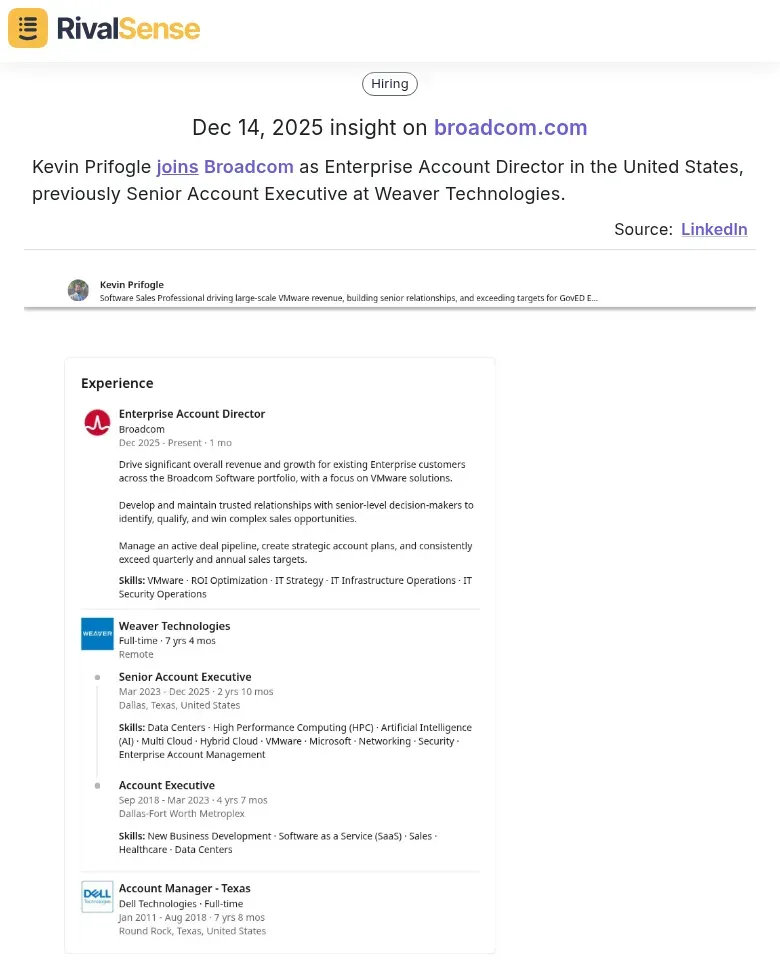
This type of insight is valuable because hiring senior sales executives often precedes aggressive market campaigns or pricing tactics, allowing you to prepare targeted counter-strategies.
Checklist for Organizational Change Response:
- 📈 Track competitor job postings, executive announcements, and facility expansions
- 🗺️ Correlate with regional pricing adjustments
- ⏱️ Implement 30-60-90 day response plans
3. Regional Market Expansion Countermeasures
Deploy geo-specific pricing when competitors enter new markets. If a competitor expands into Southeast Asia, implement aggressive introductory pricing in that region while maintaining premium pricing in your established markets.
Practical steps:
- 🗺️ Map competitor expansion timelines
- 💰 Establish regional pricing tiers
- 🛡️ Create contingency budgets for market defense
- 🤝 Use local distribution partnerships for rapid implementation
Key Implementation Tips:
- 🔔 Automate competitor tracking with tools like RivalSense for real-time alerts
- 👥 Establish cross-functional response teams (sales, marketing, finance)
- 📚 Create pricing playbooks for common competitor scenarios
- 🎯 Conduct quarterly war-gaming exercises to test response strategies
- 📈 Measure ROI on pricing adjustments within 90-day cycles
Remember: The most effective pricing strategies combine real-time competitor intelligence with agile execution frameworks that allow for rapid market response while maintaining profitability.
Risk Assessment and Mitigation Through Pricing Intelligence
Semiconductor pricing intelligence extends beyond monitoring price changes to identifying risks from competitor vulnerabilities. Proactively assessing these risks allows you to mitigate threats and seize opportunities. When a rival's technical issues emerge—like yield problems or supply chain disruptions—assess how their production costs might shift.
For example, consider a high-risk warning like the one from the Saudi National Cybersecurity Advisory Center about vulnerabilities in Broadcom products. 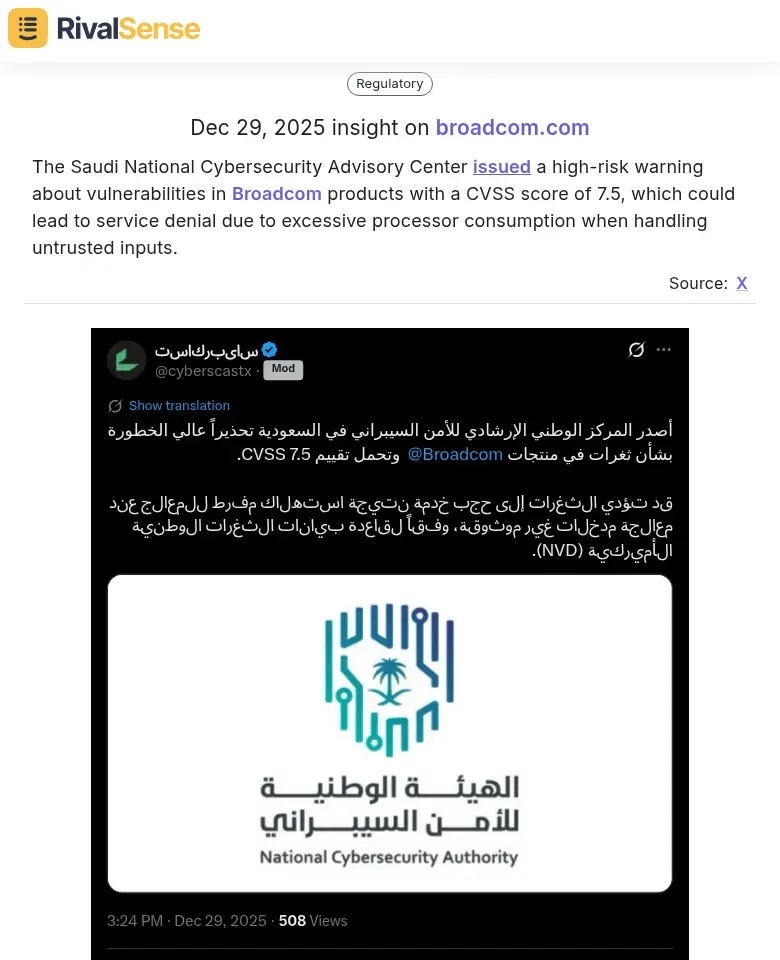
This type of insight is valuable because security vulnerabilities can lead to increased costs, reputational damage, and customer churn for competitors, creating openings for you to offer more secure alternatives at competitive prices.
If a competitor faces higher costs due to such issues, they may raise prices, creating market gaps you can exploit with strategic pricing. Conversely, if they resolve issues and lower costs, they could undercut you, threatening your market share. Use tools like RivalSense to track such vulnerabilities and model pricing impacts.
Executive appointments signal strategic shifts. A new CTO focusing on R&D might lead to innovative, cost-reduced products in 12-18 months, while a sales hire could indicate aggressive pricing tactics. Monitor these moves to anticipate pricing wars or premium positioning.
Develop contingency plans:
- ⚠️ If a competitor slashes prices due to overcapacity, have a tiered pricing response ready
- 🚀 If they launch a premium product, adjust your value proposition
- 🔄 Regularly update these plans based on real-time intelligence to stay agile in volatile markets
Building a Sustainable Competitive Advantage
Transform pricing intelligence from a reactive function to a proactive core competency. Sustainable advantage comes from embedding these practices into your organizational DNA. Establish dedicated monitoring teams using automated tools like RivalSense to track competitor pricing moves, promotional campaigns, and market positioning in real-time.
Implement weekly intelligence briefings where pricing data directly informs strategic decisions. Create structured feedback loops between pricing intelligence and product development teams. When you detect competitors lowering prices for specific chip categories, immediately analyze whether this signals technological commoditization or market saturation.
Practical Checklist for Institutionalizing Pricing Intelligence:
- 👥 Assign dedicated pricing intelligence roles with clear KPIs
- ⚙️ Implement automated monitoring tools with real-time alerts
- 📅 Create monthly cross-functional review sessions
- 📚 Develop pricing playbooks for common competitive scenarios
- ⚡ Establish rapid-response protocols for price adjustments
- 🛠️ Integrate pricing data into product roadmap planning
- 🎓 Train teams on interpreting competitive pricing signals
- 📊 Measure pricing strategy effectiveness quarterly
Use these insights to guide R&D priorities—accelerating innovation in high-margin segments while deprioritizing commoditized areas. Develop organizational agility through cross-functional pricing committees that meet bi-weekly. Empower these teams with authority to implement rapid pricing adjustments within predefined parameters.
When pricing insights flow seamlessly into strategic decisions, you create a self-reinforcing cycle of market responsiveness and innovation leadership.
Put Your Pricing Intelligence into Action
Mastering semiconductor pricing requires continuous, comprehensive competitor monitoring. From tracking executive hires and security vulnerabilities to analyzing regional expansions, every insight can inform your strategy.
To streamline this process, consider using automated tools like RivalSense. It tracks competitor product launches, pricing updates, event participations, partnerships, regulatory aspects, management changes, and media mentions across company websites, social media, and various registries, delivering all in a weekly email report.
Try RivalSense for free today and get your first competitor report to start gaining a strategic edge in the semiconductor market. Visit https://rivalsense.co/ to get started.
📚 Read more
👉 5 Quick Hacks to Track Competitor Media Mentions for Smarter SWOT Analysis
👉 Actionable Competitor Analysis: Learning from Iute Moldova's Credit Limit Increase
👉 The Strategic Benefits of a Competitor Matrix: Your 2026 Guide to Market Dominance
👉 Strategic Account Tracking Tools: IT Consulting's Competitive Edge Analysis
👉 How Hubstaff's SCIM Move Prompted Competitors to Accelerate Enterprise Security