
Advanced Financial Analysis for Video Editing Software Competitors: Turning Insights into Strategy
In the fiercely competitive video editing software market, financial analysis isn't just about balance sheets—it's your strategic lens into competitor investment patterns. By examining where rivals allocate capital, you can decode their priorities: Are they pouring resources into AI-powered features like automated editing or real-time collaboration? Are they investing in mobile-first development or enterprise-grade solutions?
These financial moves directly translate to market positioning. A competitor's R&D spending on AI tools signals a push toward professional creators, while marketing budget shifts toward social media platforms reveal user acquisition strategies targeting content creators. When you track product launch timing alongside financial reports, you can anticipate feature roadmaps and geographic expansion plans.
Practical Framework:
- 📊 Monitor quarterly earnings calls for R&D allocation trends
- 👥 Analyze hiring patterns for AI/ML engineering roles
- 💰 Track pricing strategy changes against feature releases
- 🗺️ Map geographic revenue growth to localization investments
- 🔗 Connect capital expenditure to infrastructure expansion
This financial intelligence reveals not just what competitors are doing, but why—giving you the foresight to anticipate market shifts and position your product strategically.
🤖 Analyzing Competitor AI Investment Patterns and Feature Rollout Strategies
Understanding competitor AI investment patterns requires systematic tracking of feature releases. Start by creating a timeline of each competitor's AI feature launches over the past 12-24 months. Look for patterns: Are they releasing AI tools in quarterly cycles or responding to market events? For example, if a competitor consistently launches AI-powered editing features before major industry conferences, they're likely prioritizing market visibility over staggered development.
Financial analysis reveals strategic differences between bundled and staggered releases. Bundled AI suites (like multiple AI tools in one update) often signal heavy R&D investment aimed at premium market capture, but may increase customer acquisition costs if priced aggressively. Staggered releases suggest iterative testing and potentially lower upfront investment. Track pricing changes post-launch: Do competitors increase prices after bundled AI releases or maintain them to drive adoption?
Example from RivalSense: CapCut launched Dreamina Seedance 2.0, Veo 3.0, Nano Banana Pro, and Kling 3.0 as new AI features in its video generator.

This insight is valuable because it shows a competitor's commitment to AI innovation through bundled releases. By tracking such launches, you can gauge their R&D focus and pace, helping you benchmark your own AI investments and anticipate market trends.
Assess AI diversification's impact on customer metrics. Competitors offering specialized AI tools (color grading, audio cleanup, etc.) typically see higher lifetime value from professional users but face increased support costs. Monitor their marketing spend around feature launches: Rising ad budgets with stable conversion rates indicate successful AI differentiation.
Checklist for AI Analysis:
- 📅 Document all AI feature releases with dates
- 💵 Note pricing changes within 30 days post-launch
- 📢 Track competitor blog/social media mentions of AI capabilities
- 🔄 Calculate estimated R&D cycles based on release frequency
- 😊 Compare customer review sentiment before/after AI releases
🌍 Geographic Expansion Analysis: Financial Metrics for Market Entry Decisions
Geographic expansion analysis reveals how video editing software competitors prioritize markets and allocate resources strategically. When analyzing targeted regional launches, track these financial metrics: Customer Acquisition Cost (CAC) by region, Localization ROI (return on localization investment), and Market Penetration Velocity (how quickly they reach 5% market share).
Understanding the financial logic behind expansion models is crucial for predicting competitor moves and planning your own international strategy. For instance, simultaneous multi-country launches often indicate strong capital backing, while phased entries suggest a more cautious, capital-efficient approach.
Example from RivalSense: CapCut launched Dreamina Seedance 2.0 in Indonesia, Philippines, Thailand, Vietnam, Malaysia, Brazil, and Mexico, offering AI video generation and editing with up to 15-second multi-shot storytelling.
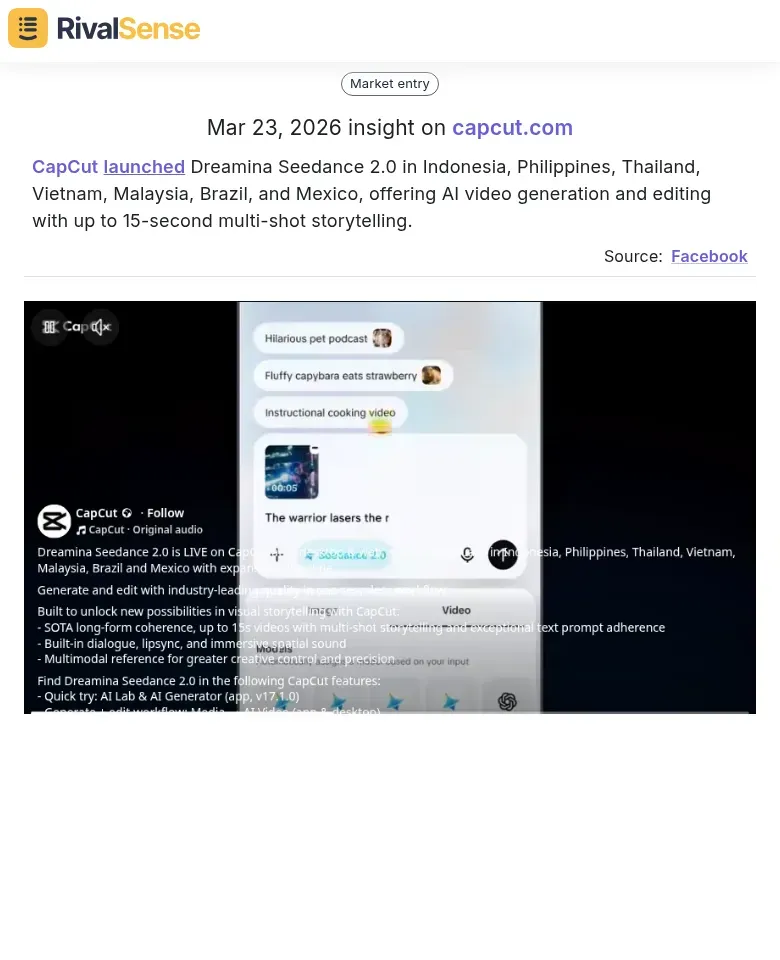
This insight is valuable as it highlights a competitor's strategic geographic targeting. By monitoring such expansions, you can identify key growth markets and assess the financial rationale behind their entry timing and localization efforts.
Practical Checklist for Analyzing Competitor Geographic Expansion:
- 🗺️ Map their launch sequence over 3-5 years to identify patterns
- 📈 Calculate their Geographic Expansion Rate (GER) = (New regions entered) / (Available regions) × 100%
- ⚖️ Compare multi-country simultaneous launches vs. phased entry by analyzing their burn rate and capital efficiency
- 💸 Assess revenue diversification by tracking international revenue percentage growth
Financial Logic Behind Expansion Models:
- Simultaneous launches indicate strong capital backing and confidence in product-market fit, but watch for dilution of marketing spend
- Phased entry suggests capital efficiency and risk mitigation, often targeting similar regulatory environments first
- Regional clustering (e.g., DACH region first) reveals understanding of cultural and payment system similarities
Growth Model Indicators:
- Land-and-expand models show gradual revenue increases in each region over 12-18 months
- Blitzscaling patterns feature rapid market entry followed by aggressive local hiring
- Partnership-first approaches prioritize local resellers before direct sales teams
Tip: Monitor their localization completeness score - competitors who translate only UI vs. full cultural adaptation reveal different investment levels. Track their pricing localization (regional price adjustments) to understand market prioritization logic.
🎄 Seasonal and Thematic Feature Launches: Financial Timing and Market Positioning
Seasonal feature launches represent a sophisticated financial strategy where video editing software companies cluster thematic tools around holidays, events, or cultural moments. This approach creates predictable revenue spikes while optimizing marketing spend. For example, launching wedding-themed templates in spring or horror effects bundles before Halloween targets specific customer segments with precision timing.
Analyzing the financial impact of these launches helps you understand how competitors leverage timing for maximum ROI. By tracking seasonal patterns, you can anticipate market demand and align your own product releases accordingly.
Example from RivalSense: CapCut introduced new AI tools including a Santa video maker, character voice generator, packaging design tool, Christmas photo generator, commercial generator, fashion model generator, and cartoon generator, with articles published between March 3-6, 2026.
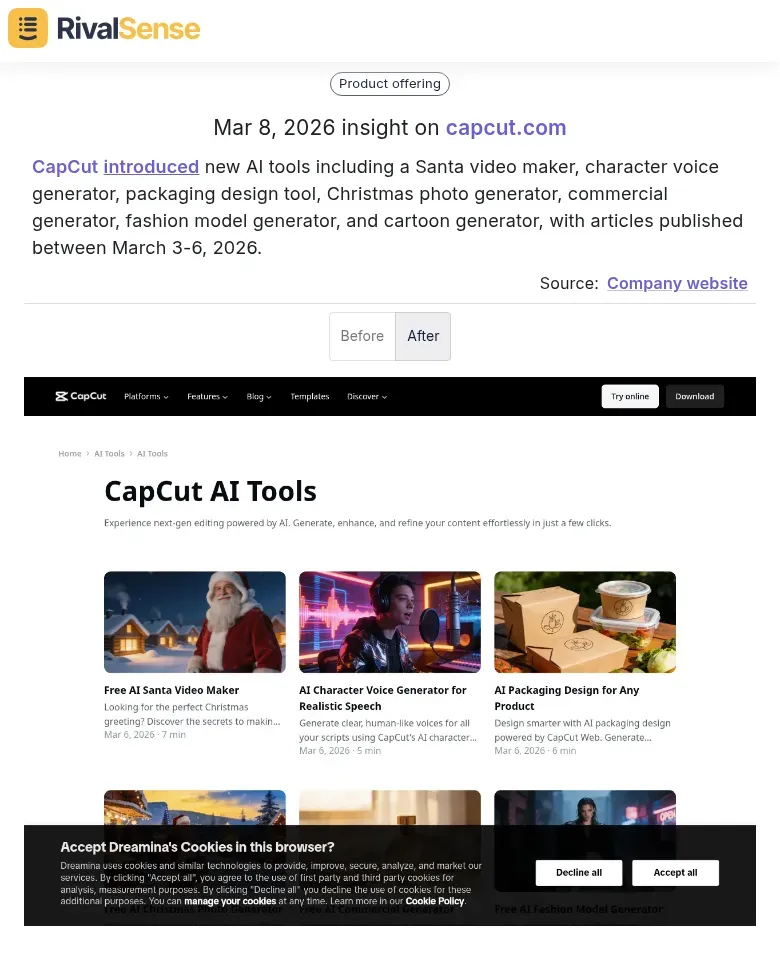
This insight is valuable because it demonstrates how competitors use seasonal themes to drive engagement and sales. Understanding such launches can inform your own seasonal planning and help you identify opportunities for thematic feature bundles.
Financial analysis should track how these clusters impact key metrics: Do seasonal features drive higher user engagement (measured by daily active users) compared to standalone releases? What's the customer acquisition cost reduction when marketing aligns with natural demand cycles? Analyze whether themed bundles justify premium pricing or if they should serve as entry points to higher-tier subscriptions.
Practical steps for competitor analysis:
- 📅 Map competitors' feature release calendars against seasonal events
- 💰 Track pricing changes before/during/after thematic launches
- 😊 Monitor user review sentiment for seasonal vs. evergreen features
- 📊 Calculate customer lifetime value differences between seasonal adopters and regular users
Assess the ROI trade-off: Concentrated seasonal releases create market buzz but risk feature fatigue, while spaced innovation maintains steady engagement but may miss timing windows. The optimal strategy often involves 2-3 major seasonal clusters annually supplemented by quarterly core feature updates. Successful companies use seasonal launches to test new pricing tiers and identify upsell opportunities within existing customer segments.
💡 Competitive Financial Intelligence: Turning Product Insights into Strategic Advantage
Competitive financial intelligence transforms product observations into actionable financial insights. For video editing software competitors, this means developing predictive models that connect product launch behaviors to investment patterns. By systematically analyzing competitor moves, you can forecast their next steps and adjust your strategy proactively.
For example, when a competitor releases a major AI feature update, analyze their R&D spending trends from public filings to forecast their next investment cycle. This approach helps you stay ahead of market shifts and allocate resources effectively.
Create frameworks to quantify financial impact: Track how competitor pricing changes affect your market share and pricing power. If a rival introduces a freemium model, calculate the potential revenue loss and customer acquisition cost impact using historical data from similar market shifts.
Establish metrics to measure innovation effectiveness: Compare R&D-to-revenue ratios across competitors to identify which innovation strategies deliver the best financial returns. Monitor customer lifetime value changes after competitors launch new features.
Practical steps:
- 📊 Build a competitor financial dashboard tracking key metrics quarterly
- 📈 Correlate product release dates with stock performance and funding rounds
- ⚖️ Calculate the financial breakeven point for competitor's new feature adoption
- 🎯 Use scenario analysis to model different competitor pricing strategies
- 📊 Benchmark your innovation ROI against top competitors annually
Tip: Focus on SaaS metrics like ARPU, churn rates, and customer acquisition costs specific to video editing software to make your financial analysis more actionable.
🏆 Conclusion: Building a Financially-Informed Competitive Strategy
Transform competitor financial analysis into a strategic advantage with these actionable steps. By consistently monitoring and interpreting financial signals, you can make informed decisions that enhance your market position and drive growth.
Implementing a structured approach ensures that you're not just reacting to competitors but proactively shaping your strategy based on financial insights.
Actionable Market Positioning:
- 🗺️ Map competitor pricing tiers against their R&D investment patterns to identify underserved market segments
- 💰 Analyze subscription vs. perpetual license revenue trends to determine optimal monetization strategies
- 📊 Benchmark your gross margins against competitors with similar geographic footprints
Financial Early Warning System:
- 🔍 Monitor competitor job postings for new product development roles as leading indicators of innovation cycles
- 🌍 Track geographic expansion patterns through hiring trends and localized pricing experiments
- ⚠️ Set automated alerts for competitor pricing changes exceeding 15% or new market entries
Adaptive Financial Strategy:
- 📋 Create quarterly competitor innovation scorecards tracking feature releases, AI integration, and platform expansions
- 📈 Develop scenario-based financial models that simulate competitor responses to your strategic moves
- 🔄 Establish a 90-day review cycle for adjusting pricing, packaging, and investment priorities based on competitor financial health indicators
Practical Checklist:
- [ ] 📅 Monthly review of competitor pricing pages and feature announcements
- [ ] 💸 Quarterly analysis of competitor funding rounds and executive team changes
- [ ] 🗺️ Bi-annual competitive landscape mapping with financial performance overlays
- [ ] ⏱️ Real-time monitoring of competitor customer reviews and support response patterns
By systematically converting financial intelligence into strategic actions, you'll build resilient market positioning that anticipates rather than reacts to competitive moves.
🔍 Leverage RivalSense for Enhanced Competitive Insights
To effectively implement the tactics discussed, consider using a tool like RivalSense. It tracks competitor product launches, pricing updates, event participations, partnerships, regulatory aspects, management changes, and media mentions across company websites, social media, and various registries, delivering all in a weekly email report.
For example, the insights from CapCut shown earlier were identified through RivalSense, helping businesses stay updated on competitor moves in real-time. By automating competitor tracking, you can focus on analysis and strategy rather than data collection.
Try out RivalSense for free today at https://rivalsense.co/ and get your first competitor report to start gaining a strategic edge.
📚 Read more
👉 Competitor Product Analysis Workflow: From Tracking to Strategic Insights
👉 Decoding Competitor Moves: What Vanta's New Storytelling Hire Reveals
👉 The Ultimate Key Account Tracking Workflow: A Practical Guide for 2026
👉 Data-Driven Aviation Fuel Competitor App Review Tracking Strategies
👉 How Real-Time Competitor Intelligence Helped Capture Market Share from Foresters Financial