
Actionable Strategies: Analyze Competitor Laundry Equipment Features to Win
In the $10.77 billion commercial laundry equipment market, competitor analysis isn't just research—it's your strategic advantage. Understanding what your competitors offer can directly impact your business decisions and market position. Equipment features directly impact market share and profitability: modern laundromats with premium equipment generate 15-30% higher revenue per square foot. Speed Queen's 35% market share dominance stems from features like stainless steel tubs and 350 G-force extraction, while Electrolux Professional captures 22% share with smart dose chemical dispensing and 30% energy savings.
Practical Checklist for Data-Driven Decisions: 📋
- Map competitor equipment portfolios (capacity, efficiency ratings, smart features)
- Analyze ROI timelines: High-efficiency washers pay back in 3.5-4 years with $1,200-$2,400 annual savings
- Compare maintenance costs: Premium brands average $1,000-$1,500 annually vs. budget options
- Track technology adoption: 78% of consumers prefer digital payment systems
Systematic feature comparison reveals competitive gaps: While most competitors offer basic IoT connectivity, only 15% integrate predictive maintenance alerts that reduce downtime by 35%. This gap represents a $3,600-$7,200 annual opportunity per location through payment system upgrades alone. By analyzing competitor equipment specifications, you can identify underserved customer segments and position your offerings to capture premium pricing—equipment-enabled services like wash-dry-fold generate $2,500-$8,000 monthly revenue potential.
Framework for Systematic Competitor Equipment Feature Analysis
A systematic framework transforms scattered competitor data into strategic insights. Without a structured approach, competitor data can be overwhelming and ineffective. Start by developing a structured approach: categorize features into core (essential functions), performance (efficiency metrics), and innovation (differentiators). For laundry equipment, this might include wash cycles (core), energy consumption (performance), and smart connectivity (innovation).
Create feature comparison matrices for side-by-side evaluation. Use a spreadsheet with competitors as columns and features as rows, noting specifications, availability, and pricing. Include both quantitative data (e.g., capacity in kg) and qualitative aspects (e.g., user interface design).
Establish metrics to quantify advantages. Calculate feature scores based on customer value—assign weights (e.g., 1-5) for importance and ratings (e.g., 1-10) for performance. For example, if energy efficiency is highly valued, a competitor's low kWh rating earns a high score. This reveals gaps where you can enhance your offerings or highlight superior features in marketing. 💡 Pro Tip: Regularly update matrices and involve cross-functional teams (sales, R&D) to ensure alignment with market needs.
Key Equipment Feature Categories to Analyze and Compare
To systematically analyze competitor laundry equipment, focus on these three critical feature categories. Breaking down features into categories makes comparison manageable and insightful.
Technical Specifications: Compare capacity (pound loads), efficiency ratings (Energy Star, IMEF), and extraction rates (G-force measurements). Higher G-force (300+) means less dryer time. Create a comparison spreadsheet tracking these metrics across competitors.
Technology Integration: Evaluate IoT connectivity for remote monitoring, smart features like app-controlled cycles, payment systems (card/app integration), and automation capabilities. Check if competitors offer predictive maintenance alerts or usage analytics dashboards.
Operational Features: Analyze maintenance requirements (service intervals, part accessibility), reliability indicators (MTBF - Mean Time Between Failures), and energy consumption patterns (kWh per cycle). Review warranty terms and energy usage data sheets.
Practical Checklist: ✅
- Document competitor specs in a standardized template
- Test payment systems as a customer would
- Calculate total cost of ownership including energy consumption
- Interview maintenance technicians about common failures
- Monitor competitor equipment uptime through customer reviews
Pro Tip: Look beyond published specs - analyze real-world performance data from industry forums and maintenance records to identify actual reliability patterns versus marketing claims.
Turning Analysis into Actionable Competitive Strategies
Once you've analyzed competitor laundry equipment features, transform insights into concrete competitive advantages. This step is where data becomes action, driving real business outcomes. Start by creating a feature gap analysis matrix comparing your offerings against key competitors. Identify where competitors lack features that your target customers value most—these are your opportunities for targeted upgrades.
Actionable Steps: 🚀
- Feature Gap Prioritization: Rank gaps by customer impact vs. implementation cost. Focus on high-impact, feasible improvements first.
- Differentiated Value Propositions: Turn competitor weaknesses into strengths. If competitors have poor energy efficiency, position your equipment as "cost-saving green solutions."
- Strategic Pricing: Use feature analysis to justify premium pricing for superior offerings or create competitive bundles for price-sensitive segments.
- Service Enhancement: Identify where competitors offer minimal support—develop proactive maintenance programs or extended warranties.
Pro Tip: Create a "competitive response roadmap" that maps each competitor weakness to a specific action item with timelines and owners. This ensures analysis translates directly into strategic execution and measurable market gains.
Implementation: Building Your Competitive Advantage Through Equipment Selection
Now that you've analyzed competitor laundry equipment features, it's time to build your competitive advantage through strategic implementation. Effective implementation ensures that your insights lead to tangible improvements in your operations. Start by developing a phased equipment investment plan that addresses identified gaps. First, prioritize investments that deliver immediate ROI—like energy-efficient washers that reduce utility costs by 30-40%. Next, implement mid-term upgrades such as smart monitoring systems that competitors lack. Finally, plan for long-term innovations like IoT-connected equipment that enables predictive maintenance.
Create a 90-day implementation checklist: 📅
- Secure vendor quotes for priority equipment
- Train staff on new technology
- Update maintenance protocols
- Launch customer education campaigns about your superior features
Establish a monitoring system using tools like RivalSense to track competitor equipment changes in real-time. Set up alerts for when competitors introduce new models or upgrade existing ones. Monitor customer reviews and social media mentions to gauge market response to competitor equipment changes. This continuous feedback loop ensures you stay ahead by adapting your equipment strategy based on market dynamics and competitor moves.
Measuring Success and Continuous Competitive Intelligence
To ensure your equipment-based strategies deliver results, establish clear KPIs. Continuous monitoring allows you to adapt and stay ahead in a dynamic market. Track market share changes, customer acquisition rates from competitor facilities, and revenue growth from new equipment features. Monitor win/loss ratios in competitive bids and customer satisfaction scores for new equipment installations.
Build an ongoing monitoring system with these steps: 🔍
- Set up automated alerts for competitor equipment launches and feature updates
- Create a centralized dashboard tracking competitor pricing, promotions, and service offerings
- Schedule quarterly competitive analysis reviews
- Monitor customer reviews and feedback on competitor equipment
- Track industry trade shows and patent filings for emerging technologies
Adapt strategies based on market dynamics by implementing a feedback loop: 🔄
- Analyze competitor responses to your equipment innovations within 30 days
- Conduct quarterly SWOT analysis of your equipment portfolio vs. competitors
- Adjust pricing and feature roadmaps based on competitor moves
- Test new equipment configurations in pilot locations before full rollout
- Maintain a competitive intelligence calendar with regular update cycles
Pro tip: Assign team members specific competitor monitoring responsibilities and establish a monthly competitive intelligence briefing to share insights across departments.
Leveraging Competitive Intelligence Tools: Real-World Examples
Incorporating competitive intelligence tools like RivalSense can automate and enhance your monitoring efforts. Here are examples of insights that can inform your business strategy:
-
Tracking Legal and Regulatory Updates: Changes in terms of service can reveal strategic shifts. For instance, NAVEX updated its Terms of Use effective date from May 2024 to December 2025 and added a restriction prohibiting the use of Educational Materials to develop or improve technologies like generative AI or commercial products/services.
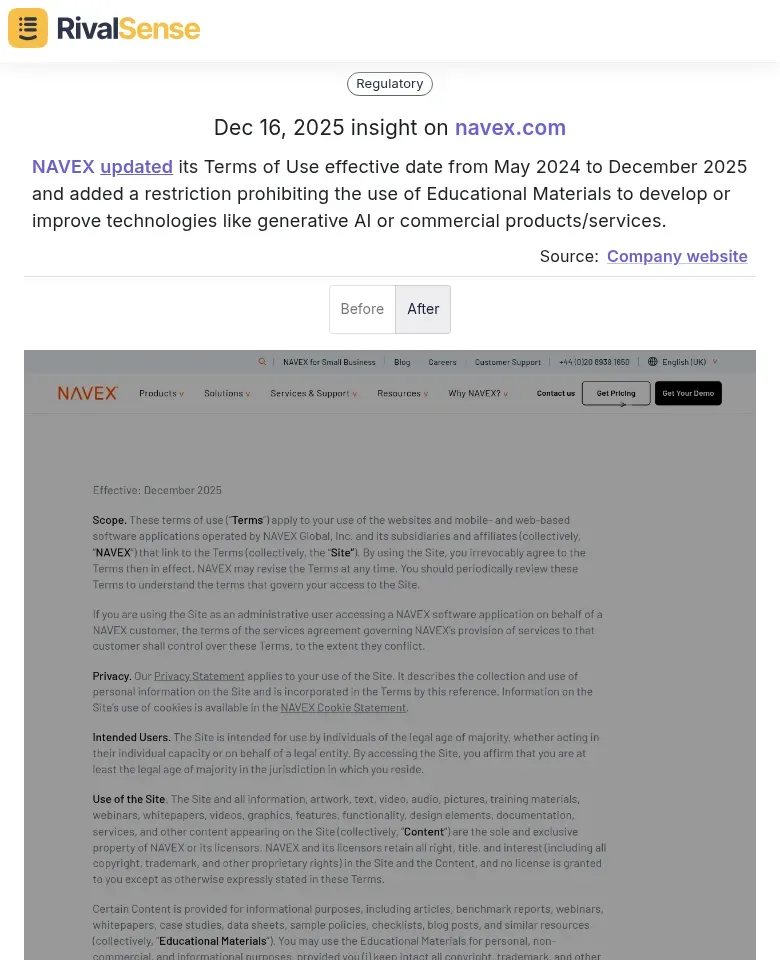 This type of insight is valuable because it helps you anticipate how competitors are protecting their intellectual property and adapting to regulatory environments, which can influence your own compliance and product development strategies.
 -
Monitoring Management Changes: New hires can signal new directions. For example, Chris Henderson joins Chaos as Chief Operating Officer in the United Kingdom, previously Chief Financial Officer at Cenevo (Formerly Labguru & Titian Software).
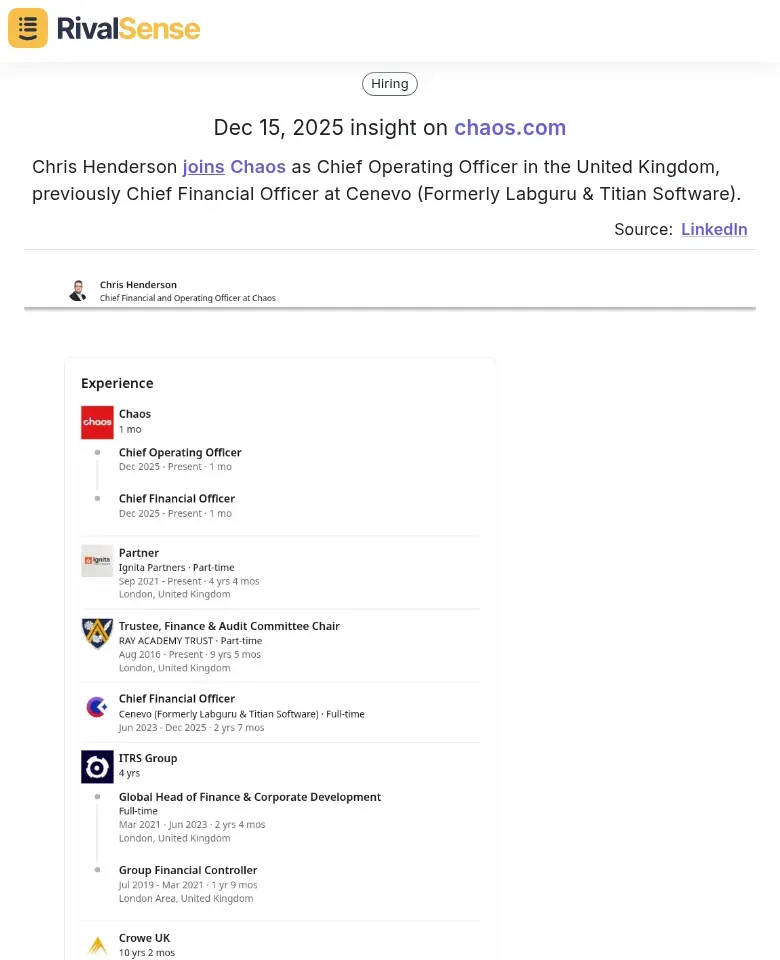 Tracking such changes is crucial as it may indicate expansion into new markets, operational overhauls, or strategic partnerships, allowing you to adjust your competitive positioning accordingly.
 -
Analyzing Personnel Movements: Employee transitions between companies can highlight focus areas. Alexandra Lee, PhD left WeightWatchers as Clinical Research Consultant in the United States to become Associate Director, Clinical Research Lead at Eli Lilly and Company.
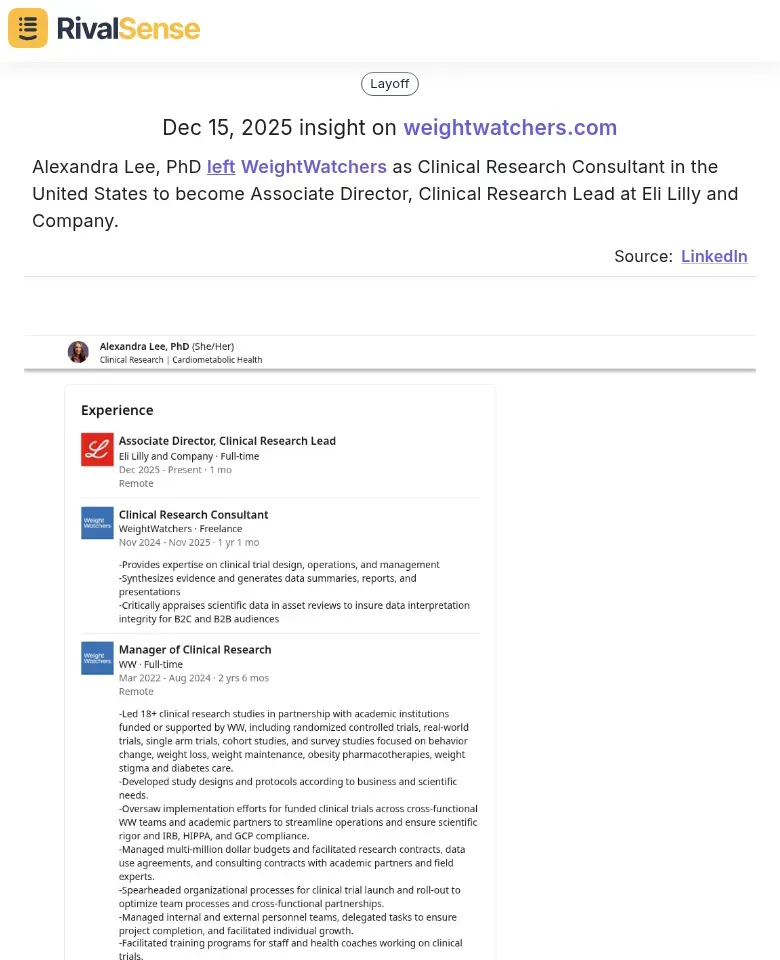 This insight is valuable because it shows where competitors are investing in talent, potentially revealing new research initiatives or market segments they are targeting, helping you anticipate future competitive threats or opportunities.
By using tools like RivalSense, you can receive weekly reports on such competitor activities across websites, social media, and registries, keeping you informed without manual effort.
Take Action with RivalSense
Ready to transform your competitor analysis? Try out RivalSense for free at https://rivalsense.co/ to assist with the challenges described in this post. Get your first competitor report today and start gaining strategic insights that drive your business forward.
📚 Read more
👉 How Roblox's The Block Launch Prompted Rivals' Immersive Strategy Shift
👉 How Top Brands Use Twitter to Analyze Competitor Customer Support
👉 Airbnb vs Hotels: Real-World Content Marketing Advantages Revealed
👉 Competitor Product Benchmarking: Actionable Insights for Key Account Management
👉 Decoding Competitor Pricing Moves: A Real-World Example from EmpMonitor