
Actionable Pricing Strategies: Uncover Competitor Insights with Strategic Account Tracking
Pricing decisions often feel like educated guesses in the dark. Traditional analysis relies on lagging indicators—historical data, quarterly reports, or broad market trends—leaving you reactive to competitor moves. This approach fails because it lacks the granular, real-time insights needed to optimize revenue at the account level. Strategic account tracking transforms pricing from a reactive tactic into a proactive strategy. By monitoring competitor activities—like feature updates, pricing changes, or customer wins—in real-time, you gain a critical edge. For example, if a rival lowers prices for a key account you're targeting, you can adjust your offer immediately rather than losing the deal. This link between account-level insights and revenue optimization is undeniable: precise tracking reveals which competitors are most active in your target accounts, allowing you to tailor pricing and messaging effectively. To implement this, start by identifying your top 10 strategic accounts and tracking competitors' digital footprints—website changes, social media mentions, and job postings. Use tools that alert you to shifts, enabling swift, data-driven decisions. Remember, without granular competitor tracking, pricing remains a blunt instrument; with it, you unlock actionable strategies that drive growth.
Decoding Competitor Pricing Structures: Tier Analysis and Plan Evolution
Decoding competitor pricing structures requires systematic tier analysis and tracking plan evolution over time. Start by mapping competitors' tier structures quarterly—note when they add/remove tiers, adjust price points, or shift features between plans. These restructuring patterns reveal market positioning shifts: adding premium tiers signals targeting enterprise segments, while consolidating plans often indicates simplifying for SMBs. For instance, tracking pricing plan updates can directly inform your own tier strategy and help you spot market gaps.
Consider this real-world insight from RivalSense: Soundtrack updated its pricing plans, introducing new tiers named STARTER, ESSENTIAL, and UNLIMITED with prices starting from 29 GBP, 35 GBP, and 48.5 GBP per month respectively, and removed the PREMIUM plan. 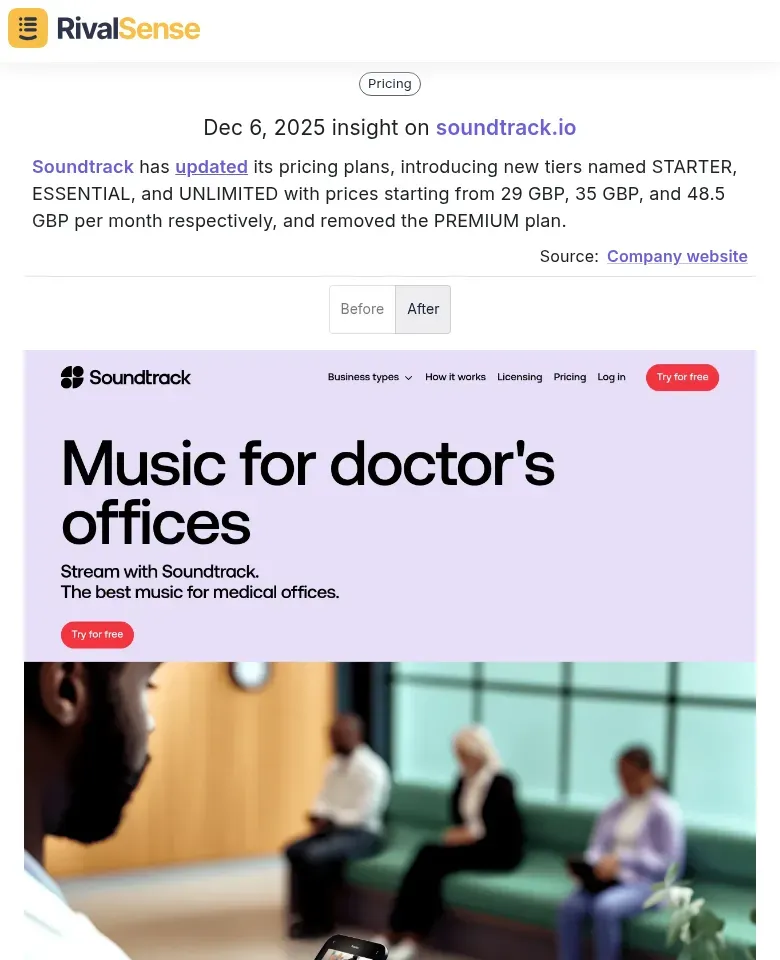
This type of insight is valuable because it shows how competitors reposition their offerings to attract different customer segments. By monitoring such changes, you can anticipate market trends and adjust your pricing tiers proactively to stay competitive.
Analyze price point strategies across customer segments by calculating price-per-feature ratios for each tier. Track how competitors price entry-level vs. premium offerings—are they using loss leaders to capture market share or premium pricing to signal quality? Monitor plan consolidation/expansion trends: when competitors merge mid-tier plans, they're likely optimizing for higher-value customers; when they add specialized tiers, they're addressing niche segments.
Practical checklist:
- Quarterly tier mapping: Document all competitor tiers, prices, and feature allocations
- Price elasticity tracking: Monitor how price changes affect competitor market share
- Feature migration analysis: Note which features move between tiers over time
- Gap identification: Find underserved segments where your pricing can differentiate
- Value metric alignment: Ensure your pricing aligns with how customers perceive value
Learn from competitors' plan evolution—if they're expanding into usage-based pricing, consider testing similar models. If they're consolidating tiers, evaluate whether simplifying your structure could reduce customer friction. Use strategic account tracking to monitor how key competitors adjust pricing for different customer cohorts, then optimize your own offerings to fill market gaps or capitalize on mispriced segments.
Promotional Intelligence: Timing, Targeting, and Conversion Optimization
Promotional intelligence transforms reactive discounting into strategic revenue growth. By tracking competitor campaigns, you can identify optimal timing patterns—launching promotions just before competitors' peak periods to capture early demand, or immediately after to poach dissatisfied customers. For example, if a competitor consistently runs Q4 holiday sales starting November 15th, launch your promotion on November 1st to capture early shoppers. Monitoring promotion updates in real-time allows you to adapt quickly and maximize conversion opportunities.
Here's an example from RivalSense: Stadium updated its promotion from '25% on clothes' to '25% on the entire purchase for members or new members' and added a last order date for Christmas delivery. 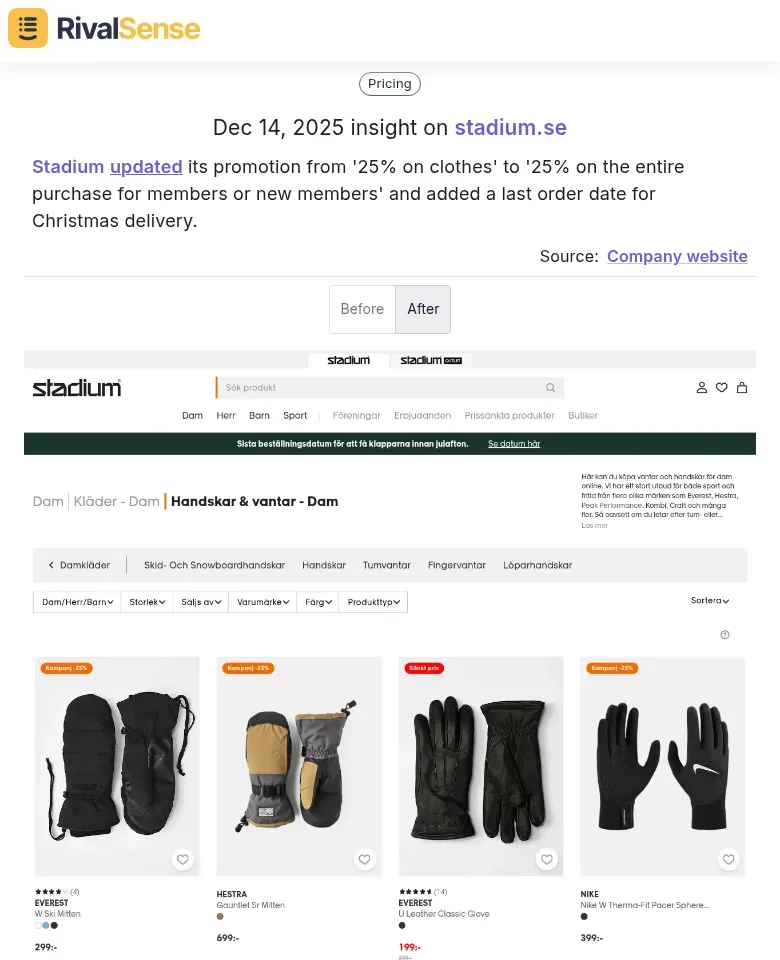
This insight is valuable because it reveals how competitors refine promotions to boost membership and create urgency. By tracking such changes, you can optimize your own promotional timing, targeting, and messaging to improve conversion rates.
Analyze promotion expansion strategies by monitoring how competitors bundle products, upsell services, or create tiered offers. Track which add-ons drive the highest conversion rates and customer lifetime value.
Create a checklist:
- Map competitor promotion calendars
- Identify cross-sell patterns
- Calculate customer acquisition costs for different bundles
Learn urgency tactics by studying deadline-driven conversion optimization. Note how competitors use countdown timers, limited-quantity messaging, and early-bird pricing. Implement A/B testing with different urgency triggers—24-hour flash sales versus 7-day promotions—to determine what drives your audience's fastest conversions. Practical tip: Set up alerts for competitor promotion launches to respond within hours, not days.
Loyalty Program Insights: Retention Strategies and Customer Value Enhancement
Loyalty programs are retention goldmines, but their true power lies in strategic design. Track competitor programs to uncover actionable insights for your own customer value enhancement. By analyzing how rivals reward loyalty, you can enhance your retention strategies and increase customer lifetime value.
Decoding Anniversary & Milestone Campaigns
Competitors use anniversary rewards to celebrate customer longevity. Monitor their timing—do they offer bonuses at 1-year, 2-year, or 5-year marks? Look for patterns: some may combine anniversaries with seasonal promotions. Actionable tip: Create a calendar of competitor milestone campaigns to identify optimal timing for your own retention pushes.
Analyzing Point Multiplier Tactics
Point multipliers drive specific behaviors. Track when competitors offer 2x or 3x points—is it for weekend purchases, specific product categories, or referral activities? Practical step: Map competitor multiplier triggers to identify gaps in your own program. For example, if rivals boost points for social media engagement, consider implementing similar gamified elements.
Understanding Gamification & Lottery Elements
Lottery-style rewards (e.g., "spin-to-win" wheels) create excitement. Analyze how competitors balance chance-based rewards with guaranteed points. Do they use lotteries for new sign-ups or to re-engage dormant users? Checklist item: Evaluate the risk-reward ratio in competitor lotteries—ensure your gamification maintains perceived value without diluting point worth.
Take this RivalSense insight: Japan Airlines launched a campaign for its JAL Life Status program's second anniversary, offering double Life Status points for domestic flights and JAL card use, plus a lottery for up to 20,000 miles, until February 28, 2026. 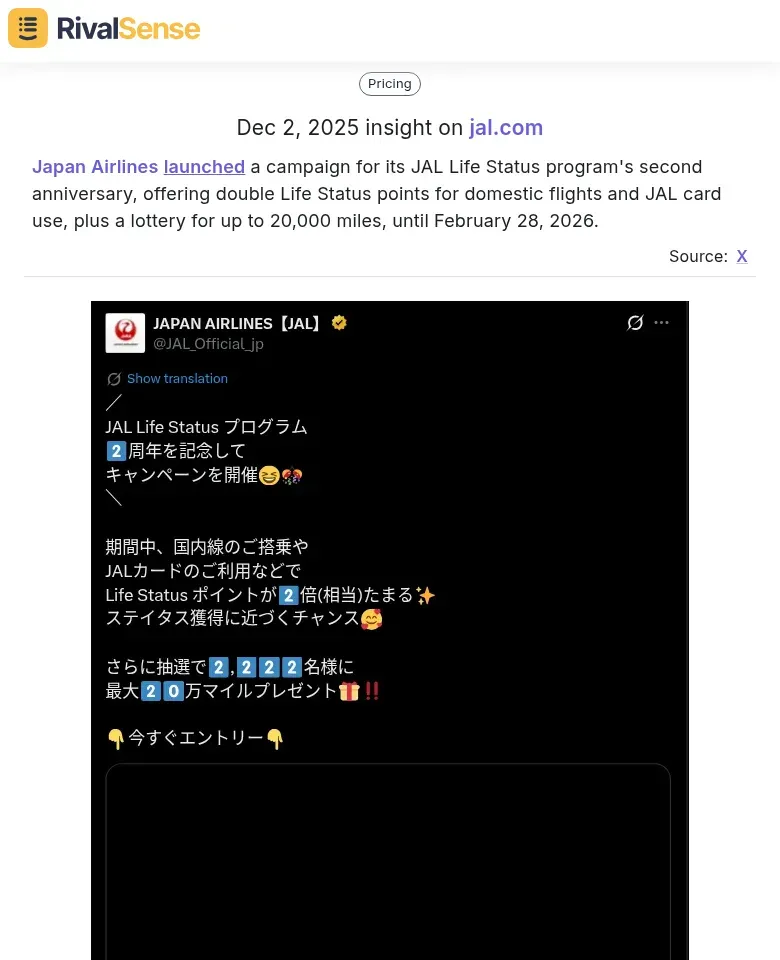
This type of insight is valuable because it showcases how competitors use anniversary campaigns and gamification to boost engagement and retention. By tracking such loyalty program updates, you can innovate your own strategies to keep customers loyal and increase their value.
Key Takeaway: Systematically track competitor loyalty mechanics through their customer communications. This reveals not just what they offer, but the strategic intent behind each element—enabling you to craft a program that enhances customer lifetime value while staying competitively distinctive.
Actionable Implementation: Turning Insights into Competitive Advantage
Turning competitor insights into actionable strategies requires a structured approach. By implementing systematic processes, you can ensure that every piece of intelligence leads to a competitive edge. Transform competitor insights into tangible advantage with this systematic approach:
-
Build Your Tracking Framework: Create a centralized dashboard monitoring 3-5 key competitors' pricing, promotions, and packaging changes. Use automated tools to track weekly changes, with manual deep-dives quarterly. Assign team members specific competitor responsibilities.
-
Develop Response Protocols: Create decision trees for different scenarios:
- Immediate response (within 24 hours): For major price cuts or new market entries
- Strategic response (1-2 weeks): For feature additions or packaging changes
- Monitoring only: For minor adjustments
Example: When Competitor X drops prices 15%, your protocol might trigger a value-add promotion rather than matching.
-
Test Before You Implement: Before adjusting your pricing:
- A/B test new price points with 5% of your customer base
- Run win/loss analysis on recent deals
- Survey existing customers on perceived value
Tip: Test packaging changes before price changes—customers respond better to added value than reduced cost.
-
Create Your Action Checklist:
- [ ] Document competitor move and potential impact
- [ ] Consult response protocol
- [ ] Run small-scale test if needed
- [ ] Implement with clear communication to sales team
- [ ] Measure results for 30 days
Pro tip: Build a "competitive intelligence library" documenting past competitor moves and your successful responses. This creates institutional knowledge that accelerates future decision-making.
Conclusion: Building a Sustainable Pricing Intelligence System
Building a sustainable pricing intelligence system requires moving beyond one-time analysis to continuous integration. To maintain a competitive edge, you need a system that evolves with the market and informs strategic decisions consistently. Start by embedding competitor insights into your quarterly strategic planning cycles. For example, schedule monthly pricing reviews where your team analyzes competitor changes and adjusts your strategy accordingly.
Establish clear ROI metrics: track revenue impact from pricing changes, win rates against specific competitors, and customer retention improvements. Use automation to streamline tracking and generate regular reports that quantify intelligence value.
Create organizational processes for continuous learning: assign a pricing intelligence owner, implement weekly competitor update briefings, and maintain a shared knowledge base of competitor pricing patterns. Develop a checklist for pricing decisions that includes competitor benchmarking, market positioning analysis, and customer value assessment.
Practical steps:
- Automate competitor tracking with dedicated tools
- Set up regular review cadences (monthly tactical, quarterly strategic)
- Create standardized reporting templates
- Train sales teams on using pricing intelligence
- Establish feedback loops between pricing, sales, and product teams
Remember: sustainable pricing intelligence isn't about gathering data—it's about creating processes that turn insights into consistent competitive advantage. To automate your competitor tracking and gain real-time insights on pricing, promotions, and loyalty programs, try RivalSense for free at https://rivalsense.co/. Get your first competitor report today and start turning insights into actionable strategies for growth.
📚 Read more
👉 How Media Mentions Unlock Competitor Insights: A Real-World Case
👉 Key Account Management Best Practices 2024: The Strategic Playbook for B2B Growth
👉 Actionable Strategies: Analyze Competitor Laundry Equipment Features to Win
👉 How Roblox's The Block Launch Prompted Rivals' Immersive Strategy Shift
👉 How Top Brands Use Twitter to Analyze Competitor Customer Support