
7 Website Change Monitoring Mistakes That Sabotage Competitor SWOT Analysis
In today's dynamic market, website changes are the pulse of competitor strategy—they provide real-time competitive intelligence that fuels accurate SWOT analysis. When you monitor a competitor's website effectively, you're not just tracking updates; you're capturing their evolving strengths (new product launches, feature enhancements), weaknesses (pricing changes, service gaps), opportunities (market expansions, content shifts), and threats (aggressive messaging, strategic pivots). This continuous data stream transforms static SWOT snapshots into living strategic maps.
However, poor monitoring sabotages this process. Missing critical updates—like a competitor's pricing overhaul or a new partnership announcement—leads to flawed analysis and misguided decisions. You might overestimate their weaknesses or underestimate emerging threats, putting your business at risk in fast-moving markets.
Common mistakes that undermine SWOT accuracy include:
- Infrequent checks (weekly instead of daily)
- Focusing only on homepage changes while ignoring blog or career pages
- Not tracking visual elements like redesigned CTAs or imagery
- Overlooking metadata and SEO shifts
- Failing to correlate changes with market events
- Relying on manual checks prone to human error
- Not documenting changes systematically for trend analysis
Practical tip: Set up automated alerts for key pages and use a monitoring tool to track not just text but design elements and backend signals. Create a change log to spot patterns—this turns raw data into actionable SWOT insights.
Mistake 1: Ignoring Content Hierarchy Changes (Like ANA's Report Transition)
When competitors reorganize their website content hierarchy—like moving reports from standalone sections to integrated knowledge centers—they're signaling strategic shifts that traditional monitoring tools miss. This isn't just about page updates; it's about how they communicate priorities to stakeholders, revealing unannounced pivots in transparency or focus.
Practical Impact:
- Strategic Transparency Shifts: When financial reports move from 'Investor Relations' to 'Corporate Governance' sections, it signals changing disclosure philosophies.
- Stakeholder Engagement Evolution: Content demoting customer testimonials while elevating ESG reports reveals shifting audience priorities.
- Reporting Standards Changes: Migration from PDF downloads to interactive dashboards indicates digital transformation investments.
Monitoring Checklist:
- Track navigation menu restructuring quarterly.
- Monitor URL path changes for key documents.
- Set alerts for metadata tag updates (especially schema.org changes).
- Compare content prominence across competitor sites.
- Document when 'About Us' sections expand to include sustainability or diversity metrics.
Pro Tip: Use RivalSense's hierarchical change detection to automatically flag when competitors elevate certain content categories—like moving 'Sustainability Reports' from footer to main navigation—revealing strategic pivots before they impact market positioning.
RivalSense Insight Example:
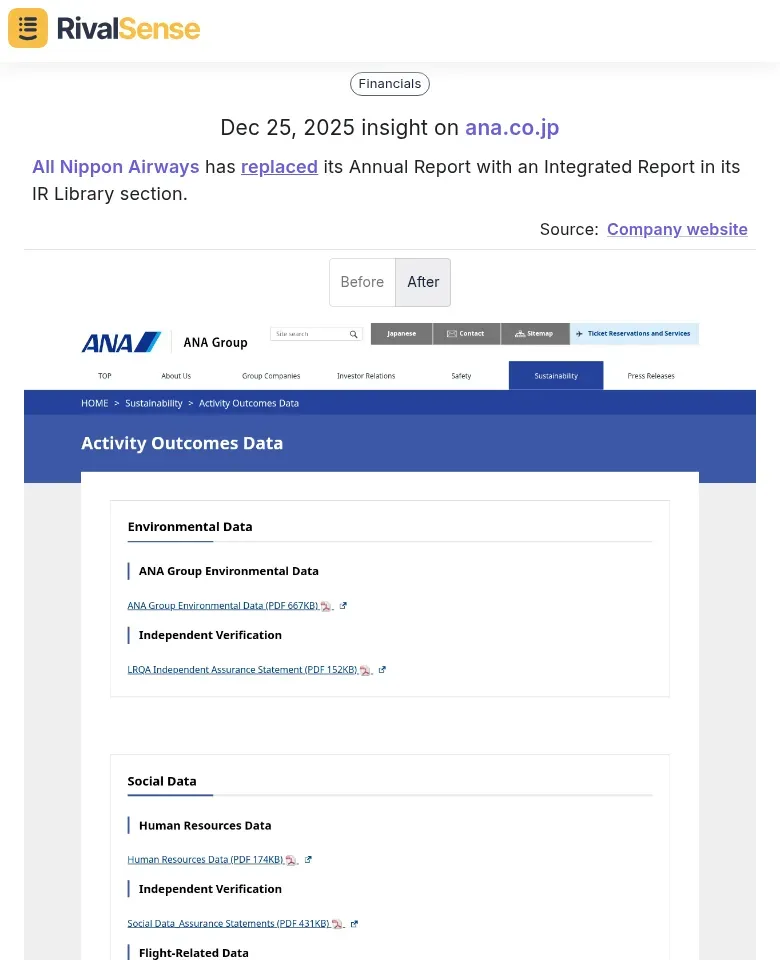
All Nippon Airways has replaced its Annual Report with an Integrated Report in its IR Library section.
Why This Matters: Insights into content hierarchy changes, such as this shift to integrated reporting, are valuable for business strategy because they signal a competitor's move towards greater transparency and stakeholder alignment. This can indicate broader trends like ESG focus or digital transformation, helping you anticipate market expectations and refine your own communication strategies.
Mistake 2: Overlooking Feature Sunsetting and Service Changes (Like Turkish Airlines' Miles Program)
Missing feature sunsetting signals reveals critical blind spots in understanding competitor resource allocation and customer retention strategies. When competitors discontinue services or features, it often indicates a shift in focus or response to market pressures, which can uncover vulnerabilities or opportunities for your business.
Practical Checklist:
- Monitor competitor's feature removal pages and support documentation.
- Track pricing structure changes monthly.
- Analyze customer feedback on discontinued services.
- Correlate sunsetting announcements with new feature launches.
- Set alerts for terms like 'discontinued,' 'sunsetting,' 'legacy,' and 'deprecated' across websites.
Remember: What competitors stop doing often reveals more about their strategy than what they start. For instance, phasing out a loyalty program feature might signal a reallocation of resources to other growth areas.
RivalSense Insight Example:
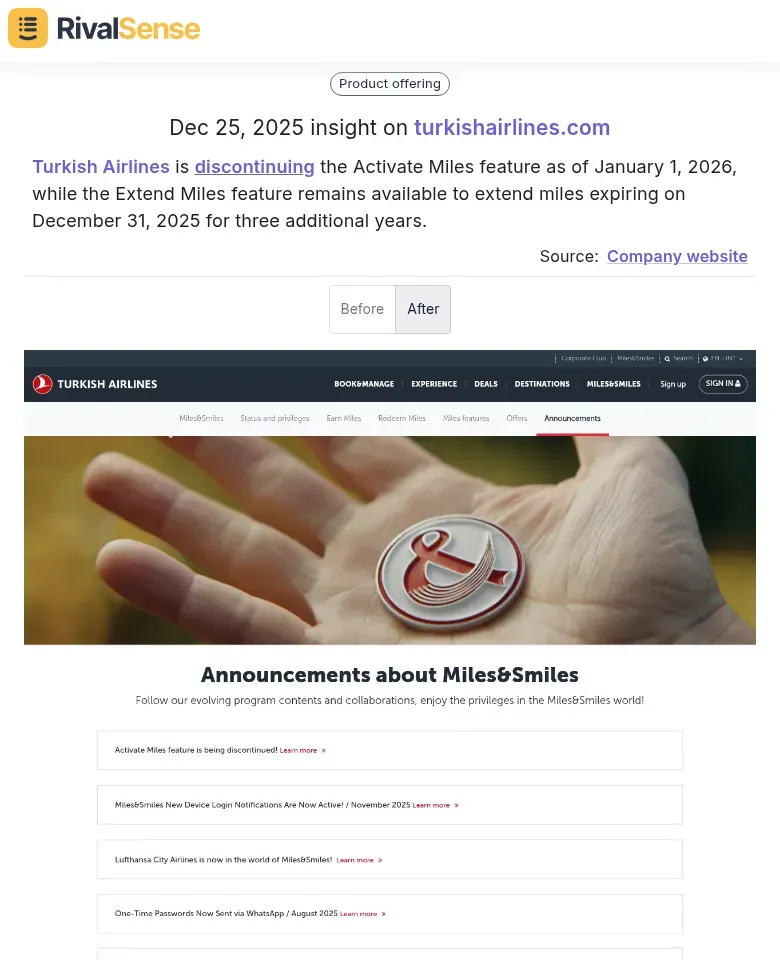
Turkish Airlines is discontinuing the Activate Miles feature as of January 1, 2026, while the Extend Miles feature remains available to extend miles expiring on December 31, 2025 for three additional years.
Why This Matters: Insights into feature sunsetting are valuable for business strategy because they highlight where competitors are cutting costs or pivoting offerings. This can reveal market gaps you can exploit or signal changing customer preferences, allowing you to adjust your product roadmap and marketing messages accordingly.
Mistake 3: Missing Geographic and Market Expansion Signals (Like New Destination Additions)
Missing geographic expansion signals is a critical oversight that blinds you to competitor growth strategies and market penetration priorities. When you fail to monitor new destination additions or regional focus shifts, you're missing key insights into where competitors are allocating resources and timing their entries, which can inform your own expansion plans.
Practical Steps to Avoid This Mistake:
- Track Location-Specific Changes: Monitor competitor websites for new city/country pages, localized content, and regional service offerings.
- Analyze Expansion Patterns: Note the sequence of new market entries to identify strategic priorities.
- Connect Geographic Changes to Strategy: Ask: Are they targeting high-growth markets first? Following key clients? Responding to regulatory changes?
- Set Up Alerts for Location Keywords: Create monitoring rules for specific geographic terms relevant to your industry.
- Compare Timing: Track when competitors enter new markets relative to product launches or funding rounds.
Checklist for Geographic Monitoring:
- ✓ New office locations mentioned
- ✓ Localized pricing/currency options
- ✓ Regional case studies or testimonials
- ✓ Language/translation additions
- ✓ Country-specific compliance mentions
RivalSense Insight Example:
Turkish Airlines has added Tirana to its European destinations list.
Why This Matters: Insights into geographic expansion, like this new destination addition, are valuable for business strategy because they reveal competitor growth trajectories and market focus. This helps you identify emerging competitive threats in specific regions or spot untapped opportunities for your own expansion, enabling proactive strategic planning.
Mistake 4: Focusing Only on Obvious Changes While Missing Subtle Strategic Shifts
Many competitor tracking tools excel at detecting obvious changes—price drops, new product launches, or homepage redesigns—but completely miss the gradual evolution that reveals deeper strategic shifts. This creates a dangerous blind spot in your SWOT analysis, as subtle messaging or positioning changes can signal market repositioning long before official announcements.
Practical Steps to Avoid This Mistake:
- Track Content Evolution Patterns: Set up quarterly reviews comparing current content against 3-6 month old versions. Look for gradual vocabulary shifts, changing value proposition emphasis, or evolving case study focus.
- Monitor Tone and Positioning Adjustments: Create a "messaging matrix" tracking key terms across competitors. Use AI-powered tools to analyze sentiment and positioning changes over time.
- Connect Multiple Small Changes: Maintain a "change log" that connects seemingly unrelated updates. Look for patterns where multiple adjustments converge to indicate a broader strategy, like premiumization or audience expansion.
Pro Tip: Set up "strategic shift alerts" by monitoring for specific keyword combinations that signal positioning changes, such as increased frequency of "enterprise" and "scalable" versus "small business" and "simple." This helps you catch strategic pivots early.
Mistake 5: Poor Timing and Frequency of Monitoring Checks
Timing is everything in competitive intelligence. When you monitor competitor websites at random intervals or infrequently, you miss critical windows where competitors launch new products, adjust pricing, or change messaging. Seasonal patterns and industry events further compound this risk, leading to reactive rather than proactive strategies.
Practical Solution: Establish a Tiered Monitoring Cadence
- High-frequency checks (daily): Pricing pages, homepage messaging, key product/service pages.
- Medium-frequency (weekly): Blog content, case studies, resource sections.
- Low-frequency (monthly): About pages, career sections, legal/terms pages.
Set calendar reminders for industry events, quarterly earnings seasons, and competitors' fiscal year-ends. Use automated monitoring tools that alert you to changes in real-time rather than relying on manual checks. Remember: The most valuable competitive intelligence often appears in the narrow windows between when a competitor makes a change and when the market reacts.
Mistake 6: Isolating Website Changes from Broader Competitive Context
Treating website changes as isolated events is a critical error that undermines SWOT analysis. When you monitor competitor site updates without connecting them to market conditions, industry trends, or financial performance, you miss the strategic intent behind those changes, whether reactive or proactive.
Practical Steps to Avoid This Mistake:
- Create a correlation matrix linking website changes to market events, earnings reports, and industry news.
- Track timing patterns—do updates precede product launches or follow market shifts?
- Use financial data to contextualize changes (e.g., cost-cutting measures vs. expansion moves).
- Monitor competitive responses—when one player changes pricing, do others follow?
- Maintain a timeline showing website updates alongside external events.
Tip: Set up alerts for competitor financial announcements and major industry news alongside your website monitoring. This holistic approach reveals whether changes are driven by internal strategy or external pressures, giving you true competitive intelligence.
Mistake 7: Not Translating Observations into Actionable SWOT Insights
The most critical mistake in website change monitoring is collecting data without translating observations into actionable SWOT insights. Many teams meticulously track competitor website updates but fail to analyze their strategic implications for strengths, weaknesses, opportunities, and threats, leaving valuable intelligence untapped.
Practical Steps to Convert Observations into SWOT Insights:
- Map Changes to SWOT Categories: When you notice a competitor adding new features, ask: Does this reveal a strength (technical capability) or weakness (reacting to market pressure)?
- Convert Observations to Opportunities: If a competitor removes a service, that's a market gap you can fill. If they struggle with UX updates, that's a vulnerability you can exploit.
- Create a SWOT Translation Checklist:
- Price changes → Threat (market pressure) or Opportunity (premium positioning)
- Feature additions → Strength (innovation) or Weakness (feature bloat)
- Content strategy shifts → Opportunity (untapped audience) or Threat (improved messaging)
- Site structure changes → Strength (improved UX) or Weakness (confusion)
- Schedule Regular SWOT Review Sessions: Dedicate monthly meetings to translate monitoring data into strategic insights. Use systematic tracking tools to ensure focus on the 'why' behind each update.
Remember: Website changes are symptoms of deeper strategic moves. Your job isn't just to notice them—it's to diagnose what they reveal about competitor vulnerabilities, advantages, and market positioning.
Conclusion: Building a Robust Website Monitoring Framework for Superior SWOT Analysis
To build a robust website monitoring framework for superior SWOT analysis, implement these practical steps to transform raw data into strategic intelligence that drives business outcomes.
Systematic Monitoring Process:
- Create a monitoring calendar with daily checks, weekly trend analysis, and monthly deep dives.
- Use automated tools to track competitor pricing, product updates, and messaging changes in real-time.
- Set up alerts for specific web pages and maintain a centralized dashboard for all monitoring data.
Integration Checklist:
- Combine website change data with SEO insights (keyword rankings, backlink profiles).
- Cross-reference with social media monitoring and email newsletter analysis.
- Incorporate financial data from public company filings for publicly traded competitors.
- Layer in customer feedback from review sites and discussion forums.
Actionable SWOT Framework:
- Strengths Analysis: Track competitor website improvements, new features, and positive customer testimonials.
- Weaknesses Identification: Monitor broken links, outdated content, and negative review patterns.
- Opportunity Detection: Spot market gaps when competitors remove products or change positioning.
- Threat Assessment: Alert on aggressive pricing changes, new market entries, or strategic partnerships.
Strategic Decision-Making Tips:
- Schedule quarterly SWOT review meetings with cross-functional teams.
- Create competitor battle cards updated with latest website intelligence.
- Use monitoring insights to inform product roadmaps and marketing campaigns.
- Establish clear action triggers based on specific competitor changes.
By implementing this integrated framework, you'll move from reactive tracking to proactive strategic intelligence. To streamline this process, consider using a dedicated competitor tracking tool like RivalSense, which monitors product launches, pricing updates, event participations, partnerships, regulatory aspects, management changes, and media mentions across websites, social media, and various registries, delivering consolidated weekly reports.
Ready to enhance your competitor SWOT analysis? Try RivalSense for free today and get your first competitor report to start turning website changes into actionable strategic insights.
📚 Read more
👉 Healthcare AI Scribe Competitive Analysis: Gaining Strategic Advantage
👉 The Essential Guide to Tracking Competitor Media Mentions and Content Strategy
👉 How Executive Moves Like Rebecca Kaplan's Reveal Competitive Strategies
👉 The Strategic Guide to Tracking Key Account Milestones: A B2B Leader's Playbook
👉 Case Study: How Project Governance Unlocks Competitor Pricing Advantages