
5 Event Participation Mistakes That Sabotage Your Competitor Intelligence
Industry events are more than just networking opportunities—they're intelligence goldmines where competitors reveal their true strategies. While public announcements show what companies want you to see, event participation uncovers what they're actually doing. Competitors showcase their priorities through which events they attend, what sessions they present, who they partner with, and how they position themselves to industry insiders.
Track these strategic insights: Which events do competitors prioritize? What messaging do they emphasize in presentations? Who are their key partners and customers in attendance? How do they position against market trends? These observations reveal market positioning, partnership strategies, and emerging focus areas before they become public knowledge.
Transform observations into actionable intelligence with this checklist:
✅ Document competitor presence at each event (booth size, location, staffing)
✅ Capture presentation themes and messaging consistency
✅ Note partner/customer interactions and announcements
✅ Analyze positioning against industry trends and pain points
✅ Compare year-over-year participation patterns for strategic shifts
This intelligence helps you anticipate competitor moves, identify market gaps, and refine your own positioning strategy based on real-time market signals rather than delayed public announcements.
Mistake 1: Ignoring Event Selection Patterns and Strategic Alignment
When competitors choose events, they're revealing their strategic priorities. This selection process offers a clear window into their target markets and growth ambitions. For example, consider how AirAsia Philippines launched its 2026 AirAsia Fiesta campaign with events at the Cebu Sinulog and Iloilo Dinagyang festivals, offering VIP perks to passengers who showed their boarding passes.
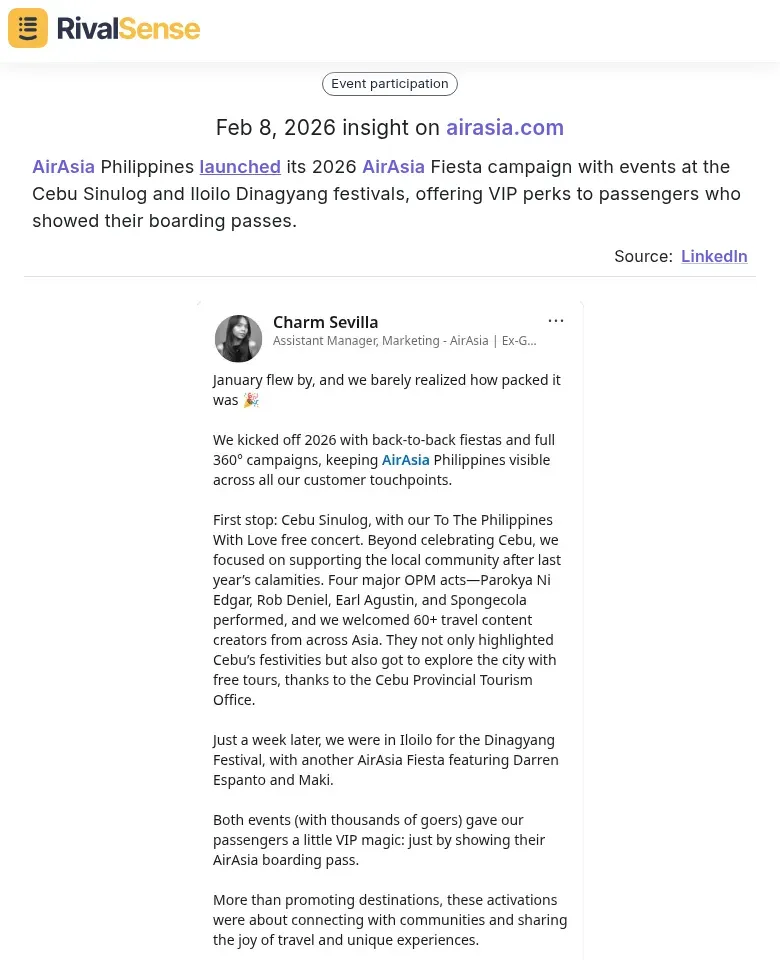
This type of insight is valuable because it shows a competitor's focus on cultural integration and customer experience, indicating a strategy to build brand loyalty through community engagement. By analyzing such event selections, you can anticipate moves into new market segments or geographic areas.
Practical Intelligence Checklist:
✅ Map competitor event patterns over 12-24 months to identify trends
✅ Analyze event types: Cultural (mass market), industry (B2B), investor (expansion signals)
✅ Identify target segments through event demographics and themes
✅ Track geographic expansion by monitoring new regional event participation
✅ Compare sponsorship levels—main stage vs. booth reveals commitment depth
Key Insight: Event choices expose whether competitors are targeting new customer segments, entering new markets, or doubling down on existing strengths. Tracking these patterns helps you anticipate competitor moves before they're publicly announced.
Mistake 2: Overlooking Sponsorship Levels and Partnership Strategies
Sponsorship tiers reveal competitor investment priorities and market confidence. Analyzing these levels helps you understand where competitors are placing their bets and forming alliances. Take Five9, which sponsors the Medallia Experience 2026 event in Las Vegas from February 10–12, 2026.
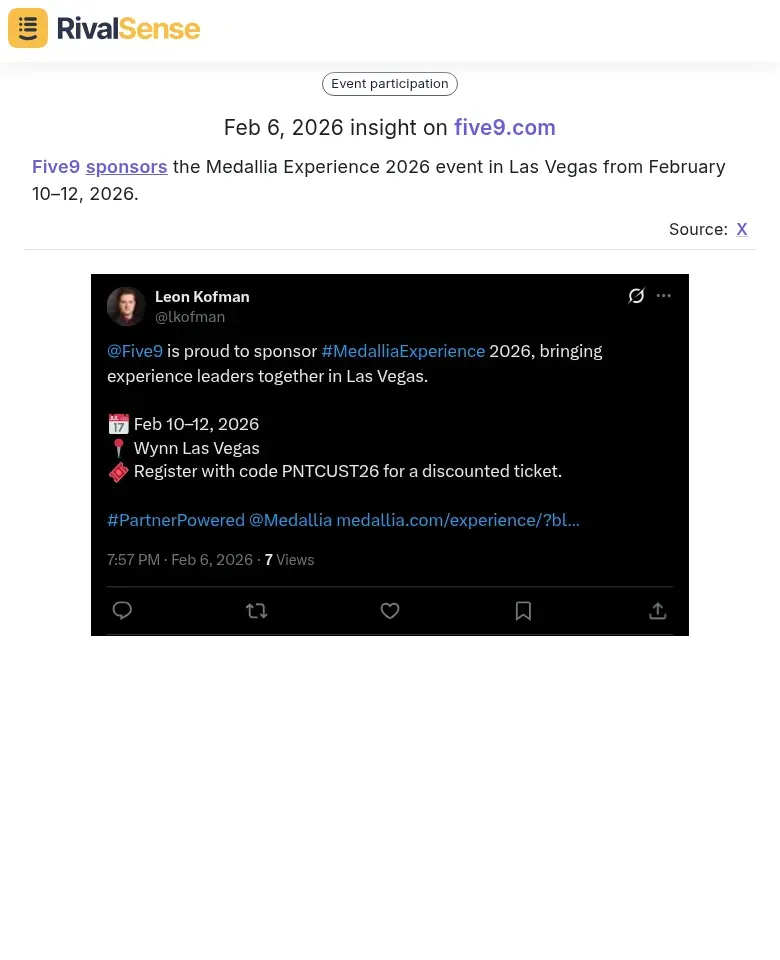
This sponsorship insight is valuable as it indicates Five9's commitment to the customer experience vertical and its strategy to align with industry leaders. Tracking such sponsorships can reveal partnership strategies and budget allocations that signal future market priorities.
Practical Checklist:
✅ Create a competitor sponsorship tracker with columns for event type, sponsorship level, estimated investment, and geographic focus
✅ Monitor event websites 3-6 months before major conferences for sponsor announcements
✅ Set Google Alerts for competitor names + "sponsor" or "partner"
✅ Analyze sponsorship patterns: heavy tech event spending indicates digital transformation focus
✅ Cross-reference sponsorship data with account-based marketing efforts
Key Insight: High-value sponsorships often precede enterprise account launches. Budget allocation patterns reveal market priorities—tracking these helps anticipate which accounts competitors will target next.
Mistake 3: Missing Product Launch and Innovation Signals
Events are prime platforms where competitors unveil new products and showcase innovation roadmaps. Paying attention to these signals can give you a head start on market trends and technological shifts. For instance, Sun Chemical will showcase its advanced functional ink range, including conductive and dielectric ink solutions, at LOPEC 2026 in Munich on February 24-26.
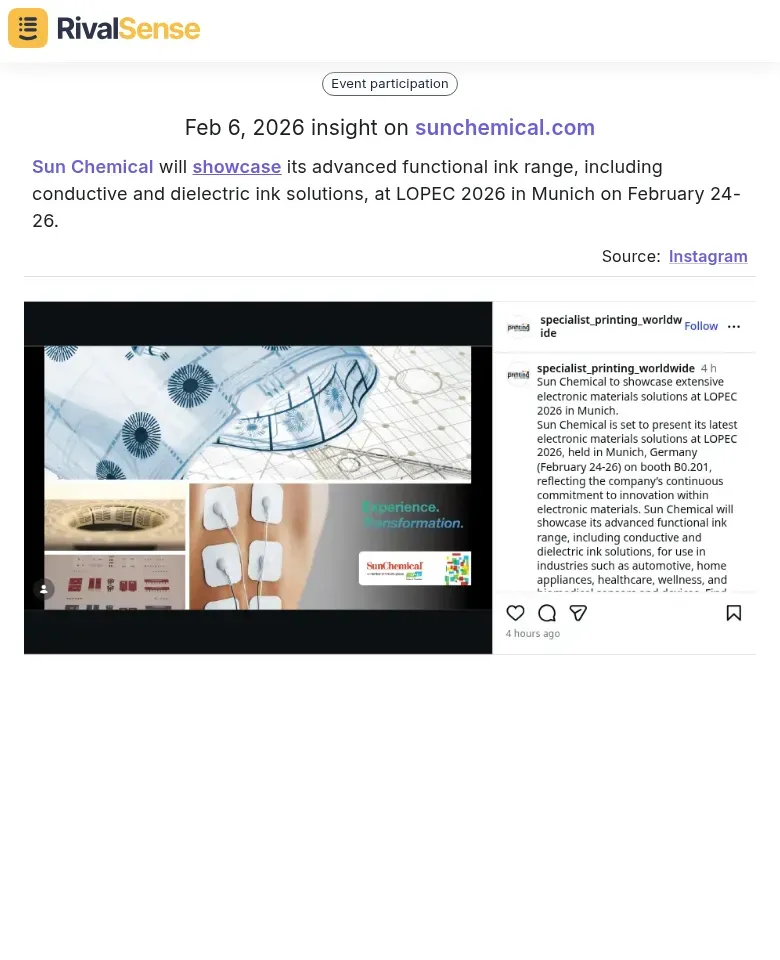
This insight is valuable because it highlights Sun Chemical's R&D priorities and upcoming product focuses, allowing you to adjust your own innovation strategy accordingly. By monitoring such demonstrations, you can decode competitor R&D investments and emerging industry trends.
Practical Checklist for Capturing Innovation Signals:
✅ Monitor event announcements for specific product demonstrations
✅ Analyze presentation topics to decode R&D priorities and technology focus areas
✅ Track year-over-year participation to identify strategic shifts in innovation investment
✅ Document showcased technologies and compare against previous events to spot evolution patterns
✅ Use automated tools to capture real-time event intelligence and avoid missing critical updates
Pro Tip: Create a competitor innovation matrix that maps event demonstrations to R&D priorities. When multiple competitors showcase similar technologies at the same event, it signals emerging industry trends worth monitoring closely.
Mistake 4: Failing to Analyze Audience Engagement and Customer Experience Strategies
Failing to analyze how competitors engage audiences at events is a critical intelligence gap. This oversight can leave you unaware of effective tactics for converting attendees into loyal customers and building brand advocacy. Observe their customer acquisition tactics, such as VIP perks and exclusive benefits, which segment high-value clients and drive conversions.
Practical Checklist:
✅ Document competitor event promotions and VIP offerings
✅ Track audience engagement metrics (participation rates, social mentions)
✅ Analyze customer journey touchpoints during events
✅ Study post-event nurturing strategies
✅ Benchmark against your own engagement ROI
Key Insight: Competitors who excel at audience engagement often turn attendees into loyal brand advocates. By analyzing their strategies, you can identify which approaches yield the highest customer lifetime value and refine your own event experiences.
Mistake 5: Neglecting Post-Event Analysis and Competitive Benchmarking
Many companies treat events as isolated activities, missing the goldmine of intelligence that emerges afterward. The real competitive insights come from tracking what happens post-event, including follow-up campaigns and performance metrics.
Practical Steps for Post-Event Intelligence:
- Monitor Competitor Follow-Up Campaigns: Track their email sequences, social media content, and lead nurturing strategies. Are they offering exclusive post-event content or special promotions?
- Analyze Performance Metrics: Look for indicators like booth traffic patterns, session attendance numbers, lead generation results, and media coverage.
- Benchmark Your Strategy: Create a simple comparison matrix evaluating lead follow-up speed, content distribution channels, post-event engagement metrics, and ROI measurement approaches.
Quick Checklist:
✅ Track competitor email campaigns for 30 days post-event
✅ Monitor social media mentions and engagement
✅ Compare lead conversion rates and follow-up timing
✅ Document competitor content distribution patterns
✅ Schedule quarterly benchmarking reviews
Key Insight: The most successful companies don't just participate in events—they use them as intelligence-gathering opportunities. By systematically analyzing competitor post-event activities, you can identify gaps in your own strategy and discover new approaches to improve future event performance.
Conclusion: Building a Systematic Competitor Event Intelligence Framework
To avoid the pitfalls outlined, develop a systematic competitor event intelligence framework. Create a centralized calendar tracking all competitor events year-round, categorizing them by type. Assign team members specific monitoring responsibilities with standardized reporting templates. Integrate event insights into your broader competitive analysis by mapping event participation patterns against product launches, hiring trends, and market expansion.
Actionable Steps:
✅ Set up automated alerts for competitor event announcements
✅ Create a shared dashboard for real-time event intelligence
✅ Conduct post-event debriefs to extract strategic implications
✅ Align event insights with sales enablement materials and product roadmap decisions
This transforms sporadic observations into a continuous competitive advantage system.
To streamline your competitor event intelligence, consider using tools like RivalSense. It tracks competitor product launches, pricing updates, event participations, partnerships, regulatory aspects, management changes, and media mentions across company websites, social media, and various registries, delivering all in a weekly email report. Try RivalSense for free at https://rivalsense.co/ and get your first competitor report today!
📚 Read more
👉 Competitor Analysis in Action: Learning from Reddit's $1B Share Buyback
👉 The Ultimate 2026 Guide to Key Account Management Certification: Free vs Paid Programs Compared
👉 Custom Key Account Tracking: PR Firm Productivity Techniques
👉 How Langdock's Company Knowledge Launch Forced Cross-Platform AI Innovation
👉 Facebook Competitor Insights for Key Account Contract Tracking: A Strategic Guide