
2026 Web Intelligence Trends: Key Account KPIs for Competitive Edge
In 2026, web intelligence has fundamentally transformed from reactive monitoring to proactive strategic intelligence. This evolution is driven by three converging forces: unprecedented data accessibility, sophisticated automation, and heightened ethical considerations. B2B leaders can no longer afford to simply track competitors—they must anticipate market shifts before they happen.
Web intelligence now serves as the foundation for competitive advantage, enabling businesses to identify emerging threats, spot partnership opportunities, and validate market assumptions with real-time evidence. The most successful companies treat web intelligence as a core strategic function, not just a tactical tool.
Practical steps for 2026:
- Shift from weekly reports to real-time dashboards that trigger alerts for strategic opportunities
- Integrate web intelligence directly into your strategic planning cycles, not just marketing
- Establish clear ethical guidelines for data collection to maintain trust and compliance
Infrastructure Innovation: The New Data Access Paradigm
In 2026, accessing web data requires infrastructure that is both scalable and adaptable. The competitive intelligence landscape demands solutions that can handle modern protocols and global deployments without bottlenecks. Self-service platforms now empower teams to deploy custom data pipelines independently, transforming how competitors are monitored.
Multi-protocol support (HTTP/2, WebSocket, gRPC) combined with global infrastructure deployment ensures you capture data from any region with minimal latency. Modern data access models prioritize flexibility over fixed contracts, offering pay-as-you-go pricing with transparent usage metrics.
Practical Implementation Checklist:
- Evaluate Protocol Coverage: Ensure your infrastructure supports modern protocols beyond basic HTTP/1.1
- Geographic Distribution: Deploy nodes in key markets where competitors operate
- Cost Modeling: Implement usage-based pricing to scale operations predictably
- Automation Integration: Connect data streams directly to your analytics stack
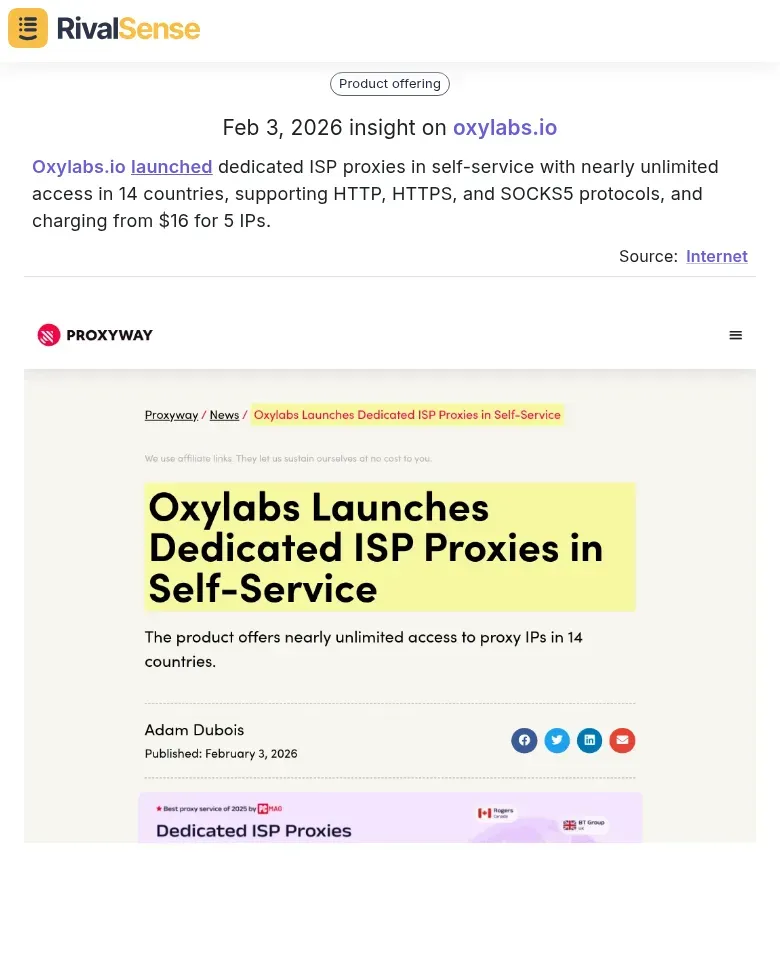
Monitoring competitor product launches is crucial for staying ahead. For example, RivalSense tracked that Oxylabs.io launched dedicated ISP proxies in self-service with nearly unlimited access in 14 countries, supporting HTTP, HTTPS, and SOCKS5 protocols. This insight into infrastructure offerings can help businesses anticipate market trends and adjust their own data access strategies, ensuring they remain competitive in pricing and capabilities.
Pro Tip: Start with a hybrid approach—combine managed infrastructure for core monitoring with self-service tools for experimental projects. This balances reliability with innovation while controlling costs.
Strategic Integration: Turning Data into Actionable Workflow Intelligence
The true value of web intelligence lies in its integration into daily operations. Leading organizations now embed competitor tracking directly into their core business workflows, enabling real-time insights to drive decisions. In 2026, web intelligence tools are no longer standalone dashboards but embedded in CRM systems, marketing automation platforms, and strategic planning workflows.
This integration transforms raw data into actionable workflow intelligence, allowing teams to respond swiftly to competitor movements. For example, competitor pricing changes detected by web intelligence tools can automatically trigger pricing strategy reviews in your ERP system.
Practical Integration Checklist:
- API-First Approach: Ensure your intelligence platform offers robust APIs for seamless integration with existing systems
- Department-Specific Dashboards: Create customized views for sales, marketing, and product teams with relevant KPIs
- Automated Alert Workflows: Set up triggers that automatically notify teams about competitor movements
- Industry Context Layer: Apply sector-specific filters to transform generic data into targeted insights
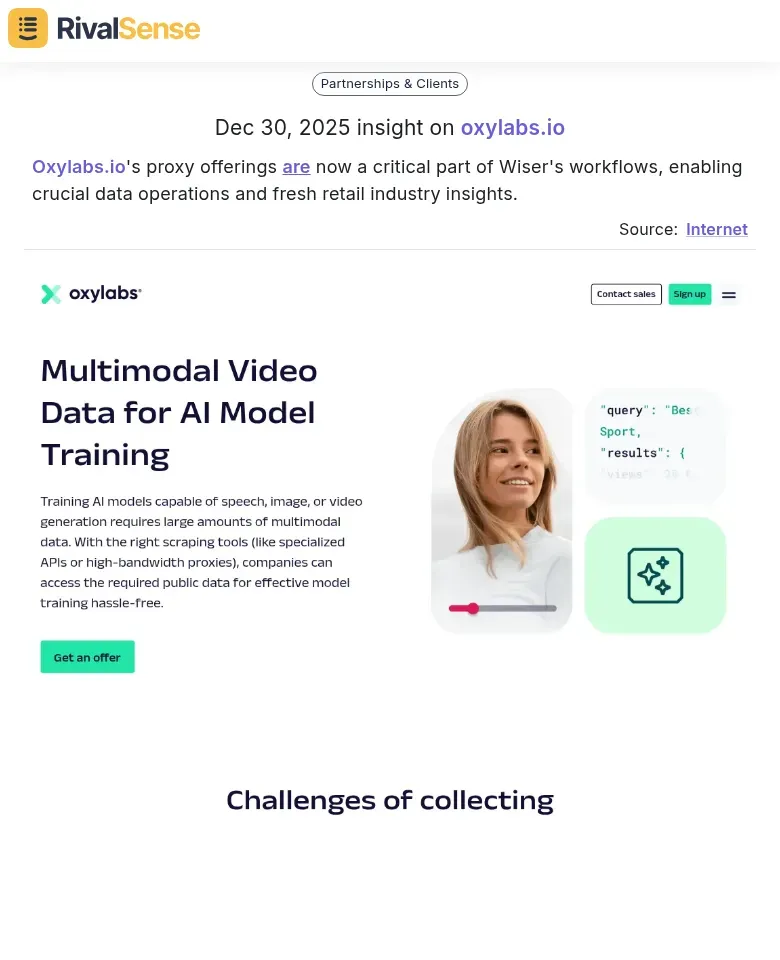
Understanding how competitors' products are used by other businesses can reveal strategic partnerships and market needs. RivalSense identified that Oxylabs.io's proxy offerings are now a critical part of Wiser's workflows, enabling crucial data operations and fresh retail industry insights. This type of insight shows how competitor solutions are integrated into industry workflows, helping you identify potential collaboration opportunities or competitive threats.
Key Tip: Start with one high-impact department (like sales or marketing) to demonstrate ROI before expanding cross-functionally. Measure success by tracking how quickly intelligence translates into strategic actions rather than just data collection metrics.
Legal and Ethical Considerations in Modern Web Intelligence
As web intelligence evolves in 2026, legal and ethical considerations have become critical differentiators for competitive intelligence programs. Regulatory frameworks like GDPR, CCPA, and emerging AI governance impose strict boundaries, making compliance a strategic imperative. Companies must balance competitive advantage with ethical data practices to avoid penalties and maintain trust.
The regulatory landscape has tightened significantly, with substantial penalties for non-compliance. Industry best practices now emphasize transparency and responsible data stewardship, focusing on publicly available information and respecting protocols like robots.txt.
Key practical steps for maintaining compliance:
- Conduct regular legal audits of your intelligence sources and methods
- Implement clear data provenance tracking for all competitive insights
- Establish internal review boards for high-risk intelligence initiatives
- Document all data collection methodologies and consent mechanisms
- Train teams on jurisdiction-specific regulations affecting target markets
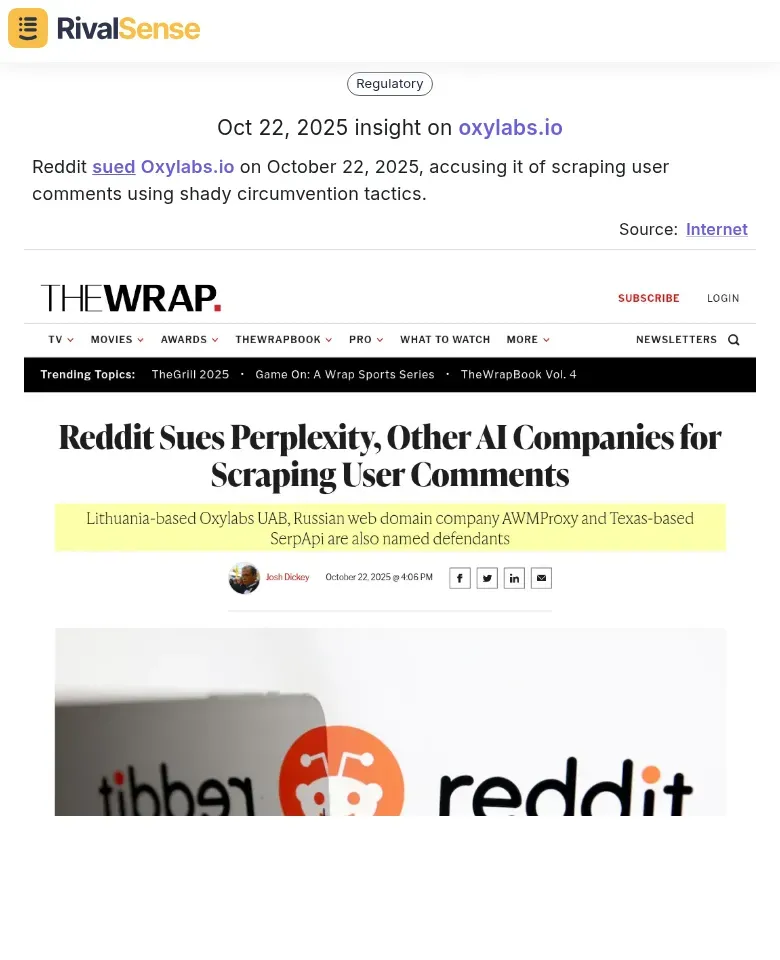
Legal developments involving competitors can signal regulatory risks or market shifts. For instance, RivalSense reported that Reddit sued Oxylabs.io on October 22, 2025, accusing it of scraping user comments using shady circumvention tactics. Tracking such lawsuits helps businesses understand legal precedents and adjust their own data collection methods to stay compliant and avoid reputational damage.
Key Account KPIs: Measuring Competitive Intelligence Impact
Quantifying the impact of web intelligence on key accounts is essential for demonstrating ROI. By focusing on specific KPIs, businesses can track how competitive insights contribute to account health and growth. To measure competitive intelligence impact effectively, focus on three KPI categories that align with strategic objectives.
These metrics help translate raw data into actionable insights that drive account retention and expansion. Without clear KPIs, it's challenging to justify investments in intelligence tools or optimize their use across teams.
Account Health Indicators:
- Threat Detection Rate: % of competitor moves identified before they impact your account
- Response Effectiveness: Time from detection to strategic response implementation
- Win/Loss Analysis: Track reasons for competitive losses in key accounts
Intelligence ROI Metrics:
- Account Retention Rate: Monitor how web intelligence contributes to preventing churn
- Expansion Velocity: Measure speed of upselling/cross-selling enabled by competitor insights
- Intelligence Utilization: Track how often account teams use competitive data in client meetings
Competitive Positioning KPIs:
- Market Awareness Score: Quantify your team's knowledge of competitor capabilities vs. your own
- Strategic Advantage Maintenance: Track how long competitive advantages last before being neutralized
- Positioning Gap Analysis: Measure differences between your perceived vs. actual competitive position
Practical Implementation Checklist:
- Establish baseline metrics for each KPI category
- Create automated dashboards for real-time monitoring
- Set monthly review cadences with account teams
- Link KPIs to specific competitive intelligence sources
- Track correlation between KPI improvements and account revenue growth
Pro Tip: Start with 2-3 core KPIs per category rather than overwhelming teams with metrics. Focus on actionable indicators that directly influence account strategy decisions.
Implementation Framework: Building Your 2026 Web Intelligence Strategy
A systematic approach ensures that intelligence gathering is scalable, ethical, and aligned with business goals. To build your 2026 web intelligence strategy, start by integrating web intelligence into existing account management systems. Begin by auditing your current tech stack to identify gaps in competitor tracking, market research, and customer insights.
Use APIs to connect tools like RivalSense with your CRM (e.g., Salesforce, HubSpot) for seamless data flow. Set up automated alerts for competitor pricing changes, feature launches, and customer reviews to trigger proactive account actions. This integration enables real-time collaboration across sales, marketing, and strategy teams.
For scalable, ethical operations, adopt a hybrid technology stack: combine AI-powered tools for data aggregation and analysis with human oversight to ensure compliance with privacy regulations. Prioritize tools with transparent data sourcing and opt-out mechanisms, and use cloud-based platforms for flexibility.
Continuously optimize by establishing a feedback loop: review intelligence reports weekly, adjust KPIs (e.g., win rates, churn reduction) quarterly, and train teams on new insights. Implement A/B testing for competitor response strategies and leverage predictive analytics to anticipate market shifts. Regularly update your ethical guidelines to align with evolving norms, ensuring long-term competitive edge without reputational risk.
Putting Insights into Action with RivalSense
To effectively implement these strategies and gain a competitive edge, consider leveraging dedicated competitor tracking tools. RivalSense monitors competitor product launches and updates, pricing changes, event participations, partnerships, regulatory aspects, management changes, and media mentions across company websites, social media, and various registries. All insights are delivered in a concise weekly email report, helping you stay ahead of market shifts.
Ready to transform your competitive intelligence? Try RivalSense for free at https://rivalsense.co/ and get your first competitor report today to start making data-driven decisions with confidence.
📚 Read more
👉 Avoid These 5 Financial & M&A Competitor Insight Mistakes That Cost Millions 🚨
👉 How Agorapulse's Comparison Page Update Reveals Key Competitor Moves
👉 How to Track Competitor Podcast Appearances: A Strategic Guide for B2B Leaders
👉 Predictive Analysis: Decoding Competitor Advertising Strategies for Insurance Brokers in 2026
👉 How TrustDecision's Soneri Bank Win Prompted Rivals to Accelerate Pakistan Market Entry